Japan’s Anticonspiracy Law Draws Mixed Responses http://jen.jiji.com/jc/eng?g=eco&k=2017071100602, Tokyo, July 11 (Jiji Press)–Japan’s controversial anticonspiracy legislation, which took effect on Tuesday, has been welcomed by some as being necessary as part of the nation’s efforts to prevent terrorism, while others are concerned that it could lead law-enforcement authorities to launch investigations prematurely before conditions are met and help create a surveillance society.
The revised organized crime punishment law now newly enables authorities to criminalize people planning and preparing to commit acts of terrorism and other serious offenses.
Noting that Japan can ratify the U.N. Convention against Transnational Organized Crime following the enforcement of the law, a senior police official expressed hopes that the country will be able to “cooperate more smoothly with other signatories in criminal investigations and handovers of suspects,” leading to progress in probes into organized crimes.
The official brushed aside concerns over possible abuse of the law by investigative authorities. Any compulsory investigations require search warrants from courts, meaning that such probes are subject to judicial scrutiny, the official noted.
Still, the official said that the application of the law to specific cases will have to be considered carefully, citing parliamentary debates on the legislation during which opposition parties strongly opposed the legislation.
Anticonspiracy Law Comes into Force in Japan
Tokyo, July 11 (Jiji Press)–The anticonspiracy law took effect in Japan on Tuesday, allowing authorities to criminalize planning and preparations to commit serious crimes, including terrorist attacks.
The government now plans to ratify promptly the U.N. Convention against Transnational Organized Crime so that the country can share investigative information about organized crimes with other nations.
Under the law, a group of two or more people can be punished for plotting a crime at the planning stage, or before committing it, if any member starts an act of preparation for the crime.
The Diet, Japan’s parliament, enacted the law last month, with support from the ruling coalition of the Liberal Democratic Party and Komeito, as well as Nippon Ishin no Kai, an opposition party.
During Diet debates on the controversial law, opposition parties expressed concerns that investigative authorities may use the law arbitrarily.
July 14, 2017
Posted by Christina Macpherson |
civil liberties, Japan |
Leave a comment
Ecocity 2017 World Summit: Cities forge ahead on climate change action http://www.heraldsun.com.au/news/ecocity-2017-world-summit-cities-forge-ahead-on-climate-change-action/news-story/586aeb5ddd424192ca4643f81aad3f6a, IAN ROYALL, Herald Sun July 12, 2017 THE great cities of the world are forging ahead with action on climate change despite US President Donald Trump’s stance on the issue, a global conference in Melbourne has been told.
World city and climate change experts said cities and other levels of government were defying Mr Trump.
Kevin Austin, deputy chief executive of the C40 cities network, said large economies such as California and New York City were still acting on emissions, regardless of national policy.
“There’s an unstoppable movement here and there is no alternative,” he told the Ecocity 2017 World Summit.
Mr Trump withdrew the US from the Paris climate agreement last month, as well as taking other measures to counter environmental action. Mr Austin said although Mr Trump said he represented the people of Pittsburgh, not Paris, the mayors of those cities and others reaffirmed their commitment to action on climate change.
John Thwaites, former deputy premier and professorial fellow at Monash University, said Mr Trump’s actions, such as scrubbing climate change from the Environmental Protection Agency, were “the modern-day equivalent of book burning”.
Debra Roberts, co-chair of the Intergovernmental Panel on Climate Change working group, said cities had to lead the way on climate action. “We need an urban revolution because we’re fiddling while Rome burns,” she said.
The conference, at the Melbourne Convention and Exhibition Centre, continues until Friday.
July 14, 2017
Posted by Christina Macpherson |
general |
Leave a comment
Guardian 13th July 2017,A dramatic growth in electric vehicles on Britain’s roads could see peak
electricity demand jump by more than the capacity of the Hinkley Point C
nuclear power station by 2030, according to National Grid.
The number of plug-in cars and vans could reach 9m by 2030, up from around 90,000 today,
said the company, which runs the UK’s national transmission networks for
electricity and gas.
The impact of charging so many cars’ batteries would
be to reverse the trend in recent years of falling electricity demand,
driven by energy efficiency measures such as better boilers.
National Gridacknowledged the cars’ batteries could also provide services andreturn
power for the grid at a time when managing the network is becoming
increasingly complex as variable sources of wind and solar power grow.
https://www.theguardian.com/business/2017/jul/13/electric-car-boom-power-demand-national-grid-hinkley-point-c
July 14, 2017
Posted by Christina Macpherson |
energy storage, UK |
Leave a comment
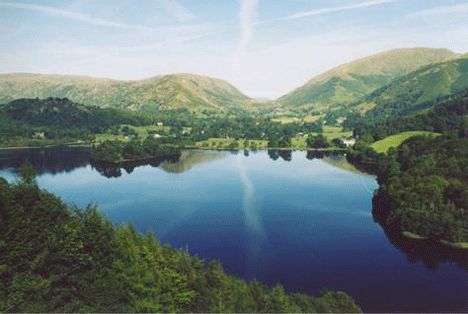
 Cumbria Trust 13th July 2017, Cumbria Trust welcomes UNESCO’s decision to make the Lake District a
World Heritage Site. In doing so, UNESCO has recognised the importance of
protecting the landscape for future generations.
It is striking that a global organisation based in Paris is more aware of the need to protect the
Lake District than Copeland and Allerdale Borough Councils, both of which
voted in 2013 to include the Lake District in a search for a burial site
for the UK’s vast stockpile of nuclear waste.
Copeland and Allerdalefailed in their duty to protect the Lake District as well as other special
areas such as the AONB near Silloth. Fortunately Cumbria County Council,
led by Eddie Martin, recognised the failure of the borough councils and
vetoed their decision. https://cumbriatrust.wordpress.com/2017/07/13/lake-district-a-world-heritage-site/
July 14, 2017
Posted by Christina Macpherson |
environment, UK |
Leave a comment
‘The island is being eaten’: how climate change is threatening the Torres Strait
In Boigu, part of Australia but just six kilometres from Papua New Guinea, roads are being washed into the sea, Guardian, Ben Doherty and Michael Slezak, 13 July 17, Torres Strait residents face being forced from their homes by climate change, as their islands are lost to rising seas.
On Boigu Island, the most northerly inhabited island in Australia, just six kilometres from Papua New Guinea, the community’s cemetery faces inundation and roads are being washed into the sea. A seawall installed to protect the community is already failing.
Boigu elder Dennis Gibuma says the situation is worsening every season.
“Our seawall is no longer any good,” he says. “When the high tide and strong winds come together, it breaks. We pray we don’t lose our homes. We don’t want to leave this place.”
Masig Island, to the south-east of Boigu, is less than three kilometres long, and just 800m across at its widest point. Also known as Yorke Island, the low-lying coral cay is steadily being lost to the waves.
“The island is being eaten,” says Songhi Billy, an engineering officer on Masig. “This is a big issue. I kind of feel hopeless in a sense. Our land is part of us.
“In the short term, we can do what we can. We can’t stop the erosion, our hope is to slow it down.”
But he says he has to face the possibility that his people may have to abandon their ancestral home.
“Long term, we may have to evacuate the island,” he says. “But I am not going. Slowly, I see Masig Island getting out of something I can control.”………
The precise sea level rise around the Torres Strait, and the projected inundation, has not been calculated but low-lying islands are expected to experience a much greater flooding risk than mainland Australia. The department identifies the remote islands of the Torres Strait as some of the most vulnerable, as does the Intergovernmental Panel on Climate Change (IPCC), which warns communities they may be forced to relocate………
Displacement caused by climate change is forecast to be a driver of massive forced migration movements in the 21st century.
Low-lying islands in the Pacific – and Torres Strait islands like Masig and Boigu – are likely to be at the forefront of forced displacement but large and densely populated countries such as Bangladesh also face widespread inundation.
Some forecasts have predicted up to 150 million people could be forcibly displaced by climate change by 2040 – larger than the record number of people already forced from their homes globally.
The US and other militaries have said that climate change poses the greatest security threat to the Asia-Pacific.
But the global legal framework for resettling people displaced from their homes lost to natural disasters or climate change is unclear. The refugee convention – established in 1951 to regularise the resettlement of those displaced by the second world war – does not recognise someone forced from their home by rising seas, or natural disaster, as requiring protection.
Already, more than a dozen Pacific Islanders have attempted to claim refugee status in New Zealand on the grounds that their homes are uninhabitable because of rising seas or climate-related disaster. All have had their claims rejected.
On Masig Island, Hilda Mosby says climate change is already affecting the marine ecosystems on which communities depend for their livelihoods. Climate changeis already affecting her community “big time”, she says.
But the greater existential threat for her home lies ahead….https://www.theguardian.com/environment/2017/jul/13/the-island-is-being-eaten-how-climate-change-is-threatening-the-torres-strait
July 14, 2017
Posted by Christina Macpherson |
AUSTRALIA, climate change, oceans |
Leave a comment
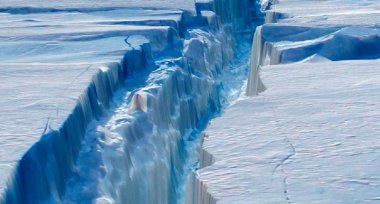 Larsen C: Giant iceberg breaks away from ice shelf in Antarctica, http://www.abc.net.au/news/2017-07-12/huge-iceberg-breaks-away-from-antarctica-larsen-c-shelf/8703238 One of the biggest icebergs on record has broken away from Antarctica, scientists have said, creating an extra hazard for ships around the continent as it breaks up. What happens now Antarctica’s ice shelf has cracked?
A massive crack in one of Antarctica’s largest ice shelves creates an iceberg bigger than Kangaroo Island. So, what impact will it have?
The 1-trillion-tonne iceberg, measuring 5,800 square kilometres, calved away from the Larsen C ice shelf in Antarctica sometime between July 10 and 12, scientists at the University of Swansea and the British Antarctic Survey said.
The iceberg has been close to breaking off for a few months. Throughout the Antarctic winter, scientists monitored the progress of the rift in the ice shelf using the European Space Agency satellites.
“The iceberg is one of the largest recorded and its future progress is difficult to predict,” said Adrian Luckman, professor at Swansea University and lead investigator of Project MIDAS, which has been monitoring the ice shelf for years.
“It may remain in one piece but is more likely to break into fragments. Some of the ice may remain in the area for decades, while parts of the iceberg may drift north into warmer waters,” he added.
The ice will add to risks for ships now it has broken off.
The peninsula is outside major trade routes but is the main destination for cruise ships visiting from South America.
In 2009, more than 150 passengers and crew were evacuated after the MTV Explorer sank after striking an iceberg off the Antarctic peninsula.
The iceberg, which is likely to be named A68, was already floating before it broke away so there is no immediate impact on sea levels, but the calving has left the Larsen C ice shelf reduced in area by more than 12 per cent.
The Larsen A and B ice shelves, which were situated further north on the Antarctic Peninsula, collapsed in 1995 and 2002, respectively.
“This resulted in the dramatic acceleration of the glaciers behind them, with larger volumes of ice entering the ocean and contributing to sea-level rise,” said David Vaughan, glaciologist and director of science at British Antarctic Survey.
“If Larsen C now starts to retreat significantly and eventually collapses, then we will see another contribution to sea level rise,” he added. Big icebergs break off Antarctica naturally, meaning scientists are not linking the rift to manmade climate change.
The ice, however, is a part of the Antarctic peninsula that has warmed quickly in recent decades.
“In the ensuing months and years, the ice shelf could either gradually regrow, or may suffer further calving events which may eventually lead to collapse — opinions in the scientific community are divided,” Professor Luckman said.
“Our models say it will be less stable, but any future collapse remains years or decades away.”
July 14, 2017
Posted by Christina Macpherson |
ANTARCTICA, climate change |
1 Comment
 Looking for Hanford’s radioactive hot spots from the air http://www.tri-cityherald.com/news/local/hanford/article160823189.html, BY ANNETTE CARY, acary@tricityherald.com Hanford will use an airplane to save some employee legwork this week.
A small plane based at the Pasco airport will fly over central Hanford to survey for slight increases in temperature. Thermal images will be collected to check for hot spots that could be caused by buried radioactive waste.
The data will be used to augment information collected two years ago with a helicopter equipped with sensors to measure levels of radiation and to help predict what type of radioactive contaminants might be present.
“It gives us a starting point of where to go look,” said Mike Cline, Department of Energy director for the Hanford nuclear reservation soil and groundwater division.

Work then will be done to determine the extent and type of waste that may have been buried in central Hanford from World War II through the Cold War, when Hanford was producing plutonium for the nation’s nuclear weapons program.
Characterization will be done with more intrusive methods, such as boring into the ground, before plans are developed for how to clean up the waste.
July 14, 2017
Posted by Christina Macpherson |
radiation, USA |
Leave a comment
 EDF May Have to Shut Up to 17 Reactors, Ecology Minister Says, Bloomberg, By Francois De Beaupuy, July 10, 2017,
Electricite de France SA, the state-controlled operator of 58 nuclear reactors in France, may have to shut as many as 17 to fulfill government plans to reduce the share of atomic power in the country’s electricity output to 50 percent by 2025, Ecology Minister Nicolas Hulot said…….
While the government has pledged to boost renewables, it’s not yet evident how they would make up for the shutdown of almost a third of EDF’s reactors. The state would also face calls from the company to compensate it for potential loss of revenue and the cost of dismantling earlier than planned.
In January, EDF reached a compromise with the government in which the utility would receive 490 million euros ($559 million) and possible subsequent payments if the two reactors of the Fessenheim nuclear plant are taken offline.https://www.bloomberg.com/news/articles/2017-07-10/edf-may-have-to-shut-up-to-17-reactors-ecology-minister-says
July 14, 2017
Posted by Christina Macpherson |
France, politics |
1 Comment
 Suspects remanded in Israel-Germany submarine deal probe, JERUSALEM (Reuters) by Maayan Lubell, JULY 10, 2017- Three suspects were remanded in custody and a fourth ordered held under house arrest on Monday after Israeli police questioned six people on suspicion of corruption in a $2 billion deal to buy submarines and patrol craft from Germany.
The 2016 deal has been under public scrutiny since it emerged that Prime Minister Benjamin Netanyahu’s personal lawyer also represented the local agent of the German conglomerate ThyssenKrupp Marine Systems set to build the vessels.
The six, who were questioned under caution on suspicion of bribery, fraud and tax offences, include public officials and private citizens, police spokeswoman Luba Samri said. No further details were immediately available.
German authorities also are looking into the deal.
In June, German magazine Der Spiegel reported Germany’s national security council had approved the sale of the three nuclear-capable submarines to Israel and that authorities inserted a clause into the contract giving it the right to void it if corruption allegations were proven…… https://www.reuters.com/article/us-israel-corruption-germany-idUSKBN19V15U?il=0
July 14, 2017
Posted by Christina Macpherson |
Germany, Israel, secrets,lies and civil liberties |
Leave a comment
Nuclear plant failing watchdog’s standards, The Times, Michael McHugh, 10 July 17, Plutonium facilities at the Sellafield nuclear plant do not meet high standards, a British watchdog has found…. (subscribers only)
July 14, 2017
Posted by Christina Macpherson |
general |
Leave a comment
Reuters 11th July 2017 The U.N. global nuclear watchdog is about to open a uranium bank in the Central Asian state of Kazakhstan, but it may never have any customers.
The raw material used to make nuclear fuel and atomic bombs will be stored in aSoviet-era industrial plant where security was once considered so lax that all the highly enriched uranium kept there was removed in a covert U.S. operation in 1994.
The International Atomic Energy Agency’s goal now is the same as Washington’s 23 years ago as it prepares for next month’s launch of its Low Enriched Uranium Bank in the city of Oskemen — to prevent nuclear proliferation.
http://uk.reuters.com/article/uk-nuclear-kazakhstan-bank-idUKKBN19W0UV
July 14, 2017
Posted by Christina Macpherson |
Kazakhstan, safety |
Leave a comment
The steel anomalies in the reactor vessel of the EPR in Flamanville and
many steam generators have led to one of the most serious crises faced by
the French nuclear industry.
The report of the High Committee on Transparency and Information on Nuclear Safety (HCTISN) highlights the
absence of precise information from Areva and EdF on the serious problems
affecting the reactor vessel of the Flamanville EPR .
The finding would be the same for steam generators. ACRO, therefore calls for more transparency.
The association made an inventory of the available documentation and
reconstructed a chronology of the events on a dedicated website:
http://transparence-nucleaire.eu.org.
July 14, 2017
Posted by Christina Macpherson |
France, safety |
Leave a comment
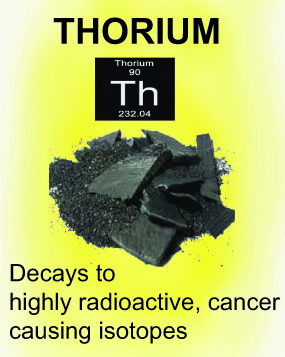 Tests Reveal Stormwater Contamination at Missouri Landfill, US News, Missouri test results reveal that stormwater from just outside a landfill complex contains radioactive contaminants. July 11, 2017, BRIDGETON, Mo. (AP) — Missouri test results reveal that stormwater from just outside a landfill complex contains radioactive contaminants.
The Missouri Department of Natural Resources found levels of alpha particles that exceeded the threshold allowed in drinking water outside the West Lake Landfill, the St. Louis Post-Dispatch (http://bit.ly/2tDXjKI ) reported.
Environmental Protection Agency officials said the data doesn’t signal a public health risk because stormwater doesn’t represent a source of drinking water. Alpha particles are a form of radiation that needs to be ingested to pose a significant health threat……
The natural resources department said the alpha readings released last month couldn’t be attributed to uranium and radium that were tested for, so the department is conducting additional tests for thorium as a potential cause for high particle levels……https://www.usnews.com/news/best-states/missouri/articles/2017-07-11/tests-reveal-stormwater-contamination-at-missouri-landfill
July 14, 2017
Posted by Christina Macpherson |
thorium, USA, water |
Leave a comment








 nuclear-news