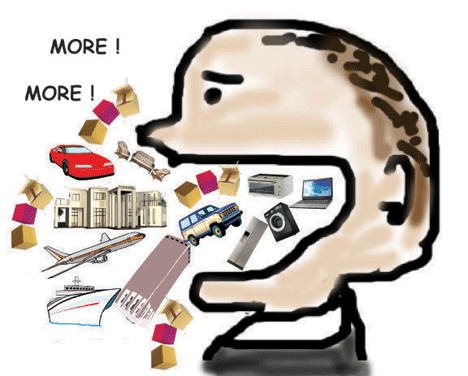
“There’s more value today in helping reduce consumption than in selling energy itself,”
 FT 27th June 2017, A year after the break-up of Eon and RWE in a
  sweeping restructuring of Germany’s power industry, investors are bracing for the next wave of upheaval in European utilities. Bankers and industry executives say further deals look certain as electricity companies scramble to adapt to the accelerating shift towards renewable energy.
The £318m sale last week of two UK gas-fired power stations by Centrica to EPH of the Czech Republic was the latest example of a utility reshaping its portfolio. Now, expectations are growing of bigger transactions to come. Much of the anticipation is focused on the new companies created by the separation of Eon and RWE. Both German utilities split themselves in two, with one unit focused on traditional thermal generating businesses – dominated by coal
and gas-fired power – and the other comprising “cleaner” businesses, such as renewables, electricity distribution and consumer services.
Uniper, the conventional power business spun out of Eon, has been touted by analysts and bankers as a potential target for Fortum, the Finnish utility. Meanwhile, Innogy, the clean energy business split from RWE, has been linked with Engie of France.
Whatever constellation of deals emerges, it looks increasingly likely that the ripples from restructuring of RWE and
Eon will not stop at Germany’s borders. As Mr Critchlow says: “Once one player consolidates, like at a dance, everybody will look for a preferred dance partner.”
Helping customers reduce their energy bills does not sound like an especially appealing business model for an electricity company. Yet that was the aim when the UK arm of Engie paid £330m to acquire a business specialising in making buildings more energy efficient from Keepmoat, the construction company.
“There’s more value today in helping reduce consumption than in selling energy itself,” says Wilfrid Petrie, head of
Engie in the UK. He likens the shift to the one undergone by the telecoms industry, which today finds its growth in services and content rather than the line rental and phone calls that used to be its core business.
https://www.ft.com/content/90003746-57f7-11e7-9fed-c19e2700005f
No comments yet.
1 This Month

of the week – Shut Down Drone Warfare!


Tell the Ukrainian Government to Drop Prosecution of Peace Activist Yurii Sheliazhenko

Petition to revoke the licensing of the Near Surface Nuclear Disposal Facility (NSDF) at Chalk River. https://www.ourcommons.ca/petitions/en/Petition/Details?Petition=e-7247
To see nuclear-related stories in greater depth and intensity – go to https://nuclearinformation.wordpress.com
-
Archives
- March 2026 (230)
- February 2026 (268)
- January 2026 (308)
- December 2025 (358)
- November 2025 (359)
- October 2025 (376)
- September 2025 (257)
- August 2025 (319)
- July 2025 (230)
- June 2025 (348)
- May 2025 (261)
- April 2025 (305)
-
Categories
- 1
- 1 NUCLEAR ISSUES
- business and costs
- climate change
- culture and arts
- ENERGY
- environment
- health
- history
- indigenous issues
- Legal
- marketing of nuclear
- media
- opposition to nuclear
- PERSONAL STORIES
- politics
- politics international
- Religion and ethics
- safety
- secrets,lies and civil liberties
- spinbuster
- technology
- Uranium
- wastes
- weapons and war
- Women
- 2 WORLD
- ACTION
- AFRICA
- Atrocities
- AUSTRALIA
- Christina's notes
- Christina's themes
- culture and arts
- Events
- Fuk 2022
- Fuk 2023
- Fukushima 2017
- Fukushima 2018
- fukushima 2019
- Fukushima 2020
- Fukushima 2021
- general
- global warming
- Humour (God we need it)
- Nuclear
- RARE EARTHS
- Reference
- resources – print
- Resources -audiovicual
- Weekly Newsletter
- World
- World Nuclear
- YouTube
-
RSS
Entries RSS
Comments RSS
 nuclear-news
Leave a comment