The very great difference in effects on the environment between nuclear bombs and nuclear meltdowns
 Nuclear Bombs and Nuclear Reactor Meltdowns Affect the Environment in Very Different Ways, http://www.huffingtonpost.com/entry/nuclear-bombs-and-nuclear-reactor-meltdowns-affect_us_59499845e4b0c24d29f4784306/22/2017, Why do nuclear bombs leave little longtime radiation, while nuclear reactor meltdowns could last for centuries? originally appeared on Quora: the place to gain and share knowledge, empowering people to learn from others and better understand the world.
Answer by Viktor T. Toth, IT pro, part-time physicist, on Quora:
Why do nuclear bombs leave little longtime radiation, while nuclear reactor meltdowns could last for centuries? Well, for starters, there is the amount of fuel involved.
Little Boy (the bomb dropped on Hiroshima) contained 64 kilograms of highly enriched (weapons grade) uranium. Of this, less than a kilogram actually underwent nuclear fission, producing fission products including short-lived but dangerous isotopes, and also producing the neutron radiation “flash” that induced secondary radioactivity in some materials that absorbed those neutrons.
In contrast, an RBMK reactor like the one that blew up in Chernobyl contains 100–150 fuel assemblies, each with over 100 kg of partially enriched uranium. So right there, the amount of fuel in the reactor is several hundred times more than the amount of fission fuel in a nuclear bomb. And whereas a nuclear bomb uses its fuel rather inefficiently (the explosive fission process takes place in milliseconds), a reactor does a more thorough job consuming its fuel over the course of several months before a fuel assembly is replaced.
Furthermore, the fission byproducts remain in the fuel assembly. Depending on the reactor design, these may, in fact, include materials a lot worse than the uranium fuel, such as weapons grade plutonium. Then there are also all the irradiated parts of the reactor that have been continuously exposed to radiation, resulting in secondary radioactivity and more nasty byproducts.
When a nuclear bomb explodes, it is dispersed over a large area. In case of a reactor accident, some of the fuel is dispersed, but a lot of it remains in place, at the reactor site. So this represents a concentration of radioactive materials that just does not occur in case of a bomb. And because all of it sits on the ground, there is the chance of leakage, e.g., into the water table, contaminating the water supply of a large region.
A nuclear reactor site may also contain other sources of radiation. For instance, one of the biggest concerns after the Fukushima accident was due to spent fuel pools located near the meltdown sites.
Having said all that, let us not forget that the Chernobyl Exclusion Zone became possibly the biggest accidental wildlife sanctuary in Europe, if not the world. That is because while radioactive contamination takes its toll, it’s nothing compared to what humans do. Remove most of the humans and even if you add a substantial amount of radiation, Nature thrives.
No comments yet.
1 This Month
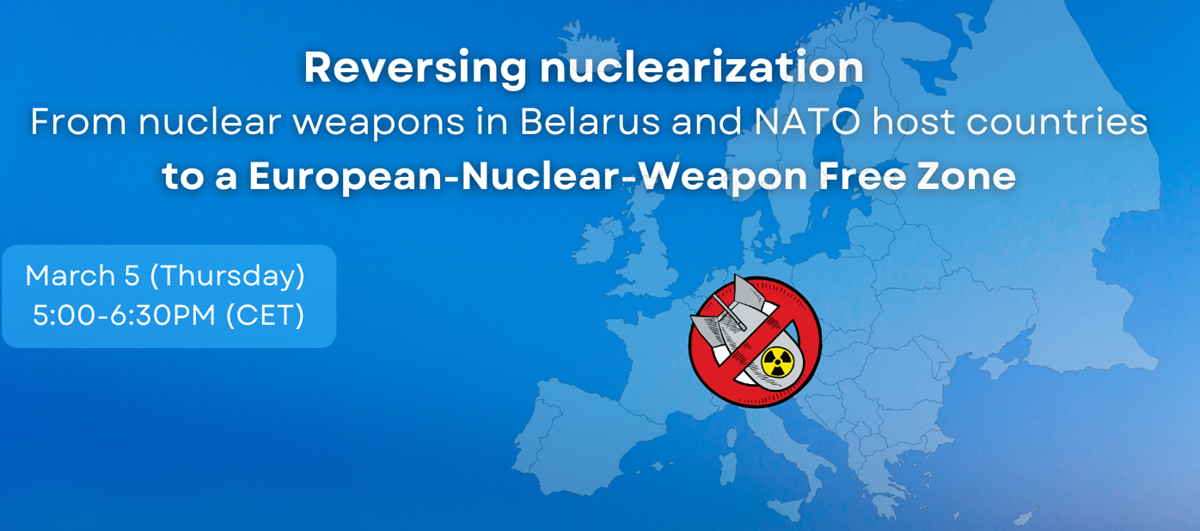
5 March -Online – Reversing nuclearization:
From nuclear weapons in Belarus and NATO host countries to a European-Nuclear-Weapon Free Zone
11am-12:30pm Eastern Time USA / 5pm-6:30pm CET

of the week – Advocating for a
nuclear free beach – https://www.samuellawrencefoundation.org/
The Samuel Lawrence Foundation advocates for a Nuclear Waste Free Beach at San Onofre, join us and take action!

10 March A LIVE WEBINAR THE REAL EFFECTS OF NUCLEAR POWER
What the Industry Isn’t Telling Us
1:00 PM Mountain, 2 pm Central, 3 pm Eastern. Live on the Keepers of the Water Facebook page

18 March Webinar @ 1 PM EST: An Assessment of SMR Projects: The Case of Canada
register for the zoom:
https://us02web.zoom.us/webinar/register/WN_o8BIIOUvQ2ONJR1nta65DQ#/registration

of the week – STOP SMALL MODULAR REACTORS IN CANADA
To see nuclear-related stories in greater depth and intensity – go to https://nuclearinformation.wordpress.com
-
Archives
- March 2026 (51)
- February 2026 (268)
- January 2026 (308)
- December 2025 (358)
- November 2025 (359)
- October 2025 (376)
- September 2025 (258)
- August 2025 (319)
- July 2025 (230)
- June 2025 (348)
- May 2025 (261)
- April 2025 (305)
-
Categories
- 1
- 1 NUCLEAR ISSUES
- business and costs
- climate change
- culture and arts
- ENERGY
- environment
- health
- history
- indigenous issues
- Legal
- marketing of nuclear
- media
- opposition to nuclear
- PERSONAL STORIES
- politics
- politics international
- Religion and ethics
- safety
- secrets,lies and civil liberties
- spinbuster
- technology
- Uranium
- wastes
- weapons and war
- Women
- 2 WORLD
- ACTION
- AFRICA
- Atrocities
- AUSTRALIA
- Christina's notes
- Christina's themes
- culture and arts
- Events
- Fuk 2022
- Fuk 2023
- Fukushima 2017
- Fukushima 2018
- fukushima 2019
- Fukushima 2020
- Fukushima 2021
- general
- global warming
- Humour (God we need it)
- Nuclear
- RARE EARTHS
- Reference
- resources – print
- Resources -audiovicual
- Weekly Newsletter
- World
- World Nuclear
- YouTube
-
RSS
Entries RSS
Comments RSS
 nuclear-news
Leave a comment