nuclear-news

The News That Matters about the Nuclear Industry Fukushima Chernobyl Mayak Three Mile Island Atomic Testing Radiation Isotope

Probe into Michael Flynn’s quiet trips involved in $100 billion nuclear energy plan with Russia and Saudi Arabia

House Dems probe into reported Flynn, Saudi Russia energy deal http://edition.cnn.com/2017/06/19/politics/michael-flynn-russia-energy-deal/index.html By Jim Sciutto and Tom LoBianco, CNNJune 20, 2017 (CNN)A pair of top House Democrats are digging into whether former national security adviser Michael Flynn may have misled officials on his security clearance form about two Middle East trips — including one reportedly about building $100 billion worth of nuclear energy plants with help from Russia’s nuclear power agency.

June 21, 2017 Posted by | secrets,lies and civil liberties, USA | Leave a comment

USA’s Michael Flynn involved in a secret hare-brained nuclear scheme with Russia and Saudi Arabia

the genius idea developed by Flynn and Co. was a U.S.-Russian partnership to build and operate nuclear plants and export the dangerous spent fuel under strict controls

It would be “funded entirely by Saudi Arabia and other Gulf countries” The kingdom’s upfront cost? “Close to a trillion dollars” 

the Saudis would recoup their costs by selling energy to Egypt, Jordan, Yemen and Gulf Cooperation Council (GCC) members Kuwait, Bahrain, Oman, the United Arab Emirates and Qatar—

MICHAEL FLYNN, RUSSIA AND A GRAND SCHEME TO BUILD NUCLEAR POWER PLANTS IN SAUDI ARABIA AND THE AND THE ARAB WORLD http://www.newsweek.com/flynn-russia-nuclear-energy-middle-east-iran-saudi-arabia-qatar-israel-donald-623396
BY JEFF STEIN ON 6/9/17     By the time Michael Flynn was fired as President Donald Trump’s nationalsecurity adviser in February, he had made a lot of bad decisions. One was taking money from the Russians (and failing to disclose it); another was taking money under the table from the Turks. But an overlooked line in his financial disclosure form, which he was forced to amend to detail those foreign payments, reveals he was also involved in one of the most audacious—and some say harebrained—schemes in recent memory:

In 2015 and 2016, according to his filing, Flynn was an adviser to X-Co Dynamics Inc./Iron Bridge Group, which at first glance looks like just another Pentagon consultancy that ex-military officers use to fatten their wallets. Its chairman and CEO was retired Admiral Michael Hewitt; another retiredadmiral, Frank “Skip” Bowman, who oversaw the Navy’s nuclear programs, was an adviser. Other top guns associated with it were former National Security Agency boss Keith Alexander and retired Marine Corps General James “Hoss” Cartwright, former vice chief of the Joint Chiefs of Staff, whose stellar career was marred when he was prosecuted last year for lying to the FBI during a leak investigation.

In the summer of 2015, knowledgeable sources tell Newsweek, Flynn flew to Egypt and Israel on behalf of X-Co/Iron Bridge. His mission: to gauge attitudes in Cairo and Jerusalem toward a fantastical plan for a joint U.S.-Russian (and Saudi-financed) program to get control over the Arab world’s rush to acquire nuclear power. At the core of their concern was a fear that states in the volatile Middle East would have inadequate security for the plants and safeguards for their radioactive waste—the stuff of nuclear bombs.

But no less a concern for Flynn and his partners was the moribund U.S. nuclear industry, which was losing out to Russian and even South Korean contractors in the region. Or as Stuart Solomon, a top executive along with Hewitt at his new venture, IP3 (International Peace, Power and Prosperity), put it in a recent speech to industry executives, “We find ourselves…standing on the sidelines and watching the competition pass us by.”

That the oil-rich, sun-soaked Arab Middle East would pursue nuclear energy seems paradoxical. But as The Economist noted in 2015, “Demand for electricity is rising, along with pressure to lower carbon emissions; nuclear plants tick both boxes.” And some of the region’s major players, like Egypt and Jordan, don’t have oil and gas resources and “want nuclear power to shore up the security of their energy supplies,” The Economist said.

So the genius idea developed by Flynn and Co. was a U.S.-Russian partnership to build and operate plants and export the dangerous spent fuel under strict controls. Flynn’s role would be helping X-Co/Iron Bridge design and implement a vast security network for the entire enterprise, according to an internal memo by ACU Strategic Partners, one of the lead companies involved, obtained by Newsweek.

Not only would the project revive the U.S. nuclear industry, but it would cost American taxpayers nothing, its principals asserted. It would be “funded entirely by Saudi Arabia and other Gulf countries,” according to the ACU memo. The kingdom’s upfront cost? “Close to a trillion dollars,” says a project insider, who asked for anonymity in exchange for discussing internal matters. Theoretically, the Saudis would recoup their costs by selling energy to Egypt, Jordan, Yemen and Gulf Cooperation Council (GCC) members Kuwait, Bahrain, Oman, the United Arab Emirates and Qatar—which hosts the largest U.S. military base in the region. (Qatar doesn’t seem to be an option for the moment, since six of the Arab states, led by the Saudis, severed diplomatic relations with it on June 5 over its alleged support of terrorism.)

Left out of this grand nuclear scheme: Iran (along with Syria, its war-ravaged Shiite proxy). In fact, “it was always part of the project that Russia’s involvement…would tilt Russia away from Iran,” Fred Johnson, ACU’s chief economist, wrote in an email to his advisers obtained by Newsweek. Not only would Russia earn cash for being a dumping ground for radioactive waste, Johnson wrote, but the consortium would purchase “Russian military hardware” to compensate Moscow for losing military sales to Iran.

“Further plans to sideline Iran,” Johnson wrote, included “the development of X-Co,” the Hewitt company that Flynn was advising, “with its very visible deployment of Sea Launch,” a Russian company “that would provide a platform for rockets.”

Attorney General Jeff Sessions talks with former National Security Advisor Michael Flynn inside of the inaugural parade reviewing stand in front of the White House on January 20, 2017 in Washington, 

It’s unclear whether Flynn was involved in negotiating with Sea Launch. The former general, now being pursued by federal investigators probing contacts between Russian officials and Trump’s inner circle, did not respond to an inquiry from Newsweek. People associated with the Middle East project say they thought Flynn’s involvement was limited to sounding out the Egyptians and Israelis on security aspects of the enterprise. He listed no income from X-Co/Iron Bridge on his financial disclosure form and “was not paid,” except for his travel expenses, according to Thomas Cochran, a prominent scientist and nuclear nonproliferation proponent involved with the project. (The cost of business-class round-trip airfare and exclusive hotels for the trip would have ranged between $10,000 and $15,000.)

Hewitt denied that isolating Iran was part of the plan. “X-Co wasn’t created to simply ‘sideline Iran,’” he responded to Johnson and their associates in an email. “It was designed to set the conditions for stability which were the precursors to building 40 plants” and to “solidify the GCC, Jordan, Egypt under a security construct, led by two superpowers, using state of the art capability.”

But the project faced opposition from the Obama administration, Cochran says. “They didn’t want to do it with the Russians and didn’t want to do it while they were negotiating the Iran deal,” he tells Newsweek.

Trump’s embrace of Russian President Vladimir Putin, on the other hand, offered an attractive possibility. And when Flynn, who had connections to the Russians, became the candidate’s national security adviser, the ACU team, led by British-American dealmaker Alex Copson, suddenly seemed to have an inside man. Last year, Copson was touting such connections when he tried to buy an unfinished nuclear plant in Alabama in concert with the Russians, telling a Huntsville reporter that “Alabama’s two senators”—both Republicans, and one, Jeff Sessions, then a top Trump campaign adviser—“can help the next administration move this project forward.” Copson’s bid for the plant failed.

When reports surfaced that the FBI was investigating possible collusion between the Russians and the Trump campaign, however, some of Copson’s partners and advisers decided it was time to walk away. “When Copson decided he was going to saddle up with the Trump team, that was the last straw for me,” the insider says. “I said it’s time to regroup.”

The Saudis hadn’t shown much interest anyway, the insider says. “Copson was promising the advisers lots of money if the Saudis put up money,” but it failed to materialize. “And so there’s nothing that anyone was going to gain unless the project was a success,” he tells Newsweek.

Hewitt and his associates also split from ACU to pursue their own path toward a nuclear-powered Middle East, one that would swap in China for Russia as a nuclear partner, two sources close to the project say. (Hewitt declined to discuss plans for IP3, telling Newsweek he was “working hard to create our public persona right now.”)

But the highly regarded Cochran stayed with ACU. A longtime senior scientist at the Natural Resources Defense Council, where he was director of its nuclear program, Cochran was the author of countless studies and articles over the decades and had initiated with Moscow the U.S.-Soviet nuclear test ban verification project in 1986. He “has extraordinary chutzpah,” a writer for Scientific American observed in 1998. “He is willing to take on what most people wouldn’t bother with because they assume it’s hopeless.”

Or nuts. In 2001, a writer for the left-wing In These Times weekly got hold of a draft proposal for a 1990s-era project that Cochran was involved in, the Nuclear Proliferation Trust, which envisioned taking control of spent fuel from reactors around the world and shipping it to Russia “on large ships mounted with an arsenal of weapons designed to ward off nuclear pirates,” wrote Jeffrey St. Clair. “The big question is what happens to the waste after it arrives in Russia.” Would NPT guards be authorized to fire on rogue Russian soldiers or Chechen rebels? And what would stop corrupt Russians from selling weapons-grade uranium to anyone who could pony up the cash?

Similar concerns are all the more reason to partner with the Russians today in an ironclad security arrangement, Hewitt says. “We’re always going to be engaged in the security of the Middle East,” he told a May gathering at the Nuclear Energy Institute. “It is in our best interests to ensure that nuclear power is introduced with all of the safety [standards of the U.S.].”

Cochran urges critics not to lose focus on the big picture, which he alternately likens to launching the U.S. Marshall Plan, which rebuilt Europe after World War II, and the Tennessee Valley Authority, which tamed rivers and brought electricity and industrial development to the American South in the 1930s. “It would provide energy and jobs and so forth for countries like Egypt and others in the region,” he says, “so that these young men have got something more useful to do than go out and shoot each other.”

For a project fraught with such diplomatic and logistical minefields, however, Copson is an odd choice to lead ACU into the Middle East. “A sometime bass player with the British rock band Iron Butterfly,” according to Time, Copson once famously “described the natives of the Marshall Islands as ‘fat, lazy fucks’ when they nixed one of his nuke dump schemes” in the Central Pacific Ocean, the muckraking journalist Greg Palast wrote in 2001. (The islands are now disappearing under rising seas.)

Copson did not respond to several calls and emails asking for comment. But it’s not likely the Trump team, many of whom are under close scrutiny for their undisclosed Russian contacts, will be any help to Copson now. And the Saudis aren’t “taking the kind of steps that would be required to really get serious about setting up a civil nuclear-energy infrastructure,” says Tristan Volpe, a fellow in the Nuclear Policy Program of the Carnegie Endowment for International Peace in Washington, D.C.

Others suspect the Saudis are up to something more nefarious because of the U.S.-led nuclear deal with Iran. The Saudis “have big ambitions for nuclear,” says David Albright, president of the Institute for Science and International Security in Washington, D.C. “The issue is whether they cross over into any processing or enrichment” with secret partners like Pakistan or China, he says.

Flynn once expressed deep worries about a Saudi-Iranian nuclear arms race. In a January 2016 interview with Al-Jazeera, he sounded like Cochran, the elder statesman of the nonproliferation movement. “An entirely new economy is what this region needs,” he said, especially for the millions of unemployed young men living under corrupt autocracies and tempted by extremism. “You’ve got to give them something else to do. If you don’t, they’re going to turn on their own governments.”

But that was before he hitched up with Trump, who has embraced the Saudi monarchy and ratcheted up his rhetoric against Iran. Talk of a grand scheme to create jobs in the Middle East, meanwhile, has evaporated, with the Russia scandal enveloping not only Flynn but Trump’s entire presidency.

Correction: An earlier version of this story called Thomas Cochran a onetime president of the Natural Resources Defense Council. He was director of its nuclear program.

June 21, 2017 Posted by | Russia, Saudi Arabia, secrets,lies and civil liberties, USA | Leave a comment

On planet Earth the heat is rising – heat death zones to appear

Heatwaves to soar above the hot air of climate politics, Future generations will fear, rather than fend for, the global environment.Nature , 20 June 2017 “……… on planet Earth the heat is rising. Britain was hit by a heatwave at the weekend that forecasters say could last for weeks, and temperatures in California are predicted to reach record levels in a few days’ time. The world is cooking and we should anticipate more of the same.

From extreme rainfall to rising sea levels, global warming is expected to wreak havoc on human lives. Sometimes, the most straightforward impact — the warming itself — is overlooked. Yet heat kills. The body, after all, has evolved to work in a fairly narrow temperature range. Our sweat-based cooling mechanism is crude; beyond a certain combination of high temperature and humidity, it fails. To be outside and exposed to such an environment for any length of time soon becomes a death sentence.

And that environment is spreading. A death zone is creeping over the surface of Earth, gaining a little more ground each year. As an analysis published this week in Nature Climate Change shows, since 1980, these temporary hells on Earth have opened up hundreds of times to take life (C. Mora et al.Nature Clim. Change http://dx.doi.org/10.1038/nclimate3322; 2017). At present, roughly one-third of the world’s population lives for about three weeks a year under such conditions. If greenhouse-gas emissions continue to rise unchecked, that figure could climb, exposing almost three-quarters of the population by the end of the century.

The analysis also reveals that even aggressive reductions in emissions will lead the number of deadly heatwaves to soar in the coming decades. Cities including London, New York, Tokyo and Sydney have all seen citizens die from the effects of excessive heat. By 2100, people in the tropics could be living in these death zones for entire summers. It’s true that warmer winters will save lives further north. And those living in urban environments may find ways to adapt to the new norm of extreme heat. But, if the researchers are correct, the politics of Pruitt and those who try to hold him to account will seem quaint and anachronistic to our grandchildren. For they will live in a world in which most will see the environment less as something to protect, and more as something to protect themselves and their families from.http://www.nature.com/news/heatwaves-to-soar-above-the-hot-air-of-climate-politics-1.22164

June 21, 2017 Posted by | 2 WORLD, climate change, health | Leave a comment

Worrying climate news, as a huge ice shelf melts, in Antarctica

Nansen Ice Shelf 

A huge part of Antarctica is melting and scientists say that’s bad news, CNN,   By AJ Willingham, June 20, 2017 NASA: Rising sea levels more dangerous than thought

June 21, 2017 Posted by | ANTARCTICA, climate change | Leave a comment

New activity at North Korean nuclear test site

US spy satellites detect activity at North Korean nuclear test site, By Barbara StarrElise Labott and Zachary CohenCNN, June 20, 2017

Story highlights

June 21, 2017 Posted by | North Korea, weapons and war | Leave a comment

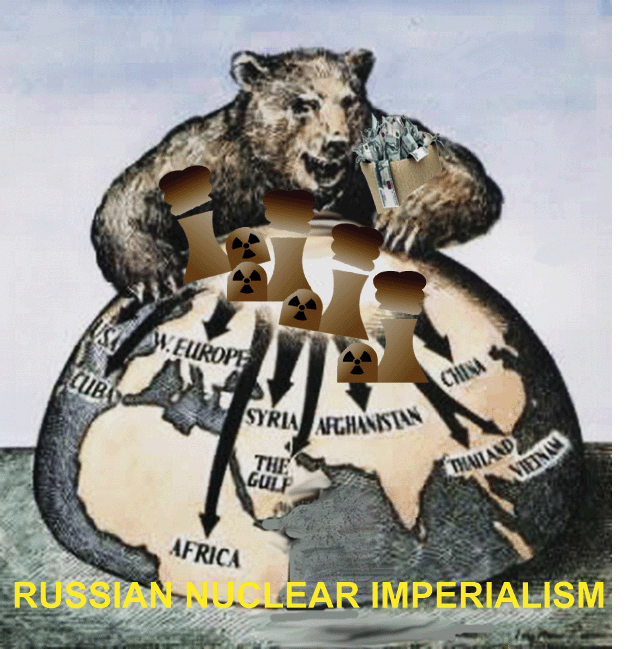
Russia keen to put Philippines into debt as it markets its Rosatom nuclear reactors

Duterte dials Russia for nuclear power future, Joel Guinto, ABS-CBN News,  Jun 19 2017 “…….President Rodrigo Duterte is bringing the Philippines closer to tapping nuclear power than any of his immediate predecessors by dialing Russia, which is offering its technology to the world. Duterte’s government forged an agreement with the Russian State Atomic Energy Corp. (ROSATOM) for the possible development of nuclear infrastructure, personnel training, and courting public support for the technology following his visit to Moscow last month.

Russia also offered to supply the Philippines with nuclear power barges and capsules.

ROSATOM on Monday opened an showcase of Russian nuclear technology, hoping to attract new clients from around the world, including the Philippines.

“We want to cooperate and be partners” said Sergey Kirienko, first deputy chief in the office of Russian President Vladimir Putin……

Project financing is the biggest concern of developing economies that seek to tap nuclear power, said Iliya Rebrov, economic and finance director at ROSATOM.

Rebrov said ROSATOM helps its clients secure funding from various sources, including loans.

“The key competitive factor is the ability of the contractor to arrange financing,” Rebrov said, citing a recent wind-farm project in southern Russia that was financed with Gazprombank.

ROSATOM is “very confident” in the world market as it diversifies its offerings to meet growing demand, said Kirill Komarov, the company’s First Deputy Director general for corporate development and international business. http://news.abs-cbn.com/focus/06/19/17/duterte-dials-russia-for-nuclear-power-future

June 21, 2017 Posted by | marketing, Philippines, Russia | Leave a comment

USA Congress passes tax bill to help nuclear industry

House passes nuclear energy tax bill http://thehill.com/policy/energy-environment/338653-house-passes-nuclear-energy-tax-bill, The House quickly passed a bill extending a nuclear energy tax credit on Tuesday.

The bill, bipartisan legislation from Reps. Tom Rice (R-S.C.), Earl Blumenauer (D-Ore.) and others, would increase the number of utilities that can qualify for the tax credit and remove construction deadlines for facilities that use it.

The House passed the bill, which would cost $16 million over 10 years, on a voice vote.

The legislation lifts a requirement that nuclear facilities be placed into service by the end of 2020 in order to receive the 1.8-cent-per-kilowatt-hour tax credit.

It would also allow government-owned utilities and nonprofit electric co-ops to receive the credit and give them the power to transfer credits to other partners on the facilities, such as the projects’ designers.

The bill is especially important for the states of Georgia and South Carolina, the only two states where new nuclear power plants are under construction.

“Without this legislation, the nuclear power industry may cease to exist as we know it in this country, which is exactly why passing this bill now is more important than ever,” Rice said.

“We need to give these plants the certainty of these tax credits, just as Congress intended.”

Only one member spoke out against the bill on Tuesday. Rep. Lloyd Doggett (D-Texas) criticized the measure as a reward for the nuclear sector, which he said has a “record of miserable failures” when it comes to getting more reactor projects up and running.

“Instead of today’s measure, our focus should be on safe, healthy forms of energy instead of an industry that costs too much and poses too much danger to humans,” he said.

The nuclear energy sector supported the bill, with five industry groups telling lawmakers in a letter last week that the bill supports the “strategic national imperative” of supporting nuclear power projects.

June 21, 2017 Posted by | politics, USA | Leave a comment

As Greenland Ice Sheet thaws, old nuclear missile site Camp Century is revealed

Mother Jones 12th June 2017, Over the last century, many glaciers have pulled back farther than humans
have ever previously witnessed. While the retreat of glaciers, and changes
in the cryosphere more generally (which includes ice sheets and
permafrost), can be seen as purely symbolic representations of the
unwavering march of climate change, they are shifting geography as they
melt and thaw, leaving dangerous implications behind.

Camp Century is only one such instance. Built underneath the surface of the Greenland Ice Sheet
in 1959 by the the US Army Corps of Engineers as part of Project Iceworm,
the project was designed to create a network of mobile nuclear missile
launch sites in Greenland. Intended to study the deployment and potential
launch of ballistic missiles within the ice sheet, the base was eventually
abandoned and decommissioned in 1967.
http://www.motherjones.com/environment/2017/06/camp-century-global-warming/

June 21, 2017 Posted by | ARCTIC, climate change, weapons and war | Leave a comment

Rise of deadly heatwaves will continue

Deadly heatwaves expected to continue to rise https://www.sciencedaily.com/releases/2017/06/170619120507.htm

Date:
June 19, 2017
Source:
University of Hawaii at Manoa
Summary:
Seventy-four percent of the world’s population will be exposed to deadly heatwaves by 2100 if carbon gas emissions continue to rise at current rates, according to a new study. Even if emissions are aggressively reduced, the percent of the world’s human population affected is expected to reach 48 percent.

Seventy-four percent of the world’s population will be exposed to deadly heatwaves by 2100 if carbon gas emissions continue to rise at current rates, according to a study published in Nature Climate Change. Even if emissions are aggressively reduced, the percent of the world’s human population affected is expected to reach 48 percent.

“We are running out of choices for the future,” said Camilo Mora, associate professor of Geography in the College of Social Sciences at the University of Hawaii at Manoa and lead author of the study. “For heatwaves, our options are now between bad or terrible. Many people around the world are already paying the ultimate price of heatwaves, and while models suggest that this is likely to continue, it could be much worse if emissions are not considerably reduced. The human body can only function within a narrow range of core body temperatures around 37oC. Heatwaves pose a considerable risk to human life because hot weather, aggravated with high humidity, can raise body temperature, leading to life threatening conditions.”

A team of researchers lead by Mora conducted an extensive review and found over 1,900 cases of locations worldwide where high ambient temperatures have killed people since 1980. By analyzing the climatic conditions of 783 lethal heat episodes for which dates were obtained, researchers identified a threshold beyond which temperatures and humidities become deadly. The area of the planet where such a threshold is crossed for 20 or more days per year has been increasing and is projected to grow even with dramatic cuts in greenhouse gas emissions. Currently, about 30% of the world’s human population is exposed to such deadly conditions each year.

Numerous examples, such as the 2003 European heatwave that killed approximately 70,000 people, the 2010 Moscow heatwave that killed 10,000 people and the 1995 Chicago heatwave that killed 700 people are staggering examples of the risk to life posed by heatwaves. But beyond these highly cited examples, little was known about how common such killer heatwaves are.

The international group of researchers and students coordinated by the University of Hawaii at Manoa set out to answer that question. From over 30,000 relevant publications, the researchers identified 911 papers with data on 1,949 case studies of cities or regions, where human deaths were associated with high temperatures. From those cases, dates were obtained for 783 lethal heatwaves in 164 cities across 36 countries, with most cases recorded in developed countries at mid-latitudes. Some of the cities that have experienced lethal heatwaves included New York, Washington, Los Angeles, Chicago, Toronto, London, Beijing, Tokyo, Sydney and Sao Paulo.

When analyzing the climatic conditions for those cities, the researchers discovered a common threshold beyond which temperatures and humidities became lethal. In agreement with human thermal physiology, the threshold was such that as relative humidity increases, lower temperatures become lethal.

“Finding a threshold beyond which climatic conditions turn deadly is scientifically important yet frightening,” said Farrah Powell, a UH Manoa graduate student and one of the co-authors in the study. “This threshold now allows us to identify conditions that are harmful to people. And because it is based on documented cases of real people across the globe, it makes it that more credible and relevant. The scary thing is how common those deadly conditions are already.”

A web-application accompanying the paper allows counting, for any place on Earth, the number of days in a year when temperature and humidity exceed such a deadly threshold. For example, by 2100 New York is projected to have around 50 days with temperatures and humidities exceeding the threshold in which people have previously died. That same year, the number of deadly days for Sydney will be 20, 30 for Los Angeles, and the entire summer for Orlando and Houston.

The study also found that the greatest risk to human life from deadly heat was projected for tropical areas. This is because the tropics are hot and humid year round, whereas for higher latitudes the risk of deadly heat is restricted to summer.

“Warming at the poles has been one of the iconic climatic changes associated with the ongoing emissions of greenhouse gases,” said co-author Iain Caldwell, a UH Manoa post-doctoral researcher. “Our study shows, however, that it is warming in the tropics that will pose the greatest risk to people from deadly heat events. With high temperatures and humidities, it takes very little warming for conditions to turn deadly in the tropics.”

“Climate change has put humanity on a path that will become increasingly dangerous and difficult to reverse if greenhouse gas emissions are not taken much more seriously,” says Mora. “Actions like the withdrawal from the Paris agreement is a step in the wrong direction that will inevitably delay fixing a problem for which there is simply no time to waste.”

June 21, 2017 Posted by | climate change, health, Reference | Leave a comment

Los Alamos National Laboratory’s poor handling of plutonium rods – near disaster

A near-disaster at a federal nuclear weapons laboratory takes a hidden toll on America’s arsenalRepeated safety lapses hobble Los Alamos National Laboratory’s work on the cores of U.S. nuclear warheads, Center For Public Integrity , by Patrick Malone, June 19, 2017

Key findings
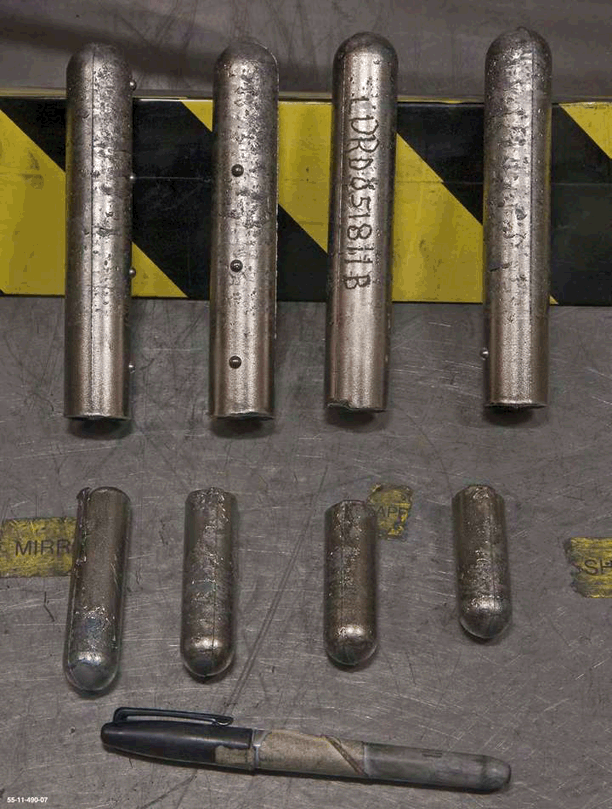
  • Technicians at Los Alamos National Laboratory placed rods of plutonium so closely together on a table in 2011 that they nearly caused a runaway nuclear chain reaction, which would likely have killed all those nearby and spread cancer-causing plutonium particles.
  • The accident led to an exodus of key engineers from Los Alamos who had warned the lab to take better precautions, and this led in turn to a nearly four-year shutdown of key plutonium operations at Los Alamos.
  • A similar incident in Japan in 1999 provoked a burst of radiation that caused two agonizing deaths, a mass evacuation and an order that 310,000 seek shelter. Three workers have died from such radiation bursts at Los Alamos in the past.
  • Los Alamos’s handling of plutonium — a key component of all U.S. nuclear weapons — has been criticized in more than 40 official government reports stretching over a decade, but the lab has repeatedly struggled to meet federal safety requirements.
  • Officials in Washington proposed to fine the lab more than a half-million dollars for its record of poor nuclear safety dating back a decade, but in the end chose not to do so, exemplifying what critics say is a climate of impunity for nuclear weapons contractors.

Eight rods of plutonium within inches — had a few more rods been placed nearby it would have triggered a disaster. Los Alamos National Laboratory/U.S. Department of Energy

At many jobs, this would be innocent bragging. But plutonium is the unstable, radioactive, man-made fuel of a nuclear explosion, and it isn’t amenable to showboating. When too much is put in one place, it becomes “critical” and begins to fission uncontrollably, spontaneously sparking a nuclear chain reaction, which releases energy and generates a deadly burst of radiation.

The resulting blue glow — known as Cherenkov radiation — has accidentally and abruptly flashed at least 60 times since the dawn of the nuclear age, signaling an instantaneous nuclear charge and causing a total of 21 agonizing deaths. So keeping bits of plutonium far apart is one of the bedrock rules that those working on the nuclear arsenal are supposed to follow to prevent workplace accidents. It’s Physics 101 for nuclear scientists, but has sometimes been ignored at Los Alamos……

Workplace safety, many of the reports say, has frequently taken a back seat to profit-seeking at the Los Alamos, New Mexico, lab — which is run by a group of three private firms and the University of California — as managers there chase lucrative government bonuses tied to accomplishing specific goals for producing and recycling the plutonium parts of nuclear weapons.

And these safety challenges aren’t confined to Los Alamos. The Center’s probe revealed a frightening series of glaring worker safety risks, previously unpublicized accidents, and dangerously lax management practices. The investigation further revealed that the penalties imposed by the government on the private firms that make America’s nuclear weapons were typically just pinpricks, and that instead the firms annually were awarded large profits in the same years that major safety lapses occurred. Some were awarded new contracts despite repeated, avoidable accidents, including some that exposed workers to radiation….

George Anastas, a past president of the Health Physics Society who analyzed dozens of internal government reports about criticality problems at Los Alamos for the Center, said he wonders if “the work at Los Alamos [can] be done somewhere else? Because it appears the safety culture, the safety leadership, has gone to hell in a handbasket.”

Anastas said the reports, spanning more than a decade, describe “a series of accidents waiting to happen.” The lab, he said, is “dodging so many bullets that it’s scary as hell.”https://apps.publicintegrity.org/nuclear-negligence/near-disaster/

June 21, 2017 Posted by | Reference, safety, USA | Leave a comment

Hinkley Point the only UK nuclear plant that is likely to go ahead

The head of one of Britain’s top utilities said on Monday that EDF’s
planned nuclear power station at Hinkley Point is likely to be the only one
to go ahead in the UK.

Alistair Phillips-Davies, chief executive officer of
SSE – an energy supplier and a former investor in new nuclear plants – said
that nuclear power has a role to play in reducing carbon emissions, but
that existing technologies may not be the right ones. “The bottom line in
nuclear is that it looks like only Hinkley Point will get built and
Flamanville needs to go well for that to happen,” Phillips-Davies told
Reuters at the Eurelectric utilities conference in Estoril.

French nuclear regulator ASN is set to give a provisional ruling next month on whether
Flamanville can start up as planned in 2018, despite potential weak spots
in its reactor vessel.

In an opinion piece published last year, Phillips-Davies said Britain does not need EDF’s Hinkley Point C nuclear
plant to ensure the lights will stay on because alternative projects like
new gas plants will be able to fill the gap. Asked whether the Toshiba-led
NuGen and Hitachi-led Horizon consortia, which also plan to build nuclear
power stations in Britain, would go ahead despite the bankruptcy of
Toshiba-owned reactor builder Westinghouse, Phillips-Davies said “just
looking from the outside, it looks tricky”. “Toshiba looks like it has a
lot of problems and whether Hitachi will view that as meaning that they do
not want to have a go either, I think that is quite likely. I would not
expect them to get done any time soon,” he said.

New York Times 19th June 2017

https://www.nytimes.com/reuters/2017/06/19/business/19reuters-britain-nuclear.html

City AM 19th June 2017

http://www.cityam.com/266971/sse-boss-hinkley-point-likely-uks-only-nuclear-new-build

Reuters 19th June 2017

http://uk.reuters.com/article/uk-britain-nuclear-idUKKBN19A2KF?rpc=401&

June 21, 2017 Posted by | business and costs, UK | Leave a comment

Airplanes grounded because of heatwave

It’s so hot in Phoenix that airplanes can’t fly, WP ,  June 20 , 17, There are certain truths that accompany summer in Phoenix: Triple-digit temperatures persist well past sundown. It’s not considered abnormal to drive with oven mitts or ice packs in the car. And after a certain threshold, even the “it’s a dry heat” jokes cease being funny.

Usually, the hot season is met with a certain amount of pearl-clutching disbelief by people outside of Arizona. Meanwhile, locals shrug, knowing simply to stay indoors as much as possible or escape to the cooler climes of Northern Arizona.

But this week has felt different, even for seasoned desert-dwellers. As the Capital Weather Gang reported, the Southwest is experiencing its worst heat wave in decades. Excessive heat warnings have been in effect from Arizona to California and will be for the remainder of the week.

How hot has it been? On Monday, temperatures in Phoenix hit 118 degrees, according to the National Weather Service, which announced the record-tying heat against a stock image of a flaming ball of fire.

It’s been so hot that even veteran local meteorologists are appending their tweets with #makeitstop.

And it was so hot that dozens of flights have been canceled this week at Phoenix Sky Harbor International Airport.

American Airlines alerted its customers over the weekend, offering fee-free changes to upcoming flights that were departing or arriving at Phoenix between 3 and 6 p.m., when temperatures peak.

Monday and Tuesday, the Fort Worth-based airline canceled 50 flights in and out of Phoenix, according to American Airlines spokesman Ross Feinstein. Delays were expected for at least seven more flights to Sky Harbor on Tuesday, he said.

Regional flights on American Eagle were the most affected, because they use Bombardier CRJ planes that can only operate at temperatures of 118 degrees or below, Feinstein said. Flights on larger Airbus and Boeing planes were not canceled because they are able to operate at higher maximum temperatures: 127 degrees for Airbus and 126 degrees for Boeing.

Each aircraft manufacturer sets its own parameters for operating temperatures, Feinstein said. As of Tuesday morning, Sky Harbor officials said no other airlines had been affected.

The heat shows no sign of relenting soon.

The National Weather Service broke out the magenta — a color category little known to the rest of the country — to illustrate parts of Arizona that would be under “rare, dangerous, and very possibly deadly” heat for the rest of the week…….https://www.washingtonpost.com/news/capital-weather-gang/wp/2017/06/20/its-so-hot-in-phoenix-that-airplanes-cant-fly/?hpid=hp_no-name_hp-in-the-news%3Apage%2Fin-the-news&utm_term=.44d992ee9914

June 21, 2017 Posted by | climate change, USA | Leave a comment

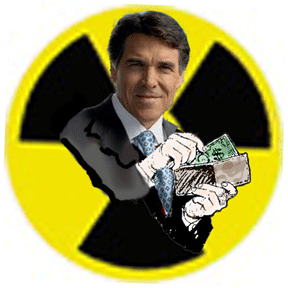
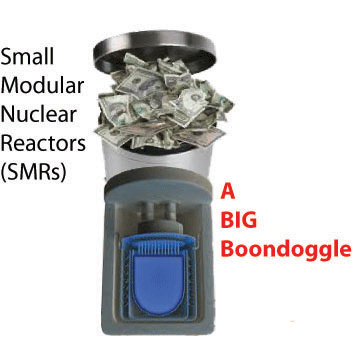
USA Energy Secretary Rick Perry will push for “new nukes” – Small Modular Reactors

Nuclear power on the ‘front burner,’ says Energy Secretary Rick Perry

  • Nuclear power as “a very important part” of the White House’s energy strategy, Department of Energy Secretary Rick Perry said Monday.
  • Projects such as small modular reactors are on the front burner, he said. CNBC, 

Monday, 19 Jun 2017 The Trump administration sees nuclear power as “a very important part” of an all-of-the-above energy strategy, Department of Energy Secretary Rick Perry said Monday.

“Bringing our nuclear energy industry back, small modular reactors for instance, that’s on the front burner so to speak,” he told CNBC’s “Squawk Box” on the sidelines of the SelectUSA Investment Summit, which promotes investment in the U.S.

Perry’s comment offers some insight into the administration’s spending priorities as it seeks to slash funding for Energy’s research and development programs by 54 percent from 2016 levels. Offices that would see deep cuts — unless Congress intervenes — include those responsible for promoting energy efficiency and extending the life of nuclear power plants.

 Nuclear reactors currently generate about 20 percent of the country’s power. The U.S. Energy Information Administration projects that share will decline to 11 percent by 2050 as some of the nation’s aging nuclear power plants retire, and due to competition from natural gas and renewable sources…….http://www.cnbc.com/2017/06/19/nuclear-energy-is-on-the-front-burner-says-sec-rick-perry.html

June 21, 2017 Posted by | politics, USA | 1 Comment

UK’s facade of military nuclear power, as it boycotts UN Nuclear Disarmament Talks

UK Boycotts UN Nuclear Disarmament Talks to ‘Maintain Facade’ of Military Power, https://sputniknews.com/military/201706201054811611-uk-trident-nuclear-ban/    19 June 17 Over 120 countries have gathered at the United Nations to discuss a treaty to ban nuclear weapons. Leading the boycott of the event is the US – perhaps unsurprisingly, given officials’ avowed dedication to maintaining Trident, the UK has also refused to dispatch an official representative to the event.

The event, which began June 15, is attended by a majority of the world’s governments, and is hoped to conclude with the inking of the landmark international agreement by July 7. Setsuko Thurlow, a Hiroshima survivor and disarmament hero, has said he believes the treaty can, and will, change the world.

In a statement, the International Campaign Against Nuclear Weapons said anything less than a categorical ban — requiring nuclear-armed countries to destroy their stockpiles in a time-bound, verifiable manner — would fundamentally fail in its objectives.

Despite the talks’ boycott by the US, UK and others, the treaty’s prospects appear positive. In all, 113 UN member nations voted to convene the talks in December 2016, and some nuclear weapon states appear receptive, or at least not totally opposed, to the prospect, with China, India, and Pakistan all abstaining — and attending the subsequent talks.

​The ban of many forms of weaponry has been proven largely effective — numerous chemical and biological weapons, cluster munitions, and landmines have all been banned, precipitating full-scale decommissioning and disarmament, and their virtual disappearance from military arsenals and battlefields.

The UK’s refusal to even attend the talks is puzzling, as a YouGov poll suggests 75 percent of the public is in favor of officials doing so. However, the UK’s determination to maintain Trident at all is arguably puzzling in itself.

A 2014 cross-party parliamentary report on Trident was unambiguous — the UK’s “independent” nuclear deterrent is in no way independent, and a “hostage to American goodwill.”

Moreover, the report’s authors suggested Trident would only ever be effective in cases of “nuclear blackmail” — which they acknowledged, the prospects of which would be slim. Their conclusions were also damning of many key myths used to justify Trident’s maintenance, and called for UK leaders to step up efforts to promote multilateral nuclear disarmament, and consider further steps to reduce Britain’s operational stockpile of nuclear warheads.

“The fact that, in theory, the Prime Minister could give the order to fire Trident missiles without getting prior approval from the White House has allowed the UK to maintain the facade of being a global military power. In practice, it is difficult to conceive of any situation in which a Prime Minister would fire Trident without prior US approval. The USA would see such an act as cutting across its self-declared prerogative as the world’s policeman, and would almost certainly make the UK pay a high price for its presumption,” the report said.

As the UK is completely technically dependent on the US for the maintenance of the Trident system, presumably one way the USA could demonstrate its displeasure would be to cut off the technical support needed for the UK to continue to send Trident to sea, robbing the country of any nuclear deterrent at all.

“In practice, the only way Britain is ever likely to use Trident is to give legitimacy to a US nuclear attack by participating in it. There are precedents for the USA using UK participation in this way for conventional military operations. The principal value of the UK’s participation in the recent Iraq war was to help legitimise the US attack. Likewise the principal value of the firing of UK cruise missiles as part of the larger US cruise missile attack on Baghdad was to help legitimise the use of such weapons against urban targets,” the report concluded.

Despite these findings, Trident continues to be deemed fundamental to the UK’s security, a particularly hot topic over the course of 2017, given the spate of terrorist attacks that have rocked the country North to South on an almost monthly basis since March.

After every atrocity, ministers have issued ringing declarations about the need to modernize the UK’s defenses against the threat of terror, in all its forms. However, Trident has been entirely absent from these discussions — officials have instead typically pushed for greater internet regulationan end to encryption and enhanced surveillance powers for the intelligence services.

The reason for Trident’s dearth in these matters is obvious — it cannot defend against these attacks, and demonstrably has not done so, whether they are conducted by lone bombers, crazed car and van drivers or knife wielding maniacs. Evidently, such sources of violence pose a far greater threat to the country’s security than nuclear weapons — as do cyberattacks, which again Trident seems fundamentally ill-equipped to combat.

The election of Jeremy Corbyn — former Campaign for Nuclear Disarmament Vice President — as Labour leader likely offered much hope to the UK’s assorted anti-nuclear campaigners, although they were surely bitterly disappointed when a pledge to renew Trident wormed its way into Labour’s election manifesto.

​Corbyn’s seeming slippage may be attributable to the unending chorus of Conservative broadsides launched at him on the issue ever since his election in September 2015 — a wave that reached a crescendo when Defense Secretary Michael Fallon suggested Corbyn wasn’t up for the job of Prime Minister due to his refusal to launch a pre-emptive nuclear strike against a “hostile” nation.

Moreover, there are clear suggestions the UK public doesn’t hold Trident in such high affinity as the country’s ruling class — a July 2016 poll demonstrated that while 51 percent backed full renewal of the system, 49 percent opposed maintaining any system. In time, a greater swath of the populace may come round to the view that the UK’s need for a nuclear, as destructive as it is illogical, is non-existent

June 21, 2017 Posted by | politics international, UK, weapons and war | Leave a comment

South Korea’s major turn away from nuclear energy with Kori-1’s permanent shutdown

 Jun.20,2017 , Changed energy policy prioritizes public safety, in line with South Korea’s turn from developing to developed country

“Permanently shutting down operations at Kori-1 is the beginning of a journey toward a nuclear-free country; it is the turning point toward a safe country. I will soon be preparing a roadmap for the nuclear power phase-out that can set South Koreans’ hearts at ease,” President Moon Jae-in said on June 19. With anxiety increasing around the world about the safety of nuclear power following the nuclear accident in Fukushima, Japan, Moon has become the first South Korean president to declare a nuclear power phase-out, signaling a major change in the country’s energy policy.

“Since South Korea has to import the majority of its energy, nuclear power was the energy policy chosen when we were still a developing country, but now it’s time to change that,” said Moon during an address delivered at a ceremony marking the permanent shutdown of Kori-1. The ceremony took place at the Kori Nuclear Power Headquarters of Korea Hydro & Nuclear Power (KHNP), located in Gijang County, Busan.

Moon’s declaration of the goal of making South Korea nuclear-free signifies his willingness to turn the country’s current energy policy paradigm on its head. It affirms a transition from the energy policy of developing countries, which prioritize cheap power and efficiency, to that of developed countries, which place a premium on the environment and on the people’s right to life.

The key message offered by Moon is “public safety.” While mentioning the earthquake that struck Gyeongju in Sep. 2016, Moon emphasized that South Korea is no longer safe from earthquakes. Citing the fact that 3.82 million people live within a 30 km radius of the Kori plant, he argued that a nuclear accident in South Korea could be even more horrific than what happened at Fukushima

“The world today is moving irreversibly toward phasing out nuclear power. This is something we have to start now on behalf of our descendants, who will live in this country for millennia to come,” Moon said, making clear that it was impossible to return to the energy policy of the past.
Moon’s address also marks the point when he begins to specifically implement the pledges he made as a presidential candidate. He had promised to scrap all plans for building new nuclear reactors, to immediately shut down reactors whose operational life cycle has ended, to suspend construction on Shin Kori-5 and Shin Kori-6, and to shut down Wolseong-1. “It’s as if the people of Busan [who live close to the Kori nuclear plant] have to live with this bomb by their beds that could go off at any time,” Moon said, after watching the nuclear disaster film “Pandora” at the end of last year. “We shouldn’t be asking whether or not to open up Pandora’s box [nuclear power]; we should be getting rid of the box altogether.”“The reason we haven’t been able to phase out nuclear power is not because of a lack of researchers but because of a lack of government will. The fact that the new government has not only shut down the Kori-1 nuclear reactor but also announced a new energy policy and declared its intention to phase out nuclear power in this address is very significant,” said Yun Sun-jin, a professor at the Graduate School of Environmental Studies at Seoul National University.“The next stage is to draw up a detailed roadmap for the nuclear power phase-out. Developed countries are reducing their consumption of electricity. A superficial comparison should be avoided since their industrial structures are different from ours, but in the future, we too should be able to move in the direction of the efficient consumption of energy,” Yun added.By Jung Yu-gyung and Lee Jung-ae, staff reporters

June 21, 2017 Posted by | politics, South Korea | Leave a comment