Russia lets fly over nuclear war games as Nato surrounds Baltic fleet in Kaliningrad, Sunday Times, Bojan Pancevski, 18 June 17 , Russia’s western exclave of Kaliningrad was surrounded on three sides by Nato forces yesterday at the start of an unprecedented set of summer war games.
Operation Sabre Strike 2017 includes the first full deployment of America’s strategic nuclear bombers and a simulated air assault by the Royal Marines in the Baltics.
Russia’s Baltic fleet is based in Kaliningrad and the territory also plays host to a deployment of Iskander short-range ballistic missiles with a 300-mile reach capable of carrying nuclear warheads.
The “historic” deployment of all three types of USstrategic nuclear bomber — B-52, B-1 and the B-2 stealth aircraft — is to show American commitment to “ready and posture forces focused on deterring conflict”, said Lieutenant-General Richard Clark, a US airforce commander…….https://www.thetimes.co.uk/article/russia-lets-fly-over-nuclear-war-games-as-nato-surrounds-baltic-fleet-in-kaliningrad-9wzmw2qhg
June 19, 2017
Posted by Christina Macpherson |
Russia, weapons and war |
Leave a comment
 Manhattan Radiation-Detection Lab To Close Due to Federal Budget Cut, The Chief ,By BOB HENNELL, Jun 16, 2017 The Department of Homeland Security will be closing its city-based National Urban Security Technology Laboratory which services the NYPD and the FDNY radiation-detection equipment used to detect an improvised nuclear device or a so-called dirty bomb, THE CHIEF-LEADER has learned. In addition to providing technical support to the city’s first-responders, the lab, under the post-9/11 Securing the Cities program, provides similar assistance to the Port Authority of New York and New Jersey as well as local departments across the region.
Casualty of Trump Budget
In a letter obtained by this newspaper dated June 1, Adam R. Hutter, the NUSTL’s director, wrote to the lab’s Securing the Cities partners that to satisfy cuts required by President Trump’s proposed budget for the Federal fiscal year that begins Oct. 1 the DHS will close the facility that helps “to detect and protect against radiological and nuclear threats by conducting functional tests of law enforcement radiation detection equipment for Securing the Cities (STC), through an agreement with the New York City Police Department.”
The lab at 201 Varick St. in lower Manhattan was established in 1947 as part of the Manhattan Project and has been a global leader in studying background atmospheric radiation. It provided critical scientific research that helped make the case for the 1963 Limited Nuclear Test Ban Treaty between the U.S. and the U.S.S.R. which banned testing on atomic bombs in the atmosphere, underwater or in outer space.
“NUSTL is honored to have tested nearly 20,000 units in support of the homeland security enterprise,” Mr. Hutter wrote. “Please be assured that we will continue to provide you with testing and support services until NUSTL’s closure is finalized.”
Union VP ‘Stunned’
“We were stunned,” said John Kada, who works at the lab and is the vice president of Local 42 of the American Federation of Government Employees. “Over the years we have built really good relations with first-responders throughout the region. We have one-on-one relations that grew out of our calibrating their equipment and providing the latest in training materials in this critical area.”…..http://thechiefleader.com/manhattan-radiation-detection-lab-to-close-due-to-federal-budget/article_9fa74bf6-3b11-11e7-b2ad-931dab76e901.html
June 19, 2017
Posted by Christina Macpherson |
radiation, USA |
Leave a comment
Overcoming Nuclear Crises: North Korea and Beyond http://www.globalresearch.ca/overcoming-nuclear-crises-north-korea-and-beyond/5594878, By Richard Falk and David Krieger Global Research, June 17, 2017
Global Justice in the 21st Century 15 June 2017 Alarmingly, tensions between the United States and North Korea have again reached crisis proportions. The United States wants North Korea to curtail any further development of its nuclear weapons program, as well as to stop testing its missiles. North Korea evidently seeks to bolster its security by acquiring a sufficiently robust deterrent capability to discourage an attack by the United States. The unpredictable leaders of both countries are pursuing extremely provocative and destabilizing patterns of behavior. Where such a dangerous interaction leads no one can now foresee. The risk of this tense situation spiraling out of control should not be minimized.
It is urgent that all governments concerned make a sober reassessment in a timely manner. The following questions need to be addressed: What can be done to defuse this escalating crisis? What should be done to prevent further crises in the future? What could be learned from recurrent crises involving nuclear weapons states?
It is discouraging that the White House continues to rely mainly on threat diplomacy. It has not worked in responding to North Korea’s nuclear ambitions for the past few decades, and it is crucial to try a different approach. Currently, there are mixed signals that such a shift may be underway. President Trump has turned to China, imploring that it use its leverage to induce Kim Jong-un to back down, and has even mentioned the possibility of inviting Kim for crisis-resolving talks. Also relevant and hopeful is the election of Moon Jae-in as the new president of South Korea, and his insistent calls for improved relations with the North.
In the end, no reasonable person would opt for another war on the Korean Peninsula. The only rational alternative is diplomacy. But what kind of diplomacy? American reliance on threat and punitive diplomacy has never succeeded in the past and is almost certain to fail now. We assuredly need diplomacy, but of a different character.
It is time to abandon coercive diplomacy and develop an approach that can be described as restorative diplomacy. Coercive diplomacy relies on a zero/sum calculus consisting of military threats, sanctions, and a variety of punitive measures. Restorative diplomacy adopts a win/win approach that seeks to find mutual benefits for both sides, restructuring the relationship so as to provide security for the weaker side and stability for the stronger side. The challenge to the political imagination is to find the concrete formula for translating this abstract goal into viable policy options.
The basic shift is a mental recognition that in the context of the Korean Peninsula any military encounter, whether nuclear or non-nuclear, is a recipe for catastrophe. It is not a win or lose situation. It is lose/lose in terms of human suffering, devastation, and likely political outcome. If nuclear weapons are used by either or both sides, millions of casualties could occur and the wider consequences an unprecedented disaster.
While there have been suggestions from the Trump administration that the time for talk with North Korea is over, actually the opposite is true. A solution to the present Korean crisis would involve an immediate return to the negotiating table with positive inducements made by the U.S. in exchange for North Korea halting its development of nuclear weapons and missile testing. Such incentives could include, first and foremost, bilateral and regional security guarantees to the North Korean government, ensuring that the country would not be attacked and its sovereignty respected. This could be coupled with confidence-building measures. The U.S. and South Korea should halt their joint annual military exercises in the vicinity of North Korea, as well as forego provocative weapons deployments. In addition, the U.S. and possibly Japan could offer North Korea additional benefits: food, medicine, and clean energy technology. China could play a positive role by hosting the negotiations, including possibly inviting the new leader of South Korea to participate.
Beyond resolving the current crisis is the deeper challenge to prevent recurrent crises that pit nuclear weapons states against one another. There is no way to achieve this result so long as some countries retain, develop, and deploy nuclear weapons, and other countries are prohibited from acquiring such weaponry even if their security is under threat. Iraq and Libya arguably suffered from the consequences of not having nuclear weapons to deter attacks against them.
The only way out of this trap is to recognize that the nuclear nonproliferation regime has failed. The treaty provisions calling for nuclear as well as general and complete disarmament negotiations have been neglected for nearly a half century. Outside the terms of the Nuclear Non-Proliferation Treaty, the United States has acted as an enforcer of a nuclear nonproliferation regime. Such a role motivated the U.S. attack on Iraq in 2003 with its disastrous impacts on the country and the entire Middle East. It also underlies the current crisis pitting Washington’s demands against Pyongyang’s provocations. Hard power approaches to such dangerous developments have a dismal record, and pose unacceptable risks of regional and global havoc.
To prohibit and eliminate nuclear weapons epitomizes prudence in the Nuclear Age. It is the only way to prevent a crisis between nuclear-armed opponents turning into a nuclear catastrophe. Such behavior would constitute an act of sanity for humanity and its future given the extreme dangers of nuclear weapons, the periodic crises that erupt among nuclear-armed countries, and the growing odds of nuclear weapons being used at some point. Yet for smaller, weaker nuclear weapons states to go along with this approach, the United Nations Charter and international law must be respected to the point that regime-changing geopolitical interventions by dominant states are convincingly rejected as a reasonable policy option.
Any use of nuclear weapons would be catastrophic.. Depending upon the extent of the nuclear exchange, cities, countries, civilization, and even all complex life, including the human species, would be at risk. Experts anticipate that a nuclear war between India and Pakistan in which 100 Hiroshima-size nuclear weapons were used against cities would likely cause a nuclear famine taking two billion lives globally. An all-out nuclear war could be an extinction event for complex life, including humanity.
Nine countries currently possess nuclear weapons (United States, Russia, United Kingdom, France, China, Israel, India, Pakistan and North Korea). Nine leaders could initiate nuclear war by mistake, miscalculation or malice. The future rests precariously in the hands of this small number of individuals. Such an unprecedented concentration of power and authority undermines democracy, as well as being extremely reckless.and irresponsible.
It is essential to maintain our focus on the challenges posed by the development of North Korean nuclear capabilities. At the same time, while struggling to defuse this crisis hanging over the Korean Peninsula, we should not lose sight of its connection with the questionable wider structure of reliance on nuclear weapons by the other eight nuclear-armed countries. Until this structure of nuclearism is itself overcome, crises will almost certainly continue to occur in the future. It is foolhardy to suppose that nuclear catastrophes can be indefinitely averted without addressing these deeper challenges that have existed ever since the original atomic attack on Hiroshima.
Richard Falk is Senior Vice President, Nuclear Age Peace Foundation, and Albert G. Milbank Professor of International Law Emeritus, Princeton University.
David Krieger is President, Nuclear Age Peace Foundation.
June 19, 2017
Posted by Christina Macpherson |
North Korea, politics international |
Leave a comment
For Fukushima returnees, security a growing concern in deserted towns, Japan Times, FUKUSHIMA MINPO, 18 June 17 “….. According to town officials, only about 300 residents have come back so far.
Many of the houses in Sato’s neighborhood remain uninhabited. So when he spots a car parked in the dark, it frightens him.
“If safety and security aren’t ensured, there won’t be more people coming back,” Sato said.
Sparked by returnees’ concerns about security, many recovering municipalities have set up neighborhood watch groups, installed security cameras and taken other measures to increase safety…..
The number of police officers brought in from outside Fukushima to help patrol the no-go zone has been reduced to 192, or about 150 fewer than five years ago. The police presence is expected to decline further as decontamination progresses, raising concerns on how to ensure security there in the future.
Many municipalities have been funding security costs with central government subsidies, but it is unclear whether that will continue after fiscal 2020, when the state-designated reconstruction and revitalization period is scheduled to end. The Reconstruction Agency is also slated to be dissolved by then.
A top Reconstruction Agency official would only say it will “consider the issue in the future.”
For its part, the town of Namie is expected to spend about ¥700 million in fiscal 2017 to fund the neighborhood watch teams and surveillance systems. But town officials are worried whether they’ll be able to afford the systems once the subsidies dry up.
Reconstruction minister Masayoshi Yoshino, a Lower House politician representing the Fukushima No. 5 district, said in April that he will consider creating a new government entity to take over the work of the Reconstruction Agency.
“I want the government to tell us that it will continue to fund” such projects, said Namie Deputy Mayor Katsumi Miyaguchi. http://www.japantimes.co.jp/news/2017/06/18/national/fukushima-returnees-security-growing-concern-deserted-towns/#.WUb79JKGPGg
June 19, 2017
Posted by Christina Macpherson |
Fukushima continuing |
Leave a comment
Proposed nuclear waste dump draws Congressional ire http://www.voicenews.com/news/proposed-nuclear-waste-dump-draws-congressional-ire/article_743d7c7d-d48f-5d35-bcaa-1ab7c08496c8.html OPG appears to sidestep Canada’s request for more details By Jim Bloch | For The Voice Jun 14, 2017
Ontario Power Generation’s latest submission to the Canadian government about its proposed nuclear waste dump on the shores of Lake Huron continues to be evasive and overly broad, according to critics of the project.
In OPG’s Dec. 28, 2016, response to the Canadian Environmental Assessment Agency, the power company chose two enormous geological formations comprising about 75 percent of the entire province: The crystalline rock of the Canadian Shield, which is about a billion years old, and the sedimentary rock formations of southern Ontario, which are 354 million to 543 million years old.
The CEAA also requested further analysis of the cumulative effects that the dump could have on the environment, especially if a high-level waste dump is built nearby, and an updated list of OPG’s commitments to reduce “each identified adverse impact” of the deep geological repository on the environment.
Despite its 144 pages, OPG’s new report did not satisfy opponents.
Congressional delegation responds
U.S. Rep. Debbie Dingell, of Michigan’s 12th District, and Rep. Dave Trott, of Michigan’s 11th District, wrote a letter to Secretary of State Rex Tillerson on June 7, urging him to enter the fray against the dump.
“We write to urge you to do everything in your power – through both diplomatic and legal channels – to protect our Great Lakes and to convince the Canadian government to require OPG to select an alternative site that will not place the health, safety, and economic security of Americans at risk,” said Dingell and Trott in the letter.
Thirty-two bipartisan Congressional representatives from the Great Lakes states co-signed the letter, including Paul Mitchell, the Republican representing the 10th District, covering Michigan’s Thumb – all of St. Clair, Huron, Lapeer and Sanilac counties and most of Macomb County. The only member of Michigan’s Congressional delegation who did not endorse the letter was Justin Amash, the Cascade Township Republican.
The lawmakers said that OPG had “doubled down” on the dump “for two inconvenient facts for the company: that they believe an alternative site would be more expensive and take longer to construct.”
In its report, OPG pegged the baseline cost of a Deep Geological Repository at the proposed site in Kincardine, Ontario, Canada, or the alternative sites in the Canadian Shield or in southern Ontario, Canada, at $2.4 billion. The company said that transporting low and intermediate nuclear waste from the province’s 20 reactors to a location in Southern Ontario would add $381 million to $493 million to cost of the project; transportation of waste to a location in the Canadian Shield would add $452 billion to $1.424 billion. Incidental costs would grow by $832 million in southern Ontario and $2.056 billion in the Canadian Shield. OPG labeled the additional transportation and incidental costs as “unacceptable.”
On April 13, Fred Kuntz, Manager of Corporate Relations and Communications for OPG in Bruce County, told Bruce County stakeholders that a shift to a new location could add 15 years to the construction timeline.
“We cannot let cost be the sole driving factor in this critical decision, as storing nuclear waste in the Great Lakes basin bears far too great a risk that would be fundamentally devastating to an entire region,” said the Congressional reps in their letter to Tillerson.
June 19, 2017
Posted by Christina Macpherson |
politics international, wastes |
Leave a comment
Reporterre 17th June 2017 [Machine Translation] Here is an edifying and accessible book that reveals
the mysteries of the atomic industry in general and the operation of our nuclear power plants in particular.
On the occasion of its release, the Network Sortir du nucléaire has created its own publishing house, Yasnost’Editions. The author, Nozomi Shihiro, comes from the EDF seraglio and has endorsed the operator’s doctrine on transparency: “To tell the public everything he would not like to learn from others . He writes,however, under a pseudonym for fear of passing under the Caudines forks of his enterprise.
Throughout the book he endeavors to show that the transparency chanted by the national electrician is in reality only powder for the attention of the disinformed populations and the docile political world.
https://reporterre.net/Dans-les-arcanes-de-l-industrie-atomique
June 19, 2017
Posted by Christina Macpherson |
France, media |
Leave a comment
Climate Change
40 countries are making polluters pay for carbon pollution. Guess who’s not.
Most people who have given climate change policy any thought agree that it is important to put a price on greenhouse gas emissions. They are a form of harmful waste; those producing the waste should pay for the harms
http://www.environmentalhealthnews.org/t/2460133000468975388
Sweden passes ambitious climate law to be carbon neutral by 2045.
Sweden passed a new Climate Act on Thursday, legally binding the country to reach net-zero emissions by the year 2045. The act, which passed in parliament by a vote of 254 to 41, is even more ambitious than what the Scandinavian country pledged under the Paris Agreement: Under the new act, Sweden will reach carbon neutrality five years earlier.
http://www.environmentalhealthnews.org/t/2460133000468975393
June 19, 2017
Posted by Christina Macpherson |
2 WORLD, climate change, Sweden |
Leave a comment
OM, EU Launch First Comparative Report on Environmental Change Migration http://reliefweb.int/report/world/iom-eu-launch-first-comparative-report-environmental-change-migration REPORT\ from International Organization for Migration Published on 16 Jun 2017 —View Original
Belgium – The International Organization for Migration (IOM) Global Migration Data Analysis Centre (GMDAC) and the European Union launched in Brussels today (16 June) the report, “Making Mobility Work for Adaptation to Environmental Changes: Results from the MECLEP Project’s Global Research”.
The ground-breaking research was conducted in six pilot countries: Dominican Republic, Haiti, Kenya, Mauritius, Papua New Guinea and Viet Nam. A major finding of the study is that migration often has a positive impact on adaptation as it allows households affected by environmental and climate change to diversify income, to improve their employment, health and education opportunities and to increase their preparedness for future hazards. Moreover, the study suggests that at least 40 per cent of the migrant households surveyed learnt new skills through migration. On the other hand, displacement due to natural hazards poses more challenges to adaptation, often linked to increasing vulnerability of those displaced.
The report is the final publication of the European Union-funded “Migration, Environment and Climate Change: Evidence for Policy” (MECLEP) project, a three-year research project which aimed at contributing to the global knowledge base on the relationship between migration and environmental and climate change. MECLEP was implemented by IOM in a consortium of six universities.
The final comparative report builds on desk reviews, household surveys and qualitative interviews conducted in the six project countries to assess the extent to which migration, including displacement and planned relocation, can benefit or undermine adaptation to environmental and climate change.
“Data analysis allows for a proactive, coherent and informed approach to policy development,” stated Frank Laczko, Director of IOM’s Data Analysis Centre. “By assessing in which ways migration can represent an adaptation strategy to environmental and climate change, the MECLEP data facilitates the development of informed policy responses,” he stressed.
Many policy implications emerge from this unique comparative study. Among others, the importance of integrating migration into urban planning to reduce challenges for both migrant households and the communities of destination and the need of paying particular attention to gender issues and to the needs of vulnerable groups, such as the elderly and trapped populations that cannot move.
The report is launched jointly with the European Commission Directorate-General for International Cooperation and Development (DG DEVCO) at the IOM Regional Office in Brussels. The conceptual approach that guided the study and the research methodology were also presented during the launch event.
In addition to this final comparative report, the MECLEP project produced other publications focusing on the migration and environment nexus: six national assessments, six country survey reports, 20 policy briefs, a training manual in five languages, a methodology paper and a glossary in three languages. All the publications are available on the Environmental Migration Portal, the knowledge platform developed in the context of the MECLEP project.
For further information, please contact Susanne Melde at IOM GMDAC in Berlin, Tel. +49 171 5474 165, Email: smelde@iom.int
June 19, 2017
Posted by Christina Macpherson |
2 WORLD, climate change |
Leave a comment
 Why wait until 2025 to close Diablo Canyon? The Tribune, BY BEN DAVIS JR. 17 JUNE 17, PG&E has reached an agreement (currently being reviewed by the state Public Utilities Commission) with environmental groups not to seek re-licensing for Diablo Canyon, thus ending energy production in 2025.
Some, including the Mothers for Peace in San Lois Obispo, are still working to close Diablo sooner. The administrative law judge in these PUC proceedings has agreed that considering closing the plant earlier than 2025 is a legitimate issue that can be addressed.
Pro nuclear groups have suggested such an early closure would be a blow to our state’s fight against global warming. However, even assuming nuclear power may be needed globally while transitioning from fossil fuels, Diablo itself has no impact on global warming and, as the most dangerously situated nuclear power plant in the U.S., according to the Nuclear Regulatory Commission and the California Energy Commission (CEC), it is not worth the risk to California……..
Contrast these minimal potential contributions to climate change with the fact that PG&E’s recent NRC required studies (2015) show that nearby faults can subject Diablo to double the ground shaking that occurred at Fukushima, well beyond what Diablo is currently licensed for. The NRC has meetings scheduled this year to consider these new findings.
And there’s more. PUC President Michael Picker in 2015 requested a cost effectiveness study from PG&E detailing “the costs, benefits and safety issues of cycling the Diablo Canyon units to mitigate over-generation problems on the grid.”
According to the energy commission, this means “… if renewable sources and DCPP are running at capacity then there is a risk that the load on the grid may exceed specifications making it necessary to curtail GHG free renewable generation.”
California has an over generation problem in which nuclear power is actually competing with renewables for grid space, making it necessary to curtail renewables when we have too much energy— thus contributing to global warming.
To date, PG&E has not replied to Picker’s information request.
Furthermore, Diablo uses ocean water for cooling, a practice being phased out because it is devastating to ocean life, and Diablo is the largest such plant in the state, larger than all the rest combined.
Thus we have a dangerously situated, minimally insured nuclear power plant killing marine life to contribute a small amount of energy to a state with a large surplus, while competing for grid space with renewables.
The need for accurate, balanced information in considering our energy future is precisely why I support both the Mothers for Peace in calling for an early closure of Diablo Canyon in current PUC proceedings, and the current legal actions of the World Business Academy to require the State Lands Commission to complete an Environmental Impact Report before allowing continued operation of Diablo Canyon.
When the public is presented with balanced environmental/economic information it will be eminently clear that nuclear power is not worth the risks to California.
Anti-nuclear activist Ben Davis Jr. drafted an initiative the led to the eventual closure of Rancho Seco Nuclear Power Plant in Sacramento County. He also tried unsuccessfully to get an anti-nuclear initiative on the November 2016 ballot, which, if passed, would have resulted in the closure of Diablo Canyon Power Plant. http://www.sanluisobispo.com/opinion/readers-opinion/article156805984.html
June 19, 2017
Posted by Christina Macpherson |
climate change, USA |
Leave a comment
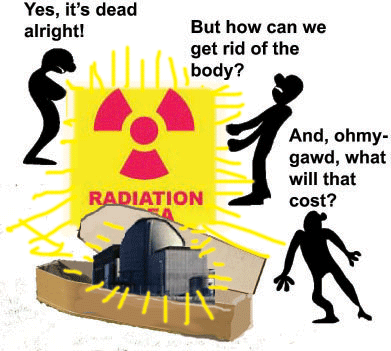
 Korea’s oldest nuclear reactor ceases operation, http://www.koreaherald.com/view.php?ud=20170618000190 By Kim Da-sol (ddd@heraldcorp.com), Kori No. 1, South Korea’s oldest nuclear reactor located in Busan, ceased operation Sunday at midnight after four decades.
Its operator Korea Hydro and Nuclear Power Co. said that it cut the power supply Saturday and began the cooling-down process of the reactor. It was officially decommissioned, with the temperature of the reactor gradually dropping to 90 degrees Celsius, from its normal operation at 300 degree Celsius, the KHNP said. Officials will then relocate the spent nuclear fuel stored inside the rector to a liquid sodium-cooled reactor for reprocessing.
The actual dismantling of the facilities is expected to start no later than 2022. The KHNP expects that at least 634 billion won ($559 million) is required for the dismantling. They also need to submit a dismantlement plan within five years for the NCCS’ approval.
The state-run Nuclear Safety and Security Commission, which approved earlier this month the permanent shutdown of Kori No. 1, said it will continue to check the safety management of the suspended reactor on a regular basis until the dismantlement.
Following the government’s approval in 2007, Kori No. 1’s operation was extended by 10 years after a 30-year run.
Some experts oppose the planned reprocessing of nuclear waste, saying the technology, though effective in reducing the volume of waste, could complicate waste disposal by creating different types of radioactive waste.
Under President Moon Jae-in, the South Korean government aims to close all nuclear power plants by shutting down aged facilities and eventually phasing out the rest over the next 40 years.
June 19, 2017
Posted by Christina Macpherson |
decommission reactor, South Korea |
Leave a comment
Point Lepreau nuclear power plant gets 5-year licence renewal, Commission says it’s satisfied plant will protect environment, safety and security By Viola Pruss, CBC News Jun 16, 2017 Point Lepreau’s nuclear power reactor is good to go for another five years.
The Canadian Nuclear Safety Commission announced its decision this week to renew the NB Power nuclear generating station’s operating licence until June 30, 2022.
The current licence runs out on June 30 of this year.
In a summary report, the commission said it found NB Power, “in carrying on that activity, will make adequate provision for the protection of the environment, the health and safety of person and the maintenance of national security,” as well as follow international obligations.
Lack of transparency
The commission said it considered a number of issues and submissions related to NB Power’s qualifications to receive an extended licence, including an environmental assessment and emergency plans in the event of a nuclear emergency.
An environmental assessment found that “adequate measures are in place to protect the environment and human health.”
However, the commission noted a lack of transparency and public availability of emergency planning documents, and directed the utility to disclose them……..
Indigenous land
In making its decision, the commission also considered information presented at two public hearings in January and May, including submissions from members of several Indigenous groups.They told the commission the plant was built on traditional and ancestral territories, and the facility “adversely affected their Aboriginal and treaty rights.”
While the commission recognized that Indigenous groups were not consulted when the plant was built, it “acknowledges the current efforts and commitments made by NB Power in relation to Aboriginal engagement,” the report said…….
Disaster-proof
A good portion of the first public hearing in January 2017 also focused on Point Lepreau’s ability to withstand a significant earthquake and other potential risks, including dam failures, shipping disasters, plane wrecks and meteor strikes……http://www.cbc.ca/news/canada/new-brunswick/point-lepreau-nuclear-power-licence-renewal-commission-safety-nb-1.4164700
June 19, 2017
Posted by Christina Macpherson |
Canada, politics |
Leave a comment

 China Daily 15th June 2017, China’s CGN a step closer to bringing its nuclear technology to UK: China’s
goal of boosting its nuclear technology sector took a big step forward on Wednesday with the creation of three new companies in the UK by China General Nuclear Power Corporation. The new entities are: Bradwell Power
Corp, which will be responsible for the 100 percent Chinese-built Bradwell B nuclear plant; General Nuclear System Ltd, which will shepherd China’s Hualong technology through the exacting five-year UK approval process; and General Nuclear International, which will manage CGN’s projects in the UK.
He Yu, CGN chairman, said: The unveiling of three companies is a solid step forward for CGN to expand its operation in the UK. With its new subsidiaries unfolding, the company is confident that it will grow steadily in the field of nuclear technology in Britain.”
The United Kingdom will formally assess the Hualong One technology as part of a deal reached last year, in which Chinese investment will help build the Hinkley Point C nuclear plant, in which France’s EDF is a major participant, and which will
feature French technology. CGN and EDF have been working together for more than 30 years on nuclear development and construction in China.
Under last year’s agreement, CGN and EDF will collaborate on three UK nuclear plants: Hinkley Point C, in Somerset; Sizewell C, in Suffolk; and Bradwell, in Essex.
CGN intends to use Hualong One technology at Bradwell, which could be the first nuclear plant in a developed economy to use Chinese technology. The companies will seek to get the Hualong One technology approved in the UK via an assessment known as the Generic Design Assessment process. It usually takes about five years to complete.
China hopes that UK approval of its technology will open the door to its use in other countries because the UK’s appraisal regime is considered by industry experts to be the strictest in the world. The proposed Bradwell project is in an early
pre-planning stage, something that is likely to continue for many years, via investigative work and public consultation, before detailed proposals will be produced, allowing a planning application to be made.
http://europe.chinadaily.com.cn/world/2017-06/15/content_29748140.htm
June 19, 2017
Posted by Christina Macpherson |
China, marketing, UK |
Leave a comment
Scottish Energy News 16th June 2017, The Royal Society of Edinburgh – Scotland’s National Academy – has set up a
new Inquiry Committee to look at Scotland’s Energy Future. The inquiry
aims to contribute to the important debate around Scotland’s energy
supply, demand and use, as well as moral and environmental
responsibilities.
It will also look to inform the policy- and decision-making at a Scottish, UK and international levels in relation to
resources needed at acceptable financial, moral and environmental costs.The
committee, which is expected to sit for around 18 months, will consider how
Scotland can meet the future energy demand and how to ensure that the
energy used is secure, affordable and environmentally justifiable. It will
also examine all areas of the debate around Scotland’s energy future in
the context of its commitment to combat global climate change and the
environmental imperative to reduce carbon emissions. http://www.scottishenergynews.com/
June 19, 2017
Posted by Christina Macpherson |
ENERGY, UK |
Leave a comment
 Jun 16, 2017,Tom Knox The federal government has awarded $1.55 million to Ohio State University for nuclear energy research.
More than half of the money, almost $800,000, goes toward a research and development project through the Department of Energy’s Nuclear Energy University Program that deals with risk assessment in power plants…..http://www.bizjournals.com/columbus/news/2017/06/16/ohio-state-gets-1-5m-in-federal-money-to-study.html
June 19, 2017
Posted by Christina Macpherson |
general |
Leave a comment
The Canary 14th June 2017, The Campaign for Nuclear Disarmament (CND) has criticised what it calls the
“ill-advised” appointment by Theresa May of Michael Gove as Environment
Secretary. Its condemnation comes ahead of a conference on renewable
energy. And The Canary spoke exclusively to CND General Secretary Kate
Hudson about climate change, renewables and the future under a potential
Conservative-led government.
The CND was formed in 1957, with the specific goal of campaigning for an end to nuclear weapons. But over the years, the
group has broadened its remit, and on Saturday 17 June it will be holding a
conference on renewable energy. Entitled No need for nuclear: the
renewables are here, it will be tackling: What’s wrong with nuclear
power; The politics of nuclear power; Energy demand and energy efficiency;
The scope of renewables in the UK. Hudson told The Canary, tackling nuclear
power is nothing new for the CND. In fact, she says the group has been
addressing renewables for “decades”: CND is best known for being
anti-nuclear weapons but for some decades now we have also had an
anti-nuclear power stance. The technologies are inextricably linked and the
radiation impacts are of shared devastation. Nuclear power is dirty,
dangerous, expensive and absolutely unnecessary. Renewables now demonstrate
that final point beyond all question. The idea that nuclear power is worth
the risk is finished. Many countries already recognise that and it’s time
for the UK to kick its nuclear addiction in the interests of people and
planet. https://www.thecanary.co/2017/06/14/major-campaign-group-slammed-ill-advised-appointment-climate-change-skeptic-government/
June 19, 2017
Posted by Christina Macpherson |
opposition to nuclear, UK |
Leave a comment









 nuclear-news