North Korea moving surprisingly fast towards launching long-range, nuclear-capable missile

 North Korea edging closer to launch a nuclear ICBM http://www.dw.com/en/north-korea-edging-closer-to-launch-a-nuclear-icbm/a-39230508, 13 June 17 Kim Jong Un’s scientists have surprised many with the speed at which they have overcome the technical obstacles to having a credible and effective long-range, nuclear-capable missile. Julian Ryall reports.
When North Korea’s dictator Kim Jong Un delivered his annual address in Pyongyang on January 1 and declared that his country was in the final stages of developing an intercontinental ballistic missile (ICBM) that would be capable of delivering a nuclear warhead to targets in the continental United States, many viewed the regime’s claim with skepticism.
But on June 4, North Korea’s state-run Rodong Sinmun newspaper reported that the military would be ready to test-fire an ICBM in the near future. This has left governments and analysts in the region more concerned that Pyongyang’s scientists have made far more rapid progress than anyone had anticipated.
“The great success of test-firing an intercontinental ballistic missile, which we are sure to achieve, will mark a historic watershed moment in the failure of the US hostile policy against us,” an editorial in the newspaper stated.
“Historically speaking, the US has never dared to go to war with a country that possesses nuclear weapons or ICBMs.”
Targeting US
It added that recent missile tests have “proved” that “anywhere in the US” is within the range of North Korean missiles.
On June 8, North Korea fired a salvo of what appeared to be anti-ship cruise missiles at targets off its east coast. The launches were the fifth since Moon Jae-in was sworn in as South Korea’s president on May 10.
The most significant of the North’s recent tests, however, came just four days after Moon’s inauguration and demonstrated the strides that Kim’s scientists have made in a remarkably short space of time.
Defense officials in South Korea and the US confirmed that the launch of the liquid-fuel Hwasong-12 missile was a success. North Korea claimed the weapon reached an altitude of 2,111.5 kilometers and travelled a distance of 787 kilometers before splashing down in the Sea of Japan.
The missile took a steep parabolic route that tested its ability to survive re-entry into the atmosphere.
North Korea’s state media reported that the missile – capable of carrying a “large-size, heavy nuclear warhead” – had come through “the worst re-entry situation” and struck its intended target.
That claim was confirmed by South Korean government sources, who told the JoongAng Daily newspaper that analysis of data communication from North Korea’s missile control center confirmed the warhead survived the 5,000 degrees Celsius and severe vibration it experienced on re-entry.
Mastered guidance and control
After numerous test launches, North Korean scientists have already mastered long-range guidance and control capabilities, while a series of underground tests have demonstrated that the regime of Kim Jong Un has acquired nuclear weapons.
Analysts say the last remaining hurdle that North Korean missiles have to overcome is consistently surviving re-entry, which will probably be the reason for the ICBM launch that the North is planning.
“The speed at which they have developed the ability to deliver a nuclear warhead over a long distance is extremely concerning,” said Kim Jae-chang, a former general in the South Korean Army and joint chairman of The Council on Korea-US Security Studies.
“The exact technical developments that they have made are only estimates, but many experts now believe they will be able to launch an ICBM by the end of this year,” he told DW. “And that is a very serious concern to the South.
“We estimate that the military purpose of North Korea developing an ICBM capability is to prevent the US from augmenting or relieving its forces in South Korea in the event of an emergency,” he said.
The belief is that the North can threaten the US mainland as well as its military bases in the Asia-Pacific region, such as those in Japan, Hawaii or the Pacific island of Guam, and interdict naval forces heading for the Korean peninsula.
In tandem with the threat of an ICBM launch, there are indications that North Korea is preparing to carry out a new underground nuclear test at its Punngye-ri proving grounds.
Media reports have suggested that satellite reconnaissance has picked up renewed activity at the site, with scientists gathering at the facility, more vehicles in the vicinity and roads in surrounding areas closed to non-military traffic. 10 kiloton test
North Korea conducted its last nuclear test in September, with experts suggesting the blast was 10 kilotons, the largest the North has ever carried out.
“Pyongyang’s actions and demands have been surprisingly consistent for many years,” said Garren Mulloy, an associate professor of international relations at Daito Bunkyo University. “They want one-on-one dialogue with the US, because they want to be respected and hope to extract concessions from the rest of the world.
“And they have concluded that the most likely way of succeeding with those aims is to threaten the US to the highest degree possible,” he said.
Read: North Korea crisis: Which country has the strongest military in the region?
The most effective way of threatening the US is through the development of multiple weapons systems, including nuclear warheads, submarine-launched ballistic missiles and ICBMs, Mulloy said.
And recent test launches with long-range missiles surviving re-entry and accurately descending on a target would be cause for serious concern in Seoul, Tokyo and Washington, he said, as the speed at which they travelled would mean that any anti-missile defensive system “would struggle to cope.”
“It is clear that they have put an enormous amount of resources into these weapons development programs and made advances that were far more rapid than I and most other analysts believed were possible,” Mulloy added. “They may have invested so heavily in nuclear weapons and ICBMs because they do not think that they have anything else to bargain with.”
Neo Nazi in Florida planned to bomb nuclear reactors

 Florida neo-Nazi plotted bombings at nuclear reactors and synagogues: prosecutors, HTTPS://WWW.RAWSTORY.COM/2017/06/FLORIDA-NEO-NAZI-PLOTTED-BOMBINGS-AT-NUCLEAR-REACTORS-AND-SYNAGOGUES-PROSECUTORS/ BRAD REED, 13 JUN 2017 A federal document filed by prosecutors this week alleges that a Florida-based neo-Nazi planned to kill civilians by planting explosives at targeted sites ranging from synagogues to power lines to nuclear reactors.
The Tampa Bay Times reports that prosecutors are alleging Tampa resident Brandon Russell had bombmaking materials at a garage adjacent to his apartment that he planned on using for the mass killing of civilians.
Officers arrested Russell after finding explosives in the garage at the same time they were investigating Russell’s roommate, Devon Arthurs, who is himself a former neo-Nazi who allegedly murdered his two other roommates after they mocked his conversion to Islam.
Russell admitted to police that the explosives in the apartment were his, and prosecutors say that Arthurs described Russell’s plans to plant them at nuclear reactors while being interrogated by police.
Prosecutors presented this new evidence in a fresh bid to get U.S. Magistrate Judge Thomas B. McCoun to deny Russell bail. McCoun ruled last week that Russell was entitled to bail, although he still hasn’t set the specific amount.
Chernobyl nuclear station – smoke detected at crippled Unit 3
Smoke detected at crippled Chernobyl power plant – Ukraine nuclear watchdog, Rt.com 13 Jun, 2017 Ukraine’s nuclear regulatory body reported smoke at one of the rooms at Unit 3 in Chernobyl, adding that it was briefly “liquidated” by the state emergency personnel and the radiological situation at the site has not changed following the incident.
“At 15:57 pm we’ve received information from Chernobyl nuclear power plant about smoke in room 509 of Power Unit Three. At 16:00 the smoke was liquidated by the State Emergency Service staff,” a statement issued by the State Nuclear Regulatory Inspectorate of Ukraine reads.
“The radiological situation in the third power unit and the station’s territory has not changed,” it added.
No further details were immediately available……..https://www.rt.com/news/392114-smoke-chernobyl-nuclear-plant/
The risky jobs of closing down 200 nuclear reactors around the world
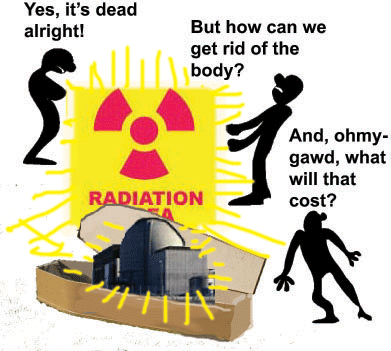 Here’s what dismantling a nuclear reactor involves: Robots, radiation, risk IEA says about 200 nuclear reactors around the world will be shut down over the next quarter century http://www.business-standard.com/article/international/here-s-what-dismantling-a-nuclear-reactor-involves-robots-radiation-risk-117061200298_1.html Reuters | Muelheim-Kaerlich, Germany June 12, 2017 As head of the Muelheim-Kaerlich nuclear reactor, Thomas Volmar spends his days plotting how to tear down his workplace. The best way to do that, he says, is to cut out humans.
About 200 nuclear reactors around the world will be shut down over the next quarter century, mostly in Europe, according to the International Energy Agency. That means a lot of work for the half a dozen companies that specialise in the massively complex and dangerous job of dismantling plants.
Those firms — including Areva, Rosatom’s Nukem Technologies Engineering Services, and Toshiba’s Westinghouse — are increasingly turning away from humans to do this work and instead deploying robots and other new technologies.
That is transforming an industry that until now has mainly relied on electric saws, with the most rapid advances being made in the highly technical area of dismantling a reactor’s core — the super-radioactive heart of the plant where the nuclear reactions take place.
The transformation of the sector is an engineering one, but companies are also looking to the new technology to cut time and costs in a competitive sector with slim margins.
Dismantling a nuclear power plant can take decades and cost up to 1 billion euros ($1.1 billion), depending on its size and age. The cost of taking apart the plant in Muelheim-Kaerlich will be about 800 million euros, according to sources familiar with the station’s economics.
Some inroads have already been made: a programmable robot arm developed by Areva has reduced the time it takes to dismantle some of the most contaminated components of a plant by 20-30 per cent compared with conventional cutting techniques.
For Areva and rival Westinghouse, reactor dismantling is unlikely to make an impact on the dire financial straits they are mired in at present as it represents just a small part of their businesses, which are dominated by plant-building.
But it nonetheless represents a rare area of revenue growth; the global market for decommissioning services is expected to nearly double to $8.6 billion by 2021, from $4.8 billion last year, according to research firm MarketsandMarkets. Such growth could prove important for the two companies should they weather their current difficulties.
“We’re not talking about the kind of margins Apple is making on its iPhone,” said Thomas Eichhorn, head of Areva’s German dismantling activities. “But it’s a business with a long-term perspective.”
When reactors were built in the 1970s, they were designed to keep radiation contained inside at all costs, with little thought given to those who might be tearing them down more than 40 years later.
First, engineers need to remove the spent nuclear fuel rods stored in reactor buildings — but only after they’ve cooled off. At Muelheim-Kaerlich this took about two years in total. Then peripheral equipment such as turbines need to be removed, a stage Muelheim-Kaerlich has begun and which can take several years.
Finally, the reactor itself needs to be taken apart and the buildings demolished, which takes about a decade. Some of the most highly contaminated components are cocooned in concrete and placed in iron containers that will be buried deep underground at some point.
Robots under water
While the more mundane tasks, including bringing down the plants’ outer walls, are left to construction groups such as Hochtief, it’s the dismantling of the reactor’s core where more advanced skills matter — and where the use of technology has advanced most in recent years.
Enter companies such as Areva, Westinghouse, Nukem Technologies, GE Hitachi as well as GNS, owned by Germany’s four nuclear plant operators. They have all begun using robots and software to navigate their way into the reactor core, or pressure vessel.
“The most difficult task is the dismantling of the reactor pressure vessel, where the remaining radioactivity is highest,” said Volmar, who took charge of the RWE-owned Muelheim-Kaerlich plant two years ago. “We leave this to a specialised expert firm.”
The vessel — which can be as high as 13 metres and weigh up to 700 tonnes — is hidden deep inside the containment building that is shaped like a sphere to ensure its 30-centimetre thick steel wall is evenly strained in case of an explosion.
The 2011 Fukushima disaster and the Chernobyl accident of 1986 are imprinted in the world’s consciousness as examples of the catastrophic consequences of the leakage of radioactive material.
France’s Areva recently won the contract to dismantle the pressure vessel internals at Vattenfall’s 806 megawatts (Mw) Brunsbuettel nuclear plant in Germany, which includes an option for the Swedish utility’s 1,402 MW Kruemmel site.
There, the group will for the first time use its new AZURo programmable robot arm. It hopes this will help it outstrip rivals in what is the world’s largest dismantling market following Germany’s decision to close all its last nuclear plants by 2022, in response to the Fukushima disaster.
AZURo operates under water because the liquid absorbs radiation from the vessel components — reducing the risk of leakage and contamination of the surrounding area. The chamber is flooded before its work begins.
Areva’s German unit invests about 5 per cent of its annual sales, or about 40 million euros, in research and development, including in-house innovation such as AZURo. By comparison, the world’s 1,000 largest corporate R&D spenders, on average, spent 4.2 per cent last year, according to PwC.
The robot arm technology helped Areva beat Westinghouse by winning tenders to dismantle pressure vessel internals at EnBW’s Philippsburg 2 and Gundremmingen 2 blocks, industry sources familiar with the matter said.
Areva and EnBW both declined to comment. Westinghouse — whose US business filed for bankruptcy in March — did not respond to repeated requests for comment. Time and money
Britain’s OC Robotics has built the LaserSnake2, a flexible 4.5-metre snake arm, which can operate in difficult spaces and uses a laser to increase cutting speeds — thus reducing the risk of atmospheric contamination. It was tested at the Sellafield nuclear site in west Cumbria last year.
This followed France’s Alternative Energies and Atomic Energy Commission (CEA), whose laser-based dismantling technology generates fewer radioactive aerosols — a key problem during cutting — than other technologies.
The complexity of the dismantling process is also giving rise to modelling software that maps out the different levels of radiation on plant parts, making it easier to calculate the most efficient sequence of dismantling – the more contaminated parts are typically dealt with first – and gives clarity over what safety containers will be needed to store various components.
GNS, which is jointly owned by E.ON, RWE, EnBW and Vattenfall, is currently helping to dismantle the German Neckarwestheim 1 and Philippsburg 1 reactors, using its software to plan the demolition.
The company also hopes to supply its software services for the dismantling of PreussenElektra’s Isar 1 reactor, which is being tendered, and aims to expand to other European countries.
“Two things matter: time and money,” said Joerg Viermann, head of sales of waste management activities at GNS.
“The less I have to cut, the sooner I will be done and the less I will spend.”
Court rejects citizen group submission, allows restart of Genkai nuclear plant
Court rejects citizens’ plea to delay restart of Genkai plant http://www.asahi.com/ajw/articles/AJ201706130012.html, THE ASAHI SHIMBUN June 13, 2017 SAGA–The Saga District Court on June 13 rejected a class action request for an injunction to delay the restart of the Genkai nuclear power plant.
A citizens group had submitted the request for the temporary injunction on the No. 3 and No. 4 reactors at the Genkai plant, operated by Kyushu Electric Power Co., in Saga Prefecture. The group will appeal the decision to the Fukuoka High Court.
Concerns about the safety of the plant led a total of 202 plaintiffs living in 17 prefectures, including Saga and Fukuoka, to join the court action.
With the Saga prefectural governor and Genkai mayor already giving the green light to resume operations, the plant could be restarted as early as this autumn.
North Korea hints that it could test a long range missile, that could hit New York
North Korea threatens to drop nuclear bomb on New York to prove Donald Trump tweet wrong
‘The DPRK is about 10,400 km far away from New York, but this is just not a long distance for a strike today’ Independent Gabriel Samuels @gabs_samuels 14 June 17 Korea has hinted that it could test a long range missile capable of hitting New York, months after President Donald Trump insisted: “It won’t happen”.
Accusing the US leader of underestimating the secretive Communist state’s capabilities, an article last week in state-run newspaper Rodong Sinmun, suggested that it was close to developing an intercontinental ballistic missile (ICBM).
“Trump blustered early this year that the DPRK’s final access to a nuclear weapon that can reach the US mainland will never happen,” the editorial said, using an abbreviation for the country’s official name, the Democratic People’s Republic of Korea. …..http://www.independent.co.uk/news/world/asia/north-korea-nuclear-bomb-new-york-donald-trump-tweet-mocking-missile-capabilities-a7787686.html
Antarctic ice shelf collapse – climate change in action
The Larsen C ice shelf collapse hammers home the reality of climate change , Guardian, John Abraham, 12 June 17, Very soon, a large portion of an ice shelf in Antarctica will break off and collapse into the ocean. The name of the ice shelf is Larsen C; it is a major extension from of the West Antarctic ice sheet, and its health has implications for other ice in the region, and sea levels globally.

How do we know a portion is going to collapse? Well, scientists have been watching a major rift (crack) that has grown in the past few years, carving out a section of floating ice nearly the size of Delaware. The speed of the crack has increased dramatically in the past few months, and it is nearly cracked through.
Project Midas provides frequent updates on the Larsen C shelf. You can read a summary there, which reports:
In the largest jump since January, the rift in the Larsen C Ice Shelf has grown an additional 17 km (11 miles) between May 25 and May 31 2017. This has moved the rift tip to within 13 km (8 miles) of breaking all the way through to the ice front, producing one of the largest ever recorded icebergs. The rift tip appears also to have turned significantly towards the ice front, indicating that the time of calving is probably very close.
The rift has now fully breached the zone of soft ‘suture’ ice originating at the Cole Peninsula and there appears to be very little to prevent the iceberg from breaking away completely.
When it calves, the Larsen C Ice Shelf will lose more than 10% of its area to leave the ice front at its most retreated position ever recorded; this event will fundamentally change the landscape of the Antarctic Peninsula. We have previously shown that the new configuration will be less stable than it was prior to the rift, and that Larsen C may eventually follow the example of its neighbor Larsen B, which disintegrated in 2002 following a similar rift-induced calving event……..
Why does all this matter? Well it is important for a number of reasons. First, when an ice shelf melts or collapses, it can unpin other ice that is sitting on land, which allows it to flow more quickly into the ocean. It is this secondary effect – the loss of ice resting on land – that changes the rate of sea level rise. Loss of a major ice shelf can also activate ice that rests on bedrock topography that makes it fundamentally unstable – ice that, once moving, will move faster and faster, until a large region is afloat.
The entire Larsen Ice shelf, which is the fourth largest in Antarctica, covers nearly 50,000 square km (20,000 square miles) according to reporting at ABC science. The ice on the land upstream of the shelf is enough to raise sea level, eventually, by ten centimeters. This is not, by itself, a major threat to the world’s coastlines, but it reveals the path that other, even larger areas are likely to take in the future.
Perhaps a quotation from a seminal work on Antarctic ice sheets best sums up the situation. In a 1978 paper, John Mercer from the Institute of Polar studies concluded:
One of the warning signs that a dangerous warming trend is under way in Antarctica will be the breakup of ice shelves on both coasts of the Antarctic Peninsula, starting with the northernmost and extending gradually southward. These ice shelves should be regularly monitored by LANDSAT imagery.
Why is the ice shelf going to break off and collapse into the ocean? Since large calving events are so rare, and since our measurements in and around ice shelves don’t go back in time far enough, it’s hard to say whether this is a natural progression, variability, or a result of human activity (or more likely a mixture). A major reason may be human-caused warming, which has led to melting from both above and below in nearby areas……. https://www.theguardian.com/environment/climate-consensus-97-per-cent/2017/jun/12/the-larsen-c-ice-shelf-collapse-hammers-home-the-reality-of-climate-change
Yet another nuclear power station to bite the dust in America
 U.S. Experiences Sixth Nuclear Retirement Announcement in Seven Years, Power Engineering Jun 13, 2017 With Exelon’s announced intentions to retire the Three Mile Island Nuclear Generating Station, the United States now has six nuclear plants in the country that are operating but will soon retire, the Energy Information Administration reported.
There are now 99 nuclear reactors at 60 nuclear stations in operations in the United States. Since the first reactor came online in 1957, more than 30 nuclear reactors have retired, including some that were test projects or experimental designs……
The six plants now slated to retire in the next nine years include four that have retirement dates more than a decade before their operating licenses expire — Palisades, Pilgrim, Oyster Creek, and Three Mile Island. New nuclear plants receive 40-year operating licenses, though 90 percent of operating nuclear facilities received license extensions for another 20 years.
Indian Point’s license extension was challenged by the state of New York, and owner Entergy subsequently chose to retire the plant. Pacific Gas & Electric chose not to seek a license renewal for Diablo Canyon.
Exelon has said that Three Mile Island has not been profitable for the past five years, and is seeking subsidies from Pennsylvania to keep it open. http://www.power-eng.com/articles/2017/06/u-s-experiences-sixth-nuclear-retirement-announcement-in-seven-years.html
Japan’s struggle to decommission Fukushima nuclear reactors
The passage route to the first reactor was flanked by gigantic storage tanks that hold contaminated water.
Reactors still showing skeletal steel frames and roof debris remind a 17-meter-high tsunami which flooded the facility on March 11 in 2011 and caused a hydrogen explosion, bringing the plant to a complete standstill.
Tokyo Electric Power Co. (Tepco), the operator of the plant, has deployed 7,000 workers including its own staff to the site. Their first priority is to tackle the influx of contaminated groundwater. Workers erected a cutoff wall and pumped out upstream groundwater, but still, about 100 to 150 tons of contaminated water is generated every day, according to Tepco. The amount of the contaminated water in storage tanks reaches nearly 1 million tons. It has not yet been decided how to treat the water.
The operation for complete decommissioning is a long way to go. It will take 30 years to finish the job, including the treatment of contaminated water, said Yuichi Okamura, Tepco communication manager.
The Japanese government is going all out to develop advanced robot and drone technology to accurately grasp the internal situation of the reactors to support decommissioning.
France set to close some nuclear reactors
He gave no indication of timing.
Hulot told reporters at the G7 environment summit in the Italian city of Bologna that it was too early to give numbers about France’s aim to reduce the share of nuclear in its power generation to 50 percent from the current 75 percent.
“We are going to close some nuclear reactors and it won’t be just a symbolic move,” he said.
EDF shares, which were down 0.8 percent before Hulot’s comments, immediately fell further to stand 2.2 percent lower.
Asked about the possibility of introducing a carbon tax, Hulot said “France already has a carbon tax which we increase every year. At an EU level we want to increase the threshold,” he said……https://www.reuters.com/article/us-edf-nuclear-idUSKBN1931AD
Call to Canadians to join talks for the Convention on the Prohibition of Nuclear Weapons

 CANNINGS: We must work tirelessly for a nuclear weapons free world http://infotel.ca/opinion/letters-to-the-editor/cannings-we-must-work-tirelessly-for-a-nuclear-weapons-free-world/it43381 By Richard Cannings, MP South Okanagan-West Kootenay 13 June 17 Last week I listened to Setsuko Thurlow, a Hiroshima survivor, speak eloquently of what it was like to have her family, her neighbourhood, her city, vaporized in an instant of mass destruction. I wish everyone in this country could have heard her moving words. Setsuko has devoted her life to advocating for nuclear disarmament, to ensure that her experience will never be repeated.
Some would say it was that threat of mutually assured destruction through nuclear warfare that kept worldwide conflict at bay through the Cold War. Even now, 25 years after the end of the Cold War, there are more than 15,000 nuclear warheads in the world. The risk to the planet was, and remains, incalculable.
Canadians have long recognized the threat of nuclear proliferation and long called for nuclear disarmament. In 2010, the House of Commons unanimously passed a motion that called on the government to deploy a major diplomatic initiative to increase the rate of nuclear disarmament.
The Liberal Party of Canada, only last year, adopted a resolution at their Winnipeg policy convention that urged the government—their Liberal government—to convene an international conference to commence negotiations for a Nuclear Weapons Convention that would ban nuclear weapons.
And yet the government’s actions in the past year go completely against that resolution.
The international community—over 130 countries are involved—is currently carrying out negotiations on the Convention on the Prohibition of Nuclear Weapons, just as the Liberal Party resolution requested. The problem is, not only is Canada not leading this process, it is boycotting it completely. Canada is not back on the international scene, it is backing away from its traditional leadership role in promoting a more peaceful world.
And Canada is backing away under pressure from the United States. Justin Trudeau said in the House of Commons last week that joining the negotiations would be “useless” as the nuclear powers are not present. Yet Canada led the world in the banning of land mines through a process in which the land mine powers, including the United States, did not, initially, participate.
These UN negotiations for nuclear disarmament are still going on. Canada could join and take a real and meaningful role in this essential project. But as I write this, the government is voting against an NDP motion to join these talks.
Opponents to a nuclear ban treaty say that disarmament must happen step-by-step, and that the time is not right for these negotiations, the world is not secure enough.
We have reached the edge of this cliff step by step over the last 60 years. The world will never be fully secure. We cannot wait for better conditions. We cannot afford to wait at all.
Yes, the nuclear powers will always oppose nuclear disarmament. But we must not bow to their wishes. We need to radically change the worldview of the nuclear powers. It will not be easy. It will not happen overnight. But we must be bold; we must live up to our convictions and our moral duty, and work tirelessly for a nuclear weapons free world.— Richard Cannings is the Member of Parliament for South Okanagan-West Kootenay.
Scottish 6 to join historic global conference to agree nuclear weapons ban treaty
Common Space Michael Gray @GrayInGlasgow, 13 June 17, SCOTTISH CAMPAIGNERS will join the global movement to ban nuclear weapons this week in New York as pressure builds on the rogue nuclear states to ditch weapons that threaten the future of life on earth.
The International Campaign to Abolish Nuclear Weapons (Ican) has made substantial progress in establishing a Nuclear Ban Treaty, with 123 countries backing progress towards a weapons ban last October at the United Nations. The UK was one of 38 nations opposed.
A cross-group civil society delegation of six will represent Scotland at the June-July session on the recently published draft Treaty document. With support from over 40 states, the Treaty will have legal status and, if successful, will enter a process of ratification. ….https://www.commonspace.scot/articles/11159/scottish-6-join-historic-global-conference-agree-nuclear-weapons-ban-treaty
Cities and states may be able to officially join the Paris Agreement
 Grist 12th June 2017, Cities and states may be able to officially join the Paris Agreement after
all. Patricia Espinosa, head of the United Nations climate change body that
negotiated the accord, told ministers at a June 11-12 meeting that she
hopes to bring U.S. cities and states into the fold. “This is obviously
important, because cities like New York and states like California that
intend to pursue the same direction — of reducing emissions very
ambitiously — will have a voice and will be able to sign agreements
inside the international convention on climate change,” said Espinosa, as
reported by Politico.
After Trump announced the U.S. would drop out of the
Paris deal, numerous states, cities, and businesses reiterated commitments
to reducing emissions. But the actual legality of cities and states joining
international treaties remains murky under the U.S. Constitution. “It’s
a little bit early to know what exactly is meant by” Espinosa’s
comment, says Vicki Arroyo, executive director of the Georgetown Climate
Center. Arroyo says it could refer to subnational representatives, like
governors, receiving credentials to attend climate talks and participate in
discussions, rather than state or municipal governments literally signing
on. http://grist.org/briefly/cities-and-states-may-be-able-to-officially-join-the-paris-agreement-after-all/
Steep fall in global use of coal
Times 14th June 2017, Global coal usage fell steeply for the second year running in 2016, in what
BP hailed as a “decisive break from the past”.Spencer Dale, the oil giant’s
chief economist, highlighted the “stark” reversal in fortunes of the fuel
source, which has been driven by declines in China and the US, as arguably
the most striking feature in its annual statistical review of world energy,
published yesterday.
Britain recorded a 52.5 per cent drop in consumption
as coal power plants were forced out of the energy mix. That took UK coal
consumption back to levels not seen in almost two centuries, since the
industrial revolution.
Coal usage worldwide grew steadily from 2009 to
2013, driven by rising energy demand in Asia. Just four years ago it still
accounted for the largest share of growth in global energy consumption.
After plateauing in 2014, however, coal has declined steeply over the past
two years, falling by 1.7 per cent in 2016. https://www.thetimes.co.uk/edition/business/coal-industry-in-sharp-decline-as-world-turns-to-cleaner-fuel-nlsvqlqzf
Niagara region to learn about transport of nuclear waste, and its dangers
 Expert to speak on nuclear transporting https://www.niagarathisweek.com/news-story/7369046-expert-to-speak-on-nuclear-transporting/ Niagara District Council of Women welcome Gordon Edwards to Lincoln town hall Jun 13, 2017 by Luke Edwards Grimsby Lincoln News A U.S. judge has ruled the Department of Energy can proceed with its plan to import 6,000 gallons of liquid nuclear waste from Canada. The proposed route goes through Niagara.
LINCOLN — As shipments of highly radioactive nuclear waste begin making their way through the Niagara region, a local group is bringing in an expert to address what they say are some unanswered questions.
The Niagara District Council of Women will be welcoming Gordon Edwards to a meeting this Friday at Lincoln town hall. Edwards is a nuclear critic and president of the Canadian Coalition for Nuclear Responsibility, a non-profit group that focuses on military and civilian uses of nuclear, as well as non-nuclear alternatives.
Earlier this year a U.S. judge approved a plan to have nuclear waste transported from a research facility in Chalk River, Ont. through Niagara and across the Peace Bridge to Buffalo. The U.S. Department of Energy plans to import nearly 23,000 litres, or 6,000 gallons, of the waste.
According to the NDCW, many unanswered questions remain, including the nature of the liquid radioactive material, historical precedence for such transportation, possible alternatives and concerns over leakage or other dangers.
The meeting is expected to run from 9 a.m. to noon at town hall, 4800 South Service Rd. in Beamsville. For more information on the meeting, contact Gracia Janes at 905-468-2841, Ann Porter Bonilla at 905-973-1621 or Susan Pruyn at 905-892-5206.
1 This Month


18 March Webinar @ 1 PM EST: An Assessment of SMR Projects: The Case of Canada
register for the zoom:
https://us02web.zoom.us/webinar/register/WN_o8BIIOUvQ2ONJR1nta65DQ#/registration


of the week – STOP SMALL MODULAR REACTORS IN CANADA
To see nuclear-related stories in greater depth and intensity – go to https://nuclearinformation.wordpress.com
-
Archives
- March 2026 (138)
- February 2026 (268)
- January 2026 (308)
- December 2025 (358)
- November 2025 (359)
- October 2025 (376)
- September 2025 (258)
- August 2025 (319)
- July 2025 (230)
- June 2025 (348)
- May 2025 (261)
- April 2025 (305)
-
Categories
- 1
- 1 NUCLEAR ISSUES
- business and costs
- climate change
- culture and arts
- ENERGY
- environment
- health
- history
- indigenous issues
- Legal
- marketing of nuclear
- media
- opposition to nuclear
- PERSONAL STORIES
- politics
- politics international
- Religion and ethics
- safety
- secrets,lies and civil liberties
- spinbuster
- technology
- Uranium
- wastes
- weapons and war
- Women
- 2 WORLD
- ACTION
- AFRICA
- Atrocities
- AUSTRALIA
- Christina's notes
- Christina's themes
- culture and arts
- Events
- Fuk 2022
- Fuk 2023
- Fukushima 2017
- Fukushima 2018
- fukushima 2019
- Fukushima 2020
- Fukushima 2021
- general
- global warming
- Humour (God we need it)
- Nuclear
- RARE EARTHS
- Reference
- resources – print
- Resources -audiovicual
- Weekly Newsletter
- World
- World Nuclear
- YouTube
-
RSS
Entries RSS
Comments RSS
 nuclear-news