USA government renews old bunkers, for political leaders and other top brass, in event of nuclear war

This is where the government will hide during a nuclear war, New York Post, 11 June 17 As nuclear threats loom from countries like Iran and North Korea, the US is knocking the dust off decades-old bunkers intended to protect government officials — and even start a new civilization — in the case of just such a nightmare event.
Journalist Garrett Graff takes readers through the 60-year history of the government’s secret Doomsday plans to survive nuclear war in his painstakingly researched book “Raven Rock: The Story of the U.S. Government’s Secret Plan to Save Itself — While the Rest of Us Die” (Simon & Schuster), out now.
He focuses on the Cold War-era government bunkers across the country that were built to house the President and various Washington elites — members of a so-called “shadow government” in the worst nuclear Armageddon scenario.
Since September 11, 2001, Congress has intensified their interest in and funding of top secret “Continuity of Government” (COG) in ways not seen since the Cold War. With hundreds of newly declassified documents, the book, currently in development with NBC as a TV show, includes never-before-heard intel on the country’s top secret bunkers — mythical places like Raven Rock and Mount Weather.
Raven Rock
Lillington, NC • For military
Built near Camp David to house the military, as a backup for the Pentagon — and perhaps even the President — during an emergency, Raven Rock has retained an air of secrecy ever since construction started in 1948……….
Peters Mountain
Appalachian Mountains, Virginia • For intelligence agencies………
Mount Weather
Bluemont, Va. • For civilian government
The President could end up at any of the Doomsday facilities, but in general terms Mount Weather is designed to hold the civilian leadership of the US government, including the President, the Supreme Court, Cabinet officials, and some senior congressional leaders……
NORAD Colorado Springs, Colo. • For air defense
Unlike Raven Rock and Mount Weather, the military’s North American Aerospace Defense Command (NORAD) was never kept secret from the public. “NORAD is specific to North American defense — it includes the command post responsible for defending both Canada and the US from air attacks, whether that’s terrorists, Russian bombers, or North Korean missiles,”…..
The most mysterious of all bunkers is this one, located right in the heart of our nation’s capital.
“There’s definitely a bunker under the White House, known as the Presidential Emergency Operations Center (PEOC), which is where Dick Cheney was rushed on September 11th and where he spent the day helping to lead the government’s response. …..http://nypost.com/2017/06/10/this-is-where-the-government-will-hide-during-a-nuclear-war/
Nuclear energy will be defunct before Sizewell C nuclear power station ever comes on line
 East Anglian Daily Times 9th June 2017, A high-profile baroness and environmental campaigner has labelled Suffolk’s new nuclear proposals “incredibly disastrous”. Jenny Jones, Baroness of Moulsecoomb, made the comments at a recent meeting attended by more than 100 people in Woodbridge at which Sizewell C faced criticism from campaigners, academics and Suffolk residents.
Discussions ranged from climate change, alternative energy options and more. Baroness Jones, a Green Party representative in the House of Lords, chaired the meeting, which was intended to raise public awareness about the possible effects of Sizewell. She said nuclear power was “so incredibly disastrous”, highlighting its impact on economic and social justice as well as the environment. “Nuclear energy will be defunct by the time it comes online,” she said.
http://www.eadt.co.uk/business/baroness-jenny-jones-slams-disastrous-nuclear-proposals-at-woodbridge-conference-suffolk-sizewell-and-the-environment-1-5054946
Permanent shutdown of unit 1 of South Korea’s Kori nuclear power plant
World Nuclear News 9th June 2017, The permanent shutdown of unit 1 of the Kori nuclear power plant has been approved by the South Korea’s nuclear safety regulator. The unit – the country’s oldest operating reactor unit – will be taken offline on 19 June.
Kori 1 is a 576 MWe pressurized water reactor that started commercial operation in 1978. A six-month upgrading and inspection outage at Kori 1 in the second half of 2007 concluded a major refurbishment program and enabled its relicensing for a further ten years. A subsequent relicensing process could have taken Kori 1 to 2027, but Korea Hydro & Nuclear Power (KHNP) announced in August 2015 that it had withdrawn its application to extend the unit’s operating licence. In June last year, the company applied to decommission the reactor. http://www.world-nuclear-news.org/C-Final-shutdown-approaches-for-Koreas-oldest-reactor-0906175.html
UK’s Nuclear Industry Association anxious about Brexit, following British election
 Politics Homes 9th June 2017, The Nuclear Industry Association (NIA) has called on the next Government, whatever its formation, to return to business as quickly as possible, and resolve the key Euratom question for the nuclear sector to ensure a Brexit cliff edge for the industry is avoided.
Brexit is a key challenge for the nuclear sector and resolving the Euratom issue should be an immediate priority for incoming Ministers. The NIA recently launched a paper, setting out the priority areas for the negotiations with the European Commission to support the UK Government, should it decide to withdraw from Euratom as part of the Brexit process. https://www.politicshome.com/news/uk/energy/nuclear-power/press-release/nuclear-industry-association/86549/nuclear-industry
Auckland commemorates 30 years of nuclear-free New Zealand
 Aucklanders celebrate anniversary of nuclear-free New Zealand, 11/06/2017, Newshub staff It’s been 30 years since New Zealand became the first country in the world to declare itself Nuclear Free.
On Sunday, hundreds formed a human peace symbol at the Auckland Domain, similar to the one made in 1983, in order to commemorate the anniversary of the passing of the New Zealand Nuclear Free Zone, Disarmament, and Arms Control Act. …….
The anniversary comes just days before a United Nations conference involving 132 countries which will negotiate a treaty to ban nuclear weapons. http://www.newshub.co.nz/home/new-zealand/2017/06/aucklanders-celebrate-anniversary-of-nuclear-free-new-zealand.html
USA nuclear weapons production, testing, and use, released carbon emissions – claims North Korea
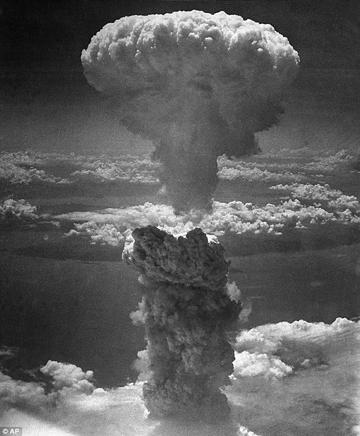 NORTH KOREA CLAIMS U.S. WAR AND NUCLEAR WEAPONS CAUSED CLIMATE CHANGE, NewsWeek, BY ON 6/10/17 North Korea has accused U.S. military and environmental policies of causing climate change and producing pollution around the world.
In a scathing report cited Friday by North Korea’s official Korean Central News Agency (KCNA), the state-run Institute for International Studies of the DPRK (an acronym for the country’s official title: the People’s Democratic Republic of Korea), asserted that the U.S.’s use of nuclear weapons, involvement in foreign conflicts and style of production had most harmed the environment since the Cold War. The study, attributed to researcher Kim Kum Hui and titled “The U.S. Is Chiefly to Blame for Global Environmental Pollution,” advised the U.S. to change course and safeguard the environment…..
North Korea’s report claimed that since the Cold War, the U.S. has forced other nations to adopt its model of “American-style development” under the guise of economic globalization. It said the U.S. alone accounted for 22.1 percent of the world’s carbon emissions in 2004. The figure appears to relatively coincide with conclusions established the following year by Washington-based think tank the World Research Institute. Research by the same organization says the U.S. contributed 14.4 percent in 2012, second only to China’s 25.36 percent. That same year, North Korea, an underdeveloped nation of around 25 million, was listed at .17 percent.
The report also laid into the military practices of the U.S., with which North Korea fought a war in the 1950s. The piece condemned the U.S.’s dropping of atomic bombs on the Japanese cities of Hiroshima and Nagasaki at the end of World War Two in 1945, as well as the government’s nuclear tests, which numbered 1,054 between 1945 and 1992, according to the Department of Energy…….
Despite North Korea’s traditionally dismissive nature toward international treaties, Pyongyang has at times been a vocal advocate of global cooperation on environmental issues. It signed the 2015 Paris Climate Agreement, which is geared toward reducing global greenhouse gas emissions, and deeply criticized Trump for pledging to withdraw from the non-binding, landmark treaty last week. North Korea has suffered from a number of deadly famines and floods that experts and international agencies have said indicate its vulnerability to climate change. http://www.newsweek.com/north-korea-us-war-nuclear-weapons-climate-change-623825
The world on the brink of nuclear war in 1983
In 1983, A NATO Military Exercise Almost Started a Nuclear World War III, The National Interest, Warfare History Network, 11 June 17, On the night of November 20, 1983, Armageddon went prime time. Over 100 million Americans tuned in to the ABC television network to watch the two-hour drama The Day After. This depiction of a hypothetical nuclear attack on the United States attracted a great deal of publicity and controversy. Schools made watching the film a homework assignment, discussion groups were organized in communities across the country, and even the secretary of state at the time, George Schulz, took part in a question-and-answer session hosted by ABC after the film’s broadcast. That a mere made-for-TV movie could garner such attention from a leading figure in the Reagan administration indicates how real the fear of a nuclear apocalypse was at the time. But almost no one watching that Sunday night realized just how close fiction came to reality in the fall of 1983.
The possibility of the world’s two greatest military powers destroying each other and the earth in a full-scale thermonuclear war was a fear shared by many throughout the world. At the time, both the United States and the USSR maintained huge nuclear arsenals of over 20,000 nuclear warheads each. In North America and Western Europe, nuclear freeze movements were gaining new members daily, with mass demonstrations that routinely numbered in the tens of thousands.
World events seemed to only reaffirm people’s fears. It was the third year of the presidency of Ronald Reagan, a man who had built his political career on a virulent hatred for all things communist. His 1980 victory over incumbent President Jimmy Carter had largely been the result of his hard-line stance against the Russians. A former film actor with a natural flair for the dramatic, Reagan both inspired and shocked people with his hardcore rhetoric, such as his statement before the British House of Commons in 1982 that the Marxist ideology would be relegated to the “ash heap of history.” Perhaps his most memorable and antagonistic remarks came on March 8, 1983, when Reagan referred to the Soviet Union as the “focus of evil in the modern world” and an “evil empire.”……
“Star Wars” and Fleetex 83: On the Brink of Nuclear War
On March 23, 1983, Reagan took the superpower rivalry to a new level when he unveiled the Strategic Defense Initiative Program during a live television address. The SDI program, more popularly referred to as “Star Wars,” was to provide an orbital shield that would protect the United States—at least partly—from a nuclear strike…..
To Yuri Andropov, then general secretary of the USSR, Reagan’s intentions spelled trouble…….http://nationalinterest.org/blog/the-buzz/1983-nato-military-exercise-almost-started-nuclear-world-war-21111
American government continues to plan for nuclear disaster action
 If a nuclear bomb goes off, this is the most important thing you can do to survive, DAVE MOSHER, JUN 12, 2017 “………A terrorist-caused nuclear detonation is one of 15 disasters scenarios that the federal government continues to plan for with state and city governments — just in case.
South Carolina electricity customers must pay up for nuclear reactors, whether or not they are actually built

 With $8.6 billion spent, fate of South Carolina nuclear reactors still unknown, Post and Courier, By Andrew Brown abrown@postandcourier.com Jun 11, 2017 COLUMBIA — If two of the Palmetto State’s largest utilities pull the plug on their nuclear power plant expansion, around half of all South Carolinians could be on the hook for $8.6 billion to pay for a project that might never produce a single kilowatt of electricity.
It’s possible that bankruptcy proceeds, corporate payments and sales of the nuclear reactor components would help defray some of the costs to ratepayers if work stops on the V.C. Summer Nuclear Station in Fairfield County.
It’s just as possible the partnering utilities — publicly operated Santee Cooper and investor-owned South Carolina Electric & Gas — could decide as early as this month to continue work on the two new reactors, which have been plagued with cost overruns, construction delays and the bankruptcy of the project’s lead contractor.
In the end, the power companies can lean on their customers to recover the costs of the nuclear reactors no matter what they decide. For SCE&G, a 2007 law passed by South Carolina lawmakers allows the Cayce-based utility to collect a 10 percent profit for investors, even if the V.C. Summer project is scrapped.
“We are stuck to a great degree. The public is in a very bad position here,” said Lynn Teague, vice president of the League of Women Voters of South Carolina, who has followed the project. “It’s a rotten situation for the ratepayers.”
SCE&G and Santee Cooper already have sunk $8.6 billion into the project — more than half of the expected $14 billion needed to finish the reactors. The new power sources would serve around 1.6 million homes and businesses across South Carolina’s 46 counties.
The utilities have already collected nearly $2 billion from electric customers since the project received approval in 2008, but all of that money has gone to covering finance costs and not to the concrete, steel and manpower used to build the reactors.
The average residential electric bill for a SCE&G customer has risen by $324 a year to pay for the ambitious energy project that was pitched as part of a new carbon-free age of nuclear power in the United States.
The power companies said they could announce by June 26 whether they would stop work all together or continue construction on one or both of the reactors.
The biggest threat to the project is Westinghouse, the primary contractor at the project north of Columbia in Jenkinsville. Westinghouse filed for bankruptcy protection at the end of March.
Officials with SCE&G and Santee Cooper say they are closely monitoring Westinghouse’s bankruptcy proceedings, where both are creditors to the failing company. ……
SCE&G is all but guaranteed to get the project covered by its electric customers because of legislation passed by the General Assembly at the request of the utility industry in 2007.
That law, known as the Base Rate Review Act, allowed SCE&G to start collecting money for construction costs while work was being completed instead of after the fact. SCE&G said that would save $1 billion for what started out as a $9.8 billion project that was scheduled to open in 2016.
But the law also helped shift almost all of the risk for the endeavor off SCE&G’s parent and its shareholders and onto the electricity customers.
The only way that SCE&G will eat any of costs of the project now is if state regulators find the utility failed to, as law says, “anticipate or avoid the allegedly imprudent costs” based on the information available at the time. …….. http://www.postandcourier.com/business/with-billion-spent-fate-of-south-carolina-nuclear-reactors-still/article_b5ea0a00-4d1a-11e7-9e76-fb2e0630d446.html
Georgia’s half-built nuclear power station – Toshiba to the rescue?
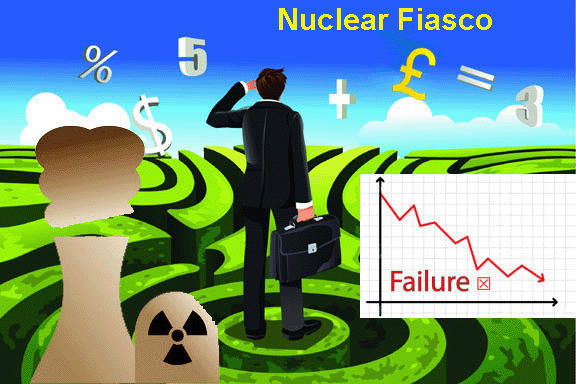 Toshiba rescues half-built Georgia nuclear plant, CNN Money , 11 June 17, Toshiba’s bankrupt nuclear unit left an uncertain future for two half-finished nuclear reactors in Georgia — but the company promised Saturday it will pour up to $3.68 billion into the project to finish it.The Tokyo-based company will pay out the billions to Georgia Power, a subsidiary of Southern Company, in installments between this coming October and January 2021.
Toshiba’s Westinghouse will still be involved with the project by way of lending engineering, licensing support, and the intellectual property rights needed for the project to Southern Company, the company said in a statement.
Toshiba’s nuclear construction efforts are at the heart of its current financial woes. Westinghouse was crippled by massive losses because the costs of its nuclear projects in the U.S. winded up “far surpassing estimates.”
Though Toshiba is known for making a vast array of product — from IT equipment to TVs and laptops — the nuclear program has dented profits so badly that the company said in April it has “substantial doubt” about its ability to stay in business.
Toshiba’s Westinghouse is also midway building two nuclear reactors in South Carolina, and the fate of that project still hangs in the balance. Toshiba said Saturday it’s “still in negotiations” with the project’s owners……http://money.cnn.com/2017/06/10/news/companies/toshiba-nuclear-plant-georgia-southern-co/index.html
American corporations hope to use Indian insurance companies, for nuclear build in India
GE, Westinghouse keen to take nuclear insurance from Rs 1,500-crore pool BY SHILPY SINHA, ET BUREAU JUN 12, 2017 MUMBAI:After years of stonewalling, India is poised to open up its nuclear liability cover to equipment suppliers, with GE and Westinghouse showing interest in taking insurance from the pool.
Secrecy on highly radioactive uranium in the nuclear waste dump in Parks Township.
Amount of nuclear waste in Parks Township could remain unknown until 2031, TRIB Live, MARY ANN THOMAS | Sunday, June 11, 2017 Secrecy, lack of documentation and inattention to warnings may have led the Army Corps of Engineers to grossly underestimate the amount of highly radioactive uranium in the nuclear waste dump in Parks Township.
Many new cracks found in Belgian nuclear reactors
Dozens of new cracks discovered at Belgian nuclear reactors https://www.rt.com/news/391826-belgium-nuclear-reactor-cracks/ 11 Jun, 2017 The latest ultrasonic inspections have detected a substantial number of new micro cracks in nuclear reactors at the Tihange and Doel power plants in Belgium since the last study conducted three years ago, Belgian and German media report.
At least 70 additional cracks were uncovered at the Tihange 2 nuclear reactor during an ultrasonic inspection in April of this year, Belga news agency reports. Some 300 new flaws have also allegedly been discovered at the Doel 3 reactor tank during a check last November, according to tagesschau.de.
Belgian Interior Minister, Jan Jambon, confirmed the micro fissures at Tihange 2 following a parliamentary inquiry posed by Green Group leader Jean-Marc Nollet, DW reports. The reported new cracks at Doel 3 have not yet been confirmed.
The cracks do not pose any danger to operations at the nuclear plants, says operator Engie-Electrabel, which carried out the inspections under instructions from the Belgian Atomic Regulatory Authority (FANC).
The operator said the new flaws were discovered due to a “different positioning of the ultrasound device.” Engie-Electrabel maintains that as long as cracks do not expand, they do not pose a danger to the reactor’s operations.
Branding Engie-Electrabel “irresponsible,” environmentalist group, Nucléaire Stop, has criticized the operator for still running Tihange 2 reactor despite a 2.22 percent increase in faults.
In February 2015, FANC said 3,149 cracks had been found at Tihange, while 13,047 were discovered at Doel. The operator must now submit additional analyzes of the situation by September.
Tihange lies only 60 kilometers (about 37 miles) from the German border, while Doel is 150 kilometers away, near Antwerp. Germans living in the area close to this border have been exerting pressure on the government to force Belgium to shut down the aging reactors.
Lawsuit over beryllium exposure
Lawsuit filed against General Dynamics for beryllium exposure http://www.cullmantimes.com/news/lawsuit-filed-against-general-dynamics-for-beryllium-exposure/article_c8a5fcf4-4e1d-11e7-b725-63d15c9435f1.html Tiffeny Owens Jun 10, 2017A local man has filed suit against General Dynamics, alleging the company fired him after he filed a worker’s compensation claim for an incurable disease he alleges he contracted from working there.
Gary Miller is suing his former employer for worker’s compensation benefits and retaliatory discharge after he was terminated from the defense contractor in April, according to a lawsuit filed in Cullman County Circuit Court Tuesday.
Miller alleges he was diagnosed with chronic beryllium disease (CBD) by a Denver, Colorado medical facility General Dynamics sent him to see after blood tests showed he had abnormal levels of the Category 1 carcinogen in his system. After working at the manufacturing facility since June 2012, Miller was terminated April 17, according to the law suit.
General Dynamics, located on Alabama 157, machines and processes beryllium and its alloys for optics and optical assemblies. Beryllium is one-third the weight of aluminum but six times stronger than steel with high thermal stability. It’s used in various industries, such as electronics, aerospace, dental, atomic energy and defense.
In his lawsuit, Miller alleges he developed chronic beryllium disease from working at the plant where he “inhaled beryllium dust and powder over a period of time.” Miller reported his symptoms to the company, and according to his complaint, General Dynamics “acknowledged” he had the disease and paid for some of his medical and pharmacy expenses.
CBD is a slowly progressive respiratory disease characterized by the formation of lung lesions called granulomas, according to the Centers for Disease Control (CDC). These granulomas and accompanying fibrosis cause impairment of the lung’s ability to expand fully and to oxygenate the blood.
There is no cure, although symptoms can be treated. It has been estimated that as many as 134,000 current U.S. workers in private industry and government may be exposed to beryllium. The rate of progression from less severe to severe disease can vary widely. An estimated 100 people die from the disease annually.
A new rule under the Obama administration was set to lower workplace exposure to beryllium but could be sidelined by the current administration’s call to roll back occupational regulations, potentially exempting major industries.
OSHA estimated the proposed rule would prevent 96 premature deaths each year and prevent 50 new cases of CBD per year, once the full effects of the rule are realized.
Tiffeny Owens can be reached at 256-734-2131, ext. 135.
Tiffeny Owens can be reached at towens@cullmantimes.com or at 256-734-2131, ext. 135.
Nuclear fuel chain releases much carbon
 Robert Methot http://www.theday.com/letters-to-the-editor/20170610/nuclear-fuel-chain-produces-much-carbon The Day continues to publish nonsense about “carbon-free” nuclear power, including its editorial “Don’t miss opportunity to secure Millstone’s future,” (June 6). Noting scientific reality as a substitute for alternative facts, only reactor operation is essentially carbon-free. All other stages of the nuclear fuel chain − mining, milling, fuel fabrication, enrichment, reactor construction, decommissioning and waste management − use fossil fuels and hence emit carbon dioxide.
Also, the transport between these segments of the fuel cycle can be very energy intensive, as they can occur in different countries and require long-range shipping. In the longer term CO2 emissions from the nuclear fuel chain will increase substantially as limited supplies of high-grade uranium ore are depleted and lower-grade ore is mined. This is not to suggest that Millstone be shut down, but that the genuine environmental impact of its total operational cycle be recognized.
1 This Month

of the week – Shut Down Drone Warfare!


Tell the Ukrainian Government to Drop Prosecution of Peace Activist Yurii Sheliazhenko

Petition to revoke the licensing of the Near Surface Nuclear Disposal Facility (NSDF) at Chalk River. https://www.ourcommons.ca/petitions/en/Petition/Details?Petition=e-7247
To see nuclear-related stories in greater depth and intensity – go to https://nuclearinformation.wordpress.com
-
Archives
- March 2026 (251)
- February 2026 (268)
- January 2026 (308)
- December 2025 (358)
- November 2025 (359)
- October 2025 (376)
- September 2025 (257)
- August 2025 (319)
- July 2025 (230)
- June 2025 (348)
- May 2025 (261)
- April 2025 (305)
-
Categories
- 1
- 1 NUCLEAR ISSUES
- business and costs
- climate change
- culture and arts
- ENERGY
- environment
- health
- history
- indigenous issues
- Legal
- marketing of nuclear
- media
- opposition to nuclear
- PERSONAL STORIES
- politics
- politics international
- Religion and ethics
- safety
- secrets,lies and civil liberties
- spinbuster
- technology
- Uranium
- wastes
- weapons and war
- Women
- 2 WORLD
- ACTION
- AFRICA
- Atrocities
- AUSTRALIA
- Christina's notes
- Christina's themes
- culture and arts
- Events
- Fuk 2022
- Fuk 2023
- Fukushima 2017
- Fukushima 2018
- fukushima 2019
- Fukushima 2020
- Fukushima 2021
- general
- global warming
- Humour (God we need it)
- Nuclear
- RARE EARTHS
- Reference
- resources – print
- Resources -audiovicual
- Weekly Newsletter
- World
- World Nuclear
- YouTube
-
RSS
Entries RSS
Comments RSS
 nuclear-news