North Korea testing missiles at unprecedented rate
US shows of force just make North Korea more angry
How much damage can North Korea’s weapons do?
At this point, the pattern is familiar.
One week, North Korea fires off a ballistic missile, then US B-1 bombers stretch their wings over South Korea. The next, North Korean leader Kim Jong Un oversees another missile test, and two US Navy aircraft carriers show their might in waters off the Korean Peninsula.
This merry-go-round of military flexing in the Pacific has become the norm.
But as the US stacks more and more firepower in North Korea’s backyard, Pyongyang marches closer to nuclear capability — and analysts say there is little the world’s strongest military can do about it.And with most estimates putting Kim’s unpredictable regime three to five years away from achieving its nuclear ambitions, the US is simply running out of time.
“There is no amount of military pressure alone that will compel Kim Jong Un to volunteer to eliminate his nuclear and missile programs,” said Adam Mount, a senior fellow at the Center for American Progress.
After two decades of sticking largely to the same ineffective playbook, the course is unlikely to change without a drastic shift in policy from an outside nation.
“The likely outcome will be similar to prior efforts,” predicted Robert Ross, a Boston College professor and China policy expert. “North Korea will call our bluff, the US will draw back from using military force, and North Korea will continue to develop their nuclear program.”…..
[Here CNN gives a detailed timelineof events]……
How the Kim dynasty has shaped North Korea
China’s role
Diplomatic pressure is just as unlikely to cause either North Korea or the US to back down, experts say.
US President Donald Trump has often cited China, North Korea’s longtime ally, as a key player in reining in North Korea’s quest to have long-range nuclear missiles.
Earlier this year, Beijing called on Pyongyang to suspend its nuclear and missile testing while calling on the US to stop military exercises on and near the Korean Peninsula, which North Korea sees as a threat to its sovereignty.
But since then, the military merry-go-round has spun faster. North Korea is testing missiles at an unprecedented rate — once a week — while there have been five B-1 bomber flights, just one of US military’s shows of force, since April 1.
Economic sanctions, which would need to be backed and enforced by China, don’t seem to be the answer, the analysts say.
China is wary of implementing sanctions on Pyongyang that would risk economic collapse in North Korea.
“The irony here is, if China amped up economic pressure on North Korea, it might lead to a collapse — which would mean more refugees even if a military conflict doesn’t take place,” said Dean Cheng of the Heritage Foundation, a conservative-leaning DC think tank.
It is unlikely China would be compelled to implement any sort of meaningful sanctions that stray from the status-quo when North Korea’s missiles do not pose an immediate threat to them, Cheng said.
“China’s priority is avoiding war on its border and it won’t sacrifice that to help US deal with North Korea’s nuclear program,” Ross told CNN. “Trump continues to rely on China and may be very frustrated by their inability to deliver.”
North Korea shows no sign of budging
Displays of US military power have only succeeded in escalating the situation — making the chances of Pyongyang giving up its missile program, which it sees as a deterrent to a military first strike from the US, very slim, according to Ross.
Statements from Pyongyang seem to bear that out.
“On May 29, the US imperialists committed a grave military provocation by letting a formation of infamous B-1B nuclear strategic bombers fly over south Korea once again to stage a nuclear bomb dropping drill,” said a statement from North Korea’s state-run media outlet KCNA. “The gangster-like US imperialists are making all the more desperate in their moves to ignite a nuclear war despite the repeated warnings of the DPRK,” it said.
Mount, the Center for American Progress analyst, says the fact that the US hasn’t given North Korea any “red lines” it cannot cross means the Kim regime has no reason to stop moving ahead with its nuclear missile program.
“Deterrence requires clear communication to work effectively,” Mount said.
The Trump administration “seems to stake its credibility on North Korea refraining from developing an ICBM, without sending a strong signal to deter it from doing so. It’s the worst of both worlds,” he said.
The countdown is underway
Further complicating the situation is the unpredictable nature of the Kim regime — as well as a shrinking window of time before North Korea is able to develop a ballistic missile capable of delivering a nuclear weapon to the US. “At some level we are going to be facing an unprecedented situation” if they are able to develop nuclear capabilities, said Cheng.
An additional concern for the US is the idea that Pyongyang is not simply interested in developing these missile capabilities for deterrence purposes as they have also long expressed a desire to “re-unify the Korean Peninsula” under their flag, according to Cheng.
“This is a regime that’s done a lot of things that are pretty out there and when you look at all of that one can’t be sure what they would do if they had nuclear capable ballistic missiles,” he said, adding that an invasion of South Korea could be possible if the North “thinks they can get away with it.”
The analysts see little hope for any resolution, diplomatic or military.
“Do we have a solution?” asked Cheng. “Probably not, but we haven’t had one for a long time.”
Times 2nd June 2017China and the European Union will announce a new joint commitment to combat global warming today, making a clear break from President Trump after he withdrew the United States from the Paris climate accord.
Critics said that Mr Trump’s promise to revive the coal industry could not be fulfilled. He was surrendering America’s leadership role on the world stage, they added – and China would step in. Nigel Purvis, a US climate negotiator under President Clinton, said: “Trump just handed the 21st century to China. It’s an opportunity for China to rebrand itself as the global leader.”
Mr Trump went against the advice of Rex Tillerson, his secretary of state; Gary Cohn, his chief economic adviser; his daughter, Ivanka; and the Pope. Tim Cook, the chief executive of Apple, had called the White House on Wednesday to urge the president to rethink. Elon Musk, the Silicon Vally billionaire who leads Tesla, the electric car company, said that he would leave the two White House councils on which he served as an adviser. “Climate change is real. Leaving Paris is not good for America or the world,” Mr Musk said.
“If I were a Chinese policymaker I’d be baffled as to why Trump had offered us an open goal,” said John Ashton, who spent years negotiating with China as the Foreign Office’s special envoy for climate change. Other countries may respond by redoubling thei r commitment to the accord, as China and Europe are doing, or by seeking to water down their pledges, as some fear that developing giants such as India and Brazil will do. https://www.thetimes.co.uk/edition/world/eu-and-china-forge-climate-alliance-and-turn-back-on-trump-27pqqzz0s
China and the EU confront Trump on climate change. May just fawns over him, Guardian, Ed Davey, 2 June 17 The Paris agreement is facing a mortal, US-led threat. But at this crucial moment, our prime minister is, once again, absent, silent and weak “……Experts in the UK have made clear that climate change is a grave threat to national security, and Trump’s own defence secretary has issued the same warning for the US. Donald Trump’s actions put us all in greater peril.
Yet in the face of this threat, May is silent. We have a prime minister who is weak on the world stage and complicit in Trump’s world-harming act. While our European neighbours are joining with Chinaand other developing countries to confront Trump and strengthen their efforts on climate change, Theresa May hasn’t issued a word of criticism. Whereas France’s new president used his first meeting with Trump to press him to stay in the Paris agreement, our prime minister failed to even mention it during her fawning trip to Washington in January…….
May’s lack of leadership on this issue is appalling, but perhaps not all that surprising. One of her first acts as prime minister was to abolish the Department of Energy and Climate Change. She’s sold off the Green Investment Bank that we established in coalition, and is now calling for a fracking “revolution”. Nick Timothy, her chief of staff and righthand man, wrongly called the Climate Change Act a “monstrous act of self-harm”. No wonder her policy on climate change is so weak.
Syria has been torn apart by a civil war which has raged since 2011. With thousands dead and accusations of atrocities committed by both sides, the country is under sanctions which make it difficult for its leaders to travel abroad.
But the reason for Nicaragua refusing to sign the deal is less obvious. The small Central American nation refused to sign in 2015 because it did not think the deal went far enough.
Nicaraguan lead envoy Paul Oquist called the Paris agreement “a path to failure” that lets big polluters off the hook when speaking to Climate Home on the sidelines of the 2015 talks.
“We don’t want to be an accomplice to taking the world to 3 to 4 degrees and the death and destruction that represents,” Mr Oquist said.
“It’s a not a matter of being trouble makers, it’s a matter of the developing countries surviving.”
Mr Oquist said the world’s 10 biggest carbon polluters accounted for 72 per cent of historical emissions, while the 100 smallest were responsible for just 3 per cent.
Nicaragua contributes 0.03 per cent of global emissions, according to the European Commission’ Emissions Database for Global Atmospheric Research.
Why Trump Actually Pulled Out Of Paris It wasn’t because of the climate, or to help American business. He needed to troll the world—and this was his best shot so far. Politico, By MICHAEL GRUNWALD June 01, 2017 Donald Trump’s decision to withdraw from the Paris climate agreement was not really about the climate. And despite his overheated rhetoric about the “tremendous” and “draconian” burdens the deal would impose on the U.S. economy, Trump’s decision wasn’t really about that, either. America’s commitments under the Paris deal, like those of the other 194 cooperating nations, were voluntary. So those burdens were imaginary.
No, Trump’s abrupt withdrawal from this carefully crafted multilateral compromise was a diplomatic and political slap: It was about extending a middle finger to the world, while reminding his base that he shares its resentments of fancy-pants elites and smarty-pants scientists and tree-hugging squishes who look down on real Americans who drill for oil and dig for coal.
He was thrusting the United States into the role of global renegade, rejecting not only the scientific consensus about climate but the international consensus for action, joining only Syria and Nicaragua (which wanted an even greener deal) in refusing to help the community of nations address a planetary problem. Congress doesn’t seem willing to pay for Trump’s border wall—and Mexico certainly isn’t—so rejecting the Paris deal was an easier way to express his Fortress America themes without having to pass legislation.
Trump was keeping a campaign promise, and his Rose Garden announcement was essentially a campaign speech; it was not by accident that he name-dropped the cities of Youngstown, Ohio, Detroit, Michigan, and Pittsburgh, Pennsylvania, factory towns in the three Rust Belt states that carried him to victory. Trump’s move won’t have much impact on emissions in the short term, and probably not even in the long term. His claims that the Paris agreement would force businesses to lay off workers and consumers to pay higher energy prices were transparently bogus, because a nonbinding agreement wouldn’t force anything. But Trump’s move to abandon it will have a huge impact on the global community’s view of America, and of a president who would rather troll the free world than lead it.
Of course, trolling the world is the essence of Trump’s America First political brand, and Thursday’s announcement reinforced his persona as an unapologetic rebel who won’t let foreigners try to tell America what to do, even when major corporations, his secretary of state, and his daughter Ivanka want him to do it. He was also leaning into his political identity as Barack Obama’s photographic negative, dismantling Obama’s progressive legacy, kicking sand in the wimpy cosmopolitan faces of Obama’s froufrou citizen-of-the-world pals.
But it’s important to recall what Obama did and didn’t do when he led the community of nations to a deal in Paris. He didn’t let the world dictate U.S. energy policy, because Paris is only a mechanism for announcing national commitments to cut emissions, not for enforcing those commitments. He didn’t commit America to unrealistically ambitious emissions goals, either, just a 27 percent reduction from 2005 levels by 2025, not that drastic considering that the U.S. led the world in emissions before Obama and led the world in emissions reductions under Obama. Our electricity sector has already achieved that 27 percent goal, thanks to the continuing decline of coal power, and while our transportation sector has a long way to go, Obama’s strict fuel-efficiency standards and the expansion of electric vehicles has it heading in the right direction. The real triumph of Paris wasn’t America’s promises; it was the serious commitments from China, India and other developing nations that had previously insisted on their right to burn unlimited carbon until their economies caught up to the developed world…….http://www.politico.com/magazine/story/2017/06/01/why-trump-actually-pulled-out-of-paris-215218
Guardian 1st June 2017 European leaders dismissed Donald Trump’s claim that the Paris climate accord can be renegotiated after the US president announced he will pull out of the deal struck in 2015 to seek better terms. Shortly after Trump’s announcement the leaders of France, Germany and Italy released a joint statement rejecting Trump’s assertion that the climate deal can be redrafted. “We deem the momentum generated in Paris in December 2015 irreversible and we firmly believe that the Paris Agreement cannot be renegotiated, since it is a vital instrument for our planet, societies and economies,” said chancellor Angela Merkel, president Emmanuel Macron and prime minister Paolo Gentiloni. https://www.theguardian.com/environment/2017/jun/01/trump-withdraw-paris-climate-deal-world-leaders-react
Trump seeks to spend more on nuclear weapons but buys little added capability, Salon.com,
Cost overruns are eating up a substantial portion of the National Nuclear Security Administration’s weapons budget PATRICK MALONE, THE CENTER FOR PUBLIC INTEGRITY , 2 June 17 President Trump’s proposed budget for 2018 aims to pump an extra $589 million into building nuclear bombs. What will he get for that sum? Pretty much the same results that President Obama expected a year ago, when they appeared to cost much less.
The Trump administration has proposed to make room for the new nuclear weapons spending by cutting expenditures in other areas at the Department of Energy, including scientific research that looks at alternatives to fossil fuels. It also has proposed a 65-percent cut in the budget for a program that helps other countries keep the ingredients for a nuclear weapon out of terrorists’ hands.
“That is certainly a broad statement of priorities,” observed Matthew Bunn, a professor at Harvard University’s John F. Kennedy School of Government who has worked as an advisor to the government on nuclear security and terrorism.
Despite the new funds, mostly to be spent for modernization of four warheads, the timetables for the completion of these programs wouldn’t be accelerated, and none of the additional money would be spent on new initiatives surpassing Obama’s aggressive nuclear modernization plans.
“In this budget, they’re not doing any new nuclear weapon projects, they’re just continuing the Obama administration’s modernization plan,” said Hans Kristensen, an analyst at the Federation of American Scientists who closely follows nuclear weapons programs. “It’s not clear to me that this budget increase is going to amount to more and quicker.
It’s not surprising that the expense of holding the status quo went up, according to Kristensen. In fact, he expects the costs of Obama’s modernization campaign, estimated by independent groups to total around $1 trillion over the next three decades, will continue to climb.
“There will almost certainly be a greater expense. No doubt about it. Unless some miracle has happened, this is always the trend with these massive programs,” he said. “They will not come in on time or on budget. That’s a fact. To portray [it] otherwise is just a little silly.”
The NNSA has long understated the costs of modernizing America’s nuclear arsenal, according to a report last month by the Government Accountability Office. Its auditors flagged what they called a “misalignment” between NNSA’s budget requests to the president and the agency’s internal estimates of what modernizing the arsenal will cost………
Trump’s budget seeks an additional $524 million to modernize aging buildings at the NNSA’s eight major sites, plus $111 million for an exascale super-computing effort. It also would curtail construction spending for the controversial Mixed Oxide Fuel Fabrication Plant at the Savannah River Nuclear Site in South Carolina, as the Obama administration had proposed. The plant was begun as a way to convert 34 metric tons of war-grade plutonium into fuel for nuclear power plants, but has since become a problem-plagued symbol of DOE and contractor mismanagement, with heavy cost overruns.
But in several other ways, the Trump budget proposal would reverse course from the Obama years. It would, for example, eliminate an initiative — hailed by then-Secretary of State John Kerry — to accelerate the disassembly of older nuclear warheads that have been retired from the stockpile. “The intention here is that [the Trump administration] didn’t want to have extra resources going into dismantlement that could go into beefing up” the weapons modernization program, Kristensen said.
The proposed cut in spending to reduce the nuclear terrorism threat appears to contradict one of the priorities spelled out by Trump before he became president. “The biggest problem we have is nuclear — nuclear proliferation and having some maniac, having some madman go out and get a nuclear weapon,” Trump said in a Dec. 2015 debate between Republican presidential candidates. “That’s in my opinion, that is the single biggest problem that our country faces right now.”
Yet his proposed budget would cut $84 million from the international nuclear security program, bringing it from its present level of $130 million to $46 million. “Is the risk of nuclear terrorism over? I would say no,” Harvard’s Bunn said in a phone interview. “So this is not the time to be slashing funding for this work.” His colleague Nickolas Roth, a research associate specializing in nonproliferation issues at Harvard’s Managing the Atom program, called the proposed cuts to nonproliferation programs “very, very concerning” because it takes money away from “the primary mechanism the U.S. has” to help countries guard weapon-useable nuclear materials from theft……..
It’s worth noting, finally, that while the nonproliferation budget is shrinking, spending for image-making by the Department of Energy — which includes the NNSA — would grow. The pot of money for its public affairs office would nearly double to $6.2 million from its enacted 2016 level of $3.4 million. And the Chief Information Officer’s division responsible for spreading feel-good news about the Energy Department would get a 25 percent boost to $91 million.
India’s nuclear-weapon inventory set to increase: Report http://www.hindustantimes.com/india-news/india-s-nuclear-weapon-inventory-set-to-increase-report/story-nmZt1ftciL78AuB73xlRBM.htmlThe IISS report stated that India’s base of long range nuclear missiles and nuclear submarines is set to grow, as a defence measure against China. Jun 02, 2017India’s nuclear-weapons inventory is expected to expand in both quantity and quality as the country is aiming to build an “adequate deterrent capacity” against China, according to a new report.
The report on Asia Pacific Regional Security Assessment for 2017 released by the International Institute of Strategic Studies at the ShangriLa Dialogue here today.
“Much of this will be driven by the need to build an adequate deterrent capacity against China,” the report said.
“Analysts broadly agree that India holds around 100-120 nuclear warheads in its inventory, half of which are mounted on ballistic missiles,” said the US-linked IISS report.
Currently, none of India’s deployed surface-to-surface missiles has the range to cover all of China unless deployed close to the Sino-Indian border, it said.
However, India has at least two longer-range missiles under development, including the Agri-IV intermediate-range ballistic missile and the Agni-V intercontinental ballistic missile (ICBM), the report said.
A developmental ICBM dubbed Agni-VI with a planned range somewhere between 6,000 and 10,000 km was reported in local news media in 2013, it pointed out.
However, the status of existence of this project is unclear, added the report.
New Delhi is also developing a submarine-based nuclear force, the report said. Its first nuclear-powered ballistic-missile submarine, the Arihant, began sea trial in 2014 and was reportedly commissioned in August 2016, it said.
Of the nuclear-capable missiles, various reports suggest the submarine might carry, the 700-km range K-15 cannot hit mainland China from the Bay of Bengal, while the K-4 may be able to target most of China if its reported 3,500-km range is accurate.
India is reportedly building four more submarines and will probably seek to develop longer-range missiles for them, said the report.
The Shangri-La Dialogue, an annual gathering of defence ministers, armed forces chiefs, military strategists an experts began this evening at Singapore’s Shangri-La hotel.
It will be hearing speakers on various defence issues and security strategies tomorrow and ends at noon on Sunday.
IAEA-database of nuclear and radiological incidentshttp://www.laka.org/docu/ines/ Here you find the full list of nuclear and radiation incidents which are reported since 1990 by national nuclear regulatory agencies to the International Atomic Energy Agency.
The list gives an impression of the spread, diversity and frequency of incidents and accidents with nuclear power plants, reprocessing plants, fuel enrichment plants, nuclear laboratories, irradiation facilities and with radioactive transports. It is not a complete list of all nuclear incidents; different national regulators have different regimes as to which incidents to report to the IAEA and which not.
The Vienna-based IAEA only releases reports from the previous twelve months to the public. After twelve months, reports are hidden from the IAEA-website. This makes it impossible for neighbors, non-governmental organizations and journalists to monitor the occurrence of nuclear incidents throughout the years. The risks of a certain nuclear power station can only be assessed by the frequency and the gravity of incidents occurring throughout the years. By releasing the full IAEA-list with all reported incidents from 1990, Laka, an Amsterdam based research group on nuclear energy, makes this safety-relevant accessible for the public.
To provide overview of incidents and accidents, Laka also put all reports also in an on-line map.
Amherstburg residents will be given iodide pills to protect against potential nuclear emergency
Potassium iodide pills are salt tablets that prevent the body from absorbing potentially radioactive poisoning CBC NewsJun 02, 2017To reduce the risk of radiation poisoning during an “unlikely” nuclear disaster in Michigan, health officials are distributing protective pills to residents on Amherst Point and Boblo Island.
The two communities fall within the primary zone of Fermi 2 nuclear power plant located near the shores of Lake Erie, just south of Amherst and Boblo. New regulations from the Canadian Nuclear Safety Commission require the distribution of potassium iodide pills, which are salt tablets that prevent the body from absorbing potentially radioactive iodine.
Even though the regulations don’t apply to U.S. facilities, officials from the Windsor-Essex County Health Unit are distributing the pills anyway.
“We still want our community to be prepared,” said Jyllian Mackie, the health unit’s public health emergency preparedness coordinator.
Primary zone precaution
Primary zone residents are those living within a 16.1 km radius. The rest of Windsor and Essex County sit in the secondary zone, which means the pills are available to residents for purchase.
A package of pills, good for about two days, for a family of five costs $20, according to Mackie.
Because human bodies absorb radioactive iodine, the pills are used to get into the thyroid and block the poisonous iodine.
Questions for the US Nuclear Regulatory Commission confirmation hearings, Bulletin of the Atomic Scientists, William J. Kinsella, 2 June 17Throughout the first four months of the Trump presidency, a troubling scenario seemed possible at the US Nuclear Regulatory Commission (NRC)—the organization entrusted with ensuring the safety of the nation’s civilian nuclear energy infrastructure. Two of the commission’s five seats were vacant when the new administration took over, and one commissioner’s term was set to expire on June 30. Much of the commission’s work requires a three-member quorum, so the prospect of disruption loomed large.
The administration addressed the situation on May 22 by nominating Chairman Kristine Svinicki for reappointment and naming two additional nominees to fill the vacant seats. The nominees now face a confirmation process involving the Senate’s Environment and Public Works Committee, followed by a full Senate vote.
What questions should senators ask the NRC nominees? All three are nuclear insiders, familiar with the commission’s mission and broad scope of activities as well as current and emerging challenges facing the agency. If the senators engage directly and substantively with the nominees about these matters, there can be an opportunity to explore the underlying philosophies and commitments they would bring to their work as commissioners.
Five broad principles of good regulation, summarized on the NRC’s website, provide some guidance, but the conversation needs to go much deeper. There are questions all three nominees should answer, and questions specific to each nominee.
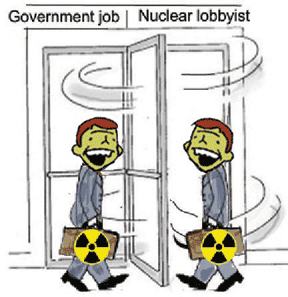
Regulatory independence and transparency. Considering the entanglements surrounding so many of the administration’s appointments to date, any potential financial and political ties to the nuclear industry are an obvious area of concern. Senators should question each nominee directly about such possibilities.
The industry’s advocacy and lobbying group, the Nuclear Energy Institute, has praised all three nominees, and their backgrounds suggest considerable sympathy with the industry’s position. Critical public interest groups regard at least two of them as “nuclear industry picks.”
In the current anti-regulatory political climate, senators will have a range of opinions about how to strike the right regulatory balance. The confirmation process should expose where each nominee stands in this regard, and may reveal where some senators stand as well. All the nominees will likely assert their unequivocal commitment to safety, but in practice, nuclear safety is always a negotiated process, accomplished by addressing particular problems and challenges.
Nuclear waste issues are perennially contentious, and have been flash points for conflict surrounding a number of previous NRC appointments. After years on hold, the Yucca Mountain nuclear waste repository project is back on the political agenda. Although the project remains controversial, and key steps in the licensing decision process remain to be completed, all three nominees appear to support it.
Senators should ask the nominees whether they see themselves as neutral referees in the Yucca Mountain process, or as advocates for moving the project forward. Related issues involve the storage and transportation of nuclear wastes, proposed new interim storage sites, and managing the wastes accumulating at operating and closed nuclear power plants across the nation…..
Two more broad issues deserve mention. Despite the Commission’s efforts to promote a strong safety culture, critics continue to raise questions about trust, accountability, and whistleblower protection at the agency and across the nuclear industry. Finally,cybersecurity has been a growing concern for some time, and is sure to remain one in the escalating threat environment.
Times 2nd June 2017 Flywheels will be used to balance supply and demand on Britain’s electricity grid in a £3.5 million project that could help the country to cope with more wind and solar power. Sophisticated flywheels that can store electricity for long periods of time are to be installed next to the University of Sheffield’s battery storage facility at Willenhall near Wolverhampton, in the first project of its kind in the UK.
The cylindrical structures draw electricity from the grid when surplus is available, powering a motor that makes the flywheel rotor spin at high speed. So far, efforts to tackle the problem have focused on lithium-ion batteries, which
can respond in less than a second to provide or absorb power and restore balance to the grid.
Eight such projects are being built around the UK after winning contracts from National Grid last year. Dr Gladwin said that such batteries would degrade over time the more they were charged and discharged, and were only expected to have a lifetime of ten years. Flywheels were a better way to deal with rapid short-term fluctuations, he said. The flywheel project in Willenhall should provide a megawatt of power for just over a minute before it runs out of energy. https://www.thetimes.co.uk/edition/business/flywheels-could-join-batteries-in-storing-electricity-for-the-national-grid-fjw95ggqv
Larsen C: What will happen when the huge Antarctic ice shelf cracks?, ABC Science By Genelle Weule, 2 June 17, A massive crack in one of Antarctica’s largest ice shelves is very close to breaking point, and when it fractures it will create an iceberg bigger than Kangaroo Island.
The Larsen C ice shelf is located on the Antarctic Peninsula, which juts out towards South America.
A large fracture, which has been growing across the ice sheet for decades, has recently started to accelerate, said Sue Cook, a glaciologist from the Antarctic Climate and Ecosystems Cooperative Research Centre.
According to the latest data by a team of UK scientists, the fracture ripped open by 17 kilometres in the last week of May and turned towards the ocean.
Dr Cook said the lengthening fracture was within 13 kilometres of the sea, and there was nothing to stop it fracturing.
When it breaks it will create an iceberg of 5,000 square kilometres.
Nuclear Insider 31st May 2017 Holtec’s two-phase licensing approach for its $280 million consolidated interim storage facility (CISF) project in New Mexico allows the company to use recent learnings in U.S. and Ukraine to accelerate approval for all
storage canisters.
In April, Holtec started the second phase of a CISF licensing program which would make it the first company to store all
canisters types currently used at U.S. plants. Holtec and Waste Control Services (WCS) are competing to build the U.S.’ first CISF facility, ahead of a proposed state-owned permanent repository at Yucca Mountain,
Nevada.
There is currently around 78,620 metric tons (MT) of used nuclear fuel stored at decommissioned and active reactor sites across 35 states. The U.S. Department of Energy (DOE) has proposed a pilot facility for consolidated storage be in place by 2021, followed by a larger storage facility by 2025 and a permanent repository by 2048.
Holtec plans to build a $280 million CISF to host 10,000 storage canisters, representing 120,000 MT of spent fuel, between the cities of Carlsbad and Hobbs. The company has launched a two-phased licensing approach, initially seeking to store Areva-supplied 24PT1-DSC canisters using Holtec’s HI-STORM UMAX dry spent fuel storage system. In a second phase, the company will file a series of license amendment requests to include all canisters currently in use at
U.S. plants– supplied by Areva, Pacific Nuclear, Vectra, NAC, Sierra Nuclear and BNFL Solutions & Westinghouse. http://analysis.nuclearenergyinsider.com/holtec-builds-first-kind-learnings-race-license-us-storage-facility










 nuclear-news