Russia to give nuclear education scholarships to Bangladesh
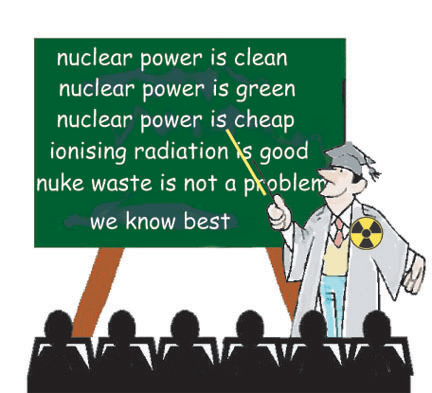 Moscow offers Bangladeshi students scholarship to study nuclear tech http://www.dhakatribune.com/bangladesh/education/2017/05/30/moscow-bangladeshi-scholarship-nuclear/
- Moscow intends to offer scholarships to Bangladeshi students to study nuclear technology
-
Russian Parliament’s Upper House Deputy Chief Ilyas Magomed-Salamovich Umakhanov on Tuesday said Moscow intends to offer scholarships to Bangladeshi students to study nuclear technology.
Bangladesh’s first nuclear plant is being being built with Russia’s assistance, according to a BSS report.
“Russian Government is keen to enhance the number of scholarships to the Bangladeshi students in the disciplines related to nuclear science,” A statement released by Bangladesh embassy in Moscow quoted Umakhanov as saying during a meeting with a delegation of Bangladesh parliament standing committee on foreign affairs led by Dr Dipu Moni on Monday.
It said Umakhanov told the Bangladesh delegation that Russia intended to offer the stipends with the aim of building a pool of talent for operating nuclear power plants in Bangladesh.
- Dipu Moni described the Rooppur Nuclear Power Plant to be a signature initiative in regard to Dhaka-Moscow ties and appreciated the progress of the project.
The delegation was comprised of lawmakers Faruk Khan, Sohrabuddin, Selim Uddin, Razee Mohammad Fakhrul and Mehjabeen Khaled, who were joined by Bangladesh Ambassador in Moscow Dr Saiful Hoque and other embassy officials.
European Union’s anti-trust regulator is expected to approve France’s EDF takeover of the troubled AREVA nuclear company
FT 28th May 2017 Brussels is expected to approve the takeover by French state-controlled utility EDF of the reactor business of Areva this week, clearing the path for a state-backed rescue deal that will reshape France’s nuclear industry.
Brussels antitrust watchdog is likely to sign off the deal on Monday, according to two people familiar with the situation, a green light that is needed before the French state can carry out the wider restructuring of Areva. Once Areva’s reactor business is acquired by EDF, what is left of Areva, mostly a uranium mining and nuclear fuel business, will then need only a sign-off of its new reactor in Flamanville in France to unlock a €5bn state-backed capital increase scheduled for later this
year.
EDF has agreed to acquire a majority stake in Areva NP, which designs, manufactures and services nuclear reactors, in a deal valuing the business at about €2.5bn. The deal will unite two of the companies responsible for building the UK’s Hinkley Point C nuclear plant, the country’s first new atomic power station for a generation, in a move executives say should help to avoid the kind of costly delays that have beset similar projects.
Nuclear power producer TVO, which owns the Finnish project, is concerned that after the EDF takeover, Areva might neglect Olkiluoto in favour of the EDF-led projects in Flamanville and Hinkley Point. The Finnish company is also facing the awkward balancing act of co-operating with Areva to finish the project while simultaneously pursuing the French company and its former partner, Siemens, for billions of euros in compensation for the delays.
https://www.ft.com/content/d44b6476-4068-11e7-9d56-25f963e998b2
Theresa May govt plans to weaken climate action rules
 Energydesk 28th May 2017 On the very day Theresa May triggered Article 50, her government quietly issued another bold statement to Brussels. Documents obtained by Energydesk reveal UK government attempts to significantly weaken draft EU climate and energy rules, even as Brexit is underway.
Key renewable energy and energy efficiency targets proposed by the European Commission should be reduced, made non-binding, or even scrapped altogether, the UK said, despite the fact that they would not take effect until after the UK had left the EU.
“This smells of obstructionism,” Jonathan Gaventa, director of environmental think-tank E3G, told Energydesk. “The UK is pissing off countries it needs as allies.” The news comes as the future of the Paris climate agreement hangs in the balance, with the United States refusing to commit to the deal at the G7 meeting.
http://energydesk.greenpeace.org/2017/05/28/brexit-uk-eu-climate-change-energy-efficiency/
Guardian 28th May 2017
UK Friends of the Earth assesses the election manifestos
 FoE 28th May 2017 Election manifestos: the scores are in: There are lots of issues close to our hearts at this election. It’s clear that the next 5 years are going to be crucial for protecting the environment. Overall when we totted up the scores (from 0 to 3) for each policy the Greens came out top, followed quite closely (almost neck and neck) by Lib Dems and Labour, with the
Conservatives some way behind. https://www.foe.co.uk/general-election/election-manifestos-scores-are
s the Korean Demilitarized Zone poised to become “ground zero for the end of the world”?
The Korean Peninsula: Ground Zero for Armageddon? May 30, 2017 By Simone Chun, Truthout | News Analysis Is the Korean Demilitarized Zone poised to become “ground zero for the end of the world”? Historian Bruce Cumings, the author of The Origins of the Korean War, raised this question in a recent article for the London Review of Books, and judging by a series of exchanges between the United States and North Korea in recent weeks, the possibility may not be as remote as it once seemed.
In April, North Korea warned of the imminence of “a thermonuclear war,” a prospect seemingly acknowledged by President Trump’s declaration that, “We could end up having a major, major conflict with North Korea.” On May 2, a US carrier strike group patrolled the waters off the Korean Peninsula in anticipation of North Korea’s sixth nuclear test, which never happened. Nevertheless, on May 14, Pyongyang test-fired a new class of missile into the waters between the North and neighboring Japan, prompting the US to move a second heavily armed carrier strike group, equipped with Aegis missile defense systems, to the Korean Peninsula. These two strike groups, which jointly field a total of some 160-attack aircraft and are escorted by substantial support fleets, considerably raise the stakes in the region.
According to Cumings, the latest high-stakes exchanges between the United States and North Korea are a continuation of six decades of US foreign policy which, “Since the very beginning … has cycled through a menu of options to try and control the [Democratic People’s Republic of Korea, or North Korea].” According to The New Yorker, in this asymmetric conflict, North Korea uses “belligerent propaganda — not to mention nuclear-tipped ballistic missiles” to counter what it perceives as a persistent existential threat from the United States.
Noam Chomsky has described the current situation as the logical outcome of the propensity of the United States to “play with fire” rather than making genuine efforts to achieve denuclearization: “Over and over again,” he observes, “There are possibilities of diplomacy and negotiation … which are abandoned, dismissed, literally without comment, in favor of increased force and violence.”
Republicans and Democrats have historically shown great unity in this approach toward North Korea, with the notable exception of the Clinton administration, whose direct talks with Pyongyang achieved an eight-year freeze on all North Korean plutonium production (from 1994-2002). However, in 2001, George W. Bush abruptly inducted North Korea into the “axis of evil,” prompting Pyongyang to withdraw from the Nuclear Non-Proliferation Treaty, and return to the reasoning that nuclear weapons alone could prevent an inevitable full-scale attack by the US in the future.
More recently, President Obama’s much-touted “pivot” to Asia — essentially a policy of isolating North Korea while boosting Japanese militarism — has succeeded only in laying the groundwork for a new regional cold war. Under the Trump administration, the pivot to Asia is overtly accelerating the militarization of the entire region, with some $7.5 billion being invested to boost infrastructure, equipment, and new troop and asset deployments. This amount accounts for nearly 14 percent of the total $54 billion increase in military spending requested by the Trump administration.
North Korea experts point out that, “Even with its nuclear program, North Korea is a weak country with an outdated military and a very small population,” incapable of anything but an insignificant military threat to the US. Yet US mainstream media pundits and government officials have tirelessly molded public perception of North Korea, portraying it as a determined, bristling adversary bent on raining destruction upon the US mainland with little or no provocation. Rounding out the propaganda image of the fearsomely irreconcilable foe, North Korean leadership itself is regularly depicted as irrational by the US, and often labeled with pseudo-psychiatric diagnoses. Most recently at the UN, US Ambassador Nikki Haley endeavored to display her psychiatric insight by “get[ting] into Kim Jong-un’s head,” and pronouncing him to be “in a state of paranoia … incredibly concerned about anything and everything around him.”
Such sophomoric appraisals of North Korea, while lacking historical and analytical perspective, play well to public fears. The characterization of North Korea as the unequivocally irrational and constantly threatening “other” have skewed US public opinion over the span of six decades. Pew public opinion polls show that “78% of Americans now have an unfavorable view of the North, with 61% holding a very unfavorable view.”…….
Nevertheless, American voices are increasingly calling for a new dialogue between the US and North Korea, for even though Americans by and large view North Korea as “the enemy,” an Economist/YouGov poll conducted in May 2017 found that 60 percent of Americans supported direct negotiations between the United States and North Korea. This statistic in itself speaks volumes, and shows that even in the worst of times, humans hope for commonality and view interpersonal interaction as a catalyst that has the potential of triggering positive change.
Officials on both sides of the Pacific have also begun renewed calls for dialogue amid heightening tensions. The new South Korean President Moon Jae-in was elected with a strong mandate for engagement with North Korea, and has promised a renewed emphasis on diplomacy and rapprochement. Even Pentagon chief James Mattis, noting the grave risks of open conflict, has reiterated the US commitment to working with allies in order to arrive at a diplomatic resolution to the nuclear stalemate.
As former Secretary of Defense William J. Perry recently noted, opportunities for peace and security in Northeast Asia still exist in the midst of conflict, awaiting only the political will and foresight to actualize them: “We now have the opportunity for a new approach to diplomacy. Will we have the wisdom to seize it?”
An overt shift toward diplomacy would be a welcome development for the many Koreans who still dream of an end to the painful schism imposed on their collective psyche by six decades of hostility and separation. David Kang, a Korean studies scholar at the University of Southern California, dreams of crossing the Korean Demilitarized Zone with his 81-year-old father to visit the site of the elder Kang’s hometown, which was destroyed during the height of the Korean War. “I would love to fly to Seoul with my father” he says, “and drive together to where he was born.”
Dr. Simone Chun has taught at Northeastern University in Boston, and served as an associate in research at Harvard University’s Korea Institute. She is an active member of the Korea Peace Network, and a member of the steering committee of the Alliance of Scholars Concerned about Korea. http://www.truth-out.org/news/item/40737-the-korean-peninsula-ground-zero-for-armageddon

Russia continuing in building “floating” nuclear power plant
 Russia building first ‘floating’ nuclear power plant, Economic Times, BY IANS | MAY 30, 2017,NEW DELHI: Russia is in advanced stages of building the world’s first “floating” nuclear power plant (FNPP) for installation in remote areas and hopes FNPP technology will also interest South Asian countries like India.
After the tests, the FNPP, called ‘Academician Lomonosov’, will be transported by Russia’s Northern Sea route to the 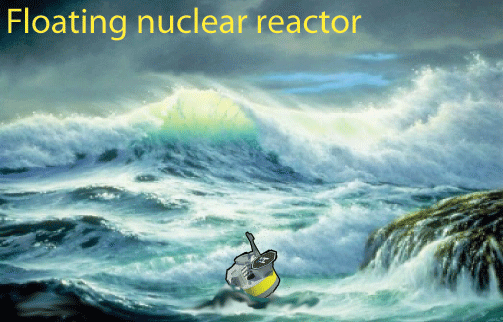 operation site, where it will be integrated into the coastal network being constructed .. …..
After all these years, sill no model of the European Pressurised Reactor in operation
Dave Toke’s Blog 27th May 2017 It’s now the middle of 2017 and still, after 12 years of trying to build the French European Pressurised Reactor, there is still no model in operation. Even in China, which has, according to some of its domestic critics, let us say a more relaxed attitude to safety requirements compared to western agencies, the EPR at Taishan is still not generating electricity.
It was 16 months ago that the constructors announced that ‘cold start’ tests had been successful and that the whole of the plant (including two sets) would be fully functional this year (2017). Now they say that this will not happen, although one set ‘will’ be running sometime in the second half of this year. But then the plant, which begun construction in 2009, was supposed to be finished in 2013. This failure does present the question of how it is that other nuclear plant built in
China have not been subject to this much delay.
How can we explain this? The obvious reason is that the EPR is a turkey that is widely regarded as bordering on, if not actually, ‘unconstructable’. The difference with other nuclear plant built in China may simply be that the EPR was designed to suit western safety standards.
It’s an easy guess to say what this means for Chinese plans to build nuclear power plant in the UK! In France
construction at the EPR at Flamanville began in 2007 and completion by 2019 seems possible but uncertain. The other EPR at Olkiluoto started in 2005 and is about, so they say. to undergo ‘cold tests’. On the basis of what has happened in Taishan this doesn’t mean that it is about the generate electricity, though. http://realfeed-intariffs.blogspot.co.uk/2017/05/more-delays-in-epr-signals-more.html
Trump govt reviving Yucca nuclear waste dump plan?
Times 29th May 2017 It may have been buried in President Trump’s first budget last week, but the irony was largely lost on the American nuclear industry and its opponents. A plan to hide nuclear waste beneath a sacred mountain in Nevada has been dusted off and is back on the table.
The Shoshone tribe has long deemed Yucca Mountain to be a holy place, but in 1987 the ridge of volcanic rock about 100 miles northwest of Las Vegas suddenly became of interest to many more people when Congress decided that it should become the nation’s nuclear waste dump.
The decision met fierce local resistance and the project faltered before, in 2010 and after $15 billion had been spent, President Obama cancelled it altogether. It turns out that cancelled meant postponed. Mr Trump has proposed a levy on nuclear power providers that would fund further development of the scheme. The nuclear waste fund fee, which had been cancelled in 2014, is intended to raise $3.1 billion between 2020 and 2027. https://www.thetimes.co.uk/edition/business/trump-to-hide-nuclear-waste-beneath-sacred-yucca-mountain-in-nevada-9z0hx5tqs
Trump administration to overturn ban on uranium mining around Grand Canyon?
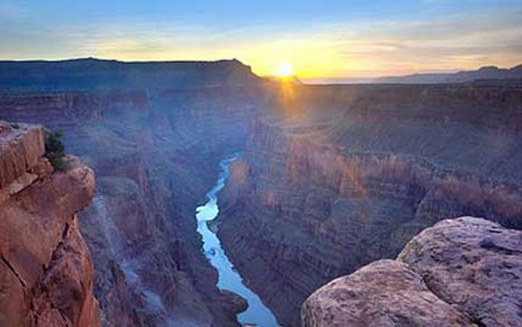 Will Trump Overturn the Ban on Uranium Mining Around the Grand Canyon? PHOENIX TIMES, MAY 28, 2017 .
That moratorium was announced by the Department of the Interior in 2012, and banned new uranium claims until 2032. Existing claims and mines were unaffected.
It was great news to environmental groups like the Grand Canyon Trust, the Sierra Club, and the League of Conservation Voters, who had spent years pointing out the environmental hazards of uranium mining — particularly the threat of polluting the Colorado River, which provides water to 40 million people in Arizona and the Southwest.
But back in March, Trump signed an executive order promoting “energy independence and economic growth.” It requires heads of each government agency to identify any federal guidelines that are getting in the way of domestic energy production, and tell him which ones can legally be reversed.
“The report shall include specific recommendations that, to the extent permitted by law, could alleviate or eliminate aspects of agency actions that burden domestic energy production,” the executive order states.
While we won’t know for sure until the Department of the Interior submits its report in late July, it’s quite possible that the moratorium on new uranium claims around the Grand Canyon would fall into that category. (The Department of Interior didn’t return a request for comment.)……..http://www.phoenixnewtimes.com/news/advocates-worry-trump-could-overturn-moratorium-on-uranium-mining-at-grand-canyon-9296810
Yet again, France’s nuclear regulator delays ruling on safety of Flamanville reactor
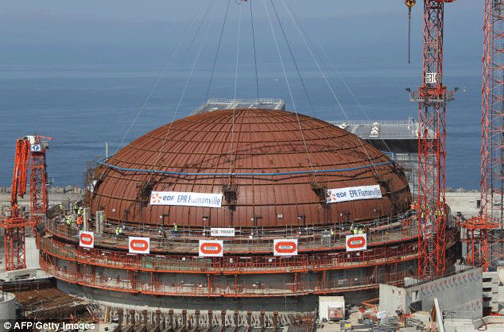 French nuclear regulator delays Flamanville ruling to autumn
ASN again delays ruling on safety of Flamanville reactor
* Postpones ruling to “autumn” from “end of summer”
* Will issue provisional ruling in July, then seek input (Adds new ASN statement)
Reuters, By Geert De Clercq PARIS, May 30 French nuclear regulator ASN said on Tuesday it will “probably” issue a final ruling in the autumn on whether the reactor that utility EDF is building in Flamanville is safe for use, in the latest delay in the process.
The ASN said in 2015 it had discovered excessive carbon concentrations in the cover and bottom of the Flamanville reactor vessel, which can weaken the mechanical resilience of the steel and its ability to resist the spreading of cracks.
Since then, Areva, which designed the EPR reactor, EDF and the ASN have been testing whether weak spots could jeopardise the safety of the reactor.
The regulator’s green light about the reactor vessel is crucial for EDF and Areva, as European Union antitrust authorities have made it a precondition for their approval of EDF’s planned takeover of Areva’s reactor unit.
The ASN has repeatedly postponed deadlines for ruling on the safety of reactor vessel.
And in what will be another delay, an ASN spokesman said in an email that the regulator now expected a “firm position probably in (the) autumn”……
Earlier on Tuesday, the ASN said it expected to receive technical reports about the reactor vessel by the end of next month. It will analyse these and then draft a provisional ruling on Flamanville, which will be made public in early to mid-July. It will then invite feedback on this ruling from the public, civil society, local authorities and the companies involved.
With the Flamanville reactor vessel welded in place in 2013 and covered by thousands of tonnes of concrete since then, taking out the vessel would delay the reactor startup by several years and cost billions of euros.
EDF has repeatedly said it is confident the ASN will find the vessel fit for operation……
The Flamanville reactor is years behind schedule and billions over budget, but EDF CEO Jean-Bernard Levy said this month EDF plans to load fuel in the reactor before end-2018. Construction in Flamanville started in 2007 and the plant was supposed to go online in 2012, but EDF has announced new delays and cost overruns every few years. The company said in 2015 the reactor would cost 10.5 billion euros ($12 billion), up from an initial budget of 3 billion. ($1 = 0.8948 euros) (Editing by Mark Potter/Alexander Smith) http://www.reuters.com/article/edf-flamanville-asn-idUSL8N1IW4N6
Senator John McCain left it too late to decide to support action on climate change
Speaking in Sydney on Tuesday night, Sen. John McCain (R-AZ) called the death of the Great Barrier Reef “one of the great tragedies of our lives
This year, McCain voted to confirm Trump’s most anti-climate nominees, supporting Secretary of Energy Rick Perry, Secretary of the Interior Ryan Zinke, Secretary of State Rex Tillerson, and EPA Administrator Scott Pruitt.
Politicians who oppose climate action are now sad about the consequenceshttps://thinkprogress.org/great-barrier-reef-john-mccain-5ee85af47a93, 30 May 17,
If only the senator from Arizona had a job where he could do something about climate change. The Great Barrier Reef, which in 2016 experienced the largest die-off of coral in its history, cannot be saved in its current form, a panel of Australian experts warned over the weekend.
The culprit, according to the panel, is climate change — specifically, the rapid warming of the oceans. Last year, record-high ocean temperatures triggered a bleaching event that affected 93 percent of the reef. Almost half of the reef’s coral has died since.
The panel, which is made up of scientists and environmental experts, conceded that the best that can be hoped for is “maintaining ecological function over the coming decades.” It also argued that any response aimed at helping the Great Barrier Reef must include policies for reducing greenhouse gas emissions.
“Members agreed that in our lifetime and on our watch, substantial areas of the Great Barrier Reef and the surrounding ecosystems are experiencing major long-term damage which may be irreversible unless action is taken now,” the panel’s official statement read.
McCain used to be extremely outspoken about climate change, going so far as to give an entire speech on the issue in Portland, Oregon during the 2008 presidential campaign. McCain used to support a cap-and-trade system for regulating carbon emissions, authoring several bills on the issue before his unsuccessful 2008 presidential campaign. Since that defeat, however, McCain has ceded ground on climate leadership, as the Republican party at large has become increasingly antagonistic towards domestic and international climate policies.
In 2009, McCain opposed the Waxman-Markey climate change bill, which would have created a cap-and-trade based system for carbon emissions. That same year, the League of Conservation Voters gave McCain a 9 percent on their annual scorecard. Every year since, McCain has scored below 32 percent — in 2016, he earned a score of 12 percent, registering just two pro-environment votes and 15 anti-environment votes.
This year, McCain voted to confirm Trump’s most anti-climate nominees, supporting Secretary of Energy Rick Perry, Secretary of the Interior Ryan Zinke, Secretary of State Rex Tillerson, and EPA Administrator Scott Pruitt.
McCain’s comments in Sydney come as the Trump administration continues to debate whether or not to withdraw from the Paris Climate Agreement, which was signed by almost 200 countries in December of 2015. The agreement aims to keep global temperatures from rising more than 2° Celsius (3.6° Fahrenheit) above pre-industrial levels.
McCain voiced support Tuesday for remaining in the agreement, either in keeping with the commitments made under President Obama or by suggesting “modifications which would make it palatable for us and acceptable to us to join.” (Arguments in favor of renegotiating the agreement to obtain better “economic” terms for the United States ignore the fact that climate action, according to economic experts, will save the planet trillion of dollars in the long run.)
“If we don’t address [climate change], I am very much afraid about what the world is going to look like for our children and grandchildren,” McCain said. McCain is not wrong to worry about his children and grandchildren: Climate change is indeed an issue that, if left unaddressed, will have devastating consequences for future generations. Because solving the problem requires fundamental transformations — in the way humans generate and use energy, transport ourselves, and manufacture goods — solutions require strong leadership and innovative thinking.
Britain’s exit from European Atomic Energy Community (Euratom) – a real damper on UK’s nuclear industry
 The other Brexit has been forgotten: leaving Europe’s nuclear community is just as fraught with fissile hazard Telegraph 29th May 2017
The other Brexit has been forgotten. This parallel drama faces an equally dramatic cliff-edge in less than two years. It too is fraught with fissile hazard.
We are told almost nothing. The Conservative Party Manifesto does not mention Britain’s exit from European Atomic Energy Community (Euratom), which must automatically take place in conjunction with Brexit.
There is no outline of how the UK will seek to replace this arrangement, or what the emergency plan might be if we crash out of the system with no treaty access to nuclear fuel, services, and research.In such circumstances, Britain will cease to come under the international safeguards regime that makes nuclear business possible. It will struggle to acquire the isotopes used in medical radiation.
In a political sense this sounds implausible. In strict legal terms the UK will have the status of a pariah state under nuclear sanctions until the technicalities are sorted out.
Wales First Minister ‘100% committed to new Wylfa nuclear plant
This comes despite a recent vow from Labour’s Shadow Chancellor to “bring an end” to nuclear power and nuclear weapons in the first 100 days of a Labour government…..
This backing is shared with three other of the island’s five parliamentary candidates, with only the Liberal Democrat candidate Dr Sarah Jackson saying she’d prefer to explore more renewable energy options…….
Liberal Democrat, Dr Sarah Jackson, would prefer further research into renewable sources.
“I recognise the potential benefits of Wylfa Newydd to the island’s economy, but my preference would be to look at investment into renewable sources of energy. Instead of investing in technology that is becoming obsolete, it is far better for Ynys Môn to invest in the future.
“There are now exciting and innovative alternatives. Let’s invest in a cleaner, greener future.”http://www.dailypost.co.uk/news/north-wales-news/first-minister-100-committed-new-13097549
1 This Month

of the week – Shut Down Drone Warfare!


Tell the Ukrainian Government to Drop Prosecution of Peace Activist Yurii Sheliazhenko

Petition to revoke the licensing of the Near Surface Nuclear Disposal Facility (NSDF) at Chalk River. https://www.ourcommons.ca/petitions/en/Petition/Details?Petition=e-7247
To see nuclear-related stories in greater depth and intensity – go to https://nuclearinformation.wordpress.com
-
Archives
- April 2026 (57)
- March 2026 (251)
- February 2026 (268)
- January 2026 (308)
- December 2025 (358)
- November 2025 (359)
- October 2025 (376)
- September 2025 (257)
- August 2025 (319)
- July 2025 (230)
- June 2025 (348)
- May 2025 (261)
-
Categories
- 1
- 1 NUCLEAR ISSUES
- business and costs
- climate change
- culture and arts
- ENERGY
- environment
- health
- history
- indigenous issues
- Legal
- marketing of nuclear
- media
- opposition to nuclear
- PERSONAL STORIES
- politics
- politics international
- Religion and ethics
- safety
- secrets,lies and civil liberties
- spinbuster
- technology
- Uranium
- wastes
- weapons and war
- Women
- 2 WORLD
- ACTION
- AFRICA
- Atrocities
- AUSTRALIA
- Christina's notes
- Christina's themes
- culture and arts
- Events
- Fuk 2022
- Fuk 2023
- Fukushima 2017
- Fukushima 2018
- fukushima 2019
- Fukushima 2020
- Fukushima 2021
- general
- global warming
- Humour (God we need it)
- Nuclear
- RARE EARTHS
- Reference
- resources – print
- Resources -audiovicual
- Weekly Newsletter
- World
- World Nuclear
- YouTube
-
RSS
Entries RSS
Comments RSS
 nuclear-news