UK’s “Small nuclear” lobby spruiking its wares, downgrading Hinkley Point nuclear project
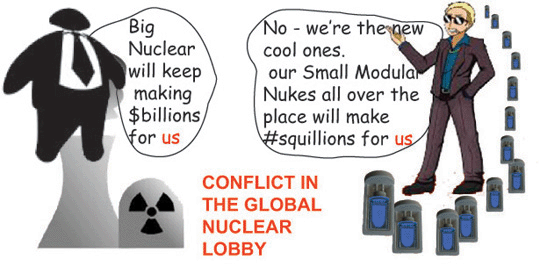 Britain’s on the brink of a small-scale nuclear reactor revolution, The Register, 24 May 2017 , Marcus Gibson Sure, there are hurdles, but no £18bn hole on the other side like Hinkley Point ……. a cheaper and smaller alternative is emerging if activity from British entrepreneurs and academics is anything to judge by – the small “modular” nuclear reactor, or SMR…….
No nuclear industry programme has yet produced a series of reactors along factory production lines, but a large order for SMRs could change all that.
Tony Roulstone, course director at Cambridge Nuclear Energy Centre, believes a production line operation could fulfil the promise of continuous improvements, of more efficient designs over the years, and the real prize of being manufactured in the UK…….
Dr Jenifer Baxter, lead author of the report, said: “Pushing ahead on the demonstration and commercialisation of SMRs would be a key way for the UK to once again become a world leader in the sector.”
This view was backed by a House of Lords committee that criticised the government’s “failure to deliver on a multimillion-pound competition to develop mini atomic power stations,” which it said “hurt the nuclear sector and risks international companies walking away from the UK.”
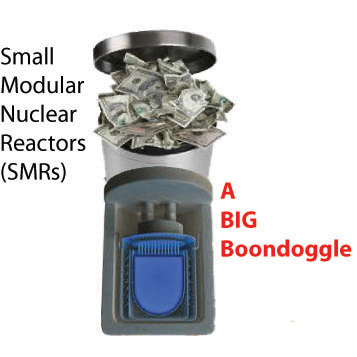 SMRs also ensure that the British government can avoid a repetition of the growing fiasco over the cost of Hinkley Point. An expert in engineering capacity and financing energy plants, who spoke to The Reg on condition of anonymity, said Hinkley Point “could cost the UK as much as £81bn if maximum financing costs are included”……
And yet SMRs face daunting development costs, and mind-boggling technical uncertainties. Like all nuclear sites they inevitably involve high costs, the problems of expensive decommissioning, the risk of accidents and waste disposal.
Sceptics include former government adviser professor Gordon MacKerron, who has described SMRs as “a classic case of supply-push technology development – no potential user of SMRs, mostly electric utilities, has expressed any serious interest in them.”…….https://www.theregister.co.uk/2017/05/24/mini_nuclear_reactors_for_british_power/
Renewable energy jobs could “offset” fossil-fuel job losses by 2030
Energy Voice 24th May 2017, Renewable energy jobs could “offset” fossil-fuel job losses by 2030, report shows. Jobs in renewable energy could cancel out fossil fuel-job losses and become an economic driver by 2030, according to the director of the International Renewable Energy Agency (IRENA).
https://www.energyvoice.com/uncategorized/140162/renewable-energy-jobs-offset-fossil-fuel-job-losses-2030-renewable-director-says/
UK Unilever powers all its sites by 100% wind energy

 Edie 23rd May 2017 Unilever has revealed that all of its UK manufacturing sites are 100% powered by electricity generated from certified renewable sources. The global consumer goods firm became the dedicated beneficiary of energy sourced from a Scottish Highlands-based wind farm in April.
The 23 turbines located in Lochluichart deliver 165GWh – 87% of the farms total output – of renewable electricity to 15 UK Unilever sites. The excess 24GWh of power generated at the farm are also sold-off under a retail tariff to local communities.
The new deal builds on Unilever’s previous agreement with Eneco in the Netherlands, which has seen a North Sea windfarm generate energy for Unilever since the New Year. Both deals mean Unilever’s UK business now sources 100% of its electricity from certified renewable sources. Across its entire global business, Unilever generates 63% of its
grid energy from renewable sources. https://www.edie.net/news/10/Unilever-goes-100–renewable-across-all-UK-sites/
Stunning new lows in solar and battery storage costs
New Arizona contract reveals record low price for large scale solar in US, and stunning reduction in cost of battery storage. The new combined solar and storage deal of below 4.5c/kWh cuts previous prices by more than 60% – far cheaper than a peaking gas plant.
http://reneweconomy.com.au/stunning-new-lows-in-solar-and-battery-storage-costs-13929/
FBI arrest member of Nazi ring, find radioactive and explosive materials
According to the Miami Herald, Brandon Russell, Arthurs’ roommate, was in possession of multiple materials meant to build explosives, including a lethal bomb-making chemical named hexamethane triperoxide diamine. FBI and Tampa Police Department officers found the materials in Russell’s garage.
Russell was arrested on May 21 during a traffic stop in Key Largo, and police have not yet revealed why he was pulled over or what he was doing in the Florida Keys.
While in Russell’s bedroom, devices used by police bomb technicians alerted to the presence of radiation sources — thorium and americium.
Russell returned home from National Guard duty on May 19 to find that Arthurs had killed their friends. It’s unclear whether the bomb was intended for Arthurs’ or for another person or group.
Russell is an admitted “national socialist,” the name of the Adolf Hitler’s party that was soon shortened to “Nazi” during the lead-up to World War II.
The Herald also reports that Russell is a member of a group called “Atomwaffen” (meaning “atomic weapon” in German.) The group has been promoted by the white supremacist Daily Stormer website since last year. The racist site praised the group for holding a protest during “a homo vigil for the victims of the Orlando nightclub shooting.”
In January, RadarOnline reported that the group’s leader was a nuclear physics student who was “trying to encourage members to conduct an attack similar to Timothy McVeigh‘s strike in Oklahoma City.”
Police reportedly found a framed photo of Oklahoma City bomber Timothy McVeigh in Russell’s bedroom. It is believed that he learned to manufacture explosives while at the University of South Florida, where he was a member of the engineering club.
According to the Chicago Maroon, the Atomwaffen Division group has described itself as a “very fanatical, ideological band of comrades who do both activism and militant training. Hand to hand, arms training, and various other forms of training. As for activism, we spread awareness in the real world through unconventional means.”
Survey of 8000 people in 8 countries: 8 in 10 now see climate change as a ‘catastrophic risk’
The survey of more than 8,000 people in eight countries – the United States, China, India, Britain, Australia, Brazil, South Africa and Germany – found that 84 percent of people now consider climate change a “global catastrophic risk”.
That puts worry about climate change only slightly behind fears about large-scale environmental damage and the threat of politically motivated violence escalating into war, according to the Global Challenges Foundation, which commissioned the Global Catastrophic Risks 2017 report.
But it indicates that many people now see climate change as a bigger threat than other traditional or rising concerns such as epidemics, population growth, use of weapons of mass destruction and the rise of artificial intelligence threats.
On climate and environmental issues, “there’s certainly a huge gap between what people expect from politicians and what politicians are doing. It’s stunning,” said Mats Andersson, vice chairman of the Stockholm-based foundation, in a telephone interview with the Thomson Reuters Foundation.
The survey, released in advance of this week’s G7 summit of advanced economies in Italy, also found that 85 percent of people think the United Nations needs reforms to be better equipped to address global threats……http://www.reuters.com/article/us-climatechange-risk-survey-idUSKBN18J36O
Renewable Energy Grid of the Future being developed in New York
 How New York Is Building the Renewable Energy Grid of the Future, This is a story of ripping up old incentives that encouraged selling as much electricity as possible, then unleashing the entrepreneurs. BY LESLIE KAUFMAN, INSIDE CLIMATE NEWS MAY 25, 2017 New York State is making a $5 billion bet that by making its power cleaner, it can become a magnet for the clean energy jobs of the future.
Potential for nuclear disaster greatly underestimated by U.S, nuclear regulators
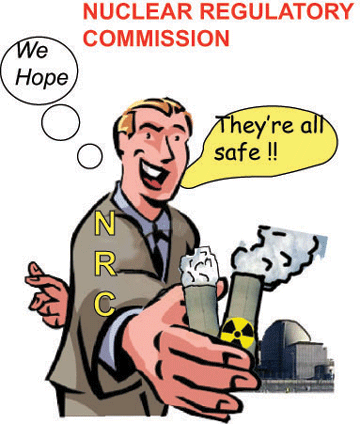 US nuclear regulators greatly underestimate potential for nuclear disaster Nuclear spent fuel fire could force millions of people to relocate https://www.eurekalert.org/pub_releases/2017-05/puww-unr052317.php PRINCETON UNIVERSITY, WOODROW WILSON SCHOOL OF PUBLIC AND INTERNATIONAL AFFAIRS, 25 May 17, PRINCETON, N.J.–The U.S. Nuclear Regulatory Commission (NRC) relied on faulty analysis to justify its refusal to adopt a critical measure for protecting Americans from the occurrence of a catastrophic nuclear-waste fire at any one of dozens of reactor sites around the country, according to an article in the May 26 issue of Sciencemagazine. Fallout from such a fire could be considerably larger than the radioactive emissions from the 2011 Fukushima accident in Japan.
These catastrophic consequences, which could be triggered by a large earthquake or a terrorist attack, could be largely avoided by regulatory measures that the NRC refuses to implement. Using a biased regulatory analysis, the agency excluded the possibility of an act of terrorism as well as the potential for damage from a fire beyond 50 miles of a plant. Failing to account for these and other factors led the NRC to significantly underestimate the destruction such a disaster could cause.
“The NRC has been pressured by the nuclear industry, directly and through Congress, to low-ball the potential consequences of a fire because of concerns that increased costs could result in shutting down more nuclear power plants,” said paper co-author Frank von Hippel, a senior research physicist at Princeton’s Program on Science and Global Security (SGS), based at the Woodrow Wilson School of Public and International Affairs. “Unfortunately, if there is no public outcry about this dangerous situation, the NRC will continue to bend to the industry’s wishes.”
Von Hippel’s co-authors are Michael Schoeppner, a former postdoctoral researcher at Princeton’s SGS, and Edwin Lyman, a senior scientist at the Union of Concerned Scientists.
Spent-fuel pools were brought into the spotlight following the March 2011 nuclear disaster in Fukushima, Japan. A 9.0-magnitude earthquake caused a tsunami that struck the Fukushima Daiichi nuclear power plant, disabling the electrical systems necessary for cooling the reactor cores. This led to core meltdowns at three of the six reactors at the facility, hydrogen explosions, and a release of radioactive material.
“The Fukushima accident could have been a hundred times worse had there been a loss of the water covering the spent fuel in pools associated with each reactor,” von Hippel said. “That almost happened at Fukushima in Unit 4.”
In the aftermath of the Fukushima disaster, the NRC considered proposals for new safety requirements at U.S. plants. One was a measure prohibiting plant owners from densely packing spent-fuel pools, requiring them to expedite transfer of all spent fuel that has cooled in pools for at least five years to dry storage casks, which are inherently safer. Densely packed pools are highly vulnerable to catching fire and releasing huge amounts of radioactive material into the atmosphere.
The NRC analysis found that a fire in a spent-fuel pool at an average nuclear reactor site would cause $125 billion in damages, while expedited transfer of spent fuel to dry casks could reduce radioactive releases from pool fires by 99 percent. However, the agency decided the possibility of such a fire is so unlikely that it could not ustify requiring plant owners to pay the estimated cost of $50 million per pool.
The NRC cost-benefit analysis assumed there would be no consequences from radioactive contamination beyond 50 miles from a fire. It also assumed that all contaminated areas could be effectively cleaned up within a year. Both of these assumptions are inconsistent with experience after the Chernobyl and Fukushima accidents.
In two previous articles, von Hippel and Schoeppner released figures that correct for these and other errors and omissions. They found that millions of residents in surrounding communities would have to relocate for years, resulting in total damages of $2 trillion — nearly 20 times the NRC’s result. Considering the nuclear industry is only legally liable for $13.6 billion, thanks to the Price Anderson Act of 1957, U.S. taxpayers would have to cover the remaining costs.
The authors point out that if the NRC does not take action to reduce this danger, Congress has the authority to fix the problem. Moreover, the authors suggest that states that provide subsidies to uneconomical nuclear reactors within their borders could also play a constructive role by making those subsidies available only for plants that agreed to carry out expedited transfer of spent fuel.
“In far too many instances, the NRC has used flawed analysis to justify inaction, leaving millions of Americans at risk of a radiological release that could contaminate their homes and destroy their livelihoods,” said Lyman. “It is time for the NRC to employ sound science and common-sense policy judgments in its decision-making process.”
The paper, “Nuclear safety regulation in the post-Fukushima era,” was published May 26 in Science. For more information, see von Hippel and Schoeppner’s previous papers, “Reducing the Danger from Fires in Spent Fuel Pools” and “Economic Losses From a Fire in a Dense-Packed U.S. Spent Fuel Pool,” which were published in Science & Global Security in 2016 and 2017 respectively. The Science article builds upon the findings of a Congressionally-mandated review by the National Academy of Sciences, on which von Hippel served.
Why Nuclear Power Subsidies Must End
http://www.independent.org/newsroom/article.asp?id=9082
New York and Illinois, bowing to pressure from a powerful nuclear utility, believe the answer is yes. Several other states, including Connecticut, New Jersey, Ohio and Pennsylvania, may follow suit, arguing that the subsidies will save nuclear power-plant jobs and help electric utilities meet environmental mandates to reduce carbon emissions.
That’s just one side of the story. The other side is this: The bailouts (subsidies by another name) reward poor management and bad judgment and would cost homeowners and businesses billions.
New York and Illinois already have bought into the dubious bailout scheme, which is being pushed by Chicago-based Exelon, the nation’s largest nuclear utility. Exelon’s plants have been losing money owing to competition from cheap natural gas and wind power. Without the financial aid, Exelon says, the plants won’t be able to operate at a profit and will have to be closed.
So close them; rather than shelling out as much as $10 billion in subsidies, close the plants and shift to natural gas.
I can’t help seeing the similarity between the Exelon bailout and what happened following the deregulation of electricity in the 1990s, when states allowed utilities to charge higher rates to cover some of the costs of “stranded assets”—capital investments made in a regulated environment that were no longer worthwhile in a competitive environment.
Propping up the utilities was wrong then and it’s wrong now.There’s no point in preventing the shutdown of nuclear plants, since the claim that they’re needed for carbon mitigation is dubious at best. Thanks to the shale revolution, which has produced an abundance of low-cost, clean-burning natural gas, carbon emissions from electric power plants have been plummeting as gas-fired plants replace coal-burning facilities.
Moreover, while gas prices are likely to stay low, the operating costs of nuclear plants are almost certain to rise in the years ahead. Southern California Edison closed its San Onofre nuclear plant after deciding it would not be worthwhile replacing steam generators that cost more than $600 million. Duke Power shuttered its Crystal River plant in Florida for much the same reason.
Since 2015, six nuclear plants have been closed, utilities have announced plans to shut down another eight, and still others may face early retirement. We should allow that to happen in an orderly, businesslike fashion.
Cost, efficiency, availability, security and other factors should determine the best energy source for electric power plants, not lobbying power and the willingness of politicians to hand out favors.
When government picks winners and losers in energy markets, consumers are stuck with the bill because regulators pass electricity costs on to them in the form of higher rates. Utilities should compete to provide electricity without government assistance.
Today’s nuclear power plants typically use technologies that are a half-century or more old. Ironically or not, keeping these plants up and running delays the introduction of more modern and much safer alternatives, such as small modular reactors, which are the nuclear industry’s future.
As for saving jobs, policymakers need to think more broadly. The United States is currently seeing a manufacturing revival. The main reasons for this are increased labor costs in China and lower electricity costs at home—the result of cheap natural gas. The best way to create even more jobs in manufacturing and other industries is to keep electricity costs down. Propping up unprofitable nuclear plants does the opposite.
Developers scale down plans for Wylfa nuclear plant
Construction Enquirer, Grant Prior, 24 May 17, Horizon Nuclear Power has unveiled a more “compact” design for its planned £10bn Wylfa power plant on Anglesey. The developer has started a new round of consultation ahead of a planning application being submitted later this year.
Horizon said: “We are making some changes to the power station layout to make it more compact and, as a result, we’ve streamlined our construction schedule and reduced construction worker numbers.”…..http://www.constructionenquirer.com/2017/05/24/developers-scale-down-plans-for-wylfa-nuclear-plant/
Sweihan mega solar project financed, Abu Dhabi
Financing agreed for Sweihan mega project in Abu Dhabi https://www.pv-magazine.com/2017/05/24/financing-agreed-for-sweihan-mega-project-in-abu-dhabi/
“Today’s financial closing is the culmination of 18 months of hard work, determination and commitment from many people, said ADWEA Chairman H.E. Abdullah Ali Musleh Al Ahbabi. “From government stakeholders, the international PV investor market, the international and local lending community, Today’s event is just the beginning. Over the course of the next two years the vision of the Sweihan PV project will become a reality.”
The joint venture of JinkoSolar and Marubeni signed a 25-year PPA for the project with ADWEA back in March, with one of the lowest electricity prices ever seen in a utility scale PV project, $0.0242/kWh.
“The financial closing of the Sweihan project is an important step forward to energizing one of the largest solar power plants in the world,” stated JinkoSolar Chairman Xiande Li. “We will continue to cultivate to the successful completion, operation and maintenance of the project, along with our partners ADWEA and Marubeni.”
1 This Month


Tell the Ukrainian Government to Drop Prosecution of Peace Activist Yurii Sheliazhenko

Petition to revoke the licensing of the Near Surface Nuclear Disposal Facility (NSDF) at Chalk River. https://www.ourcommons.ca/petitions/en/Petition/Details?Petition=e-7247


of the week – STOP SMALL MODULAR REACTORS IN CANADA
To see nuclear-related stories in greater depth and intensity – go to https://nuclearinformation.wordpress.com
-
Archives
- March 2026 (212)
- February 2026 (268)
- January 2026 (308)
- December 2025 (358)
- November 2025 (359)
- October 2025 (376)
- September 2025 (258)
- August 2025 (319)
- July 2025 (230)
- June 2025 (348)
- May 2025 (261)
- April 2025 (305)
-
Categories
- 1
- 1 NUCLEAR ISSUES
- business and costs
- climate change
- culture and arts
- ENERGY
- environment
- health
- history
- indigenous issues
- Legal
- marketing of nuclear
- media
- opposition to nuclear
- PERSONAL STORIES
- politics
- politics international
- Religion and ethics
- safety
- secrets,lies and civil liberties
- spinbuster
- technology
- Uranium
- wastes
- weapons and war
- Women
- 2 WORLD
- ACTION
- AFRICA
- Atrocities
- AUSTRALIA
- Christina's notes
- Christina's themes
- culture and arts
- Events
- Fuk 2022
- Fuk 2023
- Fukushima 2017
- Fukushima 2018
- fukushima 2019
- Fukushima 2020
- Fukushima 2021
- general
- global warming
- Humour (God we need it)
- Nuclear
- RARE EARTHS
- Reference
- resources – print
- Resources -audiovicual
- Weekly Newsletter
- World
- World Nuclear
- YouTube
-
RSS
Entries RSS
Comments RSS
 nuclear-news