It now looks increasingly as if the Hinkley C project may be quietly shelved, or even cancelled, with the agreement of both UK and French governments.
And beyond that the prospects for new nuclear power in the UK have never been gloomier. The only way new nuclear power stations will ever be built in the UK is with massive political and financial commitment from government. That commitment is clearly absent.
So yes, this finally looks like the end of the UK’s ‘nuclear renaissance’. Not with a bang, nor even with a whimper, but with a deep and profoundly meaningful silence. Not a moment too soon.
Conservative election manifesto signals the end of new nuclear power, Ecologist, Oliver Tickell & Ian Fairlie, 18th May 2017 After years of pro-nuclear bombast from the Conservative Party, its 2017 manifesto hasn’t got a single word to say about nuclear power, write Oliver Tickell & Ian Fairlie. Instead it announces a renewed focus on cutting energy costs, and a big boost for increasingly low-cost wind power; while both Labour and Libdems offer only weak, highly qualified support for new nuclear build. And so the great British ‘nuclear renaissance’ reaches its timely end.
All of a sudden the UK’s political parties want to have nothing to do with nuclear power.
OK, it does not announce an end to Britain’s massive 10GW nuclear power programme set out in the Cameron-Osborne years of government.
In fact, it does not even mention nuclear power. Instead it states that a future Tory government will remain sublimely indifferent to how our electricity is generated, so long as it’s reliable, cheap and low carbon:……
now, it’s all about keeping costs down, says the 2017 manifesto: “We want to make sure that the cost of energy in Britain is internationally competitive, both for businesses and households … Our ambition is that the UK should have the lowest energy costs in Europe, both for households and businesses. So as we upgrade our energy infrastructure, we will do it in an affordable way, consistent with that ambition.”
And one sure way not to deliver cheap energy to the UK is to build new nuclear power stations. if Hinkley C is ever built, UK energy users will be paying more than double the current wholesale power price, inflation adjusted, for 35 years from the time it opens, something that could cost the UK economy £50-100 billion.
Labour and the Libdems: a pocketful of mumbles
By contrast, Labour does give nuclear power a specific mention it is manifesto – just a rather small one that adds up to no real commitment to anything.
“The UK has the world’s oldest nuclear industry, and nuclear will continue to be part of the UK energy supply. We will support further nuclear projects and protect nuclear workers’ jobs and pensions. There are considerable opportunities for nuclear power and decommissioning both internationally and domestically.”
Let’s decipher. Yes, nuclear power will continue to be part of energy supply as we still have quite a few old nuclear power stations that we are not about to shut down.
What about “We will support further nuclear projects”? What kind of nuclear projects? How about decommissioning, nuclear waste management, production of medical isotopes … ? Do these projects include nuclear power? They’re not telling. Most likely (after all we know that Labour leader Jeremy Corbyn is firmly anti-nuclear) these are warm but empty words to placate powerful nuclear-supporting trades unions like the GMB and Unite.
And what kind of ‘support’? Speeches in the House of Commons? Or tens of billions of pounds of hard cash. It’s hard to say. Does this add up to a firm commitment to build a fleet of new nuclear power stations at massive public cost? Hardly.
The Libdem position is similarly weak, promising only that “We will … Accept that new nuclear power stations can play a role in electricity supply provided concerns about safety, disposal of waste and cost are adequately addressed, new technology is incorporated, and there is no public subsidy for new build.”
We know perfectly well that nuclear power is hugely expensive, intrinsically unsafe due to its potential for massive harm (look only to Fukushima), can only operate with enormous public subsidies, and that no one has yet figured out a way to keep nuclear wastes safely contained for tens of thousands of years, an informed interpretation of this statement might go: “Nuclear power? Not on your nelly!”…….
Meanwhile the SNP says it wants no new nuclear power stations in Scotland; and Plaid Cymu leader Leanne Wood is opposed to new nuclear power, but her executive supports Wylfa because of the jobs. Got that?
Why the turnaround?
It has surely become clear to politicians that nuclear power is in a death spiral, terminally afflicted by:
very high costs, at least double those of conventional generation, which can only be carried by governments, taxpayers and energy users at the expense of more deserving and productive investments;
apparently unconstructable reactor designs hit by massive cost overruns and delays in France, Finland and the USA;
the bankruptcy of the world’s biggest nuclear power contractor, the Toshiba-owned Westinghouse – lined up to build a massive new nuclear complex at Moorside in Cumbria with three AP1000 reactors – mainly as a result of these cost overruns and delays on AP1000 projects in the USA;
the parlous condition of the French parastatals EDF and Areva, which survive only thanks to the inexhaustible largesse of French taxpayers;
investor reluctance to have anything to do with new nuclear power stations unless returns are guaranteed in cast iron contracts at huge expense to taxpayers;
the continuing lack of a long term solution for nuclear waste storage / disposal;
the inflexibility of nuclear power stations, which means that they overproduce when electricity is in surplus, while being unable to keep up with demand when power is desperately needed;
the continuing precipitous decline in the cost of disruptive ‘new energy’ technologies such as solar, wind, including offshore wind, grid-scale batteries, power to gas, smart grid, set to continue and gather pace for many years to come.
So what’s the alternative? Given that onshore wind is already the cheapest new source of power generation, and offshore wind costs are falling rapidly (and are already far cheaper than new nuclear), wind power really should have a big role. So check out this statement from the Conservative manifesto:
“While we do not believe that more large-scale onshore wind power is right for England, we will maintain our position as a global leader in offshore wind and support the development of wind projects in the remote islands of Scotland, where they will directly benefit local communities.”
This commits a future Tory government to maintaining a strong pipeline of large offshore wind projects, while opening the door to medium and small scale onshore wind power in England, as well as to large scale wind on Scottish islands and elsewhere in the devolved nations. What it ultimately means is that wind power has a great future in the UK – in stark contrast to previous policy…….
Not with a bang, nor even a whimper
It now looks increasingly as if the Hinkley C project may be quietly shelved, or even cancelled, with the agreement of both UK and French governments.
And beyond that the prospects for new nuclear power in the UK have never been gloomier. The only way new nuclear power stations will ever be built in the UK is with massive political and financial commitment from government. That commitment is clearly absent.
BOMBSHELL FINDING Cold War nuclear weapons warped Earth’s magnetosphere – revealing what the true fallout could be if World War 3 broke out
Chaos sparked by Cold War nuke tests is only just becoming apparent – and it’s a chilling prediction of what might be in store for our fragile planet, The Sun By Margi Murphy, 19th May 2017
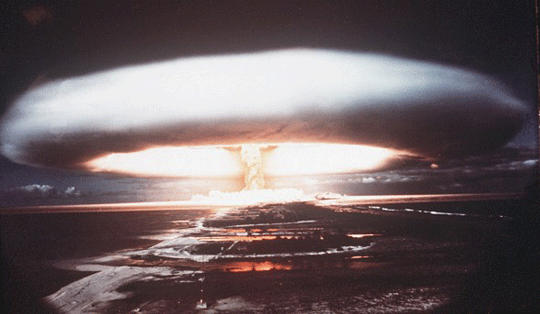
NASA have released chilling details about how Cold War nuke tests affected our planet.
Several nuclear tests were carried out by the US and the Soviet Union in the 1950s and 60s. But it’s only now that scientists are realising what the true fallout was.
The military exercises replicated the same devastating effects that solar storms can have on our planet – including blackouts and communication failures.
Detonating explosives at heights of between 16 and 250 miles above our planet’s surface temporarily distorted the Earth’s magnetic field line. This directly impacted satellites by damaging onboard electronics and disrupting communications and navigation signals.
Utility companies in Hawaii were strained and several satellites near test sites stopped working.
For years, extra radiation – which is what caused the satellites and electronics to fail – lay trapped inside Earth’s magnetosphere, a region surrounding Earth that defends us from solar flares.
The nuke tests were behind some very strange sights in our skies, too.
One triggered an aurora similar to the Northern Lights to appear over the Equator instead of the poles.
Aside from the radiation that would wipe out vast swathes of life on Earth, all power and satellite systems could be completely warped – sending us back to the Stone Age.
Plant Vogtle: Georgia’s nuclear ‘renaissance’ now a financial quagmire By Russell Grantham and Johnny Edwards – The Atlanta Journal-Constitution May 19, 2017
Southern Company’s chief executive has said more than once that the giant utility’s project to build two more nuclear reactors at Plant Vogtle would be history-making.
He may be right, but not in the way he meant.
Years behind schedule, billions over budget, and with a key contractor’s bankruptcy clouding its future, the troubled Vogtle project near Augusta is fast becoming Exhibit A for why no U.S. utility before Atlanta-based Southern had tried building a new reactor in 30-plus years.
Most Georgians who get electric bills could eventually pay for overruns on the project that are likely to grow. Customers of Southern subsidiary Georgia Power already pay a Vogtle-related surcharge that adds about $100 a year to the average residential bill, with the ultimate effect on ratepayers yet to be determined.
Also uncertain is how the project will get done.
On March 29, Westinghouse Electric, the company that designed the new Vogtle reactors and eventually became the primary contractor on the project, filed for bankruptcy. As part of its Chapter 11 restructuring, the company is expected to ditch the fixed-cost contracts that led to billions in losses on its work at Plant Vogtle and a similar nuclear project in South Carolina.
Under an interim deal announced a week ago, Southern and Georgia Power plan to take over running the Vogtle expansion, which is not quite half-done. Westinghouse will still help, but in a smaller role.
Beyond that they face a more elemental decision: spend billions more finishing the reactors, convert the project to another type of power plant such as natural gas, or just abandon it — leaving two dormant cooling towers and skeletal buildings.
A Georgia Power spokesman said the company is doing a “full-scale” study to “determine the best path forward.”
The utility has acknowledged that Westinghouse’s bankruptcy will mean more delays and costs. The elected members of the Georgia Public Service Commission eventually will determine the actual construction costs to be borne by ratepayers.
Richard Nephew, a senior research scholar at the Center on Global Energy Policy at Columbia University, said the utility underestimated the costs of replacing a vanished industry of nuclear construction workers and suppliers.
……….Westinghouse’s financial meltdown has rattled even the most loyal Plant Vogtle supporters – those living in the shadows of the towers in rural Burke County, population 23,000, who rely on the plant for a stable economy and a flush tax digest……..
History repeats itself
Delays, cost overruns and contractor snarls were not part of the picture government and industry officials painted in 2009 when state regulators approved the project to add the new reactors.
In addition to arguing it was needed to help power Georgia’s growth, Fanning called the Vogtle expansion a “national priority” to help revive the U.S. nuclear power industry. It would be a “renaissance,” he said.
But construction of Plant Vogtle’s first two reactors had provided a vivid example of the potential complications.
Plant Vogtle was conceived around 1970, with an original cost estimate of about $660 million. Construction was expected to take about eight years. Then, Three Mile Island happened. Regulations tightened. Demand for materials and interest rates shot up in the 1980s.
Construction took 13 years. The final price tag: around $9 billion…….
However the Vogtle expansion plays out from here, it won’t likely be held up as the model it was intended to provide.
FirstEnergy CEO Chuck Jones personally went before the Ohio Senate, saying subsidies would prop up their two struggling nuclear plants.
If passed, FirstEnergy customers would see about a $5 increase to their monthly electric bills.
Time might be running out to save these plants. As Jones explains, the subsidiary FirstEnergy Solutions which controls all the power generation could soon declare bankruptcy.
“They’re looking at that right now. That decision could happen anywhere between today and six months from now.”
Jones pointed out that he does not make decisions for FirstEnergy Solutions.
The nuclear credits bill has stalled in the House and Senate and will likely not come back up until the fall.
North Korea links nuclear advances to ‘hostile’ U.S. policy, Globe and Mail, EDITH M. LEDERER AND MATTHEW PENNINGTON, The Associated Press, May 19, 2017 The U.S. defence chief warned Friday that a military solution to the standoff with North Korea would be “tragic on an unbelievable scale,” while the North vowed to rapidly strengthen its nuclear-strike capability as long as it faces a “hostile” U.S. policy.
North Korea tested a longer-range missile last weekend, which experts say was a significant advance for a weapons program that aims at having a nuclear-tipped missile that can strike America. The test triggered a new U.S.-backed push for a fresh round of U.N. sanctions against the North.
At the United Nations, North Korea’s deputy ambassador, Kim In Ryong, was defiant. He said North Korea would never abandon its “nuclear deterrence for self-defence and pre-emptive strike capability” even if the U.S. ratchets up sanctions and pressure “to the utmost.”
Speaking to reporters, Kim hailed the test launch and said that if the Trump administration wants peace on the divided Korean Peninsula, it should replace the armistice that ended the 1950-53 Korean War with a peace accord and halt its anti-North Korea policy.
At the Pentagon, Defence Secretary Jim Mattis said the missile test showed North Korea isn’t heeding cautions from the international community. However, he stressed the need for a peaceful resolution by working through the U.N. with countries including China, the North’s traditional ally and benefactor.
“If this goes to a military solution it is going to be tragic on an unbelievable scale, and so our effort is to work with the U.N., work with China, work with Japan, work with South Korea to try to find a way out of this situation,” Mattis said at a news conference.
Nicolas Hulot has been named new France’s new energy and environment minister in the cabinet led by the new prime minister Edouard Philippe. Hulot’s ministry, which under the previous government was named Ministry of Energy, Ecology and Sustainable Development (MEEM), has been renamed into Ministry of the Ecological and Solidarity-based Transition.
Hulot, who was a candidate in the primary of the Green Party (Europe Écologie-Les Verts) to the 2012 French presidential election, is a well-known journalist and environmentalist who became popular thanks to his documentary tv show “Ushuaïa Nature”, whose slogan is “wonder is the first step towards respect.”
He is also the president of the Fondation Nicolas-Hulot, an environmental organization created by him in 1990.
The new minister has always been a supporter of solar energy in the French political debate.
In 2011, after the French government introduced a moratorium on solar projects which paralyzed the sector for several years, Hulot’s foundation released a study containing a series of proposals on how to further develop PV, and on how to involve all of the country’s interested parties, including government, media, enterprises and associations, in the transition to a clean energy economy.
In a more recent study published in 2015, Hulot’s foundation said that solar must be deployed “at human scale” everywhere in the world, and that it must be adopted especially in countries with low access to electricity. As for PV in France, the foundation said that the country has the potential to install a further 20 GW and 25 GW in addition to the 5.8 GW installed at the time.
This, the reports stressed, can occur without putting pressure on the national grid. If achieved, the target proposed by Hulot’s foundation would enable the country to raise the share of solar in the country power mix from 1% to 8%.
As for the outgoing energy minister, Ségolène Royal, it must be acknowledged that she performed an extraordinary job for the solar sector.
Immediately after her appointment, she started several initiatives aimed at restoring investor confidence, a clear and stable regulatory framework, and a reasonable level of incentives. Under her mandate, solar saw its target by 2023 being tripled to 20.2 GW. Royal’s energy strategy also decided that nuclears share of the French energy mix should fall to 50% by 2025.
Note: Reuters reports that news of the appointment sent the share price of nuclear utility EDF down as much as seven per cent, as the appointment raised doubts in investors’ minds about the strength of Macron’s commitment to a pro-nuclear energy policy.
“There is a fear of a stricter ecological line given Hulot’s history as an environmental campaigner,” said Andrea Tueni, markets analyst with Saxo Bank. Hulot, who scores high in popularity polls, said he hoped the job would allow him to bring about change.
In an interview with Liberation newspaper last month, Hulot said one of France’s main challenges will be to reposition EDF on a path that is compatible with a transition from dependence on nuclear power towards the use of more renewables.
“As renewable energy becomes more and more competitive, the nuclear industry business model belongs to the past,” he said.
Cold War Nuclear Explosions Freakishly Impacted Space Weather https://www.gizmodo.com.au/2017/05/cold-war-nuclear-explosions-freakishly-impacted-space-weather/Rae PaolettaMay 19, 2017,The overdrawn game of nuclear chicken between the USSR and the United States — now known as the Cold War — lasted about 45 years. While neither superpower ever deployed nukes on each others’ soil, high-altitude bomb testing caused a kerfuffle in Earth’s atmosphere. Though the conflict has (thankfully) long since ended, newly declassified information suggests it might have impacted space weather in ways we never anticipated.
According to a new paper published in Space Science Reviews, the high altitude nuclear testing conducted by both the USSR and United States created “artificial radiation belts” near Earth. Our planet is naturally surrounded by Van Allen radiation belts — zones of highly-charged particles. But the energy from nuclear explosions created hot, electrically charged regions within the atmosphere that induced geomagnetic disturbances, and even produced radiation belts of its own. As you can probably guess, the results were not so great — according to the study’s authors, this resulted in “major damages to several satellites” that orbited Earth at a fairly low altitude.
Radiation and high-energy particles from the Sun frequently interact with Earth’s geomagnetic field, in the phenomenon known as space weather. When enough of these high energy particles rain down on the magnetosphere, it can severely damage communications satellites and even electrical power grids on the ground. But the radiation from nuclear blasts in the ’60s is an extreme example of how humans can also screw with our geomagnetic field, which is salient to understand but also terrifying.
Seriously, who would have guessed that missions with names like Argus, Teak and Starfish would have this kind of an impact? The radiation released from Argus alone caused an flurry of geomagnetic storms over Sweden and Arizona, according to the new study.
“The tests were a human-generated and extreme example of some of the space weather effects frequently caused by the Sun,” study’s co-author Phil Erickson, an assistant director at MIT’s Haystack Observatory, told NASA. “If we understand what happened in the somewhat controlled and extreme event that was caused by one of these man-made events, we can more easily understand the natural variation in the near-space environment.”
By understanding how human-caused geomagnetic disturbances impact our atmosphere, space agencies hope to better understand how to protect astronauts in Low Earth Orbit from the impacts of space weather, too. Maybe studying artificial space weather can even shed light on how a future monster solar storm will impact our electric grids and technology.
Also, hopefully we can calm down with the nukes here on Earth’s surface.
Ohio House Sidelines Bailout of 2 FirstEnergy Nuclear Plants Opponents are praising a decision to suspend deliberations on a proposed bailout of Ohio’s two nuclear plants, even as Akron-based FirstEnergy continues to push for the deal. US News, May 19, 2017, By JULIE CARR SMYTH, AP Statehouse Correspondent COLUMBUS, Ohio (AP) — Opponents are praising a decision to suspend deliberations on the proposed financial rescue of Ohio’s two nuclear plants, even as Akron-based FirstEnergy continues to push for the deal.
House Public Utilities Chairman Bill Seitz, a Cincinnati Republican, discontinued testimony on legislation containing the proposal Wednesday after vocal protests by consumer, business, and environmental groups and energy competitors.
“I am not sensing a keen desire on the part of the House members to vote on this and doubt that we will have more hearings in the near future unless something cataclysmic should happen,” cleveland.com quoted Seitz as saying.
The plan calls for a special fee charged to customers that the company argues is necessary to secure the future of its aging Davis-Besse and Perry plants. The two facilities produce 14 percent of Ohio’s electricity.
FirstEnergy CEO Chuck Jones took his case to the Ohio Senate on Thursday, testifying for more than an hour before the Senate Public Utilities Committee on separate legislation containing the bailout plan……..
Exactly how much the plan would generate for the nuclear plants isn’t clear because subsidies are based on a complex formula involving plant emissions. Recently approved subsidy deals in New York and Illinois aimed at stopping unprofitable nuclear plants from closing prematurely cost billions.
The Environmental Defense Council has placed the price tag for the Ohio proposal at $5.25 billion. The Ohio Consumers’ Counsel, representing utility ratepayers, calculated the costs to each of FirstEnergy’s 2 million residential customers at $57 a year, on average, for up to 16 years, with the potential that the Public Utilities Commission of Ohio could allow upward adjustments.
Seitz’s decision to sideline the proposal was praised by the Coalition Against Nuclear Bailouts, a group of more than 50 organizations that has joined forces to fight the plan. The coalition includes the Ohio Oil and Gas Association, the Ohio Manufacturers’ Association, associations representing bars, bowling alleys and other small businesses, and a host of local community representatives.
Commissioner Pete Gerken of Lucas County, which includes Toledo, said the proposal would cause families and businesses in FirstEnergy’s territory to “foot the hefty bill.”
“Further, this proposed bailout would pick winners and losers in the energy generation market and could drive private investment, jobs and tax revenues for local governments and schools out of Lucas County and other areas of the state,” he said.
Sweden shuts down Julian Assange rape investigation, TT/The Local news@thelocal.se 19 May 2017, Swedish prosecutors have decided to end the rape investigation into Julian Assange and lift the Europe-wide arrest warrant against him, but UK police say they will still arrest him.In a statement on its website, the Swedish prosecution authority said that the “Director of Public Prosecution, Ms Marianne Ny, has today decided to discontinue the investigation regarding suspected rape (lesser degree) by Julian Assange”.
“With the consideration that all options of moving the investigation forward are now exhausted it appears that – in light of the views expressed by the Supreme Court (Högsta domstolen) on the proportionality of remanding someone in absentia – it is no longer proportional to maintain the decision to remand Julian Assange in his absence and maintain the European arrest warrant,” Ny wrote in her notification to Stockholm District Court.“I have therefore today lifted the decision to remand Julian Assange in his absence,” she added.
No longer Swedish matter’ – Assange’s lawyer on dropping investigation into WikiLeaks founder
In a press conference later in the day, Ny elaborated that it was not possible to formally serve Assange with notice of the suspicions against him, a prerequisite under Swedish law if the investigation was to progress further:
“Ecuador granted legal assistance and made it clear that all measures would be performed with full voluntary participation of Mr. Assange (…) Formal issues are important in a legal system in terms of legal certainty, it is important to be able to serve the suspect with suspicions. The decision to discontinue the investigation is not because we’ve been able to make a full assessment of the evidence, but because we didn’t see possibilities to advance the investigation. So we won’t make any statements on the issue of guilt”………
Assange’s lawyer Per Samuelsson said his client was now considering suing Sweden.
“It’s not about money but redress,” Samuelsson told news agency TT.
He added that he believed Assange would eventually try to move to Ecuador.
The WikiLeaks founder’s lawyer filed a request at Stockholm District Court earlier in May asking for an end to the arrest warrant against his client, arguing it should be dropped now that the US has expressed a desire to charge the 45-year-old.
Assange had been remanded in custody by Sweden ‘in absentia’ over a 2010 rape allegation, and has been taking refuge inside Ecuador’s embassy in London since 2012 in order to escape the warrant, citing fears he may be extradited to the US to be tried over WikiLeaks’ publication of thousands of classified documents.
One of Assange’s lawyers, Melinda Taylor, indicated earlier on Friday that the preliminary investigation into him being closed or the lifting of the European arrest warrant would not necessarily mean the Australian would make a hasty exit for Ecuador.
“The first thing one likely needs to do is seek guarantees from the British authorities that he won’t be seized in some other way,” she told news agency TT.
Both British and American authorities have “consistently refused to confirm or deny” if there is a request for extradition to the US, she said. Assange is also accused of breaching his bail conditions in the UK for fleeing to Ecuador’s embassy, she noted.
And in a statement released on Friday afternoon, the Metropolitan Police confirmed it is obliged to arrest Assange should he leave the embassy…….
When the Swedish announcement was made on Friday, WikiLeaks commented through its Twitter account that the “focus now moves to the UK”……
The world’s poorest nations say the Paris climate agreement is their “lifeline” and must be strengthened.
The Climate Vulnerable Forum, (CVF) representing 48 countries, said the deal was crucial to their survival.
In a swipe at President Trump’s oft-used phrase, they said that “no country would be great again” without swift action.
Thousands of delegates are meeting here in Bonn to develop the rule book for the Paris deal.
Around one billion people live in countries that are part of the CVF.
The group firmly supports the idea, enshrined in the Paris agreement, that countries would do all in their power to keep temperatures from increasing more than 1.5C above pre-industrial levels.
“Keeping to 1.5 degrees is quite simply a matter of survival,” said Debasu Bayleyegn Eyasu from Ethiopia, which holds the presidency of the CVF.
“For all of us, the Paris agreement is our lifeline.”
Other speakers highlighted the fact that there is widespread dissatisfaction with the current US position on climate change.
President Trump is expected to decide on future US participation in the Paris accord after the G7 summit in Italy next week.
Picking up on Mr Trump’s “make America great again,” election battle-cry, Emmanuel Guzman from the Philippines said: “Without increased climate action, no country will be great again.”
“The measure of greatness is how you are able to increase and enhance your climate action.”
Mr Guzman said he was calling on all world leaders to increase their ambition and not just Mr Trump.
“I would not like to point a finger at someone, but it is a call for action by all big or small.
“If we don’t achieve the goals of the Paris agreement there are irreversible damages and consequences.”
Rising sea levels are causing problems for farmers in many climate vulnerable nations including Vietnam
“It’s a grim scenario – that’s really unacceptable to us.”
The group highlighted some of the important differences between keeping temperature rises under 2 degrees or under 1.5.
he Greenland ice sheet would enter irreversible long-term decline, with significant impacts on sea levels at 1.6 degrees one delegate said.
Warming beyond 1.5 would also “appreciably increase the prevalence of extreme storms that have already been capable of large-scale loss of life and cutting a year’s GDP in half for some of our members.”
At the last major conference of negotiators in Marrakech last November, members of the CVF committed themselves to moving towards 100% renewable energy as soon as possible.
“Costa Rica produces 100% renewable energy most of the year,” said William Calvo, the country’s adjunct chief negotiator.
“But we won’t stop there: we are tackling now the transport sector and hope to even export renewable power more widely in the region.”
The idea that other countries are capable of picking up the slack if the Americans pull out of Paris gained support this week with the release of an analysis showing that India and China are likely to overshoot existing targets to cut carbon
President Trump’s actions to revitalise the coal industry in the US and to de-regulate oil and gas are unlikely to rapidly increase emissions before 2030 says the study from the Climate Action Tracker.
Between 2013 and 2016 Chin’s coal use declined each year and a continued slow decline is expected.
India says that planned coal-fired power plants may not be needed if recently announced green policies are effective. You have to have the U.S. on board ultimately to meet the goals set by the Paris Agreement,” Bill Hare from Climate Analytics told news agencies.
“But if there’s a hiatus for four years it doesn’t mean it’s the end of the game.”
FT 18th May 2017, After years of hype and false starts, the shift to clean power has begun to accelerate at a pace that hastaken the most experienced experts by surprise. Even leaders in the oil and gas sector have been forced to confront an existential question: will the 21st century be the last one for fossil fuels?
It is early, but the evidence is mounting. Wind and solar parks are being built at unprecedented rates, threatening the business models of established power companies. Electric cars that were hard to even buy eight years ago are selling at an exponential rate, in the process driving down the price of batteries that hold the key to unleashing new levels of green growth.
Stephen Rademaker: North Korea is a nuclear state. We have to live with that, and here’s how Stephen Rademaker, Washington Post | May 19, 2017 Last Sunday, North Korea successfully demonstrated for the first time that it could strike U.S. territory in the Pacific. After more than 25 years of wrestling with the North Korean nuclear threat, it’s time to recognize that North Korea is not merely seeking to gain bargaining leverage against us. Rather, it is determined to possess nuclear weapons, and we need to develop a realistic strategy for containing, defending against and deterring what will be a persistent and growing nuclear threat.
There’s every reason to continue pursuing sanctions and diplomacy, but we should not premise our policy on the expectation that such efforts are going to succeed in persuading North Korea to change course. We must also recognize that there is no acceptable military solution to the problem.
Even before the North produced its first nuclear weapon, the United States calculated that the potential cost for any military strike was too great for America and South Korea. Now that North Korea has nuclear weapons, as well as missiles that can reach Guam and beyond, this logic is even more compelling.
It is indeed true, as the Trump administration has concluded, that China has the wherewithal to compel North Korea to abandon its nuclear weapons. But China is a great power that has had plenty of time to think through its policy. It is concerned, but clearly not panicked. More important, it perceives plenty of downsides to overreacting, including the potential collapse and absorption of its ally, North Korea, into America’s ally, South Korea.
So great is our dependence on China that, like hostages held by a kidnapper, all previous administrations developed a sort of Stockholm syndrome, coming to believe that China was doing everything it could to help solve the problem, when it manifestly could do more. After 25 years, we should not assume that more hectoring, promises or threats will persuade China to act in ways it believes contrary to its interests…….http://news.nationalpost.com/full-comment/stephen-rademaker-north-korea-is-a-nuclear-state-we-have-to-live-with-that-and-heres-how
The service said the crew members of the WC-135 nuclear-sniffing aircraft determined the Chinese pilots of the Su-30 jets were being “unprofessional.” The encounter was still under investigation.
“The issue is being addressed with China through appropriate diplomatic and military channels,” Pacific Air Forces spokeswoman Lt. Col. Lori Hodge said in a released statement.
The WC-135 Constant Phoenix is capable of detecting nuclear weapons activity and was deployed last month to Kadena Air Base on Japan’s far southern island of Okinawa as the North Koreans were ramping up missile testing.
Since then, the Trump administration has been looking to China to pressure the regime of Kim Jong Un to give up its ambitions for a nuclear-tipped intercontinental ballistic missile that could reach the U.S. mainland.
However, there is deep friction between China and the U.S. over that country’s territorial claims in the East China Sea, which includes the Korean peninsula and Japan.
Fennovoima nuclear project faces delays over safety clearance, building permit yle uutiset , 19 May 17, The Finnish Radiation and Nuclear Safety Authority STUK will not deliver a safety assessment and related building permit for the Fennovoima nuclear project slated for Pyhäjoki in northwest Finland this year. According to the daily Kaleva, the nuclear watchdog has said that the evaluation and permit will be delayed by one year to the end of 2018.
Finland’s nuclear safety watchdog STUK will not provide a safety assessment and building permit this year for the Fennovoima nuclear power plant to be built by Russian state-owned nuclear contractor Rosatom in northwest Finland, reports the daily Kaleva. Rosatom also owns 34 percent of the venture.
Finland’s Ministry of Economic Affairs originally hoped that STUK would be able to provide the clearances this year. However the authority now says that it won’t be able to deliver them before the end of 2018. It noted that completing the safety assessment depends on factors such as Fennovoima’s ability to update information about the project’s delivery timetable. STUK’s ability to furnish the approvals will also depend on the adequacy and comprehensiveness of the information provided……..
Investor haemorrhage
Meanwhile on Wednesday, the Helsinki city council launched moves to disconnect Vantaa Energy – in which it owns 40 percent of shares — from the Fennovoima nuclear power plant. However, Vantaa Energy chief executive Pertti Laukkanen said that the city of Vantaa, which owns the remaining 60 percent of the power company, is not likely to support selling off its holdings in the project.
A number of other Finnish investors have also bailed on the project over the years. The German-based power behemoth E.ON as well as duopolist retailer S Group both shed their stake in the project in 2012. Later in 2013, 15 members of the power consortium Voimaosakeyhtiö SF pulled out of the venture, while a subsidiary of the other duopolist retailer K Group left in 2014. Meanwhile local dairy giant Valio exited in 2015 during a rocky period caused by losses over western sanctions applied against Russia, one of its main markets.
Financing controversy
The Fennovoima nuclear power plant has faced a rocky road since it received a decision-in-principle for construction during the administration of ex-PM Matti Vanhanen back in 2010. The contentious project also saw the departure of the Green Party from Alexander Stubb’s coalition government in 2014, when it decided to proceed with the proposed plant.
The project also stirred up controversy over financing arrangements when a murky Croatian firm – later found to be a front for Russian investors — emerged as a backer to help Fennovoima make up the 60-percent domestic- EU ownership required by the Finnish government. There was also speculation that state energy giant Fortum had been pressured to come forward as an investor following initial resistance to the project.
The preamble of the treaty to ban nuclear weapons now under consideration at the UN will be greatly strengthened if it includes a summary of the long-term environmental consequences of nuclear war, as described by a series of peer-reviewed studies done by prominent scientists working at major US and Swiss Universities, as well as at the US National Center for Atmospheric Research. These studies are considered to be the most authoritative type of scientific research—subjected to criticism by the international scientific community before final publication in scholarly journals—and the findings of these studies remain unchallenged.
The research predicts that a nuclear war fought between emerging nuclear weapon states—with less than 1 percent of the explosive power contained in the global nuclear arsenals—can produce catastrophic long-term damage to global environment and weather. A war fought with 100 atomic bombs can result in the coldest average annual surface temperatures experienced in the last 1,000 years, and this prolonged cold (and drought) would last for several years before temperatures began to return to normal. Medical experts predict that this prolonged cold would lead to a global famine causing up to two billion people to starve to death. Climatologists also predict that such a war would cause major damage to the Earth’s protective stratospheric ozone layer, leading to a doubling of harmful UV-B radiation in the populated mid-latitudes.
The studies also forecast that a war fought with US and Russian strategic nuclear weapons would create post-war Ice Age weather conditions across the Northern Hemisphere in a matter of weeks. These catastrophic changes in weather would be the result of a global stratospheric smoke layer, produced by hundreds or thousands of nuclear firestorms, which would block up to 90 percent of sunlight over central North America and Eurasia.
The loss of warming sunlight would cause temperatures in these central regions to fall below freezing every day for one to two years. Because the stratospheric smoke layer could not be rained out, it would remain for a decade or longer, affecting both the northern and southern hemispheres. Growing seasons in the large agricultural zones would be eliminated for many years, dooming most humans and animals to starvation from nuclear famine.
Confusion: nuclear war or a nuclear weapon? To date, there has been an unfortunate avoidance (among both diplomats and nongovernmental organizations involved in the ban treaty) of any explicit discussion of the effects of nuclear war; instead the language of the general conversation has tended to focus on the effects of a nuclear weapon, in the singular. This is evidenced by the wording of the Humanitarian Pledge, which was issued on December 9, 2014 at the conclusion of the Vienna Conference on the Humanitarian Impact of Nuclear Weapons. Notice that the pledge states:
“Understanding that the immediate, mid- and long-term consequences of a nuclear weapon explosion are significantly graver than it was understood in the past and will not be constrained by national borders but have regional or even global effects, potentially threatening the survival of humanity.” (emphasis added)
This statement is technically incorrect, as a single nuclear weapon explosion cannot produce “global effects, potentially threatening the survival of humanity.” Only a nuclear war, fought with the strategic nuclear arsenals of the United States and Russia, is predicted to have the capacity to produce the catastrophic consequences capable of wiping out most peoples and nations. Likewise, scientists predict that a war fought with atomic bombs of the emerging nuclear weapon states can cause global weather changes that will likely lead to mass starvation. But a single nuclear detonation cannot produce such an effect.
The apparent confusion about the effects of a single nuclear weapon versus the effects of nuclear war were also reflected in the UN Resolution 70/47, titled “Humanitarian Consequences of Nuclear Weapons.” It was passed in December 2015 and contains this language:
Welcoming the facts-based discussions on the effects of a nuclear weapon detonation that were held at the conferences on the humanitarian impact of nuclear weapons convened respectively by Norway in March 2013, Mexico in February 2014 and Austria in December 2014…” (emphasis added)
It is imperative to avoid any similar confusion of cause and effect within the text of the ban treaty now being written. The scientifically predicted consequences of nuclear war must be clearly distinguished from those likely be to be caused by a single nuclear weapon detonation.
Science should be part of the ban treaty. The best way to avoid confusion over the effects of nuclear weaponry on the world environment would be to include authoritative scientific predictions—detailing the likely consequences of a range of nuclear conflicts—as supporting evidence in the preamble of the ban treaty. The existential threats explained by these peer-reviewed scientific studies provide the most powerful arguments imaginable against the existence of nuclear weapons and nuclear arsenals.
A series of studies were conducted at the Laboratory for Atmospheric and Space Physics at the University of Colorado-Boulder, the Department of Environmental Sciences at Rutgers, the Department of Atmospheric and Oceanic Sciences at UCLA, the National Center for Atmospheric Research Earth System Laboratory, Boulder, Colorado, and ETH Zurich, which used a state-of-the-art computer modeling to evaluate the environmental consequences of a range of possible nuclear conflicts. The five peer-reviewed studies listed below evaluated the consequences of a war fought with atomic bombs:
Mills, Michael, Owen B. Toon, Richard P. Turco, Douglas E. Kinnison, Roland R. Garcia, 2007: Massive global ozone loss predicted following regional nuclear conflict. Proceedings of the National Academy of Sciences, Vol. 105 no. 14, doi: 10.1073/pnas.0710058105. Retrieved from http://www.pnas.org/content/105/14/5307.full
Mills, Michael J., Owen B. Toon, Julia Lee-Taylor, and Alan Robock, 2014: Multi-decadal global cooling and unprecedented ozone loss following a regional nuclear conflict. Earth’s Future, 2, 161-176, doi:10.1002/2013EF000205. Retrieved from http://climate.envsci.rutgers.edu/pdf/MillsNWeft224.pdf
Stenke, Andrea, C. R. Hoyle, B. Luo, E. Rozanov, J. Gröbner3, L. Maag, S. Brönnimann, and T. Peter, 2013: Climate and chemistry effects of a regional scale nuclear conflict. Atmos. Chem. Phys., 13, 9713-9729, doi:10.5194/acp-13-9713-2013. Retrieved from http://www.atmos-chem-phys.net/13/9713/2013/
Another important peer-reviewed study describes the catastrophic long-term environmental consequences of a large-scale nuclear war fought with strategic nuclear weapons:









 nuclear-news