France’s nuclear company EDF buys majority stake in wind power developer
 Energy Live News 15th May 2017, EDF’s renewable arm has confirmed plans to buy a majority stake in an onshore wind power developer. EDF Energies Nouvelles said it has reached a full and final agreement with the shareholders of FUTUREN to buy a 67.2% interest in the company. FUTUREN has operations in France, Germany, Italy and Morocco and currently operates around 745MW of assets in those countries….. http://www.energylivenews.com/2017/05/15/edf-to-buy-majority-stake-in-onshore-wind-developer/
Scottish Renewables publishes manifesto for 2017 UK General Election


 Scottish Energy News 15th May 2017, Scottish Renewables has published its ‘manifesto’ for the 2017 UK General Election, which outlines seven key recommendations. A spokesman said: “Advances in technology and rapid cost reductions mean that our industry can generate further economic and environmental benefit to Scotland and the UK, providing affordable energy for households and business and driving clean growth across the country.
“Much of that growth has been powered by Scotland, which accounts for a quarter of the UK’s renewable electricity generation – a sector which now supports some 26,000 jobs north of the Border. Maintain commitment to climate change
targets; Unlock investment in lowest-cost forms of energy; Continue the growth of less-established technologies; Accelerate the decarbonisation of heat and transport within an integrated energy system; Enable local communities to benefit from clean growth; Support research and innovation to deliver a smarter energy system; Back our world-leading low-carbon energy sector…….. http://www.scottishenergynews.com/
100% Renewables for Britain’s Tesco
 FT 14th May 2017 Tesco seeks to secure all of its electricity from renewable sources by 2030. Tesco is to turn its back on fossil fuels and ramp up its use of solar panels as the UK supermarket makes an ambitious pledge to cut its greenhouse gas emissions in line with the toughest goals of the Paris climate accord.
Tesco says it will cut its emissions in line with the more ambitious 1.5C target, partly by securing 100 per cent of its electricity from renewable sources such as solar panels by 2030 and by pushing its
suppliers to become greener. Tesco’s goals will require big investments in renewable power because about 65 per cent of its emissions come from electricity needed for its distribution centres and 6,500 stores around the world.
Refrigeration gases account for 15 per cent of the company’s emissions, according to Kené Umeasiegbu, Tesco’s head of climate change. Another 12 per cent comes from its delivery vehicles; 7.5 per cent from heating and 0.5 per cent from business travel…. https://www.ft.com/content/536fb55a-374e-11e7-bce4-9023f8c0fd2e
Climate change could kill off all coral reefs by 2050
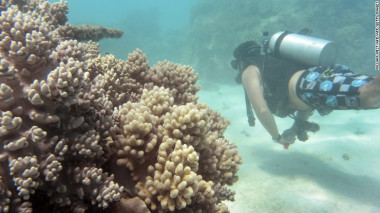 Dahr Jamail | Coral Reefs Could All Die Off by 2050, May 15, 2017, By Dahr Jamail, Truthout | Report “…… over the last two years, the Great Barrier Reef, which is so dear to Miller and countless others who revel in the beauty and mysteries of the oceans, has been dying off at an unprecedented rate due primarily to warming ocean waters.
Coral bleaching occurs when corals become stressed by warmer-than-normal water, causing them to expel symbiotic algae that live in their tissues, from which they get their energy. Coral turns completely white when it bleaches. If it remains bleached long enough, it dies.
One scientist has already gone so far as to declare the Great Barrier Reef is now in a “terminal stage.” Most of those studying the reef agree that what is happening is unprecedented. This is because, at a minimum, two-thirds of the 1,400-mile long reef bleached out last year, which led to 22 percent of it dying. Now another bleaching event has resulted in at least two-thirds of the reef bleached again.
“The bleaching this year has moved much farther south and has taken scientists by surprise in its severity and extent,” Miller said. And he fears the state of the reef could be even worse than scientists realize, since only aerial surveys have been conducted to assess the damage and no research vessel is currently active on the reef to provide finer details.
With ocean temperatures rising across the globe as anthropogenic climate disruption (ACD) continues to pick up speed, the Great Barrier Reef, the largest coral ecosystem on Earth, may well be an example of what is happening to all of the coral on the planet.
“This Is New for All of Us”……..
Miller is equally stunned by what he is seeing along the Great Barrier Reef, which is eerily similar to what Burdick is seeing on Guam.
“Parts of the reef that didn’t bleach last year are now under immense pressure, and this is totally different because this is back-to-back bleaching,” Miller explained. “The system was already stressed, and this is a new stress event. We are seeing much mortality on reefs in our area…. What didn’t die last year is dying this year.”
In addition to the new bleaching in this year’s event, southern portions of the reef that are typically in cooler waters are now also bleaching out.
“It’s heartbreaking to see,” Miller added. “Seventy thousand direct tourism-related jobs and a $6 billion tourism industry are all at risk, especially on top of the recent damage from Cyclone Debbie.”
A study published this March in the journal Nature found that last year’s bleaching of the Great Barrier Reef was so severe that there was no similar analog in the thousands of years of ancient coral cores scientists use to study past climates.
Another study published in Nature projected that by the year 2050, more than 98 percent of global coral reefs will be afflicted by “bleaching-level thermal stress” every single year.
However, the prognosis could be even worse: The scientists involved in the study from this March speculated that the era of never-ending global coral bleaching may have already arrived, albeit several decades earlier than was predicted even just last year. They explained that the Great Barrier Reef needs 10 to 15 years between bleaching events in order to fully recover, and that recovery time period is “no longer realistic.”
“We Don’t Even Know What We Are Losing”……..
A report by the UN’s Food and Agriculture Organization shows that coral reefs are responsible for producing 17 percent of all globally consumed protein, with that ratio being 70 percent or greater in island and coastal countries like those of Micronesia.
At the time of this writing, Earth has lost nearly half of its coral, and oceanic warming only continues to accelerate.
“We are finding that reefs living under anthropogenic stresses for many years have already lost their more sensitive coral species, and the ones that are there now are already the tough bastards,” Raymundo said. “And when reefs have lower diversity, there is less ecological redundancy; hence, they are more likely to collapse.”
A Future Without Coral?
A 2012 study revealed that half of the Great Barrier Reef had already vanished in just the previous 27 years. Two years later, the world’s most qualified coral reef experts released a report showing that, without dramatic intervention, the Great Barrier Reef would disappear completely by 2030.
Furthermore, a study published and released by NOAA in 2011 warned that, “unless action is taken now to reduce the threats,” 90 percent of all reefs will be “threatened” by 2030, and all of Earth’s coral reefs could be completely gone by 2050. The study, “Reefs at Risk Revisited,” listed human-caused climate disruption, warmer water temperatures, ocean acidification, shipping, overfishing, coastal development and agricultural runoff as the contributing factors.
While that might sound extreme, Miller told Truthout he thought the report actually didn’t go far enough.
“I think it’s too conservative,” he explained. “Corals need many years to adjust to the warmer ocean waters, and we don’t have that kind of time anymore. The warming we are seeing now is happening far too fast to allow for evolution…. So what we’re seeing now is death. That’s what bleaching is.”……..
Back in Australia, Miller is dismayed by the fact that his government is doing very little, if anything, to mitigate the crisis.
Truthout asked Miller what steps the Australian government is taking to save the Great Barrier Reef.
“From what I can tell, virtually nothing,” he answered. “They are not focussed on this at all, but rather are pushing for the Adani Coal Mine to go ahead. We here in Australia can hardly believe it, to be honest. In fact, the government has had almost no comment on the bleaching at all.”
The coal mine he referred to is looking like it is going to move forward, which will, according to Miller, bring an additional 500 ships carrying coal across the Great Barrier Reef every single year.
Truthout interviewed Miller’s colleague, John Rumney, the managing director of Great Barrier Reef Legacy in February, when this year’s bleaching event began.
“This coral is in big trouble,” Rumney said at the time. Like Miller, Burdick and Raymundo, Rumney warned of the extreme loss of biodiversity that comes with the disappearance of reefs.
“When all that coral goes, all that diversity of fish that depends on it goes,” Rumney told Truthout. “The entire food chain is in big trouble.”
Miller concurred, saying, “We might see ecosystem collapse as we know it.” The need for independent research on the Great Barrier Reef during this second mass-bleaching event is needed more than ever, according to Miller. His and Rumney’s organization is striving to get more scientists out to the reef as quickly as possible.
“The world’s greatest natural icon and largest living structure needs our help more than ever, and unless we act as a concerned global population, nothing will be done,” he concluded. “It is not too late. The reef is worth saving — and our actions now will determine the fate of coral reefs in as little as 5 to 10 years. We must act.” http://www.truth-out.org/news/item/40579-coral-reefs-generate-half-of-earth-s-oxygen-and-they-could-all-die-off-by-2050
UK National Grid halts plan for Moorside nuclear plant connection
 Utility Week 15th May 2017, National Grid hits pause on Moorside connection. Plans shelved for “biggest new power line since electricity network was built”. Plans to build a 102-mile power line connecting the proposed Moorside nuclear plant in Cumbria to the transmission network have been placed on hold, National Grid has revealed.
The news comes after developer NuGen confirmed earlier this month that it was conducting a “strategic review of its options” following reports that its main shareholder, Toshiba, may mothball the Moorside project.
http://utilityweek.co.uk/news/National-Grid-hits-pause-on-Moorside-connection/1302702
Japan’s Toshiba Corporation expects net loss of JPY950 billion ($8.4 billion) for the 2016-2017 financial year
JPY950 billion ($8.4 billion) for the 2016-2017 financial year, ending 31
March, according to unaudited results it released today. Last month, the
company warned of a net loss for the full year of about JPY1 trillion…. http://www.world-nuclear-news.org/C-Toshiba-projects-JPY950-billion-loss-for-FY2016-1505175.html
BMO Global Asset Management dumps BHP Billiton and other fossil fuel shares
 Guardian 15th May 2017, Archbishop of Canterbury plays crucial role in BMO Global Asset Management’s decision to dump £20m of shares in firms such as BHP Billiton One of Britain’s biggest managers of ethical funds is to dump £20m of shares in fossil fuel companies in one of the biggest divestments so farbecause of climate change.
Shares in BHP Billiton, the Anglo-Australian mining giant, will be among those sold by BMO Global Asset Management’s range of “responsible” funds, which manage £1.5bn of assets. They were previously known as the “stewardship” funds, the first ethical funds launched in Britain. The archbishop of Canterbury, Justin Welby, played a crucial role in the divestment, as president of BMO’s responsible investment council. The Church of England has already pulled out of investing in companies that make more than 10% of its revenues from thermal coal or oil from tar sands….. https://www.theguardian.com/environment/2017/may/15/top-uk-fund-manager-divests-from-fossil-fuels
Lawyers and scientists defend the integrity of climate science
Under Fire, Climate Scientists Unite With Lawyers to Fight Back https://www.nytimes.com/2017/05/15/science/under-fire-climate-scientists-unite-with-lawyers-to-fight-back.html?_r=0 MAY 15, 2017 Lawyers and scientists do not always get along, but some are now finding common cause in an effort to defend the integrity of science — especially climate science — in government and academia.
USA could make a colossal blunder – bailing out nuclear power stations
 Why a multibillion-dollar bailout for nuclear plants would be a colossal blunder, Examiner by Mark J. Perry, contributor | May 16, 2017 What could push up energy costs and stall the growth of manufacturing in the United States? Dangers abound, but what’s most ominous is a deliberate effort to increase the cost of electricity to support uncompetitive power plants.
Subsidizing money-losing nuclear reactors is the latest misstep in the long history of overzealous government intervention in the energy marketplace. State legislatures in New York and Illinois have approved as much as $10 billion in subsidies through zero-emission credit programs to keep aging nuclear plants open for the next decade. Lawmakers in Ohio, Pennsylvania, Connecticut and New Jersey are considering the same.
But in an era in which “no new taxes” is a sacred cow, New York and Illinois have invented another, creative way to raise the funds they need for subsidies, at the expense of the public.
This time, the consumer will not be victimized as a taxpayer, but as utility ratepayer, to keep money-losing nuclear plants operating. The two states have launched virtually identical programs that would reward nuclear plants with zero-emission credits tied to the plants’ clean-air attributes. The credits would be purchased by electric utilities and passed along as higher rates for households, businesses, and industries – and priced based on the social cost of carbon.
Propping up nuclear plants, some of which have been losing money for years, is counterproductive and wrong. While guaranteeing a market for nuclear power might enable a distressed plant to continue operating for a few years, it won’t bring about needed improvements in nuclear technology that would allow nuclear power to compete with low-carbon shale gas. And it will distort energy markets by favoring nuclear power over other options, saddling ratepayers with higher electricity costs.
The subsidies are being challenged in federal court by “merchant” power producers who are arguing that they intrude on the Federal Energy Regulatory Commission’s jurisdiction over wholesale markets.
The cost of subsidies adds up. If every reactor across the Northeast and Mid-Atlantic States winds up with subsidies at the same level as those in New York and Illinois, ratepayers would need to pay an additional $3.9 billion annually, according to Bloomberg Intelligence. Hardest hit will be industries that use large amounts of electricity.
The company behind this grand plan is Exelon, a Chicago-based utility that owns the largest number of nuclear plants in the U.S. Exelon threatened to shutter three nuclear plants in Illinois after the company said it had lost $700 million in the last few years from operating the plants. Exelon also threatened to close money-losing nuclear plants it owns in New York. In both states, Exelon maintains that since carbon-free nuclear power doesn’t contribute to global warming, nuclear plants should receive a premium to help level the playing field with natural gas and wind power.
But using a specious environmental argument to subsidize money-losing nuclear plants is indefensible. There seems to have been no particular logic to the bailouts of virtually-useless and technologically-backward nuclear plants in New York and Illinois – except the urge to save the jobs of nuclear plant workers. It would make more sense to retire the nuclear plants and instead use cheap natural gas to meet energy needs, while providing assistance to the workers and communities near the nuclear plants.
Electricity users are best served through market competition. If aging nuclear power plants cannot compete, handing out cash to utilities is not the answer. The plants will never get back on their feet. And the utilities aren’t going to use bailouts to innovate or improve operations.
The cost of operating aging plants will only increase in the years ahead. While the cost of other low-emissions technologies continues to decline, as is the case with natural gas and renewables, nuclear-generated electricity is getting more expensive….. http://www.washingtonexaminer.com/why-a-multibillion-dollar-bailout-for-nuclear-plants-would-be-a-colossal-blunder/article/2623212
The devastating social and mental health legacies of atomic bomb testing
The worst effects of our nuclear programme are the ones that nobody talks about http://www.independent.co.uk/voices/nuclear-war-threat-weapons-us-north-korea-russia-nuclear-testing-worst-thing-a7739131.html Between 1946-1996, more than 2,000 nuclear weapons tests were conducted by the US, UK, Soviet Union, France and China. Most of these took place in locations selected on the basis of colonial history, and in lands belonging to indigenous peoples Beyza Unal , 16 May 17 A quarter of a century after the end of the Cold War, interest in nuclear weapons has revived, not reduced. But still a taboo surrounds our nuclear legacy. For all the debate over the tensions between the United States and North Korea, a taboo still surrounds the lingering impacts of nuclear weapons testing and fears for their future use in conflict.
Our latest research looked not only at the implications of a potential future nuclear conflict, but also the humanitarian consequences of nuclear weapons testing for more than seven decades.
Between 1946-1996, more than 2,000 nuclear weapons tests were conducted by the US, UK, Soviet Union, France and China. Most of these took place in locations selected on the basis of colonial history, and in lands belonging to indigenous peoples. And the impacts were severe.
1 This Month

of the week – Shut Down Drone Warfare!


Tell the Ukrainian Government to Drop Prosecution of Peace Activist Yurii Sheliazhenko

Petition to revoke the licensing of the Near Surface Nuclear Disposal Facility (NSDF) at Chalk River. https://www.ourcommons.ca/petitions/en/Petition/Details?Petition=e-7247
To see nuclear-related stories in greater depth and intensity – go to https://nuclearinformation.wordpress.com
-
Archives
- April 2026 (68)
- March 2026 (251)
- February 2026 (268)
- January 2026 (308)
- December 2025 (358)
- November 2025 (359)
- October 2025 (376)
- September 2025 (257)
- August 2025 (319)
- July 2025 (230)
- June 2025 (348)
- May 2025 (261)
-
Categories
- 1
- 1 NUCLEAR ISSUES
- business and costs
- climate change
- culture and arts
- ENERGY
- environment
- health
- history
- indigenous issues
- Legal
- marketing of nuclear
- media
- opposition to nuclear
- PERSONAL STORIES
- politics
- politics international
- Religion and ethics
- safety
- secrets,lies and civil liberties
- spinbuster
- technology
- Uranium
- wastes
- weapons and war
- Women
- 2 WORLD
- ACTION
- AFRICA
- Atrocities
- AUSTRALIA
- Christina's notes
- Christina's themes
- culture and arts
- Events
- Fuk 2022
- Fuk 2023
- Fukushima 2017
- Fukushima 2018
- fukushima 2019
- Fukushima 2020
- Fukushima 2021
- general
- global warming
- Humour (God we need it)
- Nuclear
- RARE EARTHS
- Reference
- resources – print
- Resources -audiovicual
- Weekly Newsletter
- World
- World Nuclear
- YouTube
-
RSS
Entries RSS
Comments RSS
 nuclear-news