Australia’s activists confront the very sly and secretive global nuclear lobby
 Today, I am taking the unusual step of publishing an entire submission. That’s because it is so good. The nuclear lobby pulled a swifty on Australians, by having government and media very quietly do what is sure to be a “rubber stamp” job on Australia joining up to the Framework Agreement for Generation IV Nuclear Energy Systems.
They very quietly allowed a very short time for submissions to the Parliamentary Inquiry. The nuke lobby must have been in the know, as they put in 11, whereas there were only 3, (one mine) critical of the plan.
Fortunately the critical ones contain compelling information. So, here, in full, is the:
 Submission from Friends of the Earth
  Australia and the Australian Conservation Foundation .

Contacts:
• Jim Green (Friends of the Earth, Australia) jim.green@foe.org.au, 0417 318 368
• Dave Sweeney (Australian Conservation Foundation) dave.sweeney@acf.org.au, 0408 317 812
Contents
1. Introduction and Response to National Interest Analysis
2. Generation IV Reactor Concepts ‒ Introduction
3. Decades Away
4. Purported Benefits
5. French Government’s IRSN Report
6. US Government Accountability Office Report
7. The Slow Death of Fast Reactors
8. Integral Fast Reactors
9. Thorium 10. Small Modular Reactors 11. Fusion Scientist Debunks Fusion
- INTRODUCTION AND RESPONSE TO NATIONAL INTEREST ANALYSIS Friends of the Earth Australia and the Australian Conservation Foundation welcome the opportunity to make a submission to this inquiry and would welcome the opportunity to appear before a hearing of the Committee.
The Committee will likely receive submissions promoting the construction of Generation IV reactors in Australia and it is therefore worth noting comments by the SA Nuclear Fuel Cycle Royal Commission in its May 2016 Final Report: “[A]dvanced fast reactors and other innovative reactor designs are unlikely to be feasible or viable in the foreseeable future. The development of such a first-of-a-kind project in South Australia would have high commercial and technical risk. Although prototype and demonstration reactors are operating, there is no licensed, commercially proven design. Development to that point would require substantial capital investment. Moreover, electricity generated from such reactors has not been demonstrated to be cost competitive with current light water reactor designs.”1
Here we provide brief responses to a number of comments in the National Interest Analysis (NIA).2
The NIA asserts that participation in the Generation IV International Forum (GIF) will further Australia’s non-proliferation and nuclear safety objectives. No evidence is supplied to justify the tenuous assertion. There is much else that Australia could do ‒ but is not doing ‒ that would demonstrably further non-proliferation objectives, e.g. a ban on reprocessing Australian Obligated Nuclear Materials (AONM); a reversal of the decision to permit uranium sales to countries that have not signed or ratified the NPT; or refusing uranium sales to countries that refuse to sign or ratify the Comprehensive Test Ban Treaty. There is much else that Australia could do ‒ but is not doing ‒ that would demonstrably further safety objectives, e.g. revisiting the decision to sell uranium to Ukraine in light of the ongoing conflict in that country, refusing to supply uranium to nuclear weapon states that are not fulfilling their NPT obligations, insisting that uranium customer countries establish a strong, independent regulatory regime (as opposed to the inadequate regulation in a number of customer countries, e.g. China, India, Russia, Ukraine and others).
Nuclear non-proliferation would also be far better realised by active Australian engagement in the current UN process around the development of a nuclear weapons ban treaty. Instead Australia has spurned this pivotally important initiative and is refusing to participate. If Australia is serious about its international standing, our representatives would be at the table in New York.
The NIA states that ongoing participation in GIF will help Australia maintain its permanent position on the IAEA’s 35-member Board of Governors. ANSTO routinely makes such arguments ‒ in support of the construction of the OPAL reactor, in support of the development of nuclear power in Australia, and now in support of Australian participation in GIF. Australia has held a permanent position on the IAEA’s Board of Governors for decades and there is no reason to believe that participation or non-participation in GIF will change that situation.
The NIA asserts that accession to the Agreement and participation in GIF will have important economic benefits. No evidence is supplied to justify that tenuous assertion. There are no demonstrated economic benefits from participation in GIF ‒ however there are clear costs.
The NIA states that the “costs of participation in the System Arrangements will be borne by ANSTO from existing funds.” ANSTO should be required to provide a detailed account of past expenditure relating to this Agreement and anticipated future expenditure.
The NIA states that ongoing participation in GIF “will improve the Australian Government’s awareness and understanding of nuclear energy developments throughout the region and around the world, and contribute to the ability of the Australian Nuclear Science and Technology Organisation (ANSTO) to continue to provide timely and comprehensive advice on nuclear issues.” Those arguments are tenuous, especially given that little about GIF is secret.
The NIA states that “Generation IV designs will use fuel more efficiently, reduce waste production, be economically competitive, and meet stringent standards of safety and proliferation resistance.” Those false claims are rebuked in later sections of this submission.
The NIA states that the success of Australia’s bid for membership of GIF was based in part on ANSTO’s “world-class capabilities and expertise” in the “development of nuclear safety cases.” ANSTO should be asked to justify that assertion. ANSTO could also be asked whether, based on its “world-class” expertise in nuclear safety, whether it considers it is appropriate for Australia to sell uranium to countries with demonstrably inadequate nuclear regulatory regimes, e.g. China, India, Russia, Ukraine and others.
The NIA asserts that “a significant expansion in nuclear power production is underway or under consideration by a number of countries, including several in the Asia Pacific region.” In fact:
- Globally, nuclear power has been stagnant for the past 20 years.
- For the foreseeable future, there is zero likelihood of a “significant” nuclear expansion of nuclear power and there will be an overall decline unless growth in China matches the decline elsewhere. Declines can be predicted with great confidence in North America, across all EU countries combined, in Japan, and in numerous other countries and regions ‒ and a very large majority of the world’s countries (about five out of six) are nuclear-free and plan to stay that way.
- No country in the Asia Pacific or South East Asia is seriously planning to introduce nuclear power. The only country that was seriously planning to introduce nuclear power in the region ‒ Vietnam ‒ abandoned those plans last year.
The NIA states that Australia’s participation in GIF falls within the existing functions of ANSTO under Section 5 of the Australian Nuclear Science and Technology Organisation Act 1987. The Joint Standing Committee on Treaties should assess whether Australia’s participation in GIF is consistent with legislation banning nuclear power in Australia (the EPBC and ARPANS Acts). 2.
2. GENERATION IV REACTOR CONCEPTS ‒ INTRODUCTION Continue reading
Hanford’s unending nuclear woes
Hanford continues to have truckload of woes http://www.spokesman.com/stories/2017/may/12/hanford-continues-to-have-truckload-of-woes/If ever a place were cursed, it’s the Hanford Nuclear Reservation. The last thing cleanup managers needed was a new project.
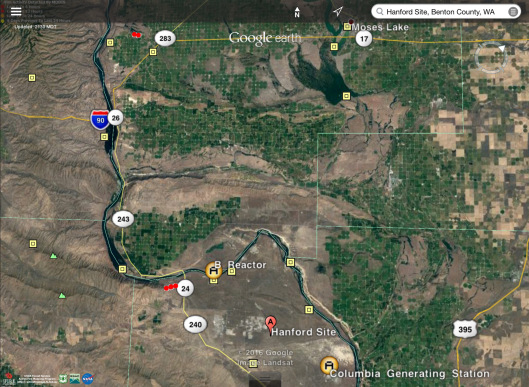
But the lifespan of rail car tunnels designed to temporarily store radioactive material is much shorter than the half-life of the waste itself, as witnessed by the 20-by-20-foot hole that was spotted above one of the caverns on Tuesday morning.
The two tunnels were built more than 50 years ago as a stopgap measure. Today, there is still no permanent solution as the cleanup drags on, with administration after administration claiming their commitment to safety as it pushes back deadlines.
The feds have spend $19 billion at Hanford, and the deadline for completion is 2060, or 115 years after the first plutonium for a nuclear explosion was produced. It’s a national embarrassment, with serious consequences for this region.
Workers are plugging the hole of the partially collapsed tunnel with a sand and soil mix. Fifty-four truckloads were dumped as of Wednesday night. No airborne radioactivity has been detected. The tunnel, constructed of wood and concrete, has stored eight rail cars filled with contaminated material since the 1960s, the Tri-City Herald reported. The other tunnel is larger, containing 28 rail cars filled with waste.
The fact that radioactive material is still being stored in such a way says everything about the failure of the federal government to come up with a permanent solution. A 2015 U.S. Department of Energy report said the tunnels were susceptible to earthquakes or deterioration, and the nearby Yakama Nation was warned, the Associated Press reported. The tribe says nothing was done.
Earlier reports also warned the tunnels would deteriorate due to time and radiation.
The state of Washington has filed a legal order outlining its expectations, including a plan for the safe storage of materials in those tunnels.
The tunnels aren’t even the worst of it. A total of 177 tanks with 56 million gallons of radioactive sludge are buried beneath Hanford and close to the Columbia River. At least 67 tanks have leaks. If the Columbia River were to be contaminated, it would be catastrophic for the entire Northwest.
The long-term plan has been to convert the waste into glass logs by a process known as vitrification. The logs would be put into permanent storage deep beneath Yucca Mountain in Nevada. But the planned $17 billion vitrification plant has been plagued by design and safety concerns. Politics has stymied the Yucca repository. Former Nevada Sen. Harry Reid, who served as Senate majority leader, blocked it.
In yet another twist, a recent Government Accountability Office report advises abandoning vitrification and encasing the waste in a cement-like mixture. It’s always something.
President Donald Trump’s initial budget increased U.S. Energy Department spending on cleanups, from $6.1 billion to $6.5 billion. New Secretary of Energy Rick Perry has much to learn about Hanford, and he will be counted on to follow up on the tunnel breach.
But it takes a truckload of faith to believe the curse will be lifted.
Close to Norway – Russia’s secret nuclear weapons build-up, and waste dumps
The satellite images, however, only reveal what is visible on the surface. Most of the actual warheads are underground.
What now takes place in regard to submarine-launched ballistic missiles’ facilities hasn’t been seen at the naval bases on Kola since the large-scale infrastructure construction to support the Typhoon submarines at the Nerpichya base in Zapadnaya Lista happened in the 1980s.
Norway pays for nuclear safety While nuclear weapons are stored inside the mountain on the east side of the Litsa fjord, huge amounts of nuclear waste are stored just two kilometers away, across the fjord in the infamous Andreeva Bay. Thousands of cubic meters of solid radioactive waste and nearly 22,000 spent nuclear fuel elements from submarine reactors are stored here. Neighbouring Norway, along with other donor countries, have spent hundres of millions kroner (tens of millions euros), on nuclear safety projects aimed at upgrading the infrastructure in Andreeva Bay.


 Satellite images show expansion of nuclear weapons sites on Kola, Barents Observer [excellent pictures] By Thomas Nilsen, May 08, 2017 The reverse gear seems to hang up for continuing disarmament of nuclear weapons in the Arctic. Barents Observer has made a comprehensive review of satellite images from naval base-level storage facilities that confirms heavy construction works.
The New START Treaty says USA and Russia must limit the numbers of deployed strategic nuclear warheads to 1,550 by February 5, 2018. Over the last two years, Russia has increased the number of deployed warheads and is now 215 over the max limit to be reached.
There are extensive construction work at two of the Northern Fleet’s facilities for storage of warheads and ballistic missiles for submarines (SLBM) on the coast of to the Barents Sea. The Barents Observer has studied satellite images of the Kola Peninsula open available via Google Earth, combined with open-source data on numbers of nuclear warheads in Russia. The results are frightening.
Expansion of the two base-level storages in Okolnaya Bay near Severomorsk and Yagelnaya Bay in Gadzhiyevo are clearly visible. At both locations, new reinforced bunkers, auxiliary buildings and infrastructure partly finished and partly still under construction can be seen.
The satellite images, however, only reveal what is visible on the surface. Most of the actual warheads are underground.
What now takes place in regard to submarine-launched ballistic missiles’ facilities hasn’t been seen at the naval bases on Kola since the large-scale infrastructure construction to support the Typhoon submarines at the Nerpichya base in Zapadnaya Lista happened in the 1980s.
There are four storages for nuclear weapons on Kola. From satellite images, these storages are not too difficult to find. All are surrounded by double or triple layer barrier of barbed wire fences with extraordinary security at the single entry-exit checkpoints. Also inside the outer fences, the different sections of the facilities are separated with similar security fence barriers. Comparing satellite images with photos posted on internet by naval officers or their family members makes it possible to get a pretty good impression of the current situation.
Several of the storage locations are visible on photos, although mainly in distance, available by searching Yandex, Russia’s own search engine. Also, Wikimapia, an online editable map where people can mark and describe places, has been a good source to information when writing this article.
Zaozersk is the nuclear weapons storage nearest to Norway in a distance of 65 kilometers to the border in Grense Jakobselv. The Norwegian town of Kirkenes is 94 kilometers away. Distance to Finland is 120 kilometers. All four storage sites on Kola are within a radius of 190 kilometers from Norway and 180 kilometers from the Finnish border………..
Today, Kristian Åtland estimates that around 60 percent of Russia’s more than 700 sea-based strategic nuclear warheads are concentrated on the Kola Peninsula, whereas the remaining 40 percent is based with the Pacific Fleet at Kamchatka.
«The numerical increase in Russia’s strategic nuclear arsenal, including the part of it that is based on submarines operating from the Kola Peninsula, is neither dramatic nor unexpected. The increase is to be understood in the context of Russia’s long-standing and still on-going defense modernization. The modernization of Russia’s strategic nuclear forces has been a key priority in the State Armaments Program for the period up to 2020 (“GPV-2020”), which was launched in 2010. In addition, the general deterioration of Russia’s relationship with the West, particularly since 2014, seems to have led to a renewed focus on the issue of nuclear deterrence, in Russia as well as in the United States,» Åtland elaborates.
Gorbachev called for nuclear-free zone
2017 marks the 30-years anniversary since Michael Gorbachev’s famous Murmansk-speech on October 1st 1987 where he called for a nuclear-free zone in Northern Europe. Since then, the numbers of nuclear warheads based on the Kola Peninsula saw a continuing decrease until 2015, five years after Barack Obama and Dmitry Medvedev signed the New START Treaty in Prague. In July 2015, Russia reportedly had less deployed strategic nuclear warheads than the United States, 1,582 versus 1,597, the Bureau of Arms Control with the U.S. Departement of State reported.
215 over New START Treaty limit
Latest exchange and verification numbers from the same bureau dated April 1, 2017 shows that Russia now has 1,765 versus the United State’s 1,411. In other words; Russia has 215 warheads more than the maximum set to be achieved nine months ahead. The questions is whether Moscow is likely to dismantle over 200 warheads in less than a year.
Katarzyna Zysk, Associate Professor with the Norwegian Defense University College, says to the Barents Observer that Russia has a vested interest in maintaining the New START agreement. «Russia has a vested interest in maintaining the New START given that it keeps the development of the US strategic nuclear capabilities under control, provides Russia transparency measures and valued insight into to the US nuclear forces, thus increasing predictability,» she says, but underscore that the numbers must down.
«In order to meet the New START Treaty limits when it enters into effect in February 2018, Russia will have to decrease the numbers. However, Russia has been moving toward meeting the obligations as the number of Russia’s deployed strategic warheads has been decreasing compared with 2016. The US is now below the treaty limit and is in fact increasing the number of strategic deployed warheads,» Zysk explains.
Åtland agrees and underscores that today’s numbers do not constitute a treaty violation.
«The fact that Russia is now above the maximum warhead limits of the new START Treaty, which entered into force in 2011, does not in itself constitute a treaty violation. The treaty does not mandate any particular schedule for reductions other than that the agreed-upon limits must be met by February 2018, which is in nine months from now. Reductions in the number of deployed warheads are fairly easy to achieve once the political will is there, either by phasing out old delivery platforms or by removing deployed warheads to central storage. Thus, the identified “peak” may be temporary,» Åtland says. He hopes both the United States and Russia will work towards an extension of the Treaty.
«Hopefully, Russia will stand by its commitments under the current START Treaty regime. In any event, it is important that Russia and the U.S. continue to exchange data about the status of their nuclear arsenals and that they provide for mutual inspections and other transparency measures outlined in the START Treaty and other documents. The parties should also work towards an extension or replacement of the Treaty when it expires in February 2021.»…………..
Norway pays for nuclear safety
While nuclear weapons are stored inside the mountain on the east side of the Litsa fjord, huge amounts of nuclear waste are stored just two kilometers away, across the fjord in the infamous Andreeva Bay. Thousands of cubic meters of solid radioactive waste and nearly 22,000 spent nuclear fuel elements from submarine reactors are stored here. Neighbouring Norway, along with other donor countries, have spent hundres of millions kroner (tens of millions euros), on nuclear safety projects aimed at upgrading the infrastructure in Andreeva Bay.
On June 27, Norway’s Minister of Foreign Affairs, Børge Brende, travels to Andreeva Bay to mark the first shipping of spent nuclear fuel out of the area, a job that is likely to continue for more than five years. Meanwhile, Russia continues to spend huge amounts of money on new nuclear weapons in the border areas. ………..
Bolshoye Ramozero – the most secret
The most secret of all secret nuclear weapons storages on the Kola Peninsula is located some 20 kilometers to the northeast of the mining town Olenegorsk, on a side road towards Lovozero. The location, diffcult to find referances to on the internet, has several names; Katalya is one, Bolshoye Ramozero is another (the nearby lake). Like other secret towns in the Soviet Union, also this one had a post-code name; Olenegorsk-2. The nickname is Tsar City, allegedly because of the priviliges the inhabitants had. The town is also simply known as Military Unit 62834 or Object 956.
While it is easy to find selfies and blogposts from most Russian military garrisons and bases, few can be found from this town. Not too strange; the town is under full supervison of the 12th Chief Directorate of the Ministry of Defense. This directorate is responsible for all of Russia’s nuclear weapons, including storages, technical maintenance and transportation.
The 12th Chief Directorate is probably the most secretive organization in the Russian Armed Forces, even more than the foreign military intelligence agency GRU and the strategic missile forces, according to Wikipedia.
Bolshoye Ramozero serves a national-level nuclear weapons facility, one of 12 such storages across Russia, according to a recent report written by Pavel Podvig and Javier Serrat. The report, focusing on non-strategic nuclear weapons in Europe, is published by the United Nations Institute for Disarmament Research (UNIDIR).
It is believed that all non-strategic nuclear warheads possible aimed for naval, air force and army weapons for the Kola area, and maybe even more, are stored at the central national level storage in Bolshaya Ramozero. According to the UNIDIR report, the 12th Chief Directorate is responsible for providing the nuclear warheads to the different military units “when deemed necessary.” If a threatening situation occurs, warheads can be transported by trucks from this site to the different military units on the Kola Peninsula which holds weapons systems that could be armed with tactical nuclear weapons, like naval cruise missiles or torpedoes, or cruise missiles carried by aircrafts.
The nearest airbase to the central storage on Kola is Olenogorsk where Tu-22 bombers are stationed.
Inside the underground storage bunkers in Bolshaya Ramozero are only the warheads stored.
Satellite images show that there are two storage areas just north of the town. The first area has three internal sites, of which only two seems to be actively used. The second area is located another kilometer further north. https://thebarentsobserver.com/en/content/satellite-images-show-expansion-nuclear-weapons-sites-kola
Putin tells South Korea’s new President that he will help resolve North Korea nuclear issue

 Russia’s Putin says ready to help resolve North Korea nuclear issue – South Korea, http://in.reuters.com/article/southkorea-russia-idINKBN1881MQ | SEOUL, 12 May 17
Russia’s President Vladimir Putin told his newly elected South Korean counterpart, Moon Jae-in, in a phone call on Friday that he is ready to play a “constructive role” in resolving North Korea’s nuclear threat, the South’s presidential office said.
Putin made the comment after Moon said the foremost task to boost cooperation between the two countries was to strengthen strategic bilateral communication to find a solution to curb North Korea’s nuclear threat, the Blue House said in a statement.
“We hope for Russia to play a constructive role in order for North Korea to stop with its nuclear provocations and go the way of denuclearisation,” Moon was citing as saying to Putin in the 20-minute conversation.
“I, too, aim to find a way to begin talks quickly between North and South Korea as well as the six-party talks,” Moon said, referring to talks aimed at denuclearising North Korea involving the United States, China, Japan, Russia and the two Koreas.
The talks collapsed in 2008 after North Korea launched a rocket.
Tension has been high for months on the Korean peninsula over North Korea’s nuclear and missile development and fears it will conduct a sixth nuclear test or test another ballistic missile in defiance of U.N. Security Council resolutions.
Moon is a liberal who advocates a more conciliatory approach to North Korea compared with his conservative predecessor.Moon also expressed hopes the two countries would be able to cooperate in developing East Asia, including extending a natural gas pipeline from Siberia to South Korea, the Blue House said. Putin said he was ready to help in all of the matters they discussed and the two leaders invited each other for state visits, the Blue House added.
Moon said he would send a special envoy to Russia soon and Putin said he would welcome the envoy.The two leaders said they looked forward to meeting at the Group of 20 summit meeting in Germany in July.
Earlier in the day, Moon spoke with British Prime Minister Theresa May and German Chancellor Angela Merkel, the Blue House said. He asked them to help in curbing North Korea’s nuclear programme and both promised to.
(Reporting by Christine Kim; Additional reporting by Se Young Lee; Editing by Robert Birsel)
Washington State taking legal action over collapse of a containment tunnel at a nuclear site

 Washington State Demands Nuclear Waste Storage Answers http://www.courthousenews.com/enforcement-action-calls-assessment-nuclear-waste-storage/ RICHLAND, Wash. (CN) — A state agency has taken legal action against the Department of Energy for the collapse of a containment tunnel at a nuclear site in Washington.
The tunnel, which housed eight rail cars of nuclear waste in Hanford – about 200 miles south of Seattle – left a 15-to-20-foot hole when it partially collapsed Tuesday. Although no one was hurt, some workers were evacuated and others sheltered in place while the air around the site was tested for radioactivity. Tests revealed that no radioactivity had leaked from the tunnel, and 50 truckloads of soil were brought in to plug the hole.
On Wednesday, the Washington State Department of Ecology (DOE) filed an enforcement action urging the federal government to immediately assess whether failure of other storage tunnels is likely and to submit a plan to the DOE for the safe storage of the materials as well as a plan for permanent cleanup.
“This alarming emergency compels us to take immediate action – to hold the federal government accountable to its obligation to clean up the largest nuclear waste site in the country,” DOE Director Maia Bellon said in a statement.
According to the Department of Energy, Hanford has produced more than 20 million pieces of uranium metal fuel for nine nuclear reactors along the Columbia River. The five plants at the Hanford site discharged an estimated 450 billion gallons of liquid waste in soil disposal sites and 53 million gallons of radioactive waste in 177 underground storage tanks. Most of the nation’s nuclear weapons, including the bomb dropped on Nagasaki, Japan, during World War II, used plutonium from Hanford.
The Hanford site stopped producing plutonium in the late 1980s, with cleanup efforts beginning in 1989. The cleanup currently employs approximately 11,000 workers.
“Our top priority is to ensure the safety of Hanford workers and the community,” Washington Gov. Jay Inslee said in a statement. “The collapse of this tunnel raises serious questions about how it happened and what can be done to make sure it doesn’t happen again. This enforcement order is necessary to make sure we get greater assurance about the condition of these tunnels and the Department of Energy’s plan to contain any further risks.”
In a press release, the DOE highlighted how the age of some of the storage areas at Hanford are of particular concern. The collapsed tunnel was built in 1956 of timber, concrete and steel and topped with eight feet of dirt. It was sealed with the nuclear-waste-filled rail cars in 1965.
“The infrastructure built to temporarily store radioactive waste is now more than a half-century old,” Bellon said. “The tunnel collapse is direct evidence that it’s failing. It’s the latest in a series of alarms that the safety and health of Hanford workers and our citizens are at risk.”
Workers returned to their jobs at Hanford on Thursday.
Jeremy Corbyn put on the spot about use of nuclear weapons

 Jeremy Corbyn is still dodging the nuclear question, George Eaton political editor New Statesman, 12 May 17
The Labour leader came close but ultimately refused to say that he would approve the use of nuclear weapons. In the general election, the Conservatives aim to shoot to kill. By denouncing Labour as soft on defence, they believe they can win their first landslide victory since 1987 (when they similarly tormented the opposition over this issue)……
But in his speech, Corbyn all but repeated it. “I am often asked if as prime minister I would order the use of nuclear weapons,” he said. “It’s an extraordinary question when you think about it – would you order the indiscriminate killing of millions of people? Would you risk such extensive contamination of the planet that no life could exist across large parts of the world?”
He added, however: “Labour is committed actively to pursue disarmament under the Nuclear Non-Proliferation Treaty and we are committed to no first use of nuclear weapons
But let me make this absolutely clear. If elected prime minister, I will do everything necessary to protect the safety and security of our people and our country. That would be my first duty.”
That, however, fell short of explicitly stating he would use nuclear weapons (which Trident supporters regard as essential for deterrence)……….
Yes, solar and wind ARE killing nuclear power, but not killing grid reliability
 Are solar and wind really killing coal, nuclear and grid reliability? The Conversation, Joshua D. Rhodes, Postdoctoral Researcher of Energy, University of Texas at Austin, Professor of Mechanical Engineering and Deputy Director of the Energy Institute, University of Texas at Austin, Graduate Research Assistant, University of Texas at Austin, Research Associate, Energy Institute, University of Texas at Austin May 12, 2017
 Some energy analysts responded with confusion, as the subject has been extensively studied by grid operators and the Department of Energy’s own national labs. Others were more critical, saying the intent of the review is to favor the use of nuclear and coal over renewable sources.
So, are wind and solar killing coal and nuclear? Yes, but not by themselves and not for the reasons most people think. Are wind and solar killing grid reliability? No, not where the grid’s technology and regulations have been modernized. In those places, overall grid operation has improved, not worsened………
Wind and solar are making older generators less viable because their low, stable prices and emissions-free operation are desirable. And they aren’t hurting grid reliability the way critics had assumed because other innovations have happened simultaneously…….
How do renewables affect the bid stack? Renewable sources such as wind, solar and hydro have no fuel costs – sunlight, wind and flowing water are free. That means their marginal operational cost is near zero; the cost is essentially the same to operate one megawatt of wind as compared to the cost of operating 10 megawatts of wind since generators don’t need to buy fuel. That means as more wind and solar farms are installed, more capacity is inserted at the cheapest end of the bid stack.
This insertion pushes out other generators such as nuclear, natural gas and coal, causing some of them to no longer be dispatched into the grid – that is, they don’t supply power into the grid (or get paid). So as more renewables are installed, power markets dispatch fewer conventional options. And, because the marginal cost of these new sources is almost free, they substantially lower the cost for electricity. This is great news for consumers (all of us) as our bills decrease, but bad news for competitors (such as coal plant owners) who operate their plants less often and are paid less when the plants do operate.
What does all this mean? Natural gas and renewables are affecting coal in two ways. Natural gas is a direct competitor with coal because both can be dispatched – turned on – when a grid operator needs more power. That is helpful for grid reliability. But, as the cost of natural gas has fallen, coal has become less competitive because it is cheaper to operate a natural gas power plant.
The effect of renewables is slightly different: Wind and solar power are not dispatchable, so they cannot be turned on at a moment’s notice. But, when they do turn on, during windy evenings or sunny days in Texas, they operate at very low marginal cost and thus operate very competitively.
Research at UT Austin shows that while installing significant amounts of solar power would increase annual grid management costs by $10 million in ERCOT, it would reduce annual wholesale electricity costs by $900 million. The result of all this is that renewables compete with conventional sources of power, but they do not displace nearly as much coal as cheap natural gas. In fact, cheap gas displaces, on average, more than twice as much coal than renewables have in ERCOT.
What about nuclear?
Nuclear’s problems are largely self-inflicted. In short: The price to build nuclear is high, so we don’t build many nuclear plants these days. Since we don’t build, we don’t have the manufacturing capability. Since we don’t have the manufacturing capability, the price to build nuclear is high. Since the price to build nuclear is high, we don’t build nuclear these days…so on and so forth.
Today, cheap gas, having already beaten up on coal, is a threat to new nuclear power plants and less efficient, older plants. New natural gas combined cycle power plants can be built for about one-sixth the cost of a new nuclear plant, is almost twice as efficient and you can build them in smaller increments, making them easier to finance.
Market innovation and IT can fix reliability
Because wind energy comes and goes with the weather, it makes grid operators nervous. But wind forecasting has improved dramatically, giving more confidence to those who need to keep the lights on.
And, interestingly enough, the requirements for reserve capacity (backup power for when wind power dips) to manage the grid smoothly went down, not up, over the past few years in Texas, despite rapid growth in wind during Governor Perry’s tenure. That is, the costs for managing variability in the grid decreased……….
there is still more to do – information technology coupled with integrated hardware can help. Consider this: There are 7.7 million smart meters in Texas, most of them residential. We’ve estimated that installing 7 million controllable thermostats for just the households in Texas would cost $2 billion. Residential air conditioning is responsible for about 50 percent of peak demand in Texas in the summer. That means about 30 gigawatts of peak demand in Texas is just from residential air conditioners.
By dynamically managing our air conditioning loads – that is, adjusting thermostats to lower overall demand without impacting people’s comfort – we could reduce peak demand by 10 to 15 GW. That means we might not need $10 billion to $15 billion worth of power plants. Spending $2 billion to avoid $15 billion is a good deal for consumers. In fact, you could give the thermostat away for free and pay each household $700 for their trouble and it would still be cheaper than any power plant we can build.
In the end, Secretary Perry has posed good questions. Thankfully, because of lessons learned while he was governor of Texas, we already have answers: despite concerns to the contrary, incorporating wind and solar into the grid along with fast-ramping natural gas, smart market designs and integrated load control systems will lead to a cleaner, cheaper, more reliable grid.https://theconversation.com/are-solar-and-wind-really-killing-coal-nuclear-and-grid-reliability-76741
USA intelligence’s “Worldwide Threat Assessment” report warns Trump on global warming
 Intelligence community to Trump: When it comes to global warming, you’re wrong, Mashable, BY ANDREW FREEDMAN, 12 May 17 Each year the intelligence community puts together a “Worldwide Threat Assessment” report, and it inevitably scares the hell out of Congress and the public by detailing all the dangers facing the U.S. (Hint: there are a lot of them.)
While it focuses on the increasing danger that North Korea’s nuclear weapons program poses as well as cyberterrorism threats, one environmental concern stands out on the list: climate change. According to the new report, delivered to the Senate Intelligence Committee by Dan Coats, the director of national intelligence (DNI), warns that climate change is raising the likelihood of instability and conflict around the world.
“The trend toward a warming climate is forecast to continue in 2017,” the report states, noting that 2016 was the hottest year on record worldwide. Climate scientists have firmly tied this to human-caused emissions of greenhouse gases, though the report does not make that link.
“This warming is projected to fuel more intense and frequent extreme weather events that will be distributed unequally in time and geography. Countries with large populations in coastal areas are particularly vulnerable to tropical weather events and storm surges, especially in Asia and Africa,” the report states………..http://mashable.com/2017/05/11/trump-intel-report-cites-climate-change-risks/#iCN3X703iiqw
Nuclear power generation declining
 Nuclear Generation Expected to Decline with Reactor Retirements http://www.power-eng.com/articles/2017/05/nuclear-generation-expected-to-decline-with-reactor-retirements.html
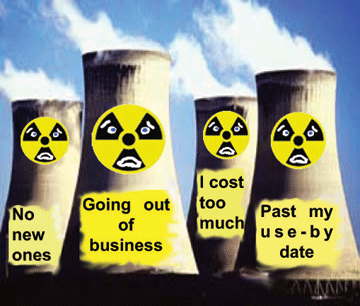
May 12, 2017 Far more nuclear generation capacity is expected to be retired rather than added through 2050, a study by the Energy Information Administration indicated.
Though 9.1 GW of new capacity is projected to be added, 29.9 GW is expected to be retired. The reactors already announced for closure include Palisades in 2018, Pilgrim Unit 1 in 2019, Oyster Creek Unit 1 in 2020, Indian Point Units 2 and 3 around 2020 and Diablo Canyon Units 1 and 2 in 2025 and 2026.
Though Quad Cities Units 1 and 2 and Clinton Unit 1 were set for retirement, financial incentives passed by the state of Illinois caused the operators of those plants to keep them open.
EIA assumes 25 percent of nuclear capacity now operating without announced retirement plans will be removed from service by 2050.
The four new reactors under construction at V.C. Summer and Vogtle are included in the assessment, EIA said their future process is uncertain due to the bankruptcy of Westinghouse Electric.
New nuclear power plants are licensed by the Nuclear Regulatory Commission for 40 years, though 90 percent of currently operating nuclear plants are either operating under or have applied for 20-year license renewals. Nearly all nuclear plants now in use began operation between 1970 and 1990.
EIA noted the capital investment needed to keep plants operating beyond 60 years is currently unknown and could vary significantly across the nuclear power fleet.
Nuclear front group “Third Way” has now got students spinning for nuclear
Local students advocate for nuclear Post Register, May 11, 2017 By KEVIN TREVELLYAN ktrevellyan@postregister.com
 Emma Redfoot and Kelley Verner noticed something when marching last year in Chicago in an effort to save two nuclear power plants from decommission
……….Fifty-four percent of Americans oppose nuclear energy, according to a 2016 Gallup poll, up from 43 percent in 2015. Last year was the first time the majority of the country opposed nuclear since Gallup started asking the question in 1994.
Public hesitance to embrace nuclear increases the need for advocacy, centrist [??] think tank Third Way communications adviser Suzanne Baker said. Baker previously was an INL spokeswoman.
“Nuclear is an often misunderstood technology,” she said. “And advocacy becomes an important way to help humanize and tell the story of the technology in a way that connects with people. Technical information is important and useful, but it doesn’t always tell us why something matters, and advocacy can do that.”…….
Advocacy can make a difference, Baker said. Following the Chicago pro-nuclear march, the Illinois House of Representatives passed a bill subsidizing operation of the unprofitable Clinton and Quad Cities nuclear generating stations.
Students for Nuclear is focusing its efforts on a handful of other plants that may face decommissioning in coming years. The group has about 70 members who attend colleges across the country.
Over the summer Redfoot and Verner will visit Pacific Northwest National Laboratory in Washington state to discuss nuclear advocacy. They’ll also speak at an American Nuclear Society meeting, and Redfoot will speak to the Association of Environmental Studies and Sciences.
The group also is in contact with the Idaho Conservation League and The Nature Conservancy……..
Redfoot and Verner are trying to bolster group membership with students who aren’t studying nuclear, and they’re gathering stories of those who are to add to the Students for Nuclear website.
They want to put faces to the technology……… Reporter Kevin Trevellyan can be reached at 542-6762 http://www.postregister.com/articles/featured-news-daily-email/2017/05/11/local-students-advocate-nuclear#
USA signs up to Arctic agreement for action on climate change
 Tillerson, at Arctic meeting, signs document affirming need for action on climate change, LA Times, William Yardley, 11 May 17, US Secretary of State Rex Tillerson signed his name Thursday to a document that affirms the need for international action against climate change, adding further uncertainty to the direction of climate policy under the Trump administration.
The document, signed by Tillerson and seven foreign ministers from Arctic nations meeting this week in Fairbanks, Alaska, says the participants concluded their meeting “noting the entry into force of the Paris agreement on climate change and its implementation, and reiterating the need for global action to reduce both long-lived greenhouse gases and short-lived climate pollutants.”
Called the Fairbanks Declaration, the document says the leaders signed it “recognizing that activities taking place outside the Arctic region, including activities occurring in Arctic states, are the main contributors to climate change effects and pollution in the Arctic, and underlining the need for action at all levels.”
The Trump administration has been in conflict for months over what to do about U.S. involvement in the landmark 2015 Paris climate accord, which commits nearly 200 nations to establishing goals to reduce emissions that lead to climate change.
Trump has repeatedly questioned climate science, calling climate change a hoax perpetrated by the Chinese and vowing during his campaign to “cancel” the Paris agreement……..
Tillerson, the former chief executive of Exxon, is among those who have argued that the U.S. should keep its commitment.
The Fairbanks Declaration does not affirm that the U.S. will honor the Paris accord. Nor does it explicitly state that human activity is causing climate change.
And Tillerson’s spoken remarks at the meeting made clear that the administration is divided. After vowing that the U.S. would “continue to be vigilant in protecting the fragile environment in the Arctic,” Tillerson said this about current U.S. climate policy:
“In the United States, we are currently reviewing several important policies, including how the Trump administration will approach the issue of climate change. We’re appreciative that each of you has an important point of view and you should know that we are taking the time to understand your concerns. We’re not going to rush to make a decision. ……..
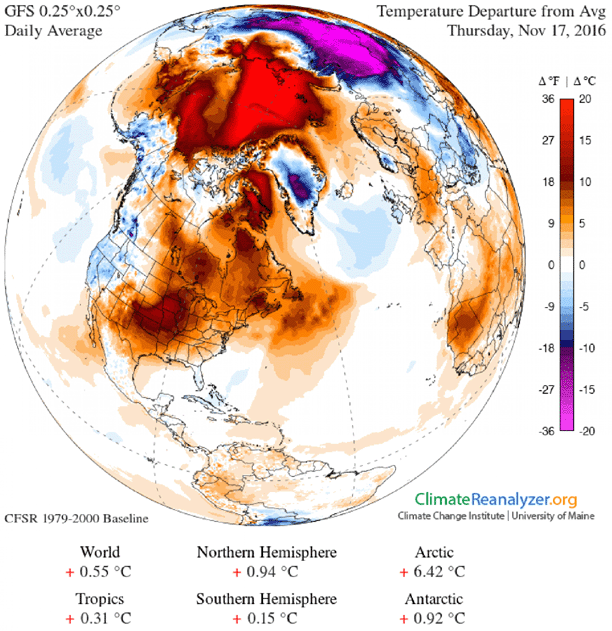
No part of the world is warming faster than the Arctic.
Summer sea ice regularly shrinks to record lows, coastlines are eroding and wildfires are getting worse. Even the frozen tundra, a critical natural storage tank for carbon emissions, is no longer so frozen. Scientists reported this week that it is warming so rapidly that it now is emitting more carbon than it captures.
The Fairbanks Declaration includes several other references to climate change and taking action to mitigate it or adapt to it. It refers to “reiterating the importance of climate science to our understanding of the changing Arctic region and our activities in the Arctic environment.”……http://www.latimes.com/nation/la-na-arctic-council-20170511-story.html
Point Lepreau Nuclear Power Station – there’s no way to make nuclear safe!

 How ‘Worst-Case Scenario’ At New Brunswick Nuclear Plant Could Affect Down East Maine, Maine Public, 12 May By JENNIFER MITCHELL Point Lepreau is a nuclear power plant just across the border in St. John. Next month its operating license expires, and the Canadian Nuclear Safety Commission is considering whether to renew it for another five years. While that’s not a long amount of time for a 30-year-old plant, there are passionate arguments for and against its operation and implications for an entire region.
This is the second of two parts. To read Part 1, a tour of Point Lepreau, click here.
Back in the 1950s, an U.S. Atomic Energy Commission film, “The Magic of the Atom,” was meant to ease the anxiety people might feel about living and working near a nuclear power plant.
“Today, if you were to take a trip in almost any direction across our great country, you might suddenly come upon a sign like this: Atomic City,” the film’s narrator says.
But after the 1979 disaster at Three Mile Island, nuclear plants developed a more sinister reputation, and ever since, facilities like Point Lepreau have been battling that legacy………
there are some who are speaking out against the facility’s license renewal.
“The health risks are too great. There is no way to make nuclear safe,” says Willi Nolan of Kent County, New Brunswick.
Nolan says she has made it her business to follow up on past major nuclear accidents, and she says the potential devastation to the environment is a deal breaker.
“I just spent some time with four survivors of Fukushima and I’m told, you know, after the worst-case scenario happened there, that there are now people dropping on the streets, 30 years old, 40 years old. We’re still not finished with Chernobyl. There are still human health effects, cancers, childhood conditions,” she says.
When it comes to a nuclear plant meltdown, there are two basic zones of concern: the critical emergency zone that extends for a 10-mile radius, and then what’s known as the ingestion pathway. That spans a 50-mile radius and, in the case of Lepreau, would include towns like Eastport, Calais, Lubec, and East Machias.
But how much do emergency responders in those towns know about nuclear events?
“Very little,” says Mike Hinerman, who runs Washington County’s Emergency Management Agency…….
the biggest problem, experts say, would come in the weeks, months and years after the event, because anything grown in or harvested from that 50-mile ingestion pathway could be tainted — for decades.
“What do you do with apples? What do you do with fish? What do you do with clams?” says Robert Gardiner, MEMA’s technological hazards manager……..a major Lepreau event would devastate the county’s economy, affecting everything from shipping at Eastport to aquaculture, forest products, fishing, tipping, hunting and tourism, and of course the region’s wild blueberries……..
While critics insist that the disaster risk doesn’t justify thee benefits, it’s the Canadian Nuclear Safety Commission that will have the final decision.http://mainepublic.org/post/how-worst-case-scenario-new-brunswick-nuclear-plant-could-affect-down-east-maine#stream/0
1 This Month


Tell the Ukrainian Government to Drop Prosecution of Peace Activist Yurii Sheliazhenko

Petition to revoke the licensing of the Near Surface Nuclear Disposal Facility (NSDF) at Chalk River. https://www.ourcommons.ca/petitions/en/Petition/Details?Petition=e-7247


of the week – STOP SMALL MODULAR REACTORS IN CANADA
To see nuclear-related stories in greater depth and intensity – go to https://nuclearinformation.wordpress.com
-
Archives
- March 2026 (204)
- February 2026 (268)
- January 2026 (308)
- December 2025 (358)
- November 2025 (359)
- October 2025 (376)
- September 2025 (258)
- August 2025 (319)
- July 2025 (230)
- June 2025 (348)
- May 2025 (261)
- April 2025 (305)
-
Categories
- 1
- 1 NUCLEAR ISSUES
- business and costs
- climate change
- culture and arts
- ENERGY
- environment
- health
- history
- indigenous issues
- Legal
- marketing of nuclear
- media
- opposition to nuclear
- PERSONAL STORIES
- politics
- politics international
- Religion and ethics
- safety
- secrets,lies and civil liberties
- spinbuster
- technology
- Uranium
- wastes
- weapons and war
- Women
- 2 WORLD
- ACTION
- AFRICA
- Atrocities
- AUSTRALIA
- Christina's notes
- Christina's themes
- culture and arts
- Events
- Fuk 2022
- Fuk 2023
- Fukushima 2017
- Fukushima 2018
- fukushima 2019
- Fukushima 2020
- Fukushima 2021
- general
- global warming
- Humour (God we need it)
- Nuclear
- RARE EARTHS
- Reference
- resources – print
- Resources -audiovicual
- Weekly Newsletter
- World
- World Nuclear
- YouTube
-
RSS
Entries RSS
Comments RSS
 nuclear-news