North Korea’s reasons for persisting in testing nuclear weapons
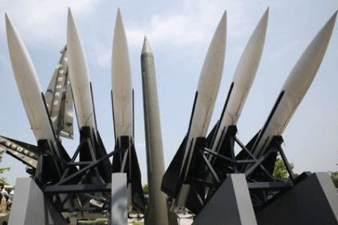
 Why North Korea is testing nuclear weapons Pyongyang accuses Washington of plotting a ‘decapitation strike’, and sees in nuclear weapons a powerful deterrent, Aljazeera, 5 May 17
1. Guaranteeing security of the state
2. Economic development and prosperity
3. Gaining respect and prestige in the international arena
On April 14, North Korea’s Vice Foreign Minister said: “We’ve got a powerful nuclear deterrent already in our hands, and we certainly will not keep our arms crossed in the face of a US pre-emptive strike.”
North Korea’s deputy ambassador to the United Nations, Choe Myong-nam, referred to the annual joint drills between the US and South Korea to justify his country’s nuclear pursuits: “It is because of these hostile activities on the part of the United States and South Korea that we strengthen our national defence capability, as well as pre-emptive strike capabilities with nuclear forces as a centrepiece.”
North Korea is publicly stating that it is going ahead with its nuclear weapons programme, while the International Atomic Energy Agency on May 4 said it has “concrete information” that this is indeed the case, and points out that security risks would apply beyond the region.
New satellite images of the Punggye-ri site in North Korea have shown workers pumping out water at a tunnel believed to have been prepared for a forthcoming nuclear test, US monitors said.
Has North Korea declared war in 2017?
North Korea has not officially declared war on any country since 1950, but has threatened to launch a “great war of justice for national reunification” and to strike the US mainland in “full-out war… under the situation where the US hurts the DPRK by force of arms,” using the alternative name for North Korea.
In 1950, North Korea invaded South Korea, starting the three-year Korean War which ended in 1953 with an armistice, not a peace treaty. This mean that North Korea is still technically at war with South Korea.
The US has 28,500 troops stationed in South Korea, while the Korean Peninsula has been divided by a 4km-wide demilitarised zone stretching 250km along the border.
The US has been performing the annual Foal Eagle military drills with South Korea, imposed sanctions on North Korea and has deployed the Terminal High-Altitude Area Defence system, designed to intercept and destroy ballistic missiles fired at South Korea.
From its side, North Korea has defiantly carried out missile test launches despite regional and US condemnation, and continues to develop its nuclear weapons capability.
How did North Korea get nuclear weapons?…….
How many nuclear weapons does North Korea have?
It was estimated that North Korea may have produced up to 20 nuclear bombs by the end of 2016, although the true nuclear capability of the isolated and secretive North Korean state could not be verified.
Meanwhile, North Korea asserts it will keep building up its nuclear arsenal in “quality and quantity”.
In September 2016, Siegfried Hecker from Johns Hopkins University in Washington toured North Korea’s main Yongbyon nuclear facility in 2010 and estimated that North Korea produced enough highly enriched uranium to make additional six nuclear bombs a year.
Experts and governments estimate plutonium production levels from tell-tale signs of reactor operation in satellite imagery. http://www.aljazeera.com/news/2017/05/north-korea-testing-nuclear-weapons-170504072226461.html
No comments yet.
1 This Month

of the week – Shut Down Drone Warfare!


Tell the Ukrainian Government to Drop Prosecution of Peace Activist Yurii Sheliazhenko

Petition to revoke the licensing of the Near Surface Nuclear Disposal Facility (NSDF) at Chalk River. https://www.ourcommons.ca/petitions/en/Petition/Details?Petition=e-7247
To see nuclear-related stories in greater depth and intensity – go to https://nuclearinformation.wordpress.com
-
Archives
- April 2026 (57)
- March 2026 (251)
- February 2026 (268)
- January 2026 (308)
- December 2025 (358)
- November 2025 (359)
- October 2025 (376)
- September 2025 (257)
- August 2025 (319)
- July 2025 (230)
- June 2025 (348)
- May 2025 (261)
-
Categories
- 1
- 1 NUCLEAR ISSUES
- business and costs
- climate change
- culture and arts
- ENERGY
- environment
- health
- history
- indigenous issues
- Legal
- marketing of nuclear
- media
- opposition to nuclear
- PERSONAL STORIES
- politics
- politics international
- Religion and ethics
- safety
- secrets,lies and civil liberties
- spinbuster
- technology
- Uranium
- wastes
- weapons and war
- Women
- 2 WORLD
- ACTION
- AFRICA
- Atrocities
- AUSTRALIA
- Christina's notes
- Christina's themes
- culture and arts
- Events
- Fuk 2022
- Fuk 2023
- Fukushima 2017
- Fukushima 2018
- fukushima 2019
- Fukushima 2020
- Fukushima 2021
- general
- global warming
- Humour (God we need it)
- Nuclear
- RARE EARTHS
- Reference
- resources – print
- Resources -audiovicual
- Weekly Newsletter
- World
- World Nuclear
- YouTube
-
RSS
Entries RSS
Comments RSS
 nuclear-news
Leave a comment