So why is there so little public protest today?………
It would be a terrible thing if it takes a disastrous nuclear war between the United States and North Korea to convince people that nuclear war is simply unacceptable.
Why Is There So Little Popular Protest Against Today’s Threats of Nuclear War? Common Dreams, Lawrence Wittner, 26 Apr 17, In recent weeks, the people of the world have been treated to yet another display of the kind of nuclear insanity that has broken out periodically ever since 1945 and the dawn of the nuclear era.
On April 11, Donald Trump, irked by North Korea’s continued tests of nuclear weapons and missiles, tweeted that “North Korea is looking for trouble.” If China does not “help,” then “we will solve the problem without them.” North Korean leader Kim Jong Un responded by announcing that, in the event of a U.S. military attack, his country would not scruple at launching a nuclear strike at U.S. forces. In turn, Trump declared: “We are sending an armada, very powerful. We have submarines, very powerful, far more powerful than the aircraft carrier. We have the best military people on earth.”
During the following days, the governments of both nuclear-armed nations escalated their threats. Dispatched to South Korea, U.S. Vice President Mike Pence declared that “the era of strategic patience is over,” and warned: “All options are on the table.” Not to be outdone, North Korea’s deputy representative to the United Nations told a press conference that “thermonuclear war may break out at any moment.” Any missile or nuclear strike by the United States would be responded to “in kind.” Several days later, the North Korean government warned of a “super-mighty preemptive strike” that would reduce U.S. military forces in South Korea and on the U.S. mainland “to ashes.” The United States and its allies, said the official statement, “should not mess with us.”
Curiously, this North Korean statement echoed the Trump promise during his presidential campaign that he would build a U.S. military machine “so big, powerful, and strong that no one will mess with us.” The fact that both Trump and Kim are being “messed with” despite their possession of very powerful armed forces, including nuclear weapons, seems to have eluded both men, who continue their deadly game of nuclear threat and bluster.
And what is the response of the public to these two erratic government leaders behaving in this reckless fashion and threatening war, including nuclear war? It is remarkably subdued. People read about the situation in newspapers or watch it on the television news, while comedians joke about the madness of it all. Oh, yes, peace and disarmament organizations condemn the escalating military confrontation and outline reasonable diplomatic alternatives. But such organizations are unable to mobilize the vast numbers of people around the world necessary to shake some sense into these overwrought government officials.
The situation was very different in the 1980s, when organizations like the Nuclear Weapons Freeze Campaign (in the United States), the Campaign for Nuclear Disarmament (in Britain), and similar groups around the world were able to engage millions of people in protest against the nuclear recklessness of the U.S. and Soviet governments―protest that played a key role in curbing the nuclear arms race and preventing nuclear war.
So why is there so little public protest today?………
The numbers of cases rose into the thousands, too high to dismiss, and in 1996 the WHO and the IAEA finally admitted that skyrocketing rates of childhood thyroid cancer were most likely due to Chernobyl exposures.
Today we know little about the non-cancerous effects that Soviet scientists working in contaminated zones reported in the late 1980s, and which they attributed to internal and external exposures to ionizing radiation. Are these effects as real as the childhood thyroid cancers proved to be? The Soviet post-Chernobyl medical records suggest that it is time to ask a new set of questions about long-term, low-dose exposures.
In June 1980 a doctor with the Oak Ridge Associated Universities in the US wrote a letter to a colleague at the Knolls Atomic Power Laboratory in upstate New York. The pair were corresponding about a forthcoming study of employee health at the Knolls reactor, and the doctor, C C Lushbaugh, wrote that he expected “little ‘useful’ knowledge” from this study “because radiation doses have been so low”. Even so, he agreed that the study had to be done because “both the workers and their management need to be assured that a career involving exposures to low levels of nuclear radiation is not hazardous to one’s health”. The results of such a study, he surmised, would help to counter anti-nuclear propaganda and resolve workers’ claims. However, they could also be a liability. If a competing union or regulatory agency got hold of the employees’ health data, Lushbaugh fretted, it could be weaponized. “I believe,” he continued, “that a study designed to show the transgressions of management will usually succeed.”
Lushbaugh’s dilemma is characteristic of research on the human health effects of exposure to low doses of radiation. He assumed he knew the results – good or bad – before the study began, because those results depended on how the study was designed. The field was so politicized, in other words, that scientists were using health studies as polemical tools and, consequently, asking few open-ended scientific questions.
A few years after Lushbaugh posted this letter, reactor number four at the Chernobyl nuclear power plant blew up, killing 31 workers and firefighters and spreading radioactive material across a broad area of what was then the Soviet Union (now Ukraine and Belarus) and beyond. The accident also exploded the field of radiation medicine and, for a while, promised to rejuvenate it. In August 1986, months after the accident, the chief of the United Nations Scientific Committee on the Effects of Atomic Radiation (UNSCEAR), Giovanni Silini, advocated an enduring epidemiological investigation similar to research on atomic-bomb survivors in Japan [1]. Many other scientists concurred, hoping that Chernobyl could clear up ongoing controversies and uncertainties surrounding low-dose exposures.
It never happened. No long-term epidemiological study took place. That’s not to say there isn’t any information. A few summers ago I went to the Ukrainian national archives in the dusty, bustling outskirts of Kiev and asked the archivists for files on Chernobyl from Soviet Ukraine’s Ministry of Health. They laughed, telling me Chernobyl was a banned topic in the Soviet Union. “You won’t find anything,” they said.
They were wrong. I found dozens of collections labelled “The medical effects of the Chernobyl disaster”. I started reading and have not yet been able to stop.
The aftermath
In the years between 1986 and 1991, doctors and sanitation officials wrote to the Ministry of Health in Kiev with alarming accounts of widespread, chronic illness among the hundreds of thousands of children and adults living in contaminated territories. They recorded increases in tonsillitis, upper respiratory disease and disorders of the digestive tract and immune system. Between 1985 and 1988, cases of anaemia doubled. Physicians from almost every region in the zone of contamination reported a leap in the number of reproductive problems, including miscarriages, stillbirths and birth malformations. Nervous-system disorders surged. So did diseases of the circulatory system. In 1988, in the heavily contaminated Polesie region of northern Ukraine, 80% of children examined had upper respiratory diseases and 28% had endocrine problems. In Ivankiv, where many cleanup workers lived, 92% of all children examined had a chronic illness.
I also went to Minsk to check the archives in Belarus. There, I read reports that sounded eerily similar to the Ukrainian documents. These reports were classified “for office use only”, meaning that at the time, scientists were not free to exchange this information across districts or republics of the Soviet Union. Even so, independently, they were reporting similar, bad news. The problem grew so dire in Belarus that in 1990 officials declared the entire republic, which received more than 60% of Chernobyl fallout, a “zone of national ecological disaster”.
The Ukrainian and Belarusian reports, hundreds of them, read like a dirge from a post-catastrophic world. Doctors wrote from clinics in Kharkiv, far outside the contaminated zone, and described similar health problems among evacuees who had settled there. Physicians sent telegrams from Donetsk, where they were treating a complex of illnesses among young miners who had burrowed under the smouldering reactor in the days after the accident. Medical workers sent in to examine people in contaminated regions also fell ill.
In response, the Union of Soviet Radiologists penned a petition to alert Soviet leaders of the ongoing public health disaster. The president of the Belarusian Academy of Science sent a detailed summary of scientists’ findings to Minsk and Moscow. Even a KGB general, Mikhailo Zakharash, sounded the alarm. Zakharash, who was also a medical doctor, conducted a study of 2000 cleanup workers and their family members in a specially equipped KGB clinic in Kiev. In 1990, summing up four years of medical investigation, he wrote, “We have shown that long term, internal exposures of low doses of radiation to a practically healthy individual leads to a decline of his immune system and to a whole series of pathological illnesses.”
Chronic radiation
These findings track with what Soviet doctors had long described as chronic radiation syndrome, a complex of symptoms derived from chronic exposure to low doses of radiation. Researchers working on Chernobyl discerned a pattern of disease that tracked with pathways of radioactive isotopes entering the body, paths that began in either the mouth and headed towards the gastrointestinal tract or started in the lungs and followed blood into circulatory systems. Radioactive iodine sped to thyroids, they hypothesized, causing endocrinal and hormonal damage.
Critics, mostly in Moscow and the ministries of health, acknowledged the growth in health problems, but denied a connection to Chernobyl. A E Romanenko, the Ukrainian Minister of Health, is credited with inventing the word “radiophobia” to describe a public fear of radiation that induced stress-related illness. He and his colleagues also pointed to a screening effect from mass medical monitoring. Local doctors, they said, were projecting the diagnoses of chronic radiation syndrome onto their patients, blaming it for any illness found after Chernobyl.
There are some problems with these arguments. From 1986 to 1989, Chernobyl was a censored topic in the Soviet Union. Doctors could not exchange information about health problems, nor did they have access to maps of radioactive contamination. They only learned to be “radiophobic” by judging the bodies they examined. In the same years, doctors were also fleeing contaminated areas en masse, leaving hospitals and clinics in those regions staffed at 60%. As physicians left, so too did the chance for diagnosis, meaning that under-reporting of illnesses was more likely than a screening effect. Moreover, doctors from the northern regions of the Rivne province, which were at first judged clean and only in late 1989 designated contaminated, reported the same growth of illness as areas originally deemed “control zones,” regions with counts of more than 5 curies per square kilometre. The president of the Belarusian Academy of Science, V P Platonov, pointed to a vacuum of knowledge: “Until this time, no population has ever lived with continual internal and external exposures of this size.” Risk assessments assuring safe levels in the contaminated zones were extrapolated from the Japanese Atomic Bomb Survivor Lifespan Study, but these began only in 1950, five years after exposure. “Much is uncertain,” Platonov continued, “about fundamental aspects of the effects of low doses of radiation on human organs,” [2].
What happened to the 1980s Chernobyl health studies, which might have led to a renaissance in the field of radioecology? Essentially, they were overlooked. To figure out why, I went to the headquarters of the World Health Organization (WHO) in Geneva, to the UN’s archives in New York and the archives of UNSCEAR in Vienna. There, I found evidence of a conflict between branches of the WHO and the International Atomic Energy Agency (IAEA) over which organization would control the studies of Chernobyl health effects.
By 1989 angry crowds were questioning the Soviet Union’s handling of Chernobyl, and Soviet leaders asked foreign experts for help in assessing the disaster’s health impacts. The IAEA agreed, and Fred Mettler, a radiologist and American delegate to UNSCEAR, was appointed to head the medical section of an IAEA team. In 1990, as he and his team examined 1726 people in six contaminated zones and six control zones, Soviet doctors gave him 20 slides from children diagnosed with thyroid cancer. Thyroid cancer is very rare in children: before the Chernobyl accident, doctors saw eight or nine cases per year in all of Ukraine. Twenty cases in just three provinces was hard to believe. Dubious, Mettler brought the slides to the US to have them verified. They indeed indicated thyroid cancer.
Cancer cluster
Mettler mentioned this major medical finding in the 1991 International Chernobyl Project (ICP) technical report, but strangely, he also stated that there was “no clear pathologically documented evidence of an increase in thyroid cancer” [3]. The report concluded that there were no detectable Chernobyl health effects and only a probable chance of childhood thyroid cancers in the future. In a 1992 publication on thyroid nodules in the Chernobyl territories, Mettler failed to mention the 20 verified cases at all [4].
How could such a lapse occur? I found a confidential 1990 UN memo that seems relevant, particularly in light of the study-design problem set out in Lushbaugh’s letter a decade earlier. The memo suggests that the IAEA was conducting the ICP study to “allay the fears of the public” in service of “its own institutional interest for the promotion of peaceful uses of nuclear energy” [5]. The experiences of Keith Baverstock, then head of the radiation protection programme in the WHO’s European office, likewise reveal an institutional aversion to bad news. In July 1992 Baverstock planned to go to Minsk to examine childhood thyroid cases in Belarus, where doctors reported an astounding 102 new cases. At the last minute, officials from the WHO and the Commission of European Communities inexplicably pulled out of the mission. In an interview with me, Baverstock, an expert on the effects of ionizing radiation, said that a WHO official told him he could get fired if he went to Minsk.
He went anyway. With Belarusian scientists, he published news of the thyroid cancer epidemic in Nature. A top IAEA official complained angrily to the WHO, and the two agencies put pressure on Baverstock to retract his article. He refused, and a barrage of letters followed in Nature disputing the connection between the cancers and Chernobyl exposures [6]. Leading scientists from the US Department of Energy, the National Cancer Institute, Japan’s Radiation Effects Research Foundation and the IAEA argued that cancers were found because of increased surveillance. They called for a suspension of judgment and for further study. Repetitive and dismissive, their letters read like an orchestrated pile-on.
We now know that these global leaders in radiology were wrong. The numbers of cases rose into the thousands, too high to dismiss, and in 1996 the WHO and the IAEA finally admitted that skyrocketing rates of childhood thyroid cancer were most likely due to Chernobyl exposures. Today, the UNSCEAR maintains that the health consequences of the Chernobyl accident are limited to 31 direct fatalities – plus 6000 cases of children’s thyroid cancer [7].
Lingering questions
The question is – so what? Despite the 1991 ICP report’s erroneous claim of no health effects, UN agencies eventually recognized the cancer epidemic. What difference did a few years make? A great deal, it turns out. The ICP report also recommended that resettlements from the most contaminated regions should cease [8]. Consequently, the planned resettlement of 200,000 people living in areas contaminated with high levels of radiation (between 15 and 40 curies per square kilometre) slowed tremendously. The UN General Assembly had also been waiting for the report before raising funds for Chernobyl relief. The $646m budget (equivalent to about $1.1bn today) included medical aid, resettlement funds and a large-scale epidemiological study of Chernobyl health effects. The assertion by important UN agencies that there were no detectable health effects deflated that effort. Before the report, Japan had given $20m to the WHO, but afterwards it gave no more and complained about the funds being wasted. A few other countries gave sums totalling less than $1m, while the US and the European Community begged off entirely, citing the ICP report as a “factor in their reluctance to pledge” [9].
In subsequent years, IAEA and UNSCEAR officials cited the ICP report when discouraging Chernobyl-related health projects. In 1993 UNSCEAR scientific secretary Burton Bennett recommended that UN agencies suspend all programmes aimed at Chernobyl relief because they were unnecessary. He and IAEA administrator Abel Gonzalez, who led the ICP assessment, widely shared their views among UN agencies about “misinformation surrounding the Chernobyl accident” [10]. When the WHO, nonetheless, started a pilot study on Chernobyl health effects, Gonzalez wrote that he could not imagine what the WHO “expects to be able to detect for the level of doses in question”. Irked that WHO officials would examine any effects but psychological ones, he charged, “The World Health Organization seems to ignore, expressly or tacitly, the conclusions and recommendations of the International Chernobyl Project,” [11].The consequences of this moment of deviant science continue 30 years later. Today we know little about the non-cancerous effects that Soviet scientists working in contaminated zones reported in the late 1980s, and which they attributed to internal and external exposures to ionizing radiation. Are these effects as real as the childhood thyroid cancers proved to be? The Soviet post-Chernobyl medical records suggest that it is time to ask a new set of questions about long-term, low-dose exposures.
References
Giovanni Silini 1986 “Concerning proposed draft for long-term Chernobyl studies” Correspondence Files, UNSCEAR Archive
V P Platonov and E F Konoplia 1989 “Informatsiia ob osnovynkh rezul’tatakh nauchnykh rabot, sviazannykh s likvidatsiei posledstvii avarii na ChAES” RGAE 4372/67/9743: 490
From Enrique ter Horst, Asst Sec Gen, ODG/DIEC to Virendra Daya, Chef de Cabinet, EOSG, 16 April 1990, United Nations Archive, New York S-1046 box 14, file 4, acc. 2001/0001
“International co-operation in the elimination of the consequences of the Chernobyl Nuclear Power Plant accident” 24 May 1990, UNA S-1046/14/4; “Third meeting of the Inter-Agency Task Force on Chernobyl” 19–23 September 1991, WHO E16-445-11, 5; “Briefing note on the activities relating to Chernobyl” 3 June 1993, Department of Humanitarian Affairs DHA, UNA s-1082/35/6/, acc 2002/0207; Anstee to Napalkov, 17 Jan 1992, WHO E16-445-11, 7
Gonzalez to Napalkov, 10 August 1993, WHO E16-445-11, 19; B G Bennett 1993 “Background information for UNEP representative to the meeting of the Ministerial Committee for Coordination on Chernobyl” 17 November 1993, New York, Correspondence Files, UNSCEAR Archive, Vienna
Gonzalez to Napalkov, 10 August 1993, WHO E16-445-11, 19
Michael Fallon had said the Prime Minister could launch a nuclear attack against another country, even if the UK was not under nuclear attack, in “the most extreme circumstances”.
Jonathan Bartley, co-leader of the Green Party, branded the position “immoral” because it would lead to the deaths of countless civilians. He also criticised Jeremy Corbyn, whose party says it will renew Trident despite its leader’s clear statement that he would not use the weapon of mass destruction. Mr Bartley branded Labour’s approach to the multi-billion pound missile system “HMS Pointless”.
Speaking at St George’s Hospital in Tooting on Monday the Green co-leader pledged spend the cost of the weapon on the NHS.
“Voters are being offered a choice between Tory first strike fanaticisms and Labour’s HMS Pointless. What could be more immoral than considering a first use of nuclear weapons, knowing full well that it would lead to the death of countless civilians?” he said.
“And what could be more illogical that pledging to renew a multi-billion pound nuclear weapons system that will never be used? With people struggling to get by in Britain it’s inexcusable to be ploughing people’s money into this cold war relic.
“Instead of replacing this nuclear monstrosity the Green Party would give the NHS an emergency kiss of life. People are being treated in corridors while we flush money away on nuclear weapons. Cancelling Trident would give our NHS more than £3bn per year – which must be added to additional funding from raising taxes.
“Real security means having a world class health service, not locking ourselves into replacing these weapons we’ll never use. Imagine the impact on our NHS of employing 85,000 more nurses, midwives and health professionals – that’s what is at stake here.”
Speaking on Sunday Labour leader Mr Corbyn said he would try to de-escalate a nuclear war and said that “any use of nuclear weapons is a disaster for the whole world”. His party however says it is committed to maintaining a “nuclear deterrent” and would renew Trident.
Speaking on BBC Radio 4 this morning Mr Fallon, Ms May’s defence secretary, said: “In the most extreme circumstances, we have made it very clear that you can’t rule out the use of nuclear weapons as a first strike.
Asked in what circumstances, he replied: “They are better not specified or described, which would only give comfort to our enemies and make the deterrent less credible.”
The highest estimate of the cost of replacing Trident is £205 billion over its lifetime, according to the Campaign for Nuclear Disarmament. One estimate collated from ministerial statement by Crispin Blunt, the Tory MP who chairs the Foreign Affairs Committee, pegged the cost at £167 billion.
The independent Trident Commission, which reported in 2014, pegged the cost at closer to £100 billion.
Theresa May would fire UK’s nuclear weapons as a ‘first strike’, says Defence Secretary Michael Fallon
‘We have made it very clear that you can’t rule out the use of nuclear weapons as a first strike’Independent, Rob Merrick Deputy Political Editor @Rob_Merrick , 24 Apr 17,
Theresa May would fire Britain’s nuclear weapons as a ‘first strike’ if necessary, the Defence Secretary has said.
Michael Fallon said the Prime Minister was prepared to launch Trident in “the most extreme circumstances”, even if Britain itself was not under nuclear attack.
The statement came as the Conservatives continued to exploit Labour divisions on the retention of the Trident deterrent, to warn of the“very dangerous chaos” if Jeremy Corbyn becomes prime minister……..
“In the most extreme circumstances, we have made it very clear that you can’t rule out the use of nuclear weapons as a first strike,” Mr Fallon said.
Asked in what circumstances, he replied: “They are better not specified or described, which would only give comfort to our enemies and make the deterrent less credible.
“The whole point about the deterrent is that you have got to leave uncertainty in the mind of anyone who might be thinking of using weapons against this country.”
Mr Fallon also insisted that critics of Trident – including senior military figures who have ridiculed the idea that it is an effective deterrent – were “absolutely wrong”……..
“The Labour party is very clear we are committed to a credible nuclear credibility at the minimum end of the scale. That is Labour party policy and it will be in the manifesto,” Mr Gwynne said.
But he appeared to rule out a first strike, adding: “We would not be in a position where the first choice would be to press that red button. It is a deterrent because we have them.
Britain would be ‘literally erased from the face of the earth’ if it launched a nuclear attack, warns Russian MP Another translation says Britain would be ‘razed to the ground’ in a retaliatory strike, Independent, Samuel Osborne@SamuelOsborne93, 24 Apr 17, Britain would be “literally erased from the face of the earth” in a nuclear war, a Russian MP has warned.
Franz Klintsevich, a retired colonel, was responding to comments from Defence Secretary Michael Fallon, who said “in the most extreme circumstances, we have made it very clear that you can’t rule out the use of nuclear weapons as a first strike.”
Mr Klintsevich said if Britain were to launch a preemptive strike, then “not having the biggest territory, it will literally be erased from the face of the earth.” Another translation, carried by the Russian news agency TASS, says Britain would be “razed to the ground” in a retaliatory strike.
Sir Michael’s comments came in response to Labour divisions over retaining the Trident deterrent, with Labour leader Jeremy Corbyn suggesting renewal might not be in the party’s election manifesto — only to be corrected later by party colleagues.
Speaking to BBC Radio Four’s Today Programme, Sir Michael said Labour had left voters “completely unsure as to what would actually happen to our nuclear deterrent.”
He said Prime Minster Theresa May would be ready to use Trident as a “pre-emptive initial strike”…….
Mr Klintsevich, who is deputy chairman of the upper house of the Russian parliament’s defence and security committee, called Sir Michael’s comments “disgusting” and said it “deserves a tough response”. He added: “In the best case this statement should be taken as an element of psychological war — which looks particularly disgusting in such a context.
“Otherwise, it sounds really bad, because a reasonable question arises: Against whom is Great Britain going to preemptively use nuclear weapons?”
If Britain intended to use nuclear weapons against a non-nuclear state, he added, “then probably English people desperately want to share the laurels of the USA who threw nuclear bombs at defenceless [Japanese cities] Hiroshima and Nagasaki [in 1945].”
STUDY: Impact Of Climate Change On Florida, Goodbye Miami
America’s trillion-dollar coastal property bubble could burst “before the sea consumes a single house.” Here’s why. “Pessimists selling to optimists.” That’s how one former Florida coastal property owner describes the current state of the market in a must-read Bloomberg story.
Right now, science and politics don’t favor the optimists. The disintegration of the Greenland and Antarctic ice sheets is speeding up, providing increasing evidence we are headed for the worst-case scenario of sea level rise — three to six feet (or more) by 2100.
The impacts are already visible in South Florida. “Tidal flooding now predictably drenches inland streets, even when the sun is out, thanks to the region’s porous limestone bedrock,” explains Bloomberg. “Saltwater is creeping into the drinking water supply.”
At the same time, President Trump is working to thwart both domestic and international climate action while slashing funding for coastal adaptation and monitoring. E&E News reported earlier this month that the EPA has already “disbanded its climate change adaptation program” and reassigned all the workers.
Faster sea level rise and less adaptation means the day of reckoning is nigh. Dan Kipnis, chair of Miami Beach’s Marine and Waterfront Protection Authority — who has failed to find a buyer for his Miami Beach home for nearly a year — told Bloomberg, “Nobody thinks it’s coming as fast as it is.”
But this is not just South Florida’s problem. The entire country is facing a trillion-dollar bubble in coastal property values. This Hindenburg has been held aloft by U.S. taxpayers in the form of the National Flood Insurance Program.
A 2014 Reuters analysis of this “slow-motion disaster” calculated there’s almost $1.25 trillion in coastal property being covered at below-market rates.
When will the bubble burst? As I’ve written for years, property values will crash when a large fraction of the financial community — mortgage bankers and opinion-makers, along with a smaller but substantial fraction of the public — realize that it is too late for us to stop catastrophic sea level rise.
When sellers outnumber buyers, and banks become reluctant to write 30-year mortgages for doomed property, and insurance rates soar, then the coastal property bubble will slow, peak, and crash.
The devaluation process had begun even before Trump’s election reduced the chances we would act in time to prevent catastrophic climate change. The New York Times reported last fall that “nationally, median home prices in areas at high risk for flooding are still 4.4 percent below what they were 10 years ago, while home prices in low-risk areas are up 29.7 percent over the same period.”
Sean Becketti, the chief economist for mortgage giant Freddie Mac, warneda year ago that values could plunge if sellers start a stampede. “Some residents will cash out early and suffer minimal losses,” he said. “Others will not be so lucky.”
As this week’s Bloomberg piece puts it, “Demand and financing could collapse before the sea consumes a single house.”
So here’s a question for owners of coastal property — and the financial institutions that back them — as they watch team Trump keep his coastal-destroying promises: Who will be the smart money that gets out early — and who will be the other kind of money?
Reuters is reporting that “sales of nuclear shelters and radiation-blocking air purifiers have surged in Japan in recent weeks…”
One company, Oribe Seiki Seisakusho, appears to be doing particularly well, receiving eight orders for nuclear shelters in April and selling all 50 of its $5,000-a-piece, poison gas filtering air purifiers.
According to Newsweek, the buying activity may have been prompted, at least in part, by Prime Minister Shinzo Abe’s recent warning to other Japanese government officials that “there is a possibility that North Korea already has a capability to put sarin on warheads to strike the ground.”
Meanwhile, the Japan Times reported last month that Oga, a Japanese city in Akita Prefecture, conducted the country’s first evacuation drill “on the premise of a ballistic missile falling into Japanese waters off Akita, [and] was aimed at promptly relaying information while facilitating the swift and safe evacuation of residents.” The media outlet further notes that the drill included participation by an elementary school, among others.
In addition to these protective measures, Japan has been working with the U.S. and its neighbor South Korea to detect and possibly intercept approaching missiles.
Japanese citizens have 10 minutes to prepare for a North Korean nuclear attack, Missile ‘will not take long to reach Japan,’ says government, The Independent, Harriet Agerholm@HarrietAgerholm 25 Apr 17, Japanese citizens will have just 10 minutes to prepare a North Korean ballistic missile attack, authorities in the country have warned.
In the event of an attack, a document posted on the country’s civil protection site advises people to find the strongest concrete building possible or go underground.
Then they should then take cover under tables and stay away from windows, it says. A ballistic missile would likely take around 10 minutes to travel 1,600 km (1,000 miles) from its launch pad in North Korea to Okinawa, it adds, citing a launch in February last year which took that length of time to fly over the Japanese island.
The warning comes as tensions ratcheted up between North Korea, its Asian neighbours and the US. The secretive communist state test-fired four ballistic missiles last month, three of which landed in Japan’s exclusive economic zone in the Sea of Japan, just off the coast of the country.
It has subsequently emerged that the country’s civil defence website had 5.7 million visitors in the first 23 days of April — more than 14 times the usual monthly traffic.
Japan’s early-warning system, which issues missile strike alerts to the population via loudspeaker and telephone has come under increased scrutiny amid the rising tensions.
In 1998, North Korea demonstrated that its missiles were capable of reaching Japan when it fired a missile to launch a satellite across Japanese territory that landed in its economic zone on the Pacific Ocean side.
North Korea highlights 1250 US marines in Darwin to claim America is preparing for nuclear war, SMH, Kirsty Needham and James Massola, 25 Apr 17, North Korea’s state newspaper has singled out the United States’ deployment of 1250 marines to Darwin to claim America is preparing for nuclear war.
And as regional tensions escalate and a US carrier strike group approaches the Korean peninsula, Australian Foreign Minister Julie Bishop said the secretive regime “must be stopped” as it represented a threat to the region and, potentially, globally.
Pusan National University associate professor Robert Kelly told Fairfax Media North Korea’s missiles might have the range to reach northern Australia, but played down the threat as “the question is guidance, not range”.
Rodong Sinmun, the official paper of the Worker’s Party of North Korea, highlighted the US marines’ arrival in northern Australia on April 18. The marines will be joined by 12 military helicopters including five Cobra helicopters and four Osprey carriers.
“This is the largest scale US military presence in Australia after World War 2,” the newspaper reported on Monday. “America is fanatically, crazily trying to optimise its nuclear war readiness,” it claimed.
The story, on page six of the North Korean newspaper, was headlined: America prepares for nuclear war in different overseas military deployments. Darwin was the only city named…….
Australia-based defence experts believe it is unlikely North Korea has the capacity to strike Australia yet, though they may do within the next three years. The nation’s most recent missile test, earlier this month, failed just seconds after launch…….
The deployment of 1250 marines is the largest to Darwin since the former prime minister Julia Gillard and former president Barack Obama struck a deal back in 2011 to undertake the yearly rotation of troops.
Pine Gap is more than a giant electronic vacuum cleaner. The facility is also involved in tactical warfare, through programs like “The Red Dot Express”.
More controversial is Pine Gap’s role in drone strikes.
Instead of trying to pump up hysteria over a non-existent North Korean missile strike, The Turnbull Government should take a hard look at the very real threat that Pine Gap and Northwest Cape pose to Australia.
Pine Gap is still there — bigger and badder than ever, Independent AustraliaNorm Sanders25 April 2017With Donald Trump putting a blowtorch to the Cold War, it is time to take another look at all the U.S. bases in Australia, including Pine Gap, writes Dr Norm Sanders.
PINE GAP, Northwest Cape and Nurrungar were the focus of the Australian Peace Movement in the 1980’s. Then the Bulletin of Atomic Scientists Doomsday Clock crept slowly away from midnight and the removal of the bases didn’t seem so urgent. The clamour to close the bases died down………
I actually knew quite a bit about what Pine Gap was up to at the time, but it was child’s play compared to what they are doing at present. A simple place to start is Pine Gap’s assumption of the function of Nurrungar in 1999. Nurrungar was located at Island Lagoon, Woomera and was crucial to America’s defenses during the Cold War. Nurrungar furnished “Launch on Warning” surveillance of ICBM or other rocket launches anywhere on the globe. Analysts regarded it as one of the USSR’s top ten targets.
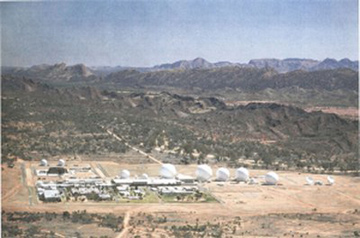
Now, Pine Gap has probably surpassed Nurrungar in the rankings. It is one of the largest satellite ground stations in the world, with over 33 satellite antennas. Pine Gap houses a number of U.S. Government agencies, such as the National Reconnaissance Office (spy satellites,) the National Security Agency, the CIA, and the Geospatial-intelligence Agency. In addition, all branches of the U.S. Military are represented.
Pine Gap is a major element of ECHELON, a signals intelligence collection and analysis network. Echelon can eavesdrop on faxes, computers and telephones, and can even scan bank accounts. It can actually pick up enemy combat forces talking to each other in the field. The U.S. Government says Echelon doesn’t exist and never did. In fact, it may have now merged with XKeyscore, another system at Pine Gap. It is run by the National Security Agency and shares data with the Australian Signals Directorate.
In an interview with a German TV station in 2014, Snowden answered the question of what he could do with XKeyscore by saying:
You could read anyone’s email in the world, anybody you’ve got an email address for. Any website: You can watch traffic to and from it. Any computer that an individual sits at: You can watch it. Any laptop that you’re tracking: you can follow it as it moves from place to place throughout the world. It’s a one-stop-shop for access to the NSA’s information.
…You can tag individuals… Let’s say you work at a major German corporation and I want access to that network, I can track your username on a website on a form somewhere, I can track your real name, I can track associations with your friends and I can build what’s called a fingerprint, which is network activity unique to you, which means anywhere you go in the world, anywhere you try to sort of hide your online presence, your identity.
No wonder Snowden has to stay in Russia!
But Pine Gap is more than a giant electronic vacuum cleaner. The facility is also involved in tactical warfare, through programs like “The Red Dot Express”.
Red Dot uses a plethora of imaging techniques, signal intercepts and other sources to identify IED’s (Improvised Explosive Devices) by their electronic emissions. All this data passes through Pine Gap, gets analysed and, ultimately, is displayed as a red dot on a Humvee computer as a warning that there is a possible IED just ahead on an Afghan road.
More controversial is Pine Gap’s role in drone strikes. This prompted the late Des Ball, a leading ANU intelligence expert, to criticise the Pine Gap facility which he formerly supported.
On the 7:30 Report, broadcast 13/08/2014, he said:
“I’ve reached the point now where I can no longer stand up and provide the verbal, conceptual justification for the facility that I was able to do in the past. We’re now linked in to this global network where intelligence and operations have become essentially fused and Pine Gap is a key node in that whole network, that war machine, if you want to use that term, which is doing things which are very, very difficult, I think, as an Australian, to justify.”………
The base is six kilometres north of the town of Exmouth, Western Australia. Exmouth itself was built to support the base and be a home to dependent families of the U.S. Navy personnel.
The station is a key link in the communication capability with U.S. Navy and Australian ships in a vast area of the Western Pacific and Eastern Indian Ocean. It transmits on VLF (very low frequency,) at 19.8 kHz with a power of 1 million watts, which makes it the most powerful transmitter in the Southern Hemisphere. For comparison, commercial TV transmitters have about 1⁄10 the power.
The powerful transmitter has been linked to two incidents in which Qantas airliners had equipment failures while flying in the area. Qantas Flight 72 had to make an emergency landing at Learmouth, near Exmouth, after uncontrolled pitch-downs which caused fractures, lacerations and spinal injuries to passengers and crew.
In order to transmit this massive power, Northwest Cape has a huge spiderweb array of antennas supported by 13 towers, each almost 400 meters high. Buried underneath the antenna is 386 kilometres of bare copper mat as a ground plane.
The combination of the very low fequency and immense power means that Northwest Cape can communicate with nuclear armed submarines while they are submerged to at least 20 meters to avoid detection. The orders to launch nuclear missiles in time of war in the region would be sent through the base. It is this function which makes Northwest Cape an obvious prime nuclear target.
The three-tier disposal scheme for the waste generated by the Tokai Reprocessing Plant is based on radiation level.
Waste with the highest radiation level, which will fill some 30,000 drums, will be buried more than 300 meters underground.
Mid-level waste, which will fill about 24,000 containers, is expected to be buried several dozens of meters underground.
Low-level waste, involving another 81,000 drums, will be buried close to the surface, the JAEA said. In the meantime, the plant’s tainted equipment and facilities will need to be decontaminated and scrapped before being filled with cement and mortar and put in drums for transport to a final disposal site.
The big problem is, there has been little progress in deciding where to bury the drums because they can’t find anyone willing to accept them.
The state-backed JAEA did not reveal the cost to taxpayers in 2014, when it made the decision to shut down the plant in the village of Tokai, Ibaraki Prefecture, over a 70-year period.
The facility started operation in 1977 as part of Japan’s desire to establish a nuclear fuel cycle, in which all spent fuel is reprocessed to extract its plutonium and uranium to make more fuel. The policy is designed to ensure resource-dependent Japan uses its nuclear fuel as efficiently as possible.
The JAEA decided to scrap the sprawling plant after it became too costly to run under the more stringent safety rules introduced following the 2011 Fukushima nuclear crisis. The facility comprises around 30 buildings and has large areas rife with contamination caused by its task of disassembling spent nuclear fuel.
According to the official, the startling decommissioning estimate is based on an estimate the agency made in 2003. The JAEA is finalizing the assessment and on course to submit it for approval by the Nuclear Regulation Authority as early as June.
The three-tier disposal scheme for the waste generated by the Tokai Reprocessing Plant is based on radiation level.
Waste with the highest radiation level, which will fill some 30,000 drums, will be buried more than 300 meters underground.
Mid-level waste, which will fill about 24,000 containers, is expected to be buried several dozens of meters underground.
Low-level waste, involving another 81,000 drums, will be buried close to the surface, the JAEA said. In the meantime, the plant’s tainted equipment and facilities will need to be decontaminated and scrapped before being filled with cement and mortar and put in drums for transport to a final disposal site.
The big problem is, there has been little progress in deciding where to bury the drums because they can’t find anyone willing to accept them.
Despite the Fukushima nuclear disaster, the government is trying to resume nuclear power generation and continue its pursuit of a nuclear fuel cycle.
This policy, however, has experienced setbacks from the recent decision to decommission the Monju fast-breeder reactor, an experimental facility in Fukui Prefecture that was considered key to the nuclear fuel cycle plan.
And the completion of a new fuel reprocessing plant in the village of Rokkasho, Aomori Prefecture, has also been largely behind schedule for years.
In the meantime, public concerns about the safety of atomic power remain strong at a time when the government is aiming to make it account for 20 to 22 percent of Japan’s electricity supply by 2030.
The new estimate for decommissioning the Tokai Reprocessing Plant includes ¥330 billion for storing waste underground, ¥166 billion for decontaminating and dismantling the facility, and ¥87 billion for transportation costs.
The JAEA facility is not to be confused with the private uranium-processing facility in Tokai where a fatal criticality accident occurred in 1999.
US prepares charges to seek arrest of WikiLeaks’ Julian Assange – sources | 20 April 2017 | US authorities have prepared charges to seek the arrest of WikiLeaks founder Julian Assange, US officials familiar with the matter tell CNN. The Justice Department investigation of Assange and WikiLeaks dates to at least 2010, when the site first gained wide attention for posting thousands of files stolen by the former US Army intelligence analyst now known as Chelsea Manning.
KIM Jong-un’s controversial nuclear weapons programme has been funded from a business being run out of a gated London home, it’s been reported.
Tens of millions of pounds have been sent on to North Korea from the anonymous looking detached property in a quiet Blackheath street. Reports in the Sunday Times claim up to £33 million a year has been funnelled through the insurance company which is said to have been controlled directly from Pyongyang. Last night UK Government officials confirmed the company has recently been closed down.
There are also local reports the luxury home was raided by police last year, but that has not been confirmed by the authorities. The move is the latest in a series of tough economic sanctions imposed on North Korea including an arms embargo and a crackdown on trade that might help the country’s military.
Reports say KNIC was targeted as a direct way of stopping funding of the nuclear programme. Two North Korean officials working for the company were said to have been deported but the Home Office refused to confirm this.
An EU report into KNIC concluded: ‘The Korea National Insurance Corporation, a state-owned and controlled company, is generating substantial foreign exchange revenue which could contribute to the DPRK’s [Democratic People’s Republic of Korea] nuclear-related, ballistic missile-related or other weapons of mass destruction-related programmes.’
Official documents reveal the property in Kidbrooke Park Road was purchased by the North Korean government in 2006 for £542,500 and Land Registry documents confirm KNIC as the sole proprietor.
Companies House records show that the huge sums made by the company were funnelled back to the regime in North Korea’s capital Pyongyang.
The North Korean embassy in London described the allegations against the KNIC as “groundless”.
Turkey Point nuclear wastewater plan needs further study, groups say, Susan Salisbury, Palm Beach Post Staff Writer, April 25, 2017If Florida Power & Light’s proposed Turkey Point units 6 and 7 nuclear reactors are ever built, will it be safe to inject wastewater used to cool to the reactors into deep wells in the Boulder Zone?
FPL and the U.S. Nuclear Regulatory Commission say yes, but groups who oppose the new $20 billion reactors say no. They assert that injecting the wastewater underground could contaminate the Upper Floridan Aquifer above the Boulder Zone and threaten the water supply of 3 million South Floridians.
Mindy Goldstein, an attorney and director of the Turner Environmental Law Clinic at Emory University School of Law, said Tuesday that more studies are needed for the NRC to make an informed decision about the potential impact of possible upward migration of wastewater.
“The NRC and FPL continue to wish away the problem, saying upward migration would not occur,” Goldstein said.
On May 2, at 9:30 a.m. the issue is scheduled to be heard before the U.S. Nuclear Regulatory Commission’s Atomic Safety Licensing Board at Homestead City Hall, 100 Civic Court, Homestead.
The Southern Alliance for Clean Energy, the National Parks Conservation Association and Miami-Dade residents Capt. Dan Kipnis and Mark Oncavage intervened in the licensing proceedings. They assert an environmental impact statement issued last year is deficient.
The intervenors say that the chemical concentrations of ethylbenzene, heptachlor, tetrachloroethylene, and toluene in the wastewater injections could adversely impact the water supply should they migrate from the Boulder Zone to the Upper Floridan Aquifer……
On Tuesday, the intervenors referred to a 40-page 2015 study that found water could migrate from the boulder zone into the lower Floridan Aquifer through “tectonic faults” or cracks and through collapsed karst, the limestone layer that was formed millions of years ago from the remains of sea creatures.
The U.S. Geological Survey report by Kevin Cunningham was prepared in cooperation with the Miami-Dade Water and Sewer Department. It focused on the Floridan Aquifer system near Boulder zone deep wells where the department injects treated wastewater.
FPL already operates two nuclear units at the site about 20 miles south of Miami. In 2009, FPL applied for permission to construct and operate two AP1000 reactors at the site, but the NRC has not yet granted FPL a license.
The case involved the tax treatment of the costs to dispose of spent nuclear fuel — nuclear wastes.
In a 20-page ruling issued last week, West Palm Beach-based U.S. District Judge Robin Rosenberg ruled in favor of the Internal Revenue Service and said the company is not entitled to a tax refund.
NextEra had argued that the fees it pays to the Department of Energy for the disposal of nuclear waste qualify as decommissioning expenses and should be counted as net operating losses. The fees should also be eligible for carry-back to the in-service date of the reactor, the company asserted.
Rosenberg ruled that the disposal of nuclear fuel as waste from a nuclear power plant does not constitute decommissioning.
“Stated another way, for fuel to be decommissioned, it would first have to be commissioned,” Rosenberg wrote.
FPL owns and operates nuclear reactors at its Turkey Point plant south of Miami and at its St. Lucie plant on Hutchinson Island. NextEra owns three nuclear plans through other subsidiaries. They are Seabrook, Seabrook, N.H.; Duane Arnold, Palo, Iowa and Point Beach, Two Rivers, Wis.
Nuclear reactors require nuclear fuel assemblies containing radioactive uranium, and after about four years the assemblies no longer efficiently produce energy. They are then spent fuel and must be removed from the reactor and replaced with a new fuel assembly.
The tax years the company claimed it was owed a refund are 2003-05 and 2008-10. During those years, NextEra paid more than $73 million in nuclear waste fees to the Energy Department, and FPL paid more than $24.5 million, according to the lawsuit filed in April









 nuclear-news