 North Korea threatens ‘nuclear thunderbolts’ as US and China finally work together, Business
 Insider, ALEX LOCKIE APR 14, 2017 With the world on edge after reports that the US and North Korea are on the verge of war, North Korea has threatened “nuclear thunderbolts” at the first sign of a US preemptive strike while also slamming China for cooperating with the West, according to NKNews.com.
While North Korea stands ready to carry out another provocative nuclear test on Saturday, which will mark the 105th anniversary of the birth of the regime’s founder, Kim Il Sung, threats and provocations from the Kim regime have become common.
But the cooperation seen lately between the world’s two greatest powers on containing Kim’s nuclear ambitions is new.
“Currently, with the cooperation of ‘somebody,’ the US is planning to collapse our system, the action that is such a naive and foolish delusion,” NKNews.com reports a North Korean think tank as saying.
That reference to “somebody” appears to be a swipe at China, who recently rejected coal shipments from the hermit kingdom, thereby hamstringing the North Korean economy. Additionally, China announced it would suspend their only direct flights to North Korea on Friday, according to the South China Morning Post……..https://www.businessinsider.com.au/north-korea-us-china-nuclear-thunderbolt-cooperation-war-2017-4?r=US&IR=T
April 15, 2017
Posted by Christina Macpherson |
North Korea, politics international |
1 Comment
 Is Trump Turning to Missile Strikes to Salvage His Failing Presidency? Truth Out, , April 14, 2017 By Michael Meurer, Truthout | News Analysis Donald Trump’s April 6 missile strike against a Syrian airfield, purportedly in response to photos of injured children from President Bashar al-Assad’s April 3 sarin nerve gas attack against his own people in Idlib province, was not only a dizzying reversal of policy in only three days, but also a possible harbinger of things to come, most likely in Iran.
The missile strike came just two days after the release of a Quinnipiac University poll showing Trump’s approval rating at a historically unprecedented 35 percent for a presidency less than 90 days old. His 3 to 1 negative rating was mirrored in a March 29 Gallup poll. In response, his aides cooked up something they billed as “leadership week” to introduce Trump as Commander-in-Chief as he was also meeting with Chinese President Xi Jinping.
Iran is Assad’s strongest backer next to Russia. Any military engagement in Syria increases the chance of direct conflict with Iran. And under Trump, the US is already engaged in a series of aggressive actions against Iran that may be designed to trigger a war.
The Danger of Trump’s Failing Presidency As Trump’s knee-jerk decision to strike “the pose he needs in the narrative du jour” by attacking Syria clearly demonstrates, there is palpable danger that the precedent of provoking war for purely political reasons that was established under the presidency of George W. Bush could be reproduced under Trump in a much more condensed timeframe.
Fearing a descent into unelectability as Bush’s approval ratings plummeted in 2002-2003, Karl Rove, Dick Cheney and the White House Iraq Group manufactured the political strategy of making Iraq a nuclear weapons threat and declaring war in early 2003 to improve Bush’s chance of election in 2004. It took Bush two years of declining polls before he resorted to war as a political remedy.
Trump’s approval ratings have collapsed to historically unprecedented levels after less than three months in office. His disapproval ratings are already approaching 60 percent.
Having surrounded himself with hawkish generals, there is a risk that Trump will use war as a political remedy much more quickly than Bush did if current public opinion trends continue. The Syria attack may be the first in what could quickly become an escalating series of foreign policy aggressions………..
If this sounds alarmist, it is because it needs to be. The Iraq War that was started in order to salvage the failing presidency of George W. Bush has now destabilized half the planet half the planet. It was created with the same kind of bombast and threat inflation that is already coming out of the Trump administration. This is not a lesson that the US and the rest of the world can afford to learn anew.
Sen. Ben Sasse (R-Nebraska) has correctly observed that the Trump presidency has created “a civilization-warping crisis of public trust.” This crisis will continue to deepen even among his core supporters as Trump leaves a trail of abandoned campaign promises and investigations widen into his financial conflicts of interest and Russian connections. Trump’s false allegations of treasonous wiretapping by a former president may also spur an investigation, with legal scholars saying they constitute an impeachable offense.
Some polls show nearly 50 percent public approval for Trump’s impeachment.
Impeachment would only be a start in the long and difficult process of rebuilding a republican civic society driven by citizens, not ideologically deranged billionaires. But without it, there may be nothing left to rebuild. http://www.truth-out.org/news/item/40201-is-trump-turning-to-missile-strikes-to-salvage-his-failing-presidency
April 15, 2017
Posted by Christina Macpherson |
politics, USA |
Leave a comment
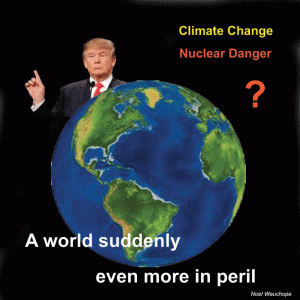 New Yorker, By Elizabeth Kolbert April 12, 2017 Next week, millions of Americans will celebrate Earth Day, even though, three months into Donald Trump’s Presidency, there sure isn’t much to celebrate. A White House characterized by flaming incompetence has nevertheless managed to do one thing effectively: it has trashed years’ worth of work to protect the planet. As David Horsey put it recently, in the Los Angeles Times, “Donald Trump’s foreign policy and legislative agenda may be a confused mess,” but “his administration’s attack on the environment is operating with the focus and zeal of the Spanish Inquisition.”
The list of steps that the Trump Administration has already taken to make America polluted again is so long that fully cataloguing them in this space would be impossible. Here’s a sample:
In February, the Department of Energy delayed putting into effect new energy-efficiency standards for, among other things, walk-in freezers, central air-conditioners, and ceiling fans. The new standards, according to the department’s own estimates, would prevent the emission of nearly three hundred million tons of carbon dioxide while saving consumers almost twenty-four billion dollars over the next three decades. (Ten states, led by New York, have
sued the Administration over the delay.)
In March, the Environmental Protection Agency and the Transportation Department announced their intention to roll back fuel-economy standards for cars that were set to go into effect in 2022.
Earlier this month, the E.P.A. announced its plans to review—and presumably revoke—President Obama’s Clean Power Plan, a set of regulations aimed at reducing pollution from power plants. The Clean Power Plan would not only have cut carbon emissions by almost nine hundred million tons a year but also, according to E.P.A. figures, prevented more than thirty-five hundred premature deaths and ninety thousand asthma attacks annually. The plan is central to the commitments that the United States made under the Paris climate accord, which the Administration may or may not formally abrogate, but which it has apparently already informally abandoned.
Meanwhile, the Administration has proposed slashing the E.P.A.’s budget by thirty-one per cent, which is even more than it has proposed chopping the State Department’s budget (twenty-nine per cent) or the Labor Department’s (twenty-one per cent). The proposed cuts would entail firing a quarter of the agency’s workforce and eliminating many programs entirely, including the radiation-protection program, which does what its name suggests, and the Energy Star program, which establishes voluntary efficiency standards for electronics and appliances…….
How is it that a group as disorganized as the Trump Administration has been so methodical when it comes to the (anti) environment? The simplest answer is that money focusses the mind. Lots of corporations stand to profit from Trump’s regulatory rollback, even as American consumers suffer. Auto manufacturers, for example, had argued that the 2022 fuel-efficiency standards were too expensive to meet. (This is the case even though, when they accepted a federal bailout, during the Obama Administration, the car companies said that the standards were achievable.) Similarly, utilities have argued that the power-plant rules are too costly to comply with. Coal companies will probably benefit from the rollbacks. So, too, will oil companies, and perhaps also ceiling-fan manufacturers, though, in the case of the appliance standards, the affected manufacturers were at the table when the proposed regulations were drafted.
But, while money is clearly key, it doesn’t seem entirely sufficient as an explanation. There’s arguably more money, in the long run, to be made from imposing the regulations—from investing in solar and wind power, for example, and updating the country’s electrical grid. Writing recently in the Washington Post, Amanda Erickson proposed an alternative, or at least complementary, explanation. Combatting a global environmental problem like climate change would seem to require global coöperation. If you don’t believe in global coöperation because “America comes first,” then you’re faced with a dilemma. You can either come up with an alternative approach—tough to do—or simply pretend that the problem doesn’t exist.
“Climate change denial is not incidental to a nationalist, populist agenda,” Erickson argues. “It’s central to it.” She quotes Andrew Norton, the director of the International Institute for Environment and Development, in London, who observes, “Climate change is a highly inconvenient truth for nationalism,” as it “requires collective action between states.” This argument can, and probably should, be taken one step further. The fundamental idea behind the environmental movement—the movement that gave us Earth Day in the first place—is that everything, and therefore everyone, is connected……
To acknowledge our interconnectedness is to acknowledge the need for caution, restraint, and, yes, rules. Almost a hundred days into Trump’s Presidency, it’s obvious that he has no agenda or coherent ideology. But two qualities that clearly have no place in his muddled, deconstructive Administration are caution and restraint. As a result, the planet, and everything on it, will suffer.
April 15, 2017
Posted by Christina Macpherson |
environment, USA |
Leave a comment
A big chill Much more detail could be provided about the possibly fatal problems facing Toshiba and Westinghouse, but let’s instead put the issues into context.
Beyond the direct impact of the unfolding crisis on numerous reactor projects around the world, the most important impact of the crisis is the chilling effect it will have ‒ and is already having ‒ on the nuclear power industry.
The AP1000 fiasco in the US shows that industry giants can be brought to their knees by cost overruns on just a few reactors. Further confirmation comes from two French EPR reactors under construction in France and Finland: combined cost overruns amount to at least US$13.5bn and counting, and French utilities EDF and Areva would both be bankrupt if not for repeated multi-billion-dollar government bailouts.
Governments, energy utilities and companies, banks, and investors will be considerably less likely to gamble on nuclear power in light of recent events.
 Nuclear power lobbyists ‘freaked out’ as crisis deepens http://reneweconomy.com.au/nuclear-power-lobbyists-freaked-crisis-deepens-22759/ By Jim Green on 13 April 2017 The nuclear power crisis escalated dramatically on March 29 with the announcement that US nuclear giant Westinghouse, a subsidiary of Japanese conglomerate Toshiba, had filed for Chapter 11 bankruptcy protection. The filing marks the start of lengthy and complex negotiations with creditors and customers and the US and Japanese governments.
The companies are in crisis because of massive cost overruns building four AP1000 nuclear power reactors in the southern US states of Georgia and South Carolina. The combined cost overruns for the four reactors amount to about US$11.2bn and counting. Stephen Byrd from Morgan Stanley said that the cost of the plants, if completed, will be about twice Westinghouse’s original estimate.
The crisis escalated again on April 11 when Toshiba released unaudited financial figures and noted in its financial statementthat there is “substantial doubt about the Company’s ability to continue as a going concern”. Toshiba reported a net loss of US$5.9bn for the Oct.‒Dec. 2016 quarter, mainly because of a US$6.3bn writedown on Westinghouse. Equity stood at negative US$5.7bn as of 31 March 2017.
Adding to the drama, auditor PricewaterhouseCoopers did not endorse the April 11 financial statement and instead submitted a statement emphasising the risks to Toshiba’s future.
Toshiba had already twice delayed release of its financial figures, and released unaudited figures on April 11 in the hope of avoiding a stock exchange delisting that would worsen the crisis engulfing the firm, increasing financing costs and exposing it to further lawsuits from shareholders.
But all that can be said about the release of hideous figures, accompanied by a disclaimer from the auditor, is that it was the least-worst of Toshiba’s options. The company still risks being delisted. Toshiba was already sitting in the fiscal naughty chair, its shares designated “securities on alert” due to a profit-padding accounting scandal from 2008‒2014 that was revealed in 2015.
Financial figures for the March 2016 ‒ March 2017 fiscal year will not be released until mid-May. Toshiba says that it could end up with a net loss of US$9.1bn for the fiscal year, well over double the estimate provided just a month earlier. “Every time they put out an estimate, the loss gets bigger and bigger,” said Zuhair Khan, an analyst at Jefferies in Tokyo. “I don’t think this is the last cockroach we have seen coming out of Toshiba.”
Toshiba will still be liable for existing cost overruns with the four AP1000 reactors in the US but the bankruptcy filing may limit its liability for future cost overruns. Thus Toshiba has somewhat reduced the likelihood of facing bankruptcy itself … by throwing Westinghouse under a bus. The bankruptcy filing bodes poorly for Westinghouse and the AP1000 projects in Georgia and South Carolina ‒ the future of the company and its reactor projects are in doubt.
Even if Toshiba and Westinghouse survive the unfolding crisis, some of their reactor projects and plans will not. Four AP1000 reactors under construction in China will likely be completed, but plans for more AP1000 reactors in China seem unlikely to progress, and plans for 6‒12 AP1000 reactors in India will likely be shelved.
Toshiba has tried but failed to sell Westinghouse several times already so must instead sell off profitable parts of its operations ‒ including its highly-profitable memory chip business ‒ to stave off bankruptcy.
Incredibly, Toshiba chief executive Satoshi Tsunakawa said in mid-March that Toshiba might have to pay a buyer to take Westinghouse off its hands.
So Friends of the Earth could take control of Westinghouse and use the accompanying payment to turn it into a renewable energy start-up or a karaoke bar franchise? Perhaps, but anyone willing to take Westinghouse off Toshiba’s hands would presumably also be taking on a debt load as well as future risks associated with company’s nuclear business.
Meanwhile, French company Engie has exercised its right to sell its 40% stake in NuGen to Toshiba. NuGen is the consortium which hoped to build three AP1000 reactors at Moorside, near Sellafield, in the UK. Toshiba wanted to sell its 60% stake in NuGen, and now wants to sell its 100% stake.
A big chill
Much more detail could be provided about the possibly fatal problems facing Toshiba and Westinghouse, but let’s instead put the issues into context.
Beyond the direct impact of the unfolding crisis on numerous reactor projects around the world, the most important impact of the crisis is the chilling effect it will have ‒ and is already having ‒ on the nuclear power industry.
The AP1000 fiasco in the US shows that industry giants can be brought to their knees by cost overruns on just a few reactors. Further confirmation comes from two French EPR reactors under construction in France and Finland: combined cost overruns amount to at least US$13.5bn and counting, and French utilities EDF and Areva would both be bankrupt if not for repeated multi-billion-dollar government bailouts.
Governments, energy utilities and companies, banks, and investors will be considerably less likely to gamble on nuclear power in light of recent events. Not many energy utilities and companies are as large, and as capable of absorbing debt, as Toshiba and Westinghouse. And few are as experienced: Toshiba has built 20 reactors in Japan (some in joint ventures), and Westinghouse has built 91 reactors globally. Yet cost overruns on four conventional reactors have brought these industry giants to their knees.
Nuclear lobbyists freaked out
The French Liberation newspaper said on March 29 that the Toshiba / Westinghouse crisis, and the huge problems facing French utilities EDF and Areva, forebode a lasting “nuclear winter”.
A February 15 piece in the Financial Times said: “Hopes of a nuclear renaissance have largely disappeared. For many suppliers, not least Toshiba, simply avoiding a nuclear dark ages would be achievement enough.”
Nuclear advocate Rod Adams wrote in Forbes on March 27: “Outside of Asia and Russia, prospects for nuclear power plants in the extra-large size range seem to be dimming by the week.”
Ted Norhaus from the Breakthrough Institute, a pro-nuclear lobby group, wrote on March 27 about his ideas to forge “a globally competitive advanced nuclear sector … from the ashes of today’s dying industry”. His innovative, ecomodernist proposal is to supersize taxpayer subsidies to the nuclear industry, combined with some Silicon Valley-inspired tish and fipsy about “radically reorganizing the nuclear sector” to facilitate “bottom-up innovation, led by start-ups, not large incumbents”.
Following the Westinghouse bankruptcy filing, the Breakthrough Institute’s Michael Shellenberger said: “I’m freaked out, honestly. If we were building nuclear plants, I wouldn’t be so worried. But if nuclear is dying, I’m alarmed.5
Of course those lobbyists are dramatising the situation to highlight the importance and urgency of supersizing taxpayer subsidies to the nuclear industry. If the nuclear power industry is dying, or if it is dying in the West, that will take some decades to play out. Nonetheless, nuclear power growth can be confidently ruled out in the US, Japan, across EU countries combined, and in numerous other countries for the foreseeable future … not to mention the 160+ countries that are nuclear-free and plan to stay that way.
The industry is downsizing and the recent Toshiba / Westinghouse crisis is the sort of convulsion that inevitably attends an industry-wide downsizing. Smart money has already walked: the UK Nuclear Free Local Authorities noted on April 4 that seven energy utilities and companies have abandoned plans to build new reactors in the UK over the past decade.
The nuclear industry may or may not be dying, but it is certainly in deep trouble and downsizing. After a growth spurt followed by 20 years of stagnation, nuclear power is approaching the Era of Nuclear Decommissioning (END) and recent events tend to confirm that the industry is indeed at the beginning of the END.
Dr Jim Green is the national nuclear campaigner with Friends of the Earth Australia and editor of the Nuclear Monitor newsletter produced by the World Information Service on Energy.
April 15, 2017
Posted by Christina Macpherson |
2 WORLD, business and costs |
Leave a comment
 China warns North Korea tension has to be stopped from reaching ‘irreversible’ stage, SMH, 14 Apr 17, Beijing/Pyongyang
: China said on Friday tension over North Korea had to be stopped from reaching an “irreversible and unmanageable stage, SMH, ” as a US aircraft carrier group steamed towards the region amid fears the North may conduct a sixth nuclear weapons test on Saturday.Concern has grown since the US Navy fired 59 Tomahawk missiles at a Syrian airfield last week in response to a deadly gas attack, raising questions about US President Donald Trump’s plans for North Korea, which has conducted missile and nuclear tests in defiance of UN and unilateral sanctions.
The United States has warned that a policy of “strategic patience” is over. US Vice President Mike Pence travels to South Korea on Sunday on a long-planned 10-day trip to Asia.
China, North Korea’s sole major ally and neighbour which nevertheless opposes its weapons programme, has called for talks leading to the denuclearisation of the Korean peninsula.
“We call on all parties to refrain from provoking and threatening each other, whether in words or actions, and not let the situation get to an irreversible and unmanageable stage,” Chinese Foreign Minister Wang Yi told reporters in Beijing.
“Once a war really happens, the result will be nothing but losing all round and no one could become a winner,” Mr Wang told reporters in Beijing on Friday, according to the official Xinhua News Agency.
North Korea denounced the United States for bringing “huge nuclear strategic assets” to the region as the Carl Vinson strike group with a flag-ship nuclear-powered aircraft carrier steamed closer, and said it stood ready to strike back.
“The Trump administration, which made a surprise guided cruise-missile strike on Syria on April 6, has entered the path of open threat and blackmail,” the North’s KCNA news agency quoted the military as saying in a statement………
North Korea, still technically at war with the South after their 1950-53 conflict ended in a truce, not a treaty, has on occasion conducted missile or nuclear tests to coincide with big political events and often threatens the United States, South Korea and Japan.
On Saturday, it marks the “Day of the Sun”, the 105th anniversary of the birth of state founder Kim Il Sung.
US ally South Korea warned against any North Korean “provocation”, such as a nuclear or missile test.
“There is certain to be powerful punitive measure that will be difficult for the North Korean regime to endure,” the South’s Foreign Ministry said in a statement………
Worry about North Korean aggression has also led to a deterioration of ties between China and South Korea because China objects to the deployment of a US Terminal High Altitude Area Defense (THAAD) anti-missile system in the South.
“It’s not hard to see that ever since the United States and Republic of Korea decided to deploy THAAD, the situation has not become harmonious but has become more tense,” Chinese Foreign Ministry spokesman Geng Shuang, said in response to a question about the system………http://www.smh.com.au/world/china-warns-north-korea-tension-has-to-be-stopped-from-reaching-irreversible-stage-20170414-gvleo7.html
April 15, 2017
Posted by Christina Macpherson |
China, North Korea, politics international |
Leave a comment
US Forces Just Dropped Their Largest Non-Nuclear Bomb For The First Time, Gizmodo, Adam Clark Estes Apr 14, 2017,Citing military sources, CNN reports the United States just dropped a 9.14m-long bomb with a blast yield equivalent to 11 tons of TNT on suspected ISIS targets in Afghanistan. Nicknamed MOAB (short for “Mother of All Bombs”), the weapon is the largest non-nuclear bomb in America’s arsenal. This is the first time a MOAB has been used in combat.
April 15, 2017
Posted by Christina Macpherson |
Afghanistan, USA, weapons and war |
Leave a comment

 South Korea coal, nuclear power targeted for cuts by presidential candidates http://www.channelnewsasia.com/news/asiapacific/south-korea-coal-nuclear-power-targeted-for-cuts-by-presidentia/3672862.html12 Apr 2017 SEOUL: No matter who is elected as South Korea’s new leader next month it is clear that coal and nuclear power generation will likely be scaled back, with most of the candidates laying out plans on Wednesday to address public concerns over pollution and safety.
Less than a month from a May 9 election to replace impeached president Park Geun-hye, policy experts outlined in a forum the energy proposals of four of the five contenders.
The two leading candidates, liberal front-runner Moon Jae-In and centrist Ahn Cheol-soo, both plan to lower South Korea’s reliance on coal and nuclear power, pointing to a need to shift to renewable energy, according to their policy advisors. In the latest poll by Gallup Korea, Moon got the support of 38 percent of respondents, and Ahn got 35 percent.
South Korea, Asia’s fourth-largest economy, gets 40 percent of its electricity from coal, 30 percent from nuclear, 20 percent from natural gas, and the rest from oil and renewables.
But policy changes are expected amid growing concerns over pollution and the safety of nuclear energy, and Moon and Ahn appear determined to help drive them.
“We should move away from coal and nuclear power, and shift to clean or renewable energy-based platforms,” said Kim Jwa-kwan, head of Moon’s energy policy team. Kim said his team planned for nuclear and coal power to account for 18 percent and 15 percent respectively of power supply by 2030, while the contribution of liquefied natural gas (LNG) would increase to 37 percent to support the rise of renewables.
If elected, Moon also “would scrap a plan to build Shin Kori No.5 and Shin Kori No.6 nuclear reactors on which construction began last year and revamp the country’s nuclear power expansion scheme,” Kim said.
That means South Korea’s plan to build 11 nuclear reactors by 2029 could be under threat.
Ahn would similarly shelve a plan to construct four coal-fired power plants and not extend the lifespan of ageing coal and nuclear power stations, said Oh Jeong-Rye, deputy director of Ahn’s People Party.
Both candidates target a 20 percent renewable energy share by 2030 as part of efforts to cut carbon emissions.
Under the current power supply plan, in addition to building 11 nuclear reactors by 2029 – three of which are already under construction – South Korea plans to add 20 more coal-fired power plants by 2022.
Policy experts for two other candidates – the conservative Bareun Party’s Yoo Seong-min and the left-wing Justice Party’s Sim Sang-jung – also said they would overhaul South Korea’s coal and nuclear energy policy.
Sim would cut nuclear power to zero by 2040 and phase out coal by 2060, according to her energy advisor.
(Reporting By Jane Chung; Additional reporting by Heekyong Yang; Editing by Tom Hogue)
April 15, 2017
Posted by Christina Macpherson |
politics, South Korea |
Leave a comment
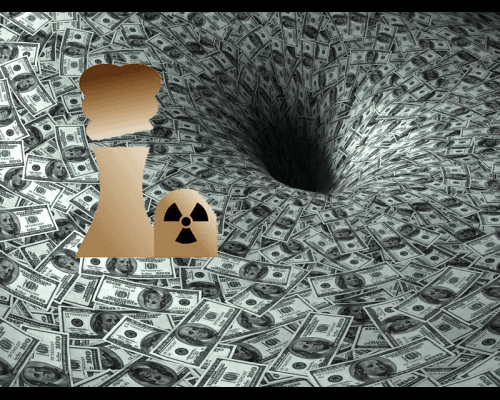
Nuclear giants limp towards extinction http://climatenewsnetwork.net/nuclear-giants-limp-towards-extinction/ April 14, 2017, by Paul Brown Cost overruns and delays are pushing the nuclear industry into a financial black hole that threatens any future expansion.
LONDON, 14 April, 2017 – Any lingering hope that a worldwide nuclear power renaissance would contribute to combating climate change appears to have been dashed by US company Westinghouse, the largest provider of nuclear technology in the world, filing for bankruptcy, and the severe financial difficulties of its Japanese parent company, Toshiba.
After months of waiting, Toshiba still could not get its auditors to agree to its accounts this week. But it went ahead anyway and reported losses of nearly $5 billion for the eight months from April to December, in order to avoid being de-listed from the Japanese stock exchange.
The company admitted it too could face bankruptcy, and is attempting to raise capital by selling viable parts of its business.
In a statement, it said: “There are material events and conditions that raise substantial doubt about the company‘s ability to continue as a going concern.”
Nuclear reactors
The knock-on effects of the financial disasters the two companies face will be felt across the nuclear world, but nowhere more than in the UK, which was hoping Westinghouse was about to start building three of its largest nuclear reactors, the AP 1000, at Moorside in Cumbria, northwest England.
The UK’s Conservative government will be particularly embarrassed because, in late February, it won a critical parliamentary by-election in the seat that would be home to the Moorside plant, on the guarantee that the three reactors would be built − a pledge that now seems impossible to keep.
Martin Forwood, campaign co-ordinator for Cumbrians Opposed to a Radioactive Environment, says: “I think the day of the large-scale nuclear power station is over. There is no one left to invest anymore because renewables are just cheaper, and these prices are still going down while nuclear is always up.”
Toshiba and Westinghouse are in deep trouble because the reactors they are currently building − the same design as the ones planned for Cumbria − are years late and billions of dollars over budget. Even if the companies can be re-financed, it seems extremely unlikely they would risk taking on new reactor projects.
Both the UK and Toshiba have looked to the South Korean nuclear giant KEPCOto take over the Moorside project, but the company is unlikely to want to build the Westinghouse design and would want to put forward its own reactor, the APR 1400.
“There is no one left to invest anymore because
renewables are just cheaper, and these prices
are still going down while nuclear is always up”
This would delay the project for years, since the whole safety case for a new type of reactor would have to be examined from scratch.
But the company is already under pressure from within South Korea, where Members of Parliament have urged KEPCO not to take on a risky project in the UK. Twenty-eight members of the Republic of Korea’s “Caucus on Post-Nuclear Energy” have called on KEPCO not to invest in Moorside.
The other nuclear giant present in Britain, the French-owned Électricité de France (EDF), is in serious difficulties of its own. It is already deep in debt and its flagship project to build a prototype 1,600 megawatt reactor at Flamanville in northern France is six years behind schedule and three times over budget at €10.5 billion.
Originally due to open in 2012, its start date is now officially the end of 2018, but even that is in doubt because an investigation into poor quality steel in the reactor’s pressure vessel is yet to be completed.
Despite this, the company and the UK government are committed to building two more of these giant reactors in Somerset in southwest England, and have started pouring concrete for the bases to put them on. These reactors are due to be completed in 2025, but nobody outside the company and the UK government believes this is likely.
So, with troubles of its own, EDF is in no position to help Toshiba out of its financial difficulties. In the nuclear world, this leaves only the Chinese and the Russians who might be capable of taking on such a project.
The Russians will be ruled out on political grounds, and the Chinese are already helping out EDF with a large financial stake in the Somerset project. They also want to build a nuclear station of their own design at Bradwell in Essex, southeast England – another project that looks likely to take more than a decade to complete.
Vast capital costs The problem for all these projects, apart from the vast capital cost and the timescales involved, is that the energy industry is changing dramatically. Solar and wind power are now a cheaper form of producing electricity across the world, and are less capital-intensive and quicker to build.
Despite the fact that there are more than 430 nuclear reactors in operation worldwide and the industry still has great economic and political clout, it is beginning to look like a dinosaur – too big and cumbersome to adapt to new conditions.
Nuclear power now produces about 10% of the world’s electricity, while 40% is from coal and 23% from renewables. The rest is mainly from natural gas.
Dr Jim Green, national nuclear campaigner with Friends of the Earth Australia, says: “Nuclear lobbyists are abandoning the tiresome rhetoric about a nuclear power renaissance. They are now acknowledging that the industry is in crisis.
“The crisis-ridden US, French and Japanese nuclear industries account for half of worldwide nuclear power generation.
“Renewable energy generation doubled over the past decade, and strong growth, driven by sharp cost decreases, will continue for the foreseeable future.” – Climate News Network
Comment: Terrific article, thank you – encompassing the severe problem that nuclear power can survive only where tax-payer funds it. However, I wish that you would also consider the way in whic h this nuclear financial crisis is being cleverly used by the “new nukes” lobby. In Britain, the thorium nuclear lobby have managed to get themselves the status of a registered charity!! That’s the Alvin Weinberg Foundation (not to be confused with the genuine charity in the USA the Weinberg Foundation) Comanies like NuScale, Fluor, Transatomic, Terrestrial Energy, etc are touting their wares to government. The argument goes lik ethis. “Our reactors, (still only as bluepints), are different from the conventional ones. Therefor they must be safer cheaper, and a boon to humanity.”
April 15, 2017
Posted by Christina Macpherson |
2 WORLD, business and costs |
Leave a comment
 Toshiba’s US nuclear problems provide cautionary tale for UK Experts say construction delays and cost problems at two plants are due to lack of experience and absence of supply chains, Guardian, Adam Vaughan, 14 Apr 17,
The roots of Toshiba’s admission this week that it has serious doubts over its “ability to continue as a going concern” can be found near two small US towns.
It is the four reactors being built for nuclear power stations outside Waynesboro, in Georgia, and Jenkinsville, South Carolina, by the company’s US subsidiary Westinghouse that have left the Japanese corporation facing an annual loss of £7.37bn.
Construction work on the units has run hugely over budget and over schedule, casting a shadow over two of the biggest new nuclear power station projects in the US for years.
Events came to a head last month when Westinghouse was forced to file for bankruptcy protection to limit Toshiba’s losses……..
Toshiba’s losses stem from Westinghouse’s acquisition in 2015 of the nuclear construction business CB&I Stone & Webster, which it hoped would solve the delays on the two sites. That deal has now backfired spectacularly, pushing Westinghouse and its parent company to the brink of financial collapse.
The regulator for one of the projects, Plant Vogtle, in Georgia, has said Westinghouse’s bankruptcy means the project will require more “time and money”.
Meanwhile the utility company paying for the Virgil C Summer Nuclear Generating Station, near Jenkinsville, South Carolina,
warned this week that abandonment of the project was one of the options it was now considering………
Nephew said: “This experience may push the US into a different model, perhaps focused on smaller modular reactors, or less complicated designs.”
The US energy secretary, Rick Perry, signalled the Trump administration’s support for nuclear this week, issuing a statement at the G7 summit in which he said the US backed “advanced civil-nuclear technologies”. That suggested support for next-generation reactors rather than the sort being built by Westinghouse.
Richard Morningstar, chairman of the Global Energy Centre at the international affairs thinktank Atlantic Council, said: “What is happening to Westinghouse and Toshiba only emphasises the need to double down on research on new, safe, nuclear technologies, such as small modular reactors. If we do not do so in the US, leadership will be ceded to other countries.”
One such aspiring atomic leader is the UK, where the government wants to build a new generation of nuclear power stations to help satisfy the country’s power needs for decades to come.
But there are obvious parallels between the two countries on the issues of recent experience and supply chains. The UK has not completed a new nuclear power station since Sizewell B on the Suffolk coast started generating power in 1995………
The EPR reactor design for Hinkley is the same as that for the reactors it is building in Finland, and at Flamanville, in France, though both of those are running late and over budget.
The other new nuclear projects proposed around the UK, all by foreign companies, look less certain and all are still years from construction starting in earnest.
Toshiba said this week it would consider selling its shares in the consortium behind another plant planned at Moorside, in Cumbria, which would utilise three of the same AP1000 Westinghouse reactors being built for the two crisis-hit US plants.
The South Korean power company Kepco last month expressed an interest in buying into the project, and the business secretary , Greg Clark, went to South Korea last week for talks on collaboration on nuclear power.
However, any rescue by Seoul is far from certain. The two leading candidates in South Korea’s elections in May said this week that they favoured rowing back on nuclear power and switching to renewable energy. Kepco would also face a regulatory delay of several years if it wanted to use its own technology at Moorside……..
While the government has argued that it has plans in place to keep the lights on if new nuclear projects do not materialise, others said the deepening crisis at Toshiba this week showed the need for ministers to consider a new energy policy.
“It’s time to come up with a new plan A,” said Paul Dorfman, of the Energy Institute, at University College London, who believes the Moorside project is dead. “It’s time for a viable strategy that talks about grid upgrades, solar, energy efficiency, and energy management.”
A report published on Thursday highlighted another alternative: a U-turn on the Conservative party’s manifesto commitment to block new onshore windfarms. Analysis for the trade body Scottish Renewables suggested wind turbines on land had become so cheap they could be built for little or no subsidy, compared to the lucrative contract awarded to EDF for Hinkley. https://www.theguardian.com/business/2017/apr/14/toshiba-us-nuclear-problems-uk-cautionary-tale
April 15, 2017
Posted by Christina Macpherson |
business and costs, UK |
Leave a comment
 https://www.energyvoice.com/other-news/136569/nuclear-contractors-not-turning-work-amid-westinghouse-woes/ by Bloomberg – 14/04/2017The company contracted to build Scana Corp.’s two nuclear reactors in South Carolina went bankrupt. Scana’s credits ratings are, as a result, at risk of downgrades. Its shares have plunged.
And now some of the people hired to help finish the reactors aren’t showing up for work.
In a meeting Wednesday, Scana executives assured South Carolina regulators that work continues on the two reactors being installed at its V.C. Summer plant, despite Toshiba Corp.’s Westinghouse Electric unit filing for Chapter 11 last month. But the Cayce, South Carolina-based utility owner also said Westinghouse is cutting weekend and overtime work and that contractor Fluor Corp. has seen a “high incidence” of new hires failing to show up for training since Westinghouse went bankrupt.
“We’re monitoring this aspect of the project to see if that trend continues,” Stephen Byrne, a senior vice president at Scana, said, based on a transcript released by the state Public Service Commission Thursday. “Work continues on-site without substantial disruption,” he said, adding that about $120 million a month is being paid to keep up construction.
Westinghouse’s bankruptcy has thrown the fate of both Scana’s reactors and Southern’s Vogtle nuclear project in Georgia into question. Westinghouse has estimated that finishing the plants may cost another $4 billion that it can’t collect from Southern and Scana. The projects are already years behind schedule and billions of dollars over budget. Byrne identified Fluor and Bechtel as two companies capable of finishing Scana’s project should Westinghouse drop out as lead contractor.
Fluor didn’t immediately respond to a request for comment.
Scana Chief Financial Officer Jimmy Addison said during Wednesday’s meeting that the company was recently told by Westinghouse that its V.C. Summer project accounts for $1.5 billion of those estimated cost overruns. Should Westinghouse walk away from its obligations, the utility may collect about $1.7 billion worth of damages from it and could seek compensation directly from Toshiba.
“Toshiba has a number of very valuable businesses, the most prominent of which is its flash memory business — in fact, they invented the flash memory and are Apple’s principal flash memory supplier,” Addison said. “Our assessment is that there is substantial at Toshiba to support our claim for damages if Westinghouse fails to pay.”
Scana is in the middle of a 30-day evaluation period during which it’s reviewing its options for the V.C. Summer project. The company’s considering continuing construction, abandoning plans for one of the two reactors or dropping the project altogether and seeking recovery under state law.
The entire project is about one-third complete, Byrne said.
April 15, 2017
Posted by Christina Macpherson |
business and costs, USA |
Leave a comment
 Sea-level rise in California could be catastrophic, study says http://www.sfgate.com/bayarea/article/Sea-level-rise-in-California-will-be-bad-to-11069686.php By Kurtis Alexander, April 12, 2017
A state-commissioned report on climate change released Wednesday raises the stakes for fighting global warming, offering a clearer and, in some cases, more catastrophic picture of how much sea levels will rise in California.
The Bay Area will see the ocean swell as much as 3.4 feet by 2100 if significant action isn’t taken, the report says. The scientists who produced the study pegged the prospect of that outcome at 67 percent. Tougher action on greenhouse gases would mean a lesser rise of up to 2.4 feet, the study says.
The scope of the likely rise is largely in line with earlier estimates, but not completely. One worst-case scenario says ocean levels could rise 10 feet by century’s end, which would swamp countless homes, roads, harbors and even airports along the coast.
“We have learned that the potential for a higher sea level is greater than we thought,” said
Gary Griggs, a professor of Earth sciences at UC Santa Cruz and one of seven climate experts who prepared the report.
The 71-page document was requested by the California Natural Resources Agency and the California Ocean Protection Council, in collaboration with the governor’s office, to help state and local officials plan for rising seas.
The report, an update of a 2013 state analysis, lays out expected ocean levels through 2150 for a number of locations and scenarios varying with the amount of greenhouse gas emissions globally.
Last year, nearly 200 nations committed in Paris to curb greenhouse gases enough so that the Earth’s temperature wouldn’t rise more than 2 degrees Celsius. The emission targets are not binding, however, and many scientists predict that President Trump’s executive order aimed at repealing Obama administration limits on coal-fired power plant pollution will prevent the U.S. from reaching its target.
The new analysis for California is based largely on recent, better information on ice melt at the Earth’s poles.
The main drivers of rising seas to date have been melting glaciers and the expansion of water that naturally occurs as temperatures warm. However, thawing ice sheets will soon become the primary contributor, according to the state-commissioned study.
The report indicates that Greenland has enough ice to raise global sea level by 24 feet while Antarctica has enough to lift oceans 187 feet. Glaciers, meanwhile, contain only enough ice to raise seas 1.5 feet.
While these continent-size masses of ice are not expected to completely melt, even a small amount of liquefaction could have big effects, particularly for California.
Because the ocean at the poles is lifted by strong gravitational forces, when that ice thaws and water is released toward the tropics, the liquid relaxes and spreads out, according to Griggs.
“It turns out for Antarctica, the biggest impact is along the California coast,” he said. For every foot of global sea-level rise caused by melting ice in the western Antarctic, California will see the the ocean rise about 1.25 feet, according to the report.
The report emphasizes the importance of preparing for the spike.
“California leads the way in both addressing climate change and protecting our coastal and ocean communities and resources,” Jenn Eckerle, deputy director of the Ocean Protection Council, said in a statement. “Our statewide policy on sea-level rise is another example of that leadership. We provide guidance to state agencies and local governments for incorporating sea-level rise projections into planning, permitting, investment, and other decisions.”
Kurtis Alexander is a San Francisco Chronicle staff writer. Email: kalexander@sfchronicle.com Twitter: @kurtisalexander
Rising Reality series
Read Chronicle urban design critic John King’s stories on the challenges posed by sea-level rise in the Bay Area: http://projects.sfchronicle.com/2016/sea-level-rise/
April 15, 2017
Posted by Christina Macpherson |
climate change, USA |
Leave a comment
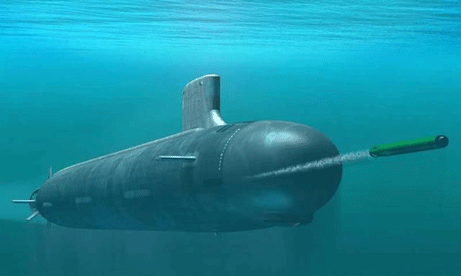
 MoD appoints nuclear chief to help keep Dreadnought submarines on course, Telegraph UK, Alan Tovey, industry editor 14 APRIL 2017 A Treasury troubleshooter has been brought in to run Britain’s military nuclear programmes with a remit to keep the massive Trident replacement submarine programme on track.
Civil servant Julian Kelly will join the Ministry of Defence in May in the new position of director-general nuclear, where he will be responsible for Britain’s nuclear submarines, nuclear warheads and day-to-day policy.
Top of his to do list in the £200,000-a-year role will be ensuring the £41bn programme to build the next generation of Dreadnought nuclear missile submarines for the Royal Navy stays on track. A key task will be working with the soon-to-be appointed head of the Submarine Delivery Authority (SDA), an arm’s-length body created to ensure the Dreadnought programme meets its targets.
The Telegraph understands that final interviews for this role took place in past fortnight, with top engineers and executives being lined up as the MoD looks to tap industry for its experience in running huge projects on time and budget.
The £500,000-a-year job as SDA chief executive is one of the highest paid public roles, reflecting the immense importance of the Trident programme to the UK’s security, with the Navy tasked with keeping one submarine armed with nuclear missiles at sea at all times.
Defence Secretary Sir Michael Fallon has repeatedly warned how critical Britain’s nuclear programmes are, saying delivery of the new submarines “cannot and must not slip”.
Suppliers including BAE Systems, which is leading overall programme, and Rolls-Royce, which is building the submarines’ nuclear powerplants, have been warned of a “pain and gain” regime to contracts. This will mean they will share the results of coming in under budget but cost over-runs and delays will result in heavy penalties.
“We will absolutely challenge BAE and other suppliers such as Rolls-Royce,” the Defence Secretary has warned. “They are going to be incentivised to keep the targets and they will suffer if they don’t.”
Building the four new Dreadnought submarines is seen as the biggest financial risk the MoD faces. Although the work has been costed at £31bn, a £10bn contingency was added on reflecting the huge complexity of the task and vital importance on being on time, with the current Vanguard class missile submarines coming to the end of their lives in the 2030s…… http://www.telegraph.co.uk/business/2017/04/14/mod-appoints-nuclear-chief-help-keep-dreadnought-submarines/
April 15, 2017
Posted by Christina Macpherson |
UK, weapons and war |
Leave a comment
 Plenty of carbon used in nuclear energy April 14 https://www.washingtonpost.com/opinions/plenty-of-carbon-used-in-nuclear-energy/2017/04/14/055e9262-1e1e-11e7-bb59-a74ccaf1d02f_story.html?utm_term=.a0219255a149 Paki Wieland
The April 2 editorial “Nuclear energy in peril” referred to nuclear energy as carbon-free. It is not carbon-free.If we look at nuclear power in whole, from the uranium mining to the dismantling of nuclear power plants, there is an extraordinary use of energy, from the initial devastation of the environment where the uranium is mined to the costly cleanup.
The impact on the environment continues through every phase of nuclear-energy production. A deep look into the issue of nuclear power would lead to overwhelming evidence to support ending nuclear power as a source of energy.
April 14, 2017
Posted by Christina Macpherson |
general |
Leave a comment
 EPA chief Scott Pruitt tells ‘Fox & Friends’ U.S. should exit Paris climate deal, Think Progress, 14 Apr 17
He then left the interview to give the coal industry a boost. Environmental Protection Agency chief Scott Pruitt said Thursday during an appearance on Fox and Friends that the United States should exit the Paris climate agreement because the accord only serves the interests of Europe, China and India.
“Paris is something that we need to really look at closely because it is something we need to exit, in my opinion,” Pruitt told the Fox News show hosts. “It’s a bad deal for America”
Pruitt, a former Oklahoma attorney general with close ties to the state’s oil and gas industry, has labeled the agreement a “bad deal” in the past but had not previously called for the United States to withdraw from the accord……
President Donald Trump reportedly is expected to meet with his senior advisers to decide whether the Unites States should stay in the Paris climate agreement. It remains to be seen whether Trump’s daughter, Ivanka, will attend the meeting. Ivanka Trump reportedly favors the country meeting its Paris climate agreement obligations. https://thinkprogress.org/scott-pruitt-calls-for-exit-of-paris-agreement-cd3d04a5f780
April 14, 2017
Posted by Christina Macpherson |
climate change, politics, politics international, USA |
Leave a comment
 The Nuclear Requiem Bob Frye’s The Nuclear Requiem is now airing on PBS nationwide. WYCC has a broadcast scheduled for 8 p.m.on April 30th, with WTTW airing it on the same day at 6 p.m. Or watch online anytime at PBS. Check out the film’s website or Facebook page for more details.
April 14, 2017
Posted by Christina Macpherson |
Resources -audiovicual |
Leave a comment















 nuclear-news