 NewsWeek, BY TOM O’CONNOR ON 4/18/17 The U.S. has built a better, smarter nuclear bomb capable of replacing all four of its predecessors and, as of last month, it’s ready to fly.
The U.S. Air Force said Thursday it conducted an inert test in March of an upgraded version of one of its primary nuclear gravity bombs, the B61, in an effort to refurbish the nuclear arsenal of the nation with the second-largest nuclear weapons stockpile in the world. The long-awaited upgrade comes amid a new effort by President Donald Trump to conduct a massive review of the nation’s nuclear capabilities.
An F-16 dropped the non-nuclear B61-12 over the Nellis Test and Training Range Complex in Nevada, assessing functions such as the weapon’s fire control system, radar altimeter, spin rocket motors and weapons control computer. The B61-12 was set to replace four current models—the B61-3, -4, -7, and -10, according to theAviationist. The initiative, which hoped to see the weapon in production by 2020, was part of the nuclear life-extension program overseen by the Air Force Nuclear Weapons Center in conjunction with the Department of Energy’s National Nuclear Security Administration……….
The life-extension program continued as the Pentagon announced Monday the beginning of its Nuclear Posture Review, according to Defense News. The six-month process was commissioned by an executive order signed January 27 by Trump and would assess the nation’s nuclear forces in light of the current geopolitical scheme. Former President Barack Obama conducted the last review in 2010, and the new administration would likely take into account heightened tensions in Europe, Asia and the Middle East. Trump has recently feuded with his former political ally, Russian President Vladimir Putin, who currently commands the largest nuclear force on the planet, and has suggested a harder line on nuclear-armed North Korea.
Modernizing the U.S.’s entire nuclear arsenal would cost $400 billion by 2026, according to a figure released Tuesday by the Congressional Budget Office. Some military officials have reportedly suggested abandoning nuclear projects such as the Long-Range Standoff nuclear cruise missile (LRSO) in favor of optimized conventional strike options. http://www.newsweek.com/us-build-better-nuclear-missile-585686
April 19, 2017
Posted by Christina Macpherson |
USA, weapons and war |
Leave a comment
 Pentagon starts U.S. nuclear posture review under President Trump’s order, WASHINGTON, April 17 (Xinhua) — The U.S. Defense Ministry has officially started a review of the country’s nuclear posture and will submit a final report to President Donald Trump at the end of this year, the Pentagon announced Monday.
“Today, Secretary (James) Mattis directed the commencement of the review, which will be led by the deputy secretary of defense and the vice chairman of the Joint Chiefs of Staff, and include interagency partners,” Pentagon spokeswoman Dana White said in a statement.
“The process will culminate in a final report to the president by the end of the year.” said the statement.
The nuclear posture review was ordered by President Trump in a January executive action on military readiness, according to a theHill news daily report.
The January memo called for a review “to ensure that the United States nuclear deterrent is modern, robust, flexible, resilient, ready and appropriately tailored to deter 21st-century threats and reassure our allies.”…….
Though planned since January under Trump’s order, the start of the nuclear review comes at a time of high anxiety over increasing tensions on the Korean peninsula.
The last time the Pentagon conducted a nuclear posture review was in 2010.http://news.xinhuanet.com/english/2017-04/18/c_136216300.htm
April 19, 2017
Posted by Christina Macpherson |
USA, weapons and war |
Leave a comment
‘Trump’s U-turn on NATO: Making it more expansionist, rather than more defensive, ’https://www.rt.com/op-edge/384649-nato-trump-policy-defense/ 13 Apr, 2017 President Trump is going along with NATO chief Jens Stoltenberg on the alliance’s increased deployment in Eastern Europe to supposedly deter Russia, but it will only reduce European security, Martin Sieff of the Global Policy Institute told RT.
US President Donald Trump on Wednesday had his first face-to-face meeting with NATOSecretary General Jens Stoltenberg in Washington DC.
He admitted changing his position on NATO, calling the alliance the “bulwark of international peace and security.”
However, his stance on having peaceful relations with Russia also stays in place, and Stoltenberg supported it.
“It would be wonderful, as we were discussing just a little while ago if NATO and our country could get along with Russia. Right now, we’re not getting along with Russia at all. We may be at an all-time low in terms of a relationship with Russia. This has built over a long period of time. But we’re going to see what happens. Putin is the leader of Russia. Russia is a strong country. We’re a very, very strong country. We’re going to see how that all works out,” Trump said.
Former CIA analyst Elizabeth Murray shared her thoughts with RT on President Trump’s change of tune on NATO.
“That seems to be in line with a lot of contradictory messages that have been coming from the White House. It seems like just over a week ago we heard that the Syrian people were going to decide their leadership. Apparently now it seems they don’t have that option. So it seems that we’re hearing a lot of contradictory statements from the White House and it is hard to know what to make of it,” she said.
As to why this is happening, Murray suggested that perhaps this has something to do “with the ratcheting up of tensions and ratcheting up of rhetoric vis-à-vis both Syria and Russia.”
“As you well know, we have a record number of NATO troops massed on the border with Russia – in Poland and the Baltic States. This is consistent with the tensions that have been rising since last week after this chemical incident in Syria and then the bombing of the Syrian airfield. I’m just hoping that dialogue, cool heads, and adult supervision will prevail here,” she added.
Martin Sieff of the Global Policy Institute called Trump’s change of rhetoric “depressing” but at the same time “predictable.”
“President Trump is inexperienced in the foreign policy area. He has not made the same effort he made in the economic sphere to appoint senior officials and advisors who would implement the policies that he spilled out consistently during his election campaign. Instead, he is letting himself be swayed by establishment positions,” he told RT.
Effectively, in Seiff’s view, Trump has made a U-turn on his NATO policy.
“He repeatedly said during his campaign that NATO was obsolete, that it needs to be restructured. Now he says it is not obsolete,” he said. “If he is going to change NATO radically, it looks like he is going to change it by making it more expansionist rather than more defensive and stabilizing. This is exactly the opposite of the positions he took consistently during his campaign.”
Speaking on Wednesday Trump yet again raised the spending issue.
“Fair burden-sharing has been my top priority since taking office. We have now turned a corner,” the president said.
Seiff says that even if European countries do increase their NATO spending, it will make no difference in practical terms.
“Secretary General Stoltenberg today in Washington – and he is a hawk in these issues – expressed confidence that the overall spending rates would be rising to 3.8 per cent for NATO. He said there are now $10 billion more of defense spending in NATO. But when you look currently – only five NATO nations have reached the two per cent of GDP standard, which Stoltenberg has been pushing, and which Trump is now also pushing – last year in 2016. Stoltenberg says another two or three nations will reach this stage in the next year or two. This includes very small countries: Romania, which although is a large country geographically, has a very weak economic base; and Latvia, which is a very small country indeed,” he explained.
He went on to say that in Germany and France powerful political forces are emerging who want neither increases in defense spending nor heightened tension with Russia.
“This year we’re going to see elections in a couple of weeks in France – the first round of the presidential elections. And we’re going to see the German elections for the Federal government coming in the fall, in September. If those go against the hawks, then all of Trump’s hopes to have increased spending in NATO is going to go by the board. It is not going to happen,” he said.
Trump’s reassessment of NATO could also have an impact on the United States’ relations with Russia, the analyst said.
“The signs again in the short term are very pessimistic, unfortunately. NATO has been pushing under President Obama and under NATO Secretary General Stoltenberg to deploy increased numbers of forces in Eastern Europe allegedly to deter Russian aggression. This will only have the opposite effect. It is Russia that was invaded from Western Europe and devastated in WWI and WWII. It was the Russian people who suffered more than anyone else. This concern, these historic memories go deep in Russia. Even relatively small forward NATO deployments, especially in countries that have very anti-Russian popular traditions in them – small countries even like Latvia, or even larger countries like Poland – create great alarm in Russia,” he said.
“So far from giving increased security to NATO and to its eastern members, these deployments that Stoltenberg wants, and Trump is going along with, will reduce security in Europe, and are much more likely to threaten the very catastrophes and breakdown of peace and security that they allegedly claim to prevent,” Seiff concluded.
“If he is going to change NATO radically, it looks like he is going to change it by making it more expansionist rather than more defensive and stabilizing. This is exactly the opposite of the positions he took consistently during his campaign.”
April 19, 2017
Posted by Christina Macpherson |
EUROPE, politics international, USA, weapons and war |
Leave a comment
 North Korean envoy at UN warns of nuclear war possibility | 17 April 2017 | North Korea’s UN deputy representative, Kim In Ryong, on Monday unleashed at a hastily called UN press conference a torrent of threats, war scenarios and rhetoric aimed at the United States. The press event was held hours after US Vice President Mike Pence visited the demilitarized zone between North and South Korea. Pence warned North Korea not to test the resolve of the United States “or the strength of our military forces.” In New York, North Korea’s UN ambassador condemned the US naval buildup in the waters off the Korean Peninsula, plus the US missile attacks on Syria. Kim said, “It has created a dangerous situation in which thermonuclear war may break out at any moment on the peninsula and poses a serious threat to world peace and security.”
U.S. May Launch Strike If North Korea Reaches for Nuclear Trigger | 13 April 2017 | The U.S. is prepared to launch a preemptive strike with conventional weapons against North Korea should officials become convinced that North Korea is about to follow through with a nuclear weapons test, multiple senior U.S. intelligence officials told NBC News. North Korea has warned that a “big event” is near, and U.S. officials say signs point to a nuclear test that could come as early as this weekend. The intelligence officials told NBC News that the U.S. has positioned two destroyers capable of shooting Tomahawk cruise missiles in the region, one just 300 miles from the North Korean nuclear test site.
April 19, 2017
Posted by Christina Macpherson |
North Korea, politics international, USA, weapons and war |
Leave a comment
“At the end of the day, the North Koreans believe that their nuclear weapons are too foundational to their survival and to the survival of their regime.”
 WITH the whole world staring daggers at North Korea, why is it so intent on harnessing the very weapon that could destroy it? Charis Chang news.com.au, 18 Apr 17,
Another factor that has added pressure to the situation is the political turmoil in South Korea.
The US made a deal with South Korea to place a powerful anti-missile system in the country that could intercept and destroy missiles fired from North Korea.
But this deal was placed under a cloud earlier this year when then-president Park Geun-hye was impeached for corruption and then removed from office.
The man seen as a frontrunner to replace her, Moon Jae-in, does not seem supportive of continuing with the deal, and said he wanted to review the decision. While the presidential race has since narrowed, if Moon was elected on May 9, it could weaken the US bargaining position.Moon has said he wants to met with North Korea’s Kim Jong Un in Pyongyang as a priority over going to Washington, indicating he favours working with the dictator.
This may calm tensions in the area but could allow North Korea to continue developing its nuclear weapons.
With South Korea currently under interim leadership favourable to the US, Prof Blaxland said there was a “certain moment of opportunity” for the US to act.
Last month the US started installing its advanced missile defence system called THAAD (Terminal High Altitude Area Defence) in South Korea, despite some saying it should wait until the presidential elections were held.
US President Donald Trump has also ordered a naval strike group, led by the USS Carl Vinson aircraft carrier, to the region, though the vessels remain a long way from the peninsula………
CAN CHINA HELP? Many countries have been looking to China to try and solve the impasse, saying it should exert its influence over North Korea to get it to fall in line. But Brad Glosserman said the belief the Chinese could force an outcome in Pyongyang was a mistake.
He pointed to the US relationship with Israel as an example, saying despite all that America does to help the Jewish state, it is unable to force Israel to do what it wants. “The problem with North Korea’s relationship with the world, is the North’s relationship with the US,” he said.
“What China believes is that if there is to be a resolution, it must be a resolution between Washington and Pyongyang. “Beijing’s only real role is to facilitate that task, the idea that they can put the screws on … and deliver North Korea is something that the Chinese don’t believe and I don’t believe.”
SHOULD NORTH KOREA BE ALLOWED TO HAVE NUCLEAR WEAPONS?
If the US did become open to the idea of a nuclear-armed North Korea, Mr Glosserman said this would place stress on the US relationship with South Korea and also with Japan.
“It undermines the integrity of the non-proliferation treaty,” he said.
“I believe North Korea went nuclear because Pakistan went nuclear and got away with it. And I’m willing to bet that if North Korea goes nuclear, Iran will go nuclear and if Iran goes nuclear who knows what other dominoes will fall?.
“If North Korea is allowed to become a nuclear weapons state, I would suggest South Koreans might be encouraged to do the same and the Japanese will actively be pushed to do the same.
“There are a number of nuclear dominoes that have the potential to fall.”
HOW CAN WE STOP THEM?
According to the New York Times, the US has been trying to sabotage North Korea’s development of missile program using cyber and electronic strikes.
This may even have been why a ballistic missile launched on Saturday was unsuccessful. Lately, President Donald Trump is reportedly considering “utterly destroying” Kim Jong-un’s nuclear sites using pre-emptive strikes.
But Mr Glosserman said he didn’t think the US knew where North Korea’s warheads or missiles were located.
“The idea that we can intimidate the North Koreans strikes me as being a bit of a stretch,” he has previously said.
But while it may be hard for the US to take out North Korea’s weapons stockpile if it doesn’t know where to target, the use of a military option was still a possibility………
Mr Glosserman said the countries involved needed to be very careful as diplomacy was everyone’s preferred outcome.
Unfortunately Mr Glosserman said he didn’t think a deal could ultimately be brokered.
He said the US was demanding that North Korea give up its nuclear weapons but this is something they were not willing to do. The Chinese have asked for a freeze in activity but this doesn’t get rid of what the weapons they have already got.
“At the end of the day, the North Koreans believe that their nuclear weapons are too foundational to their survival and to the survival of their regime.,” he said.
“No one has come up with good terms by which we can at least begin a process to cap then roll back North Korea’s nuclear weapons.”http://www.news.com.au/technology/why-its-so-important-for-north-korea-to-develop-nuclear-weapons/news-story/ae936c8099fdcfb137860260afcee844
Email: charis.chang@news.com.au | Twitter: @charischang2
April 19, 2017
Posted by Christina Macpherson |
North Korea, weapons and war |
Leave a comment
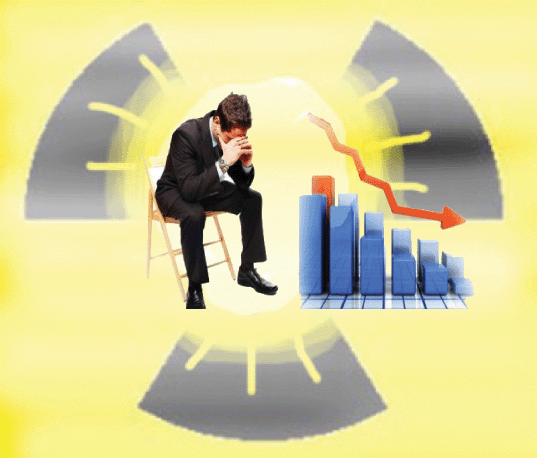
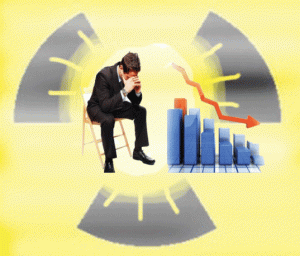 As the industry struggles, is it ‘time to recognize the nuclear show’s over’?, LA Times, 17 Apr 17, There was a time when nuclear power was considered to be the bulwark of America’s energy future.
Now the titan appears to be teetering. Westinghouse Electric Co. — long considered the leader in nuclear power development — filed for bankruptcy protection in late March. The move puts in jeopardy the completion of two nuclear plants in the Southeast that had been heralded as proof the industry’s future was still vibrant.
The news added to a long list of nuclear’s woes:
- California is on the verge of eliminating its last remaining nuclear power plant.
- Nuclear waste, stranded in places such as the San Onofre Nuclear Generating Station, isn’t going away any time soon.
- The industry is still reeling from the 2011 tsunami that hit the Fukushima plant in Japan, which prompted some countries such as Germany to turn away from nuclear power…….
Even the industry’s biggest supporters acknowledged the Westinghouse news was bad.
“I’m freaked out, honestly,” said Michael Shellenberger, president of [Ed. – nuclear front group] Berkeley-based Environmental Progress, a group that considers nuclear power an essential element to battle climate change……..
even before the Westinghouse announcement, nuclear energy faced growing competition from natural gas and renewable sources.
Utilities have increasingly turned to natural gas, which emits half the amount of greenhouse gases as coal. And thanks to the booming shale market, natural gas can be extracted in burgeoning supplies at a price that has remained consistently low for years.
Renewable sources such as wind and solar also have grown while their costs have dropped. That’s left nuclear struggling to just hold onto its 20% share of the nation’s energy mix.“The bottom line is that nuclear was already having problems and in decline,” said Andy Smith, senior analyst covering utility stocks for the investment firm Edward Jones.
Bedeviled at Diablo The Diablo Canyon facility near San Luis Obispo is the last nuclear power plant operating in California — but maybe not for long.The plant’s operator, Pacific Gas & Electric Co., announced plans last summer to shut down the site for good by 2025, blaming greater renewable sources in the state’s power mix, developments in energy efficiency and battery storage as well as lower demand.
In the meantime, the list of nuclear closures keeps growing. A plant in Nebraska shut down at the end of last year, and as many as 10 other reactors are proposed to go offline in the coming years, including the two at Diablo. Ohio’s two nuclear plants are in danger of going down.
The country’s nuclear fleet is also getting older, with 99 reactors having an average age of 35 years old……
April 19, 2017
Posted by Christina Macpherson |
general |
Leave a comment
 Lawsuit Warns $234B In Aid To Israel Violates US Law Against Supporting Secret Nuclear States, Mint Press, By Kit O’Connell | Follow on Facebook | @KitOConnell | August 16, 2016
The lawsuit warns that the U.S. gave Israel about $234 billion in foreign aid since the passage of the International Security Assistance and Arms Export Control Act of 1976, despite a ban on support for secret nuclear weapons programs.
By Kit O’Connell AUSTIN, Texas — A lawsuit warns that U.S. aid to Israel violates a law meant to prevent nuclear weapons proliferation, even as the United States prepares to increase the already massive Israeli aid program.
Filed Aug. 8 by Grant Smith, director of the Institute for Research: Middle East Policy, or IRMEP, in the U.S. District Court for the District of Columbia, the suit alleges that U.S. aid to Israel violates two amendments to the 1961 Foreign Assistance Act, known as the the Symington and Glenn Amendments, which collectively ban support for countries engaged in clandestine nuclear programs.
In the lawsuit, Smith alleges that violating these amendments means that Israel has received approximately $234 billion in illegal aid since the passage of the International Security Assistance and Arms Export Control Act of 1976.
The lawsuit reads:
“This lawsuit is not about foreign policy. It is about the rule of law, presidential power, the structural limits of the U.S. Constitution, and the right of the public to understand the functions of government and informed petition of the government for redress.”…….
Israel’s dangerous ‘nuclear ambiguity’
The IRMEP lawsuit argues that Israel’s policy of official secrecy on its nuclear weapons program perfectly fits the definition of the 1976 Export Control Act, and that the U.S. government broke the law through its “failure to act upon facts long in their possession while prohibiting the release of official government information about Israel’s nuclear weapons program, particularly ongoing illicit transfers of nuclear weapons material and technology from the U.S. to Israel.”
Smith wrote that the U.S. offers material support to Israel’s nuclear program while helping suppress information about the program. He continued:
“These violations manifest in gagging and prosecuting federal officials and contractors who publicly acknowledge Israel’s nuclear weapons program, imposing punitive economic costs on public interest researchers who attempt to educate the public about the functions of government, refusing to make bona fide responses to journalists and consistently failing to act on credible information available in the government and public domain.”
This policy of secrecy goes by many names, he noted. “These acts serve a policy that has many names all referring to the same subterfuge, ‘nuclear opacity,’ ‘nuclear ambiguity,’ and ‘strategic ambiguity.’”
Although long denied by both American and Israeli politicians, Israel’s nuclear program was first revealed by whistleblower Mordechai Vanunu, who spent 16 years in prison for sharing secret details of the program with Britain’s Sunday Times in 1986, and has been repeatedly arrested for continuing to publicly speak out.
Although the program is still not officially acknowledged, a November report by the Institute for Science and International Security suggested the Israeli government has amassed enough material to create at least 115 nuclear warheads. That would put Israel, a country roughly the size of New Jersey, on nearly equal nuclear footing with India and Pakistan…….http://www.mintpressnews.com/lawsuit-warns-234b-aid-israel-violates-us-law-supporting-secret-nuclear-states/219502/
April 19, 2017
Posted by Christina Macpherson |
Israel, Legal, USA |
Leave a comment
Fast breeder nuclear reactor delayed by 8 yrs, Deccan Herald, Kalyan Ray, DH News Service, New Delhi, Apr 15 2017, On record, the target continues to be October 2017 The Centre has set a new target schedule of mid-2018 to commission India’s first gen-next fast breeder nuclear reactor – eight years behind original schedule. Sources in the Department of Atomic Energy told Deccan Herald that the middle of 2018 was being looked at a more realistic target to put the new reactor into operation.
Once functional, the fast breeder reactor would usher in the second stage of India’s three-stage nuclear power programme as envisioned by Homi Bhabha, the father of Indian nuclear programme.
Fast breeder reactors “breed” more fissile material than the fuel they consume. They burn plutonium – generated in Uranium-fueled pressured heavy water reactors and light water reactors – to breed a special type of fissile uranium known as U-233, which is used as fuel.
Anti-nuclear activists, however, are concerned on the FBR reactors for two reasons. No one is sure about its long-term commercial viability and ecological-impact in the absence of similar reactors in other nations. Secondly, it uses liquid sodium, a hazardous material as coolant.
The sodium cooling leads to a temperature of 600 degrees Celsius inside the reactor, because of which there are safety concerns.
“From the day of pouring liquid sodium into the system, we need at least five months for the FBR to generate commercial electricity,” sources said.
As per the original schedule, the project was to be commissioned in September, 2010, which was later rescheduled to September 2014.
The goalpost was against shifted to September 2016 and later on to October 2017….http://www.deccanherald.com/content/606431/fast-breeder-nuclear-reactor-delayed.html
April 19, 2017
Posted by Christina Macpherson |
India, technology |
Leave a comment
Staff writers news.com.au 19 Apr 17 FILTHY rich people who have prepared for nuclear warfare and other catastrophic disasters by investing in five-star luxury bunkers might soon move into their multi-million dollar purchases as concerns grow over a nuclear war.
April 19, 2017
Posted by Christina Macpherson |
2 WORLD, business and costs, weapons and war |
Leave a comment
Meet the First Nation Above the Arctic Circle That Just Went Solar https://www.desmog.ca/2017/03/28/meet-first-nation-above-arctic-circle-just-went-solar By Matt Jacques • Tuesday, March 28, 2017 Across Canada’s north, diesel has long been the primary mode of providing year-round electricity to remote communities — but with the advent of small-scale renewables, that’s about to change.
Northern communities were already making strides toward a renewable energy future, but with $400 million committed in this year’s federal budget to establish an 11-year Arctic Energy Fund, energy security in the north has moved firmly into the spotlight.
“This level of support shows positive commitment from the Canadian government on ending fossil fuel dependency in Indigenous communities and transitioning these communities to clean energy systems,” said Dave Lovekin, a senior advisor at the Pembina Institute.
Burning diesel not only pollutes the atmosphere, but getting it into remote communities is often inefficient in and of itself: it’s delivered by truck, barge or, sometimes when the weather doesn’t cooperate, by plane.
There are more than 170 remote indigenous communities in Canada still relying almost completely upon diesel for their electricity needs.
But, for some, at least, that’s beginning to change. Take the community of Old Crow (Vuntut Gwitchin First Nation), above the Arctic circle in the Yukon.
Despite its northern latitude, and near total darkness between December and February, a 2014 Government of Yukon pilot study demonstrated that solar represents a major untapped renewable resource for the community. Now Old Crow has a number of small-scale solar panel installations, including an 11.8 kilowatt array at the Arctic Research Centre — but its sights are set higher. Plans for a 330 kilowatt solar plant are well underway. A 2016 feasibility study estimated that this large-scale installation could offset 17 per cent of the community’s total diesel use, or up to 98,000 litres of fuel each year.
“Anything that affects our community, we want to have control over. That’s our goal with this project is to have ownership over the facility,” said William Josie, director of Natural Resources for the Vuntut Gwitchin First Nation. “We burn a lot of fuel up here per capita and we’re trying to reduce that.”
Josie said his community is excited to build further solar capacity.
“This has been in the works for a long time, and it’s just the right thing to do,” he said. “It’s the first solar project of this size in the Yukon with community ownership.”
The Vuntut Gwitchin First Nation has a self-governing final agreement in place with the Government of Canada, the Government of the Yukon and the Council of Yukon First Nations. So too does the Kluane (Burwash Landing/Destruction Bay) First Nation in the southwestern Yukon, which is taking another approach to delivering a similar level of renewable energy capacity.
A major $2.4 million wind power generation project is set to be installed in 2018. Three refurbished 95 kilowatt turbines will deliver just under 300 kilowatts of total power and are estimated to offset 21 per cent of the community’s total diesel use.
“One of the big things for the community is to be self-reliant and self-sufficient. Diesel is neither of those two,” explains Colin Asseltine, general manager of the Kluane Community Development Corporation. “We’re looking at what we can possibly do to reduce our carbon footprint and move off-grid.”
The wind project will expand on the earlier successes in the community. Since 1998, Burwash Landing has used biomass for district heating, and began selling solar power back into the grid not long after installing a 48 kilowatt array in 2003. Along the way, they have been collecting the data required to inform the next steps and increase the impact of the community’s investment in renewable energy.
April 19, 2017
Posted by Christina Macpherson |
ARCTIC, decentralised |
Leave a comment
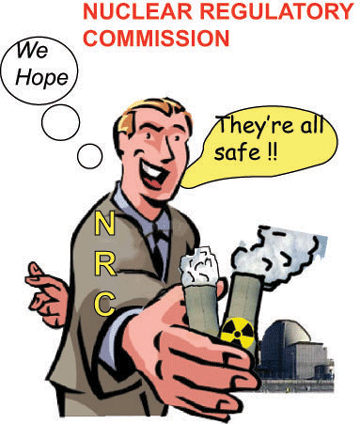
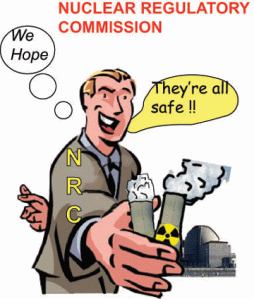 How will the federal government protect nuclear safety in an anti-regulatory climate?, https://theconversation.com/how-will-the-federal-government-protect-nuclear-safety-in-an-anti-regulatory-climate-75680 The Conversation, William J. Kinsella Professor, Department of Communication, North Carolina State UniversityApril 18, 2017 , The Trump administration and congressional Republicans have undertaken a wide-ranging effort to shrink the federal government’s regulatory footprint. Much attention has focused on high-profile targets, such as the Environmental Protection Agency. But this trend also has major implications for other agencies.
One example is the U.S. Nuclear Regulatory Commission, which oversees safety across a complex, privately owned network of nuclear power plants, used fuel storage facilities and other sites related to civilian uses of nuclear energy.
As a researcher studying communication in energy and environmental settings, I have followed the NRC’s work with particular interest since 2011. The agency and the system it regulates exemplify what some scholars call a “high reliability organization” – one that cannot be allowed to fail, because the consequences would be grave.
As studies have shown, failures of external oversight were key factors in the disasters at Chernobyl in 1986 and Fukushima in 2011. Those examples show that there is good reason to assess how today’s anti-regulatory climate could affect the NRC and nuclear safety in the United States.
An industry in flux
The NRC conducts risk-related research and develops and enforces rules for the design and operation of nuclear facilities nationwide. Today it is grappling with major challenges that will shape the future of nuclear power in the United States.
The U.S. nuclear industry is struggling economically to compete with renewable energy and cheap natural gas. Older plants are nearing the end of their 40-year licensed operating lifetimes, while at least 15 reactor construction projects have been canceled or suspended since 2010. The four still in progress have been delayed, and now face possible cancellation.
In response, the industry is relying on 20-year license renewals for existing reactors, which allow them to operate for up to 60 years. As of December 2016, the NRC had approved 87 renewal applications.
Now the agency is preparing to consider applications for “subsequent license renewals” that would extend reactor lifetimes to 80 years. This prospect poses new challenges. Notably, the NRC needs to analyze the safety implications of operating geriatric plants and develop regulatory rules to manage issues such as structural and operational risks.
At the same time, the industry is promoting new reactor designs, which advocates say will be safer and more cost-efficient than current plants. The NRC is building a framework for reviewing and licensing these untested new technologies – an enormous and safety-critical task.
Highly radioactive used nuclear fuel, which is accumulating at reactor sites across the nation, poses additional challenges. As onsite storage capacity fills up, two private companies have applied for licenses to develop “consolidated interim storage facilities” in Texas and New Mexico that could hold used nuclear fuel for up to 40 years.
Authorizing such facilities would require changes to the Nuclear Waste Policy Act, which currently allows only permanent disposal of used nuclear fuel. Nevertheless, the NRC is already engaged in new risk analysis and public communication issues related to these projects.
Used fuel now held at power plants would need to be packaged and moved long distances, secured safely for decades and ultimately moved again to its final disposal site. Communities are also concerned about whether current or interim sites could end up as long-term locations for “stranded” nuclear waste.
Meanwhile, the administration’s 2018 budget blueprint proposes reopening the licensing process for a permanent nuclear waste repository at Yucca Mountain in Nevada. President Obama ended work on licensing Yucca Mountain in 2010, so the NRC would need to reorganize its staffing and resources to resume work on the project.
Anti-regulatory challenges
The current anti-regulatory climate could affect the NRC in multiple ways. Broader executive and legislative developments, and a recent agency leadership change, provide early clues. For example, an executive order issued in January requires federal agencies to eliminate two rules for every new rule they create.
Because the NRC is formally designated as an independent regulatory agency, it might be exempt from this order. However, asked in March about that possibility, NRC Chair Kristine Svinicki responded ambiguously that although the agency is “in some ways beyond the reach” of such orders, she wants to “look to the spirit and intent” they express. It is hard to see how the NRC can develop new regulations for so many emerging activities and keep the U.S. nuclear industry operating safely while slashing existing rules.
Meanwhile, in Congress, Republicans have sought since 2011 to pass the “Regulations from the Executive in Need of Scrutiny” (REINS) Act. This measure would require agencies to get congressional approval for “major rules” with substantial economic impacts.
When the House passed the latest version of the bill in January, New York Democratic Rep. Jerrold Nadler sought to exempt the NRC due to its safety-critical role, but his amendment was defeated.
Leadership transitions
Three days after the presidential inauguration, the role of NRC chairman was transferred to Commissioner Svinicki, a nuclear engineer and former Senate staff member regarded by some critics as particularly friendly to the nuclear industry. Although nuclear insiders learned of the transition quickly, the usual public press release was absent.
The new chairman, who serves as the agency’s sole official spokesperson (working through staff), has espoused a commitment to public transparency but has not always acted accordingly. For example, although up-to-date archives of speeches and testimony by the other commissioners are provided with their NRC website biographies, a recent look at the link for Commissioner Svinicki showed none more recent than 2012.
Svinicki’s appointment will expire on June 30, and the NRC cannot normally operate without a three-member quorum, so action on her reappointment or replacement will soon be needed. Two additional seats on the five-member commission remain open. This will be an important time to look closely at the backgrounds and qualifications of nominees.
To regulate the industry effectively, commissioners must have a firm grasp of the technical and administrative complexities of nuclear safety. Watchdog groups have called on the NRC to enforce safety regulations more aggressively and to promote greater confidence that staff members can bring problematic issues to light.
Perhaps most importantly, commissioners must demonstrate a firm commitment to regulatory independence and openness. Avoiding “recreancy” or “capture” by the regulated industry is crucial for effectiveness and public legitimacy.
In this context, the Trump team’s approach to filling key positions in science and technology agencies and the broad funding cuts proposed for those agencies are troubling. Many nominees have deep ties to regulated industries such as energy, finance and pharmaceuticals.
An essential regulatory mission
As a specialized agency working in a highly technical area, the NRC does not usually receive much public or media attention – except when nuclear failures occur at home or abroad. Although there have been more close calls in the United States than is generally understood, NRC oversight has been crucial to the industry’s overall positive safety record.
A high reliability organization is not automatically a highly reliable organization. Reliability is an ongoing accomplishment involving continuous learning, sustained vigilance and a strong system of checks and balances. Moving forward in an anti-regulatory climate, with so many complex challenges facing the agency, it is essential to ensure independent leadership, public transparency and adequate resources to support the NRC’s mission.
April 19, 2017
Posted by Christina Macpherson |
safety, USA |
Leave a comment
Nuclear Plant Exempted From Regulations As Shutdown Nears http://www.chem.info/news/2017/04/nuclear-plant-exempted-regulations-shutdown-nears PLYMOUTH, Mass. (AP) — The only nuclear power plant in Massachusetts won’t have to comply with certain safety requirements as it prepares to shut down, getting a pass on precautions put in place after the Fukushima disaster in Japan.
The U.S. Nuclear Regulatory Commission, or NRC, says that Pilgrim Nuclear Power Station won’t have to upgrade its vent system before it closes in 2019, despite not meeting all standards. It will also be exempted from seismic and flooding regulations established after the Fukushima meltdowns.
An NRC spokesman says the plant doesn’t have time to complete necessary upgrades and they wouldn’t meaningfully improve safety.
Earlier this month, federal regulators said the plant is safe to operate despite some “performance deficiencies.”
Democratic Senator Edward J. Markey says the decision undermines the safety of people living nearby.
April 19, 2017
Posted by Christina Macpherson |
safety, USA |
Leave a comment
http://www.ecowatch.com/pakistan-schools-go-solar-2360991261.html, Lorraine Chow, 17 Apr 17, About 20,000 schools in the province of Punjab in Pakistan will convert to solar power, according to government officials.
Punjab chief minister Muhammad Shahbaz Sharif reviewed the progress of the “Khadim-e-Punjab Ujala Programme” to install solar rooftop systems on the area’s schools at a recent meeting.
The project will kick off in Southern Punjab schools and expand in phases across the province, according to a local report.
The Asian Development Bank and France’s AFD Bank are backing the program, Cleantechnica reported. This is the first program of its kind in the country.
In Pakistan, nearly half of all residents are not connected to the national grid. Residents who are connected to the grid regularly experience rolling blackouts and power outages. And the problem is only expected to get worse in the coming years.
Renewable resources can help mitigate this growing energy crisis. Pakistan happens to be rich in solar, as the Express Tribune described:
“With eight to nine hours of sunshine per day, the climatic conditions in Pakistan are ideal for solar power generation. According to studies, Pakistan has 2.9 million megawatts of solar energy potential besides photovoltaic opportunities.
“According to figures provided by FAKT, Pakistan spends about $12 billion annually on the import of crude oil. Of this, 70 percent oil is used in generating power, which currently costs us Rs18 per unit. Shifting to solar energy can help reduce electricity costs down to Rs 6-8 per unit.”
Solar energy has made great strides in Pakistan in recent years. In February 2016, its parliament became the first national assembly in the world to be powered entirely by solar energy. The legislative body, known as the Majlis-e-Shoora, is in the capital city of Islamabad.
One of the world’s largest solar farms is currently under construction in Punjab. Developers of the 1,000-megawatt Quaid-i-Azam Solar Park in Bahawalpur have already added hundreds of megawatts of energy to the national grid.
April 19, 2017
Posted by Christina Macpherson |
decentralised, Pakistan |
Leave a comment
A major reason why installations increased, even though dollars invested fell, was a sharp reduction in capital costs for solar photovoltaics, onshore and offshore wind,” the report said.
At the same time, because of the drop in prices, last year, the overall investment in renewable energy plummeted 23% to $241.6 billion from the record established in 2015; it was the lowest total investment since 2013.
Investment in new renewables capacity was roughly double that in fossil fuel generation in 2016, for the fifth successive year. The proportion of global electricity coming from renewable sources rose from 10.3% in 2015 to 11.3% in 2016, and prevented the emission of an estimated 1.7 gigatons of CO2.
Unsubsidized wind and solar now the cheapest source for new electric power http://www.computerworld.com/article/3190409/sustainable-it/unsubsidized-wind-and-solar-now-the-cheapest-source-for-new-electric-power.html Between 2015 and 2021, China is expected to install 40% of all worldwide wind energy and 36% of all solar, By Lucas Mearian Senior Reporter, Computerworld | APR 17, 2017, While investments in renewable energy slumped last year, a big drop in unsubsidized costs for new wind and solar power installations indicated that they remain popular energy alternatives.
Last year, the average “levelized cost” or total cost of generating power from solar worldwide dropped 17% percent, onshore wind costs dropped 18% and offshore wind turbine power costs fell 28%, according to a new report from the United Nations and Bloomberg New Energy Finance (BNEF).
Well, after the dramatic cost reductions of the past few years, unsubsidized wind and solar can provide the lowest cost new electrical power in an increasing number of countries, even in the developing world — sometimes by a factor of two,” Michael Liebreich, chairman of the Advisory Board at BNEF, said in the report.
The average capital cost for solar power projects of new construction in 2016 was 13% lower than in 2015, while for onshore wind the drop was 11.5% and for offshore wind, 10%.
It’s a whole new world: even though investment is down, annual installations are still up; instead of having to subsidize renewables, now authorities may have to subsidize natural gas plants to help them provide grid reliability,” Liebreich said.
Last year, more gigawatts of solar power were added (75GW) than of any other technology for the first time. Trailing behind solar, in order of net gigawatts installed, were wind, coal, gas, large hydroelectric, nuclear and biomass.
Renewable energy accounted for 55% of new worldwide power last year, or a total of 138.5 gigawatts (GW). That compares with 127.5GW of new renewable energy in 2015; and renewable power installed in 2016 was done so at a cost 23% lower than 2015, the report showed.
Since 2010, the dollars committed per year to new renewable energy worldwide — excluding hydroelectric — have increased roughly five-fold, and have since oscillated between $234 billion and $312 billion, the report said.
A major reason why installations increased, even though dollars invested fell, was a sharp reduction in capital costs for solar photovoltaics, onshore and offshore wind,” the report said.
At the same time, because of the drop in prices, last year, the overall investment in renewable energy plummeted 23% to $241.6 billion from the record established in 2015; it was the lowest total investment since 2013.
Investment in new renewables capacity was roughly double that in fossil fuel generation in 2016, for the fifth successive year. The proportion of global electricity coming from renewable sources rose from 10.3% in 2015 to 11.3% in 2016, and prevented the emission of an estimated 1.7 gigatons of CO2.
Smart energy hardware such as smart meters, energy storage sources and associated IoT technologies also saw record investments last year. Asset finance for smart meters and energy storage, plus equity raised for specialist companies in energy efficiency, storage and electric vehicles, totalled a record $41.6 billion last year. That was up 29%.
In the U.S., utilities and private energy companies are increasingly investing in smart grid technology, including microgrids.
China now leads the world in renewable investments
China is now the world leader in domestic investments in renewable energy. In 2015, it invested $103 billion, a 17% increase in spending year over year — twice as much as the U.S. invested. The country is now actively pursuing a “global” strategy, which aims for a Pan-Asian development approach.
In 2016, China increased its foreign investments in renewable energy by 60% year over year to $32 billion, according to a January report from the Institute for Energy Economics and Financial Analysis (IEEFA)
China will install 36% of all global hydro electricity generation capacity from 2015-2021, according to the report. During the same period, it will install 40% of all worldwide wind energy and 36% of all solar, the IEEFA said.
“A change in leadership in the U.S. is likely to widen China’s global leadership in industries of the future, building China’s dominance in these sectors in terms of technology, investment, manufacturing and employment,”
April 19, 2017
Posted by Christina Macpherson |
2 WORLD, renewable |
Leave a comment
http://www.france24.com/en/20170417-focus-france-ageing-nuclear-plants-safety-extend-life-edf-defect-anomalies-costs-britain
Despite heightened surveillance and draconian control measures, the answers from nuclear analysts is far from unanimous. Despite these questions, the French power giant that manages them, EDF, wants to prolong their life by ten or even 20 years. Furthermore, the public utility’s finances are at least €37 billion in debt.
What’s more, EDF is due to build two more reactors in Britain – this after embarrassing revelations of neglect relating to the manufacturer of the reactors, Creusot.
We take a closer look after France‘s nuclear watchdog expressed concern.
April 19, 2017
Posted by Christina Macpherson |
general |
Leave a comment









 nuclear-news