Plutonium in space – the danger in space probes
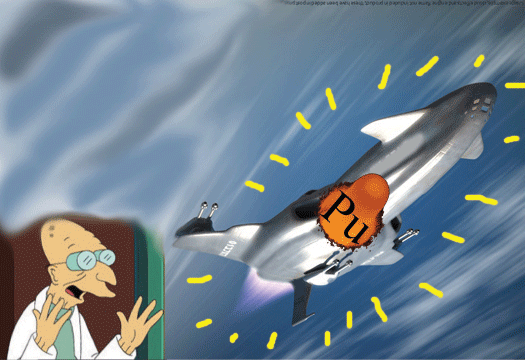 The final mission for Cassini, Enformable, 26 Apr 17, Karl Grossman Despite protests around the world, the Cassini space probe—containing more deadly plutonium than had ever been used on a space device—was launched 20 years ago. And this past weekend—on Earth Day—the probe and its plutonium were sent crashing into Saturn.
The $3.27 billion mission constituted a huge risk. Cassini with its 72.3 pounds of Plutonium-238 fuel was launched on a Titan IV rocket on October 17, 1997 despite several Titan IV rockets having earlier blown up on launch.
At a demonstration two weeks before in front of the fence surrounding the pad at Cape Canaveral from which Cassini was to be launched, Dr. Michio Kaku, professor of theoretical physics at the City University of New York, warned of widespread regional damage if this Titan IV lofting Cassini exploded on launch. Winds could carry the plutonium “into Disney World, University City, into the citrus industry and destroy the economy of central Florida,” he declared………
on an Earth “flyby” by Cassini , done on August 18, 1999, it wouldn’t have been a regional disaster but a global catastrophe if an accident happened.
Cassini didn’t have the propulsion power to get directly from Earth to its final destination of Saturn, so NASA figured on having it hurtle back to Earth in a “sling shot maneuver” or “flyby”—to use Earth’s gravity to increase its velocity so it could reach Saturn. The plutonium was only used to generate electricity—745 watts—to run the probe’s instruments. It had nothing to do with propulsion.
So NASA had Cassini come hurtling back at Earth at 42,300 miles per hour and skim over the Earth’s atmosphere at 727 miles high. If there were a rocket misfire or miscalculation and the probe made what NASA in its “Final Environmental Impact Statement for the Cassini Mission” called an “inadvertent reentry,” it could have fallen into Earth’s atmosphere, disintegrating, and releasing plutonium. Then, said NASA in its statement, “Approximately 7 to 8 billion world population at a time … could receive 99 percent or more of the radiation exposure.”
The worst accident involving space nuclear power occurred in 1964 when a satellite powered by a SNAP-9A plutonium system failed to achieve orbit and fell to Earth, breaking apart and releasing its 2.1 pounds of Plutonium-238 fuel, which dispersed all over the planet. According to the late Dr. John Gofman, professor of medical physics at the University of California at Berkeley, that accident contributed substantially to global lung cancer rates……….
the U.S. Department of Energy working with NASA has started up a new production facility at its Oak Ridge National Laboratory in Tennessee to produce Plutonium-238 for space use. Other DOE labs are also to participate.
Says Gagnon of the Maine-based Global Network: “Various DOE labs are rushing back into the plutonium processing business likely to make it possible for the nuclear industry to move their deadly product off-planet in order to ensure that the mining operations envisioned on asteroids, Mars, and the Moon will be fully nuclear-powered. Not only do the DOE labs have a long history of contaminating us on Earth but imagine a series of rocket launches with toxic plutonium on board that blow up from time to time at the Kennedy Space Center. They are playing with fire and the lives of us Earthlings. The space and the nuke guys are in bed together and that is a bad combination—surely terrible news for all of us.”
“The Global Network,” said Gagnon, “remains adamantly opposed to the use of nuclear power in space.” http://enformable.com/2017/04/the-final-mission-for-cassini/?utm_source=feedburner&utm_medium=email&utm_campaign=Feed%3A+Enformable+%28Enformable%29
No comments yet.
1 This Month

10 March A LIVE WEBINAR THE REAL EFFECTS OF NUCLEAR POWER
What the Industry Isn’t Telling Us
1:00 PM Mountain, 2 pm Central, 3 pm Eastern. Live on the Keepers of the Water Facebook page


18 March Webinar @ 1 PM EST: An Assessment of SMR Projects: The Case of Canada
register for the zoom:
https://us02web.zoom.us/webinar/register/WN_o8BIIOUvQ2ONJR1nta65DQ#/registration


of the week – STOP SMALL MODULAR REACTORS IN CANADA
To see nuclear-related stories in greater depth and intensity – go to https://nuclearinformation.wordpress.com
-
Archives
- March 2026 (62)
- February 2026 (268)
- January 2026 (308)
- December 2025 (358)
- November 2025 (359)
- October 2025 (376)
- September 2025 (258)
- August 2025 (319)
- July 2025 (230)
- June 2025 (348)
- May 2025 (261)
- April 2025 (305)
-
Categories
- 1
- 1 NUCLEAR ISSUES
- business and costs
- climate change
- culture and arts
- ENERGY
- environment
- health
- history
- indigenous issues
- Legal
- marketing of nuclear
- media
- opposition to nuclear
- PERSONAL STORIES
- politics
- politics international
- Religion and ethics
- safety
- secrets,lies and civil liberties
- spinbuster
- technology
- Uranium
- wastes
- weapons and war
- Women
- 2 WORLD
- ACTION
- AFRICA
- Atrocities
- AUSTRALIA
- Christina's notes
- Christina's themes
- culture and arts
- Events
- Fuk 2022
- Fuk 2023
- Fukushima 2017
- Fukushima 2018
- fukushima 2019
- Fukushima 2020
- Fukushima 2021
- general
- global warming
- Humour (God we need it)
- Nuclear
- RARE EARTHS
- Reference
- resources – print
- Resources -audiovicual
- Weekly Newsletter
- World
- World Nuclear
- YouTube
-
RSS
Entries RSS
Comments RSS
 nuclear-news
Leave a comment