The cold hard reality is there is no viable military option against North Korea. They have nuclear weapons, which they can respond with. They have formidable conventional artillery, which they can use to hit Seoul. A preventive strike may provoke the very action it is designed to prevent. As Bismarck warned, it is like committing suicide from fear of death.
A political settlement with Pyongyang is probably not plausible, so America and its allies have no choice but to contain North Korea as best we can. Deterrence and diplomacy have risks, to be sure, but the risks seem far lower than those involved in attacking or further isolating North Korea.
Of course North Korea wants nukes. We should learn to live with it
Deterrence and diplomacy carry risks, but attacking or further isolating North Korea could be worse. The Age , Tom Switzer, 23 Apr 17, “……I listen to the debates about North Korea’s nuclear ambitions. Once again, we are told that a rogue state is bent on developing nuclear weapons that threaten world peace and that either a preventive strike or regime change, or both, will disarm this strategic and moral threat.
But remember the realists were right about Iraq. Leave aside that Saddam’s regime did not even possess serious weapons of mass destruction capacity. Regime change was always fraught with the danger of unintended consequences. Iran and its Shiite militias acquired new influence within Iraq and the broader region while parts of Iraq fell into the hands of Sunni jihadists, who were even more fanatical than al-Qaeda.
Although anguish over a nuclear North Korea is understandable, it’s a fair bet the realists are also right today.
We are told Kim Jong-un is really a madman because he really has nuclear weapons. But although he is a nasty piece of work, the North Korean despot is not crazy. His primary goal is survival: the end of his regime means the end of Kim. From his perspective, it makes sense to develop nuclear weapons.
Why? Because nukes are the ultimate deterrent. North Korea is a minor power surrounded by three major powers – China, Japan, Russia – and with an outside power – the US – constantly threatening it with regime change. As Professor John Mearsheimer, the doyen of foreign-policy realism, told me recently, when Washington strikes Bashar al-Assad’s Syria, or helps topple Saddam’s Iraq or Colonel Gaddafi’s Libya, it gives Pyongyang a very powerful incentive to keep its nuclear weapons.
We are told that Beijing must force North Korea into giving up its nukes or at least not develop an intercontinental ballistic missile that can hit California and Darwin. Chinese co-operation would be ideal and Beijing’s leaders, as Malcolm Turnbull reiterated at the weekend, have some leverage with their communist comrade.
But China also needs North Korea for geopolitical reasons. It is a vital strategic asset. Remember that China entered the Korean War in late 1950 when the Americans crossed the 38th Parallel.
From Beijing’s standpoint, the collapse of North Korea would create a refugee crisis and mean a reunified Korea under a US nuclear security umbrella. If you think Russia is overly sensitive about Ukraine being a western bulwark on its doorstep, imagine how China would respond to a western bulwark on its doorstep. As unfashionable as it is to say, great powers still have spheres of influence.
We are told that regime change is an option in dealing with the North Korean menace. But if there is any hope of discouraging Pyongyang from using nuclear weapons, the West will need to stop threatening regime change and try to reach an accommodation with the Hermit Kingdom. The only way North Korea will jettison its nukes is if it feels relatively secure and has the sense that relations with the West are improving.
Alas, Donald Trump sounds tougher with Pyongyang than even Bush and Barack Obama. At the weekend, Vice-President Mike Pence told the Prime Minister the US will not relent until the Korean peninsula is free of nuclear weapons. That could box in Trump, limit his options, and force him on a path that could push him into a preventive war.
The cold hard reality is there is no viable military option against North Korea. They have nuclear weapons, which they can respond with. They have formidable conventional artillery, which they can use to hit Seoul. A preventive strike may provoke the very action it is designed to prevent. As Bismarck warned, it is like committing suicide from fear of death.
A political settlement with Pyongyang is probably not plausible, so America and its allies have no choice but to contain North Korea as best we can. Deterrence and diplomacy have risks, to be sure, but the risks seem far lower than those involved in attacking or further isolating North Korea. Just think of Iraq.
Tom Switzer is a Fairfax Media columnist and a presenter on the ABC’s Radio National. http://www.theage.com.au/comment/of-course-north-korea-wants-nukes-we-should-learn-to-live-with-it-20170423-gvqkbs.html
April 24, 2017
Posted by Christina Macpherson |
2 WORLD, politics international, weapons and war |
Leave a comment
North Korea issues nuclear warning to Australia, Camden Narellan Advertiser ,23 Apr 2017 Beijing: North Korea’s foreign ministry has lashed out at Foreign Minister Julie Bishop and warned Australia was “coming within the range of the nuclear strike”. The threats were reported by the North Korean state news agency KCNA as being made on Friday, in response to a radio interview given by Ms Bishop.
 According to a translation of the KCNA report, which was dated Friday, the same day US Vice-President Mike Pence arrived in Australia, Ms Bishop had said in the radio interview that North Korea seriously threatens regional peace and she supports the US policy that “all options are on the table”.
A spokesman for the Foreign Ministry of North Korea – officially the Democratic People’s Republic of Korea (DPRK) – was quoted as saying: “The present government of Australia is blindly and zealously toeing the US line. It is hard to expect good words from the foreign minister of such government.”….
“If Australia persists in following the US moves to isolate and stifle the DPRK and remains a shock brigade of the US master, this will be a suicidal act of coming within the range of the nuclear strike of the strategic force of the DPRK.”….
The KCNA report continued: “The Australian foreign minister had better think twice about the consequences to be entailed by her reckless tongue-lashing before flattering the US.”
Prime Minister Malcolm Turnbull on Saturday pledged support for the US policy on North Korea and again urged China to do more to place economic pressure on North Korea.
China has turned back coal shipments to North Korea in recent weeks, one of the regime’s few sources of funding. Chinese media have speculated the Chinese government is also considering cutting oil supplies.
There are renewed concerns that North Korea may conduct its sixth nuclear test on Tuesday, the 85th anniversary of its military, and China said this week it was “gravely concerned”.
China’s official People’s Daily newspaper on Saturday evening reported online that new satellite images of the North Korean nuclear test site had shown probable new trailer activity, citing US research website 38 North. http://www.camdenadvertiser.com.au/story/4614177/north-korea-issues-nuclear-warning-to-australia/?cs=5
April 24, 2017
Posted by Christina Macpherson |
AUSTRALIA, North Korea, politics international |
Leave a comment

A girl holds her petition to ask the education ministry to protect children from radioactive contamination at Fukushima prefecture during a rally at the Education Ministry in Tokyo on May 23, 2011. Some 400 civic group members, including 60 parents and children from Fukushima, demanded to review the radiation limit of 3.8 microsieverts per an hour as the education ministry has set a radiation limit to allow children in Fukushima. AFP PHOTO / Yoshikazu TSUNO
Incredible contamination in Namie, Fukushima where people are being forced to live! European News Weekly, April 22, 2017 by arclight2011part2 Mirrored, Source for article – https://fukushima311voices.wordpress.com/2017/04/22/incredible-contamination-in-namie-fukushima/
The evacuation orders of the most populated areas of Namie, Fukushima were lifted on March 31st this year.
“Fukuichi area environmental radiation monitoring project” has published airborne radiation measurements map and soil surface density map. The results are simply incredible. This is far much worse than in Radiation Control Zone. Any area becomes designated as such when the total effective dose due to external radiation and that due to radioactive substances in the air is likely to exceed 1.3mSv per quarter – over a period of three months, or when the surface density is over 40,000Bq/m2. In the Radiation Control Zone, it is prohibited to drink, eat or stay overnight. Even adults are not allowed to stay more than 10 hours. To leave the zone, one has to go through a strict screening.
Namie’s radio contamination is far over these figures! And people are told to go back to these areas……..https://europeannewsweekly.wordpress.com/2017/04/22/incredible-contamination-in-namie-fukushima-where-people-are-being-forced-to-live/
April 24, 2017
Posted by Christina Macpherson |
Fukushima continuing |
Leave a comment
But besides demanding North Korea give up its only trump card — no pun intended — some are pushing the administration to go even further: to consider launching a preemptive strike on Pyongyang.
What happens next is one of the worst military and human tragedies in history: Kim orders a nuclear strike on Seoul. While the missile lands four miles outside of the city thanks to a targeting error, millions of people are instantly killed with millions more poisoned by radioactive fallout. In a sheer panic, the millions of people who survive the attack rush south, creating a massive humanitarian crisis of the worst magnitude.
From here, things get even worse……the price of such a victory could be millions of people dead and large sections of Korea rendered uninhabitable for decades, if not longer.
No one wants to talk to the dictator of a nation with over 200,000 people or more in prison camps — but an attack that could lead to a conflict where millions could die in a nuclear war is far worse. The stakes are too great to at least not consider it.
 How a preemptive strike on North Korea could end up killing millions http://theweek.com/articles/692872/how-preemptive-strike-north-korea-could-end-killing-millions Harry J. Kazianis 21 Apr 17 While North Korea might not have tested another nuclear weapon in recent days, tensions in Asia keep rising — and Washington is at least partially to blame.
First, it seems the Trump administration is ready to take the toughest of lines when it comes to dealing with the Hermit Kingdom. In an interview with The Washington Post‘s Josh Rogin, Vice President Pence declared that North Korea must give up its nuclear and missile programs in exchange for nothing, not even talks.
As the piece points out, it is tough to tell at this point if this was just rhetoric, maybe a trial balloon of sorts, or a new Trump administration policy. The vice president, however, seemed clear: “I think the path of negotiations with North Korea has been a colossal failure now for more than 25 years.”
But besides demanding North Korea give up its only trump card — no pun intended — some are pushing the administration to go even further: to consider launching a preemptive strike on Pyongyang.
In an interview on the Today show, Sen. Lindsey Graham (R-S.C.) explained that if China would not stop North Korea from building a missile that can hit the U.S. homeland, Washington should use diplomacy, sanctions, and possibly “a military strike to stop their program.”
On the surface, both comments in isolation might not draw oodles of attention. But taken together with the facts that Washington will not negotiate with North Korea and that the Hermit Kingdom already has, according to most estimates, 10-20 nuclear weapons, the comments are nothing short of apocalyptic.
In order to appreciate the ramifications of such a policy, let’s game out what such ideas would look like in practice. Let us assume in the near future that Washington decides to push China hard into somehow “solving” the North Korea issue. Beijing, for its part, does cut back some food and fuel aid and does, to its credit, end all direct and indirect aid to Pyongyang’s various military programs. North Korea’s nuclear and missile programs continue to advance, but instead of racing towards a missile that can nuke America, the program is slowed dramatically.
The Trump administration is not satisfied. It threatens China, declaring that it must do more. But Beijing does not want to precipitate the possible downfall of the Kim dynasty. They fear Washington’s wrath, but they’re much more worried about millions of hungry North Koreans trying to seek refuge in China as well as potentially loose nuclear, chemical, and biological weapons. Combined with Beijing’s other great concern — that Seoul would eventually unite the Korean peninsula under its control and continue its military alliance with the U.S. — China decides to take its chances with America.
Washington is now faced with a dilemma. They have made substantial progress on curtailing the speed in which Pyongyang can pair a nuclear warhead with a long-range missile — but the threat does remain. So the Trump administration leaks to the press that it is considering military action, and begins to move its best military assets into the region — and this time it’s for real. President Trump orders B-2 bombers at the ready, with the ability to evade radar and drop large, bunker-buster bombs on North Korean nuclear facilities.
But North Korea is not to be deterred. It declares to the world that if the Trump administration decides to attack, Pyongyang will unload its full arsenal on South Korea and Japan. And considering North Korea’s large military — thousands of artillery pieces, rocket launchers, 4,300 tanks, 1.1 million men under arms, 200,00 special forces, and a dangerous offensive cyber warfare capability — it is a threat that can’t exactly be taken lightly
But Trump presses ahead. After moving three aircraft carrier battlegroups into the region and sending additional bombers and fighters to South Korea, Japan, and Guam, the administration warns North Korea that “it must decide whether it wants peace or war” and that “the Kim regime clearly can see that now we truly have all options on the table.” Trump then goes on Twitter, declaring, “I hope Kim makes the right choice!”
Kim Jong Un, North Korea’s third dynastic dictator, decides not to budge. He knows that if he gives up his nukes he has no leverage with America. And even worse, North Korea’s political elites will see him as weak — and regime change could occur from within. He makes the only choice he can, and hopes Trump is bluffing.
Unfortunately for Kim, and Asia, war is now inevitable.
Trump orders a massive assault on North Korea’s nuclear weapons and missile programs. The goal is simple: Destroy not only Pyongyang’s ability to create nuclear weapons and advanced missiles, but the current stockpiles they have. Washington launches what can only be described as a “shock and awe” campaign on steroids: over 1,000 cruise missiles in the first few hours alone, B-2 bombers flying around the clock from bases in Missouri with stealth F-22 Raptors leading the way.
The assault itself, according to every metric conceivable, is a success. North Korea’s nuclear and missile programs are set back a decade or more with most of Kim’s nuclear weapons and missile launchers destroyed. Republicans and Democrats alike applaud President Trump’s bold actions — acting when leaders of the past decided to do nothing.
There is however a catch to what seems like a resounding military success: The Kim regime’s nuclear deterrent was not completely destroyed. One weapon, buried deep underground, survived the attack. And since North Korea’s chemical and biological weapons were largely hidden underground as well, Kim has a terrible choice to make: Use the weapons he has now, or lose them in a potential second wave of strikes. He decides to use his full arsenal before it’s too late.
What happens next is one of the worst military and human tragedies in history: Kim orders a nuclear strike on Seoul. While the missile lands four miles outside of the city thanks to a targeting error, millions of people are instantly killed with millions more poisoned by radioactive fallout. In a sheer panic, the millions of people who survive the attack rush south, creating a massive humanitarian crisis of the worst magnitude.
From here, things get even worse. Kim launches dozens of chemical and biological weapons at South Korea and Japan. Sarin, VX ,and other toxins are lobbed at Tokyo, Pusan, and other large cities. Millions of people try to flee the impacted areas just as in Seoul — creating a panic not seen since World War II.
In just a few hours, hell is unleashed on the Korean peninsula. And while the United States and its allies would eventually win any war against North Korea, it is clear from the above — far from what could be the most extreme of examples of a Second Korean War — what damage the Kim regime could do in a military confrontation. Indeed, the price of such a victory could be millions of people dead and large sections of Korea rendered uninhabitable for decades, if not longer.
Yet, there is another path forward. It seems due time for President Trump to remember his own words from the campaign when it comes to talking to North Korea — and maybe even to Kim Jong Un directly: “I would speak to him. I would have no problem speaking to him.”
No one wants to talk to the dictator of a nation with over 200,000 people or more in prison camps — but an attack that could lead to a conflict where millions could die in a nuclear war is far worse. The stakes are too great to at least not consider it.
April 24, 2017
Posted by Christina Macpherson |
North Korea, politics international, USA, weapons and war |
Leave a comment
What would happen if a nuclear bomb hit Coventry? http://www.coventrytelegraph.net/news/coventry-news/what-would-happen-nuclear-bomb-12913136 The city centre would be turned into a 300m wide and 200m deep crater, BY JAMES RODGER, 23 Apr 17, Hundreds of thousands of people would be killed if a nuclear blast hit Coventry and Warwickshire.
Imagining the bomb went off at ground level in Broadgate, the city centre would be turned into a 300m wide and 200m deep crater, according to interactive data site Nukemap.
The map below shows the impact of a nuclear explosion in Coventry.

Fireball radius (orange)
Fatal levels of radiation would increase greatly if the nuke exploded at ground level.
The fireball radius (orange) would see the entire city centre including monuments such as the Cathedral, Broadgate and West Orchards Shopping Centre consumed by a nuclear fireball 3.2km wide.
This would stretch as far as the Ricoh Arena at one end, and Finham at the other.
The fatality rate is 100 per cent.
- Crater inside radius: 150 m (0.07 km²)
- Crater lip radius: 300 m (0.28 km²)
- Fireball radius: 0.71 km (1.56 km²)
- Air blast radius (20 psi): 1.67 km (8.8 km²)
- Radiation radius (500 rem): 2.26 km (16.1 km²)
- Air blast radius (5 psi): 3.52 km (39 km²)
- Thermal radiation radius (3rd degree burns): 8.95 km (251 km²)
-
Radiation radius (green)
Slightly wider than the fireball radius. Without medical treatment, expect between 50 per cent and 90 per cent mortality from acute effects alone. Dying takes between several hours and several weeks.
Air blast radius (red – 20psi)
The most intense air blast would have a radius of 4.75km and demolish heavily built concrete buildings in the University of Warwick campus, Binley Road, and Holbooks, among other areas. The fatality rate is still 100 per cent – or very close.
-
Air blast radius (grey – 5psi)
A lesser air blast radius would still cause the collapse of all residential buildings within a 10km radius. That means houses would collapse all the way out in Fillongley, Bedworth, Kenilworth and Ryton.Injuries are universal and fatalities widespread.
-
Thermal radiation radius (lighter orange)
The thermal radiation radius is 29.1km. This would mean third degree burns “throughout the layers of the skin”, which could cause severe scarring, disablement and even amputation. This radius covers Nuneaton, Hinckley, Sutton Coldfield, parts of Birmingham and Leamington Spa.
- The city would be dependent on outsiders and national agencies for help after the blast. In the fallout survivors would find dozens of hospitals and medical facilities would have been destroyed. A dozen fire stations would also have been wiped out.At the same moment around 200 schools and hundreds of churches, mosques, gurdwaras and temples could have been levelled or badly damaged.
April 24, 2017
Posted by Christina Macpherson |
Reference, UK, weapons and war |
8 Comments
Volleyball Over, North Koreans Go Back to Work at Nuclear Site, Analysts Say, NYT, By CHOE SANG-HUNAPRIL 22, 2017, SEOUL, South Korea — North Korea appears to have resumed work at its nuclear test site after a perplexing series of volleyball matches were held there, according to analysts who studied satellite images of the site, renewing concerns that a major weapons test could be imminent.
Many observers had feared that North Korea would test a nuclear device at the site around April 15, the birthday of Kim Il-sung, the North’s founding president and the grandfather of the current leader, Kim Jong-un. But Mr. Kim’s government celebrated the day instead with a military parade in Pyongyang, the capital, during which a fleet of missiles were rolled out, including what analysts believed were never-before-seen long-range ballistic missiles.
North Korea carried out a missile test on Sunday, but it was considered an embarrassing failure, with the projectile exploding immediately after liftoff.
But North Korea is preparing to celebrate another major holiday this coming week: Tuesday will be the 85th anniversary of the founding of the Korean People’s Army, and the North often uses such occasions to show off its military advances…….
On Friday, the analysts Joseph S. Bermudez Jr. and Jack Liu posted new satellite images of the nuclear test site in Punggye-ri, in northeastern North Korea, on 38 North, a website affiliated with the Johns Hopkins University School of Advanced International Studies……
Mr. Bermudez and Mr. Liu said it was unclear whether the latest activity from Punggye-ri reflected a “tactical pause” before a coming nuclear test, a prolonged “stand-down” from testing or normal operations at the site.
“Regardless, satellite imagery continues to indicate that the Punggye-ri nuclear test site appears able to conduct a sixth nuclear test at any time once the order is received from Pyongyang,” they concluded…..
On Saturday in Sydney, Australia, Mr. Pence said that an American naval strike group led by the aircraft carrier Carl Vinson was expected to be in the Sea of Japan, which borders the Korean Peninsula, by the end of April.
Senior aides to Mr. Trump have said that military options are not off the table in dealing with North Korea’s rapidly advancing nuclear and missile technologies. Those remarks prompted fears in the region that the new American president might order a pre-emptive strike at North Korea’s weapons sites, which could set off a war…….https://www.nytimes.com/2017/04/22/world/asia/north-korea-nuclear-test-preparations.html?_r=0
April 24, 2017
Posted by Christina Macpherson |
North Korea, weapons and war |
Leave a comment
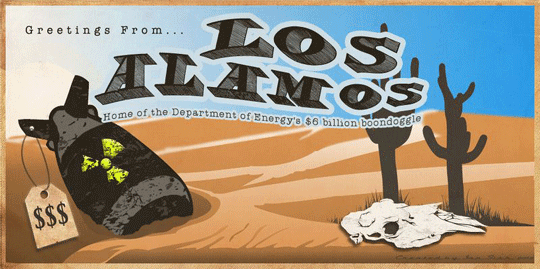
Area G, perhaps more than any other place at Los Alamos National Laboratory, represents the challenges that the U.S. Department of Energy faces in cleaning up the hundreds of waste sites at the lab while work continues to produce new or modernized nuclear weapons.
A report released this spring by the Energy Department’s Environmental Management Los Alamos Field Office says that out of 2,100 contaminated sites, including Area G, only about half of the cleanup at the lab has been completed after decades of work and billions of dollars spent.
If all goes as planned, it will take Los Alamos almost a century to clean up the remnants of the nation’s first generation of nuclear weapons. All the while, tiny, new nuclear bombs are being made.

LANL’s Area G at center of nuclear cleanup effort, http://www.santafenewmexican.com/news/local_news/lanl-s-area-g-at-center-of-nuclear-cleanup-effort/article_31af6d36-e24c-5d63-b131-7877f813d6be.html By Rebecca Moss The New Mexican, 23 Apr 17 LOS ALAMOS — To stand at one of the largest radioactive dumps in the nation requires a drive through two security checkpoints, a clearance badge and, for outsiders, a three-to-one guard by federal employees.
Visitors cross the final checkpoint on foot. There is just a metal gate, with stop signs and notifications that crossing this threshold means entering a nuclear facility.
The 63-acre Material Disposal Area G at Los Alamos National Laboratory holds radioactive and other hazardous waste generated by nuclear weapons production during the Manhattan Project of World War II and the Cold War that followed.
Just three feet below the dusty ground, there are nearly 40 pits and 200 shafts, containing somewhere between several hundred thousand and 11 million cubic feet of waste. Large, white structures, like joyless wedding tents, dot the mesa’s surface, holding drums of waste that are intended to be shipped to the Waste Isolation Pilot Plant near Carlsbad and disposed of forever.
Many of these drums are especially volatile. They belong to a waste stream that was improperly packaged, causing one drum to explode at WIPP in 2014, leaking radiation and shutting down the facility for nearly three years at a $2 billion cleanup cost.
Area G, perhaps more than any other place at Los Alamos National Laboratory, represents the challenges that the U.S. Department of Energy faces in cleaning up the hundreds of waste sites at the lab while work continues to produce new or modernized nuclear weapons.
The lab recently gave reporters a rare tour of Area G and other sites contaminated by waste generated before 1999, the year the Energy Department opened WIPP. It is the nation’s only permanent disposal site for transuranic waste, which includes soil, tools, gloves and other materials that have come in contact with highly radioactive elements like plutonium, which is used in weapons production. Before WIPP opened, Area G was where the lab disposed of its transuranic waste.
A report released this spring by the Energy Department’s Environmental Management Los Alamos Field Office says that out of 2,100 contaminated sites, including Area G, only about half of the cleanup at the lab has been completed after decades of work and billions of dollars spent.
The report says the initial investigation into the extent of contamination at those sites is 90 percent done, and 93 percent of the above-ground transuranic waste — 4,000 drums — has been removed from the lab since 2011.
But much of the buried waste at Area G is likely to stay there forever.
The lab could dig everything up, but “the federal government and the state don’t require it,” said a senior lab official who took the tour with reporters. Officials on the tour prohibited reporters from quoting them by name.
The circumstances that led to one of the costliest nuclear accidents in U.S. history began at Area G. A drum of waste improperly packaged with organic — rather than inorganic — kitty litter at Area G in 2013 and shipped to the Waste Isolation Pilot Plant overheated and burst underground in February 2014.
At Area G, there are 89 more drums similar to the one that burst. They are kept within the largest tent on the mesa, called the PermaCon.
Inside, the light takes on a yellowish-gray hue and the air is at least 15 degrees cooler than the April day outside. At the center of the space, behind a rope and a sign that reads “combustible restricted area,” the waste drums have been placed inside a refrigerated metal structure, like enormous eggs in an incubator.
They contain some of the most volatile waste at the site, a mix of nitric acids, kerosene, heavy metals, plutonium-239, uranium-238 and nitrate salt.
Sixty of the drums, like the one that burst at WIPP, contain the organic kitty litter. The rest of the 89 drums have the same waste but haven’t yet been mixed with an absorbent.
Before entering the tent, visitors must protect their eyes with plastic glasses and make sure their hands are devoid of wounds. Radiation is more easily absorbed into the body if it can slip through a cut. Visitors are told to avoid touching surfaces and their mouths, and to leave outside anything they don’t want to be surveyed for radioactive contamination.
Area G workers are told to make a habit of wearing gloves at all times, even at home, officials said. “Fight the way you train,” is how one person explained it.
Workers at the PermaCon wore purple gloves and were dressed head to boots in a yellow, plastic material that forms a protective hood and thick goggles.
A sign on a door leading to where the drums are kept informs workers that they will be exposed to 0.1 rem of radiation per hour. The average American receives 0.6 rem per year, according to the U.S. Nuclear Regulatory Commission.
The drums are kept at 57 degrees Fahrenheit and monitored daily to ensure the pressure and heat do not change. If a drum starts to heat, officials can open large vents added to the drums and reduce pressure, but releasing some radiation, too, within the PermaCon.
From Area G it takes just two minutes to walk onto San Ildefonso Pueblo land; The community of White Rock is one mile from the site.
As reporters and officials exited, workers traced radiation detection monitors slowly across palms and the soles of shoes.
By May, a 3-mile stretch of the road between Area G and a waste repackaging facility will be closed off daily as drums are transported uphill to the Waste Characterization, Reduction and Repackaging Facility, which looks like a series of oversized garages.
As reporters entered the facility, one worker whispered, “Hold your breath.”
Over roughly two months, lab workers will repackage the waste in two-hour shifts using a glove box — a large, sealed container. Inserting their hands into gloves attached to the box, the workers will open the drums.
The waste will be combined with water and zeolite — a fine, gray mineral mined in Western states, including New Mexico, and sold as absorbent cat litter — and stirred in an industrial kitchen mixer within the glove box. Once the waste is mixed, it will be funneled into new “daughter” drums and returned to Area G for later shipment to WIPP, officials said.
An official said zeolite was chosen as an absorbent in part because it eliminates any confusion about the type of kitty litter that can be used.
Tacked to the glove box is a printed sheet of paper with numbered instructions for how to mix the waste. It’s pinned just above the radiation detection panel that workers must press their hands against the moment they are removed from the glove box.
Area G is situated on a mesa between two canyons, and wildfire is a threat to the drums waiting for repackaging and shipment to WIPP.
In 2000, the Cerro Grande Fire burned through both canyons simultaneously, creating extremely high temperatures on the mesa. If this happened again, an official said, the lab would cover the drums with fire blankets but could not move them. They could only hope that the flames subside before the drums overheat and begin a reaction like the one that closed WIPP.
The Los Conchas Fire in 2011 burned within four miles of Area G.
The administrations of Govs. Bill Richardson and Susana Martinez have sought to expedite the removal of vulnerable canisters from lab property. But deadlines for the lab to do so, first by 2010 and then by June 2014, went unmet, in part because waste shipments to WIPP stalled following the radiation leak caused by the Los Alamos drum.
Waste disposal at Area G is expected to stop next year when the last open pit is filled. The lab’s newly constructed Transuranic Waste Facility, an outdoor storage site, will temporarily hold newly generated waste before shipment off-site. The lab also is seeking approval from the New Mexico Environment Department for temporary storage at the plutonium processing facility where pits, the triggers for nuclear weapons, are produced. Pits are similar to small atomic bombs.
But the Defense Nuclear Facilities Safety Board, an independent agency, and others have raised concerns about storing radioactive waste at these locations. New waste sites, even those intended to be temporary, increases the potential for dangerous waste to remain on lab property long term.
On the drive to Area G on a winding road within the national laboratory complex, in a lab “taxi” van playing 1980s rock, many buildings appeared more like prison structures than research facilities, with thick, glass windows — or no windows at all — and tall, barbed-wire fences.
One official remarked on the great irony of the work: The first atomic bomb took only 27 months to create, but like the myth of Pandora’s box, it unfurled a seemingly endless stream of deadly waste.
Last September, the Energy Department said the remaining scope of legacy waste cleanup is estimated to cost $3.8 billion, and it will take 24 more years to finish shipping the rest of the waste to permanent storage and decontaminating the land.
If all goes as planned, it will take Los Alamos almost a century to clean up the remnants of the nation’s first generation of nuclear weapons. All the while, tiny, new nuclear bombs are being made.
Kaitlin Martinez, a spokeswoman for the Environmental Management Los Alamos Field Office, said the “biggest priorities right now are the safety of the workers and the public as we execute our mission.”
April 24, 2017
Posted by Christina Macpherson |
USA, wastes |
Leave a comment

 Future of nuclear energy bleak in Korea All major candidates vow to stop building new reactors, Korea Times, By Jung Min-ho, 21 Apr 17, The future of nuclear energy looks bleak in Korea for whoever becomes the next president.
All major candidates have vowed to stop building new nuclear reactors and close down older ones in an effort to reduce the country’s dependence on nuclear energy.
Left-leaning Democratic Party of Korea (DPK) candidate Moon Jae-in, the frontrunner in the race, promised to cancel construction plans for two additional nuclear reactors ― Shin Kori 5 and 6. He believes Korea will have to phase out all of its remaining nuclear power plants over the next 40 years.
Ahn Cheol-soo of the People’s Party, the runner-up, also made the same promises, though he did not mention specifically by when he plans to remove all nuclear reactors. Korea has 23 nuclear reactors in operation, from which it gets about 30 percent of its power. Five more reactors are under construction.
Sim Sang-jeung of the minor Justice Party is taking the strongest stance against nuclear energy. She said she will immediately close down all the reactors under construction and rid the country of nuclear reactors by 2040.
The two right-wing candidates ― Yoo Seong-min of the Bareun Party and Hong Joon-pyo of the Liberty Korea Party ― are more cautious about the idea of removing all the nuclear reactors, but still, they are not far apart on the issue compared to other candidates.
Four of the candidates have also vowed to reduce the country’s dependence on coal power plants as well to resolve the issue of fine dust, which has become worse in recent years. Hong alone remains skeptical of doing so, but he said he will regulate their operations more strictly instead…….
Meanwhile, all the candidates vowed to increase investment into developing renewable energy sources. The two leading candidates said they will initiate the project to increase the country’s reliance on renewable energy to 20 percent by 2030.
“Compared with the previous presidential election, candidates have taken more progressive approaches over the issue,” said Kim Mi-kyung, a climate change activist at the environmental group Greenpeace. “We expect Korea to follow the global trends of nuclear-free, coal-free and more renewable energy.”
April 24, 2017
Posted by Christina Macpherson |
politics, South Korea |
Leave a comment
https://www.skepticalscience.com/Heartland-Institute-misinformation-campaign-schools.html
|
21 April 2017 by John Cook
Last month, the Heartland Institute sent a climate denial booklet to 25,000 teachers around the US. In Episode 8 of the Evidence Squared podcast, we look at the why and how of this book. What is the chief motivation for the book’s misinformation and what are the techniques they employ to cast doubt on climate science?
|
April 24, 2017
Posted by Christina Macpherson |
spinbuster, USA |
Leave a comment
Kelly: Trump will face nuclear North Korea in this term http://thehill.com/homenews/administration/330107-kelly-trump-will-deal-with-nuclear-north-korea-before-his-second-term BY MALLORY SHELBOURNE – 04/23/17 Department of Homeland Security Secretary John Kelly said Sunday that President Trump will face a nuclear-armed North Korea with missiles that could reach the United States in this term.
“I think Mr. Trump will be dealing with this in real terms before he starts his second term,” Kelly told CNN’s “State of the Union.”
Kelly refused to answer host Dana Bash’s question over whether or not the U.S. military could shoot down a missile from North Korea, telling Bash that the information is classified. Kelly did say the United States will be “at grave risk” when a North Korean missile can reach its shores.
“The instant that happens, this country is at grave risk,” said Kelly.
North Korea earlier this month failed to launch a ballistic missile on its east coast. The launch came amidst mounting tensions between the U.S. and North Korea, as the Trump administration continues talks with China over how to curb North Korea’s nuclear ambitions.
April 24, 2017
Posted by Christina Macpherson |
North Korea, weapons and war |
Leave a comment
 Sec. John Kelly: Terrorism on US Planes Keeps Me ‘Awake at Night, http://www.newsmax.com/Politics/john-kelly-terrorism-us-planes-keeps-me-awake/2017/04/23/id/785878/, Homeland Security Secretary John Kelly said Sunday a terrorist plot against American planes “keeps me literally awake at night,” calling the threat “something that is very real.”
In an interview on CBS News’ “Face The Nation,” Kelly said a successful strike at a U.S. plane would kill “hundreds and hundreds of people in one fell swoop.” “The … thing that keeps me literally awake at night is the threat against aviation,” he said. “We know that would be the Super Bowl for the terrorists to knock down an air plane in flight, particularly if it was full of Americans.
“There are a number of plots that we’re watching very, very closely— very sophisticated, very threatening, and the number-one thing in my mind is to protect the American people,” he added, calling the “aviation threat… something that is very real.”
On the issue of North Korea’s threat to the nation, Kelly said “as long as they’re on the other side of the world without a missile and a nuclear weapon to deliver against the United States, they’re not much threat right now— except in the world of cyber. They’re pretty aggressive when they want to be in cyber,.”
“The instant they get a missile that can reach the United States, and they have a weaponized atomic device, nuclear device on it, we’re at grave risk as a nation,” he warned.
April 24, 2017
Posted by Christina Macpherson |
safety, USA |
Leave a comment
Jeremy Corbyn does not guarantee the Labour manifesto will back Trident nuclear weapons
Jeremy Corbyn was grilled on pushing the “nuclear button” and killing the leader of ISIS in his first big TV interview of the general election campaign, Mirror, BYDAN BLOOM 23 APR 2017
Jeremy Corbyn has thrown Labour’s controversial support for Britain’s nuclear weapons programme Trident into question by failing to guarantee it will be in the party’s manifesto.
The Labour leader swerved the question in a TV interview today by saying the document was still being drawn up.
Mr Corbyn is a lifelong anti-nuclear campaigner but Labour policy supports the renewal of
Trident – for which the government has set aside £41bn and campaigners say will cost £205bn.
That has caused ructions in the 18 months since he became Labour leader and the party split three ways on whether to back renewal last year. In a testy interview Mr Corbyn also did not guarantee he would push the so-called “nuclear button” to launch a pre-emptive strike.
And he did not guarantee he would authorise a strike to kill ISIS’ leader, instead saying any killing must support a “political solution”.
Pressed on whether killing ISIS’s leader would help that solution, Mr Corbyn said: “I think the leader of ISIS not being around would be helpful and I’m no supporter or defender in any way whatsoever of ISIS.”
But he added the bombing campaign had killed innocent civilians.
Labour later attempted to clarify Mr Corbyn’s remarks in a statement saying: “The decision to renew Trident has been taken and Labour supports that.”
Mr Corbyn clashed with the BBC’s Andrew Marr in his first major broadcast interview of the 2017 general election campaign……..http://www.mirror.co.uk/news/politics/jeremy-corbyn-not-guarantee-labour-10278663
April 24, 2017
Posted by Christina Macpherson |
politics, UK |
Leave a comment
“We consider it a major victory,” said Karen Hadden of the Sustainable Energy & Economic Development Coalition, an environmental advocacy group that has opposed Waste Control Specialists’ expansion plans.
While the company’s questionable finances were a factor in its request, Hadden suggested that mounting public opposition might also have played a role.

West Texas nuclear waste project on hold — for now Dallas-based Waste Control
Specialists has asked the U.S. Nuclear Regulatory Commission to temporarily suspend a review of its application to store tens of thousands of metric tons of spent nuclear fuel at its West Texas dump. The Texas Tribune BY JIM MALEWITZ AND KIAH COLLIER APRIL 19, 2017 A proposal to bring the nation’s spent nuclear fuel to West Texas appears to be on the ropes.
Waste Control Specialists, which currently stores low-level radioactive waste in Andrews County, has asked the U.S. Nuclear Regulatory Commission to temporarily suspend a review of its application to store tens of thousands of metric tons of spent nuclear fuel currently scattered at reactor sites throughout the country. The Dallas-based company pitched the massive expansion as a solution to a problem that has bedeviled policymakers for decades.
The reason for the requested freeze? The company, which runs the state’s only radioactive waste dump, is bleeding cash and is struggling to find the estimated $7.5 million needed to continue the licensing process. Waste Control Specialists “is faced with a magnitude of financial burdens that currently make pursuit of licensing unsupportable,” Rod Baltzer, the company’s president and CEO, said in a letter to the federal commission dated Tuesday.
The review’s price tag caught the company off guard, Baltzer wrote.
The Nuclear Regulatory Commission confirmed Wednesday that it would freeze the review.
“Managers are working with the staff to close out their work to prepare for a future resumption, and to reassign them to other casework,” said Maureen Conley, a commission spokeswoman.
The request comes as EnergySolutions, a Salt Lake-city based waste company, is trying to buy Waste Control Specialists. The U.S. Department of Justice is suing to block the merger, arguing it would essentially create a monopoly on radioactive waste disposal.
“WCS expects to go forward with this project at the earliest possible opportunity after completion of the sale,” Baltzer said in a statement.
Experts call this week’s request a setback for a project that the company initially suggested it would start constructing by 2019; opponents of the plan declared the request a win for their side.
“We consider it a major victory,” said Karen Hadden of the Sustainable Energy & Economic Development Coalition, an environmental advocacy group that has opposed Waste Control Specialists’ expansion plans.
While the company’s questionable finances were a factor in its request, Hadden suggested that mounting public opposition might also have played a role. In February, Bexar County commissioners unanimously approved a resolution opposing shipment of high-level nuclear waste through the San Antonio area on its way to the site. Midland-area residents have urged local officials there to back a similar resolution.
And several longtime Andrews residents spoke out against the project in February during a public hearing held by the Nuclear Regulatory Commission.
“I think WCS is becoming aware that this is a bigger battle than they anticipated,” said Hadden…..
Waste Control Specialists has been the only company in the country officially seeking to build a temporary storage facility while the federal government grapples with finding a permanent disposal site. But this month, a New Mexico group submitted an application to the Nuclear Regulatory Commission to build a temporary storage facility, just across the state line from Andrews.
In a 2014 letter to his then-fellow state leaders, Rick Perry — who championed the WCS expansion as Texas governor — cited that competition as reason to move ahead with the project. He now heads the U.S. Department of Energy, which plays a major role in advancing and implementing policy on nuclear waste. https://www.texastribune.org/2017/04/19/west-texas-nuclear-waste-project-hold-now/
April 24, 2017
Posted by Christina Macpherson |
USA, wastes |
Leave a comment
Bill McKibben New York Times, 23 Apr 17
President Trump is in charge at a critical moment for keeping climate change in check. We may never recover. President Trump’s environmental onslaught will have immediate, dangerous effects. (subscribers only)
http://www.environmentalhealthnews.org/t/-6735592669933143349
April 24, 2017
Posted by Christina Macpherson |
general |
Leave a comment
 Nuclear ‘bailout’ debate heats up, http://thetimes-tribune.com/news/nuclear-bailout-debate-heats-up-1.2184204 BY ROBERT SWIFT, HARRISBURG BUREAU CHIEF, 23 APR 17, HARRISBURG —Nuclear energy is emerging as a live issue at the statehouse in a way not seen since the Three Mile Island nuclear accident in March 1979 — nearly 40 years ago.
The formation of a very diverse coalition to oppose any nuclear “bailouts” following the creation by lawmakers last month of a pro-Nuclear Energy caucus sets the stage for a potential clash over the future of nuclear plants. The nuclear industry has faced plant shutdowns across the nation and problems selling its electricity at competitive rates, with competition from cheaper natural gas in recent years.
New York State has approved a surcharge on customers’ electric bills to provide a subsidy to keep plants open. Other bailout proposals would inflate electricity prices to help the industry.
No actual proposals have surfaced in Harrisburg to have electricity customers pay surcharges to help keep Pennsylvania’s five nuclear plants open. The legislative caucus said its top priority is preserving the jobs of nuclear plant workers, including 1,000 employees at the Susquehanna power plant in Salem Twp. owned by Talen Energy.
But Citizens Against Nuclear Bailouts isn’t waiting for a bill to appear. This coalition of consumer groups, business groups and other power generators wants to stop a bailout in its tracks. Surcharges would hit senior citizens and working families, coalition members said. A bailout would fly in the face of Pennsylvania’s decision to deregulate its electric market nearly 20 years ago, they added.
The statement by the Pennsylvania Manufacturers’ Association is interesting:
“Like every other industry, nuclear power providers should be free to compete for customers in the electricity market, but they shouldn’t benefit from a taxpayer or ratepayer bailout,” said PMA President David Taylor
April 24, 2017
Posted by Christina Macpherson |
politics, USA |
Leave a comment









 nuclear-news