Why Trump Can’t Rip Up Iran’s Internationally Brokered Nuclear Deal ,Sputnik News 21 Apr 17 While the Trump administration admitted that Iran has complied with the 2015 nuclear agreement, it continues to send mixed signals to Tehran, accusing the latter of sponsoring terrorism. Speaking to Sputnik Persian, Hamid Gholamzadeh assumed that Washington is looking for any excuse to rip the deal up.
Although the Trump administration admitted Tuesday that Iran is complying with the terms of the 2015 nuclear agreement and extended the sanctions relief given to Tehran, US Secretary of State Rex Tillerson leveled criticism at Iran on Wednesday, dubbing the deal a “failed approach.”
Tillerson emphasized that the US is going to carry out a “comprehensive review” of its policy toward Iran, which, according to the Secretary of State, is about to follow in North Korea’s footsteps.
“The Trump administration is currently conducting across the entire government a review of our Iran policy… an unchecked Iran has the potential to follow the same path as North Korea and take the world along with it. The United States is keen to avoid a second piece of evidence that strategic patience is a failed approach,” Tillerson said as quoted by CNBC……..
Speaking to Sputnik Persian, Hamed Mousavi, a professor at the Department of Political Sciences of the University of Tehran, highlighted that Iran’s nuclear agreement is an international deal in the first place.
“One should pay attention to a few points, in particular, the multilateral nature of the obligations under the JCPOA. The US should not forget that a nuclear deal is not a bilateral agreement between [Washington] and Iran. The United States cannot unilaterally abolish the international agreement that was signed by Iran and several other countries and which was approved by the UN Security Council. This is contrary to international law,” Mousavi emphasized.
Grigory Yarygin, Associate Professor at the Department of American Studies of the School of International Relations at St.Petersburg State University, echoed Mousavi.
“This nuclear deal was concluded not only between Tehran and Washington, but it is Iran’s deal with six international mediators. Therefore, it is highly unlikely that the attempt to cancel this deal will succeed,” Yarygin told Radio Sputnik.
“We must understand that at the international level, significant efforts were made… to ease tensions between Iran and the United States and prevented possible tragic consequences related to the [Iranian] nuclear program,” he said.
For his part, Hamid Gholamzadeh, an expert on North America and English Chief Editor of Mehr News Agency, suggested in an interview with Sputnik Persian that Washington is looking for an excuse to undermine the deal.
“The US has recognized that Iran is fulfilling its obligations. But this did not convince them. Therefore, the US is looking for new pretexts, which they want to prove using the relevant documents. Despite the reaffirmation of Iran’s commitment to its obligations, the US accused it of supporting terrorism in order to obtain a justification [for imposing sanctions],” Gholamzadeh explained.
“I believe that the US will play out its own scenario: they will try to reimpose the sanctions, unless Europe, Russia and China, as the main negotiators, try to prevent these plans,” he added.
The question then arises as to why the new administration is pushing ahead with its plan to rip the Iran nuclear deal up?
Risk of ‘catastrophic’ nuclear accident as world relations worsen,UN warns ‘The more arms produced, particularly in countries with unstable societies, the more potential exists for terrorist acquisition and use of nuclear weapons’, The Independent, 21 Apr 17 Will Worley@willrworley There will be “catastrophic” consequences when “luck runs out” on nuclear deterrence, the United Nations (UN) has warned in a major report which highlights the massive risk of an accidental or deliberate use of the world’s most deadly weapons.
The “poor relations” between nuclear powers has contributed to an atmosphere that “lends itself to the onset of crisis,” said the report by the UN Institute for Disarmament Research.
The rise in cyber warfare and hacking has left the technical vulnerabilities of nuclear weapons systems exposed to risk from states and terrorist groups, it added.
“Nuclear deterrence works—up until the time it will prove not to work,” it said. “The risk is inherent and, when luck runs out, the results will be catastrophic.
“The more arms produced, particularly in countries with unstable societies, the more potential exists for terrorist acquisition and use of nuclear weapons.”
Deterrence is at the “greatest risk of breaking down” in North Korea and between India and Pakistan over the disputed territory of Kashmir, it said ……….
Denuclearisation would require “visionary leadership”, the report said, but added this was “sadly rare” as many powerful states “increasingly turn inward”.
It added that new technology and spending on nuclear weapons had “enhanced” the risk of a detonation. However, it acknowledged the secrecy surrounding the programmes made it difficult to accurately assess their true scope. Increased reliance technology has also introduced new problems, the report said. In the past, accidental nuclear detonations have been averted by a human decision. Replacing military officers with computers could therefore rule out a potential safety check on the weapons, and open the possibility of hacking a nuclear weapon.
Donald Trump has ‘dangerous mental illness’, say psychiatry experts at Yale conference Mental health experts say President is ‘paranoid and delusional’, Independent UK, 21 Apr 17 May Bulman@maybulman Donald Trump has a “dangerous mental illness” and is not fit to lead the US, a group of psychiatrists has warned during a conference at Yale University.
Mental health experts claimed the President was “paranoid and delusional”, and said it was their “ethical responsibility” to warn the American public about the “dangers” Mr Trump’s psychological state poses to the country.
Speaking at the conference at Yale’s School of Medicine on Thursday, one of the mental health professionals, Dr John Gartner, a practising psychotherapist who advised psychiatric residents at Johns Hopkins University Medical School, said: “We have an ethical responsibility to warn the public about Donald Trump’s dangerous mental illness.”
Dr Gartner, who is also a founding member of Duty to Warn, an organisation of several dozen mental health professionals who think Mr Trump is mentally unfit to be president, said the President’s statement about having the largest crowd at an inauguration was just one of many that served as warnings of a larger problem.
“Worse than just being a liar or a narcissist, in addition he is paranoid, delusional and grandiose thinking and he proved that to the country the first day he was President. If Donald Trump really believes he had the largest crowd size in history, that’s delusional,” he added.
Chairing the event, Dr Bandy Lee, assistant clinical professor in the Yale Department of Psychiatry, said: “As some prominent psychiatrists have noted, [Trump’s mental health] is the elephant in the room. I think the public is really starting to catch on and widely talk about this now.”……..
James Gilligan, a psychiatrist and professor at New York University, told the conference he had worked some of the “most dangerous people in society”, including murderers and rapists — but that he was convinced by the “dangerousness” of Mr Trump…….
Dr Gartner started an online petition earlier this year on calling for Mr Trump to be removed from office, which claims that he is “psychologically incapable of competently discharging the duties of President”. The petition has so far garnered more than 41,000 signatures.
It states: “We, the undersigned mental health professionals (please state your degree), believe in our professional judgment that Donald Trump manifests a serious mental illness that renders him psychologically incapable of competently discharging the duties of President of the United States.
“And we respectfully request he be removed from office, according to article 4 of the 25th amendment to the Constitution, which states that the president will be replaced if he is ‘unable to discharge the powers and duties of his office’.” ……..
The doctors have said that even if it is in breach of tradition ethical standards of psychiatry, it was necessary to break their silence on the matter because they feared “too much is at stake”.It is not the first time Mr Trump’s mental health has been called into question. In February, Duty to Warn, which consists of psychiatrists, psychologists and social workers, signed an open letter warning that his mental state “makes him incapable of serving safely as president”.
The next French president’s nuclear problem, Candidates face tough decisions on the country’s nuclear energy future. Politico By MARION SOLLETTY AND SARA STEFANINI4/20/17,
France’s next president is in for a big nuclear headache.
He or she will have to figure out how to either extend the life of or shut down 58 reactors fast approaching retirement age and keep the country’s energy supply flowing at the same time. All the options risk being complicated and costly — financially and politically — and require savvy planning to encourage France’s dominant electricity company EDF to shift away from an energy source that has long been the core of its business.
The top candidates going into the April 23-May 7 election have widely varying nuclear energy policies, from a far-left push to get rid of it entirely to a far-right call to hang on to the country’s biggest energy source and a decades-old source of pride in the country’s industrial prowess. Center-left front-runner Emmanuel Macron falls somewhere in the middle: He wants to carry on with the existing policy, which aims to shrink the share of nuclear energy in France’s mix from 75 percent to 50 percent.
“These things are being discussed as if they were a matter of opinion, and they are not,” said Mycle Schneider, a Paris-based energy policy adviser. “The financial stress has become so harsh that it is virtually impossible to imagine maintaining a nuclear fleet of 58 reactors. They cannot afford to maintain the status quo, so consecutive shutdowns will be forced upon decisionmakers.”
Despite the industry’s financial problems, navigating the politics of nuclear power can be dangerous in a very close election campaign. A 2016 poll by the French public opinion institute Ifop found that 53 percent of people are against a nuclear phase-out. Right-leaning voters are generally pro-nuclear, while left-leaning ones support a phase-out — which keeps candidates from shifting positions.
EDF and France’s nuclear technology company Areva have experienced huge financial strain in recent years as European power prices dropped and new nuclear plants under construction in France and Finland ran into significant cost overruns and delays. As a result, the French government pushed EDF to take over Areva and approved €3 billion in support before EDF committed to building a new nuclear plant in the U.K. last year. The costs and problems around these projects, however, have raised doubts about the future of Areva’s European Pressurized Reactor technology after the British plant.
Nuclear battle lines
French divisions over nuclear were on display this month in a battle over the closure of France’s oldest nuclear power plant, the 39-year-old Fessenheim………
Whatever the campaign rhetoric, France’s next president will have to take into account an unpleasant truth: Any option is going to cost a lot of money.
Decommissioning nuclear power plants is complicated, long and expensive work, but so is building new reactors or upgrading old ones. A quick nuclear phase-out would cost €217 billion, according to the French liberal think tank Institut Montaigne. The Mélenchon and Hamon campaigns responded by pointing to a Court of Auditors estimate that it would cost €100 billion to keep existing reactors running. http://www.politico.eu/article/the-next-french-presidents-nuclear-problem-election-france-power-energy/
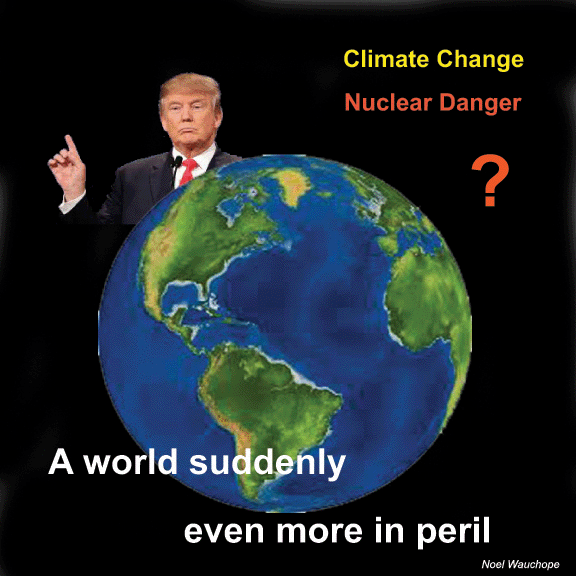
The greatest threat to the future of mankind? http://www.manilatimes.net/greatest-threat-future-mankind/323418/BY JAIME J.YAMBAOON APRIL 22, 2017UNLESS rebuffed by the US Congress like it did with his repeal of Obamacare, President Trump’s proposal to boost the budget for nuclear weapons production could make him the greatest threat to the future of mankind. Not climate change. Not terrorism.
Already America’s 5,500 strategic nuclear weapons possess enough destructive power to destroy Planet Earth at least five times over; some experts estimate up to 50 times over.
The US and Russia own 95 percent of the world’s nuclear warheads, with Russia slightly ahead. But the two powers have been reducing their stockpiles under the US- Russia Strategic Arms Reduction Treaty (START). Obviously not a candidate for the Nobel Peace prize, Trump has announced his wish to renegotiate the new START and be at the top of the nuclear heap, not only numerically but also in lethalness.
Trump’s desire to be absolutely No. 1 could conceivably trigger a new nuclear arms race among the nuclear powers today. This could also encourage new aspirants for the exclusive nuclear circle as the race further accentuates the basic flaw of the Non-Proliferation Treaty: its discriminatory nature. The nuclear powers as of July1968, the time of signing of the NPT, are exempt from the ban the treaty imposes.
Sanctions have not prevented states from violating the NPT. India with an economy large enough to go autarkic considered the sanctions imposed on it after its nuclear tests “meaningless.” Sanctions against Pakistan were dropped as soon as its cooperation was deemed essential by the US in the latter’s Afghan wars. For all the sanctions slapped on it, North Korea has so far conducted nuclear and missile tests at relentlessly short intervals that the risk of a nuclear detonation being made either by the US or North Korea today is considered the highest since the Cold War.
Small wonder that the world has not been too happy and content with the NPT. In accordance with the decision of the majority last year, the UN General Assembly a few days ago launched a conference to negotiate a new legally binding treaty to prohibit nuclear weapons in line with previous treaties prohibiting chemical and biological weapons, landmines and cluster munitions.
Customary international law makes no mention of nuclear weapons because they are of a later invention. But as their immediate and longer term effects were demonstrated in Hiroshima and Nagasaki, nuclear weapons clearly fall under the weapons prohibited by customary international law—weapons which are of a nature to strike at military objectives and civilians without distinction.
It was the monitoring of the effects of the bombing of Hiroshima and Nagasaki that showed how a single nuclear bomb detonated over a large city could kill millions of people, bring unimaginable suffering to survivors and their future generations, and cause catastrophic and long-term damage to the environment. The use of tens or hundreds of nuclear bombs would be cataclysmic, severely disrupting the global climate and causing widespread famine. The UN conference serves to negotiate a treaty that would for the first time explicitly and universally prohibit nuclear weapons. The ban would include the five permanent members of the Security Council.
For all its defects, the NPT by the number of countries subscribing to it manifests the desire of the vast majority of countries around the world (almost 200) to ban nuclear weapons. One hundred fifteen countries are also part of nuclear weapons-free zones which cover Southeast Asia, Central Asia, the South Pacific, Latin America and the Caribbean, and Africa. While a majority of UN members are participating in the conference. The United States and its allies have boycotted it, calling it an unrealistic exercise. One US ally, the Philippines is not in that boycott. Its own Constitution bans nuclear weapons.
Given Trump’s pledge to make America great again in nuclear weapons and given the ongoing efforts in the United Nations to negotiate a ban, it appears that the world is at a historic juncture. To ban or not to ban.
With the US boycotting the conference, one cannot be sanguine about what any resulting treaty can amount to. The colossal nuclear stockpile of the US will be outside the ban. Would a label or reputation as a rogue leader matter to Trump? Probably not. The United States anyway has a history of not ratifying landmark treaties and not learning any lesson from the disastrous consequences of its non-ratification.
Trump is one damn determined fellow. This is shown by the fact that to make a significant increase in his defense and nuclear weapons budget, he has to make drastic cuts in components of the federal budget that contribute significantly to national security. Trump is also one narrow-minded fool. Said a New York Times
“[T]he armed forces are a vital component of the national security tool kit, but so are diplomacy, economic engagement, and post-conflict reconstruction. The use of military force should always be a last resort, and the balanced application of other, less costly tools of national power helps prevent wars and crises from arising in the first place.”
The reason the US gave for the bombing of Hiroshima and Nagasaki, killing millions of civilians, was to stop the war and prevent further US military casualties.
The nuclear bomb has been associated to this day with caring for the lives of America’s soldiers. It has been noted that Trump counts on the customary popularity of defense with legislators to get his budget passed. Trump may get the additional more powerful nuclear bombs that he wants.
What makes people nervous about this prospect is that in the few weeks he has been in the White House, Trump has done little to dispel the notion engendered by the election campaign that his short-fuse temperament may willy-nilly unleash a nuclear cataclysm. His issuance of orders without much consultation with appropriate agencies, his all-bluster-and-wind assaults on mass and social media grounded on “alternative facts” are far from reassuring of a man close to the nuclear button.
It seems that under the protocol concerned, the US President, contrary to the popular imagery, does not actually press his finger on the button. He issues an order to a War Room in the Pentagon where officials are bound by law to execute the order. There is an anecdote related in the Internet of one such top brass fired for asking whether he should follow an order to release nuclear bombs coming from an insane President. The US President has the sole authority to use nuclear weapons. The Pentagon must simply obey his command. Theirs not to question why…
Jaime J. Yambao is a retired Ambassador of the Philippines
Climate Change is a global threat to international security, John Pratt 21 Apr 17, https://wordpress.com/read/feeds/17124327/posts/1428211610Terrorist groups such as the Islamic State and Boko Haram have been dominating the headlines since 2013.
Both groups have gained international notoriety for their ruthless brutality and their rise is posing new challenges for national, regional and international security.
Such non-state armed groups (NSAG) are not a new phenomenon.
Today, however, we can observe an increasingly complex landscape of violent actors with a range of hybrid organisational structures, different agendas and different levels of engagement with society that set them apart from ‘traditional’ non-state actors and result in new patterns of violence.
At the same time, there has been increasing acknowledgement within the academic literature and among the policy community of the relationship between climate change and security.
The Intergovernmental Panel on Climate Change (IPCC) underlined in its latest report from 2014 that human security will be progressively threatened as the climate changes.
Analysing its impacts on fragility, an independent report for the G7 Foreign Ministers concluded that climate change is a global threat to international security.
As the ultimate threat multiplier, it aggravates already fragile situations and may contribute to social upheaval and even violent con ict (Rüttinger et al. 2015). …….
Today the UN, the EU, the G7 and an increasing number of states have classified climate change as a threat to global and/or national security (American Security Project 2014; European Commission 2008; UN Security Council 2011).
However, the links between climate change, conflict and fragility are not simple and linear.
The increasing impacts of climate change do not automatically lead to more fragility and conflict.
Rather, climate change acts as a threat multiplier. It interacts and converges with other existing risks and pressures in a given context and can increase the likelihood of fragility or violent conflict.
States experiencing fragility or conflict are particularly affected, but seemingly stable states can also be overburdened by the combined pressures of climate change, population growth, urbanization, environmental degradation and rising socio-economic inequalities (Carius et al. 2008; WBGU 2007, CNA 2007, Rüttinger et al. 2015).
In 2015, the report “A New Climate for Peace” (Rüttinger et al. 2015), commissioned by the G7 Foreign Ministries, identified seven compound climate-fragility risks that pose a serious threat to the stability of states and societies.
Local resource competition: As the pressure on natural resources increases, competition can lead to instability and even violent conflict in the absence of effective dispute resolution.
Livelihood insecurity and migration: Climate change will increase the human insecurity of people who depend on natural resources for their livelihoods, which could push them to migrate or turn to more informal or illegal sources of income.
Extreme weather events and disasters will exacerbate fragility challenges and can increase people’s vulnerability and grievances, especially in conflict-affected situations.
Volatile food prices and provision: Climate change is highly likely to disrupt food production in many regions, increasing prices and market volatility, and heightening the risk of protests, rioting, and civil conflict.
Transboundary water management is frequently a source of tension; as demand grows and climate impacts affect availability and quality, competition over water use will likely increase the pressure on existing governance structures.
Sea-level rise and coastal degradation: Rising sea levels will threaten the viability of low-lying areas even before they are submerged, leading to social disruption, displacement, and migration, while disagreements over maritime boundaries and ocean resources may increase.
Unintended effects of climate policies: As climate change adaptation and mitigation policies are more broadly implemented, the risks of unintended negative effects – particularly in fragile contexts – will also increase.
“A New Climate for Peace” is an independent report commissioned by the G7 Member States.
The report was prepared by an independent consortium of leading research institutions, headed by adelphi, with International Alert, the Wilson Center, and the EU Institute for Security Studies, and was submitted to the G7 in April 2015.
Paying Nuclear Losers for ‘Clean’ Power Upends U.S. Markets, Bloomberg by Jim Polson
April 22, 2017,
Labeled emission-free, nuclear plants compete with cheaper gas
States permit higher fees to protect jobs, cut fossil-fuel use
Some U.S. states are trying to save money-losing nuclear plants — and disrupting America’s electricity markets in the process. New York and Illinois have cleared the way for nuclear power to be subsidized with higher fees on buyers — aid normally reserved for renewable energy like solar and wind. One reason policy makers gave was to protect jobs at aging plants teetering on closure. Another was nuclear’s emission-free electricity, because states are trying to address climate change by relying less on fossil fuels like coal and natural gas. Connecticut and Ohio are considering similar moves, and pressure is mounting in New Jersey.
But federal regulators and gas-fueled generators including Dynegy Inc. and Calpine Corp. say the states are fundamentally altering the way wholesale power markets work. Armed with billions of dollars in new clean-energy benefits, higher-cost nuclear generators can now compete with companies that get no aid. The first test comes next month when PJM Interconnection LLC, the biggest grid, takes bids to supply power from Chicago to Washington.
“Markets only work if everyone’s competing evenly,” said Joseph Bowring, president of Monitoring Analytics, the company that oversees PJM’s electricity market. “If some get subsidies, then other people are going to want subsidies. And then pretty soon, we’re going to be competing for subsidies instead of competing in the market.”
While nuclear power has kept its share of U.S. electricity at around 20 percent over the past decade, it’s become a high-cost supplier with the emergence of gas-fired turbines burning cheap shale fuel, as well as more-efficient wind farms and solar panels. The country now gets more electricity from gas than from coal, which has seen its market share plunge.
All that cheap fuel has cut electricity prices, creating financial problems for aging nuclear plants. Five have closed in the past five years and more shutdowns are planned, primarily for economic reasons, according to the Energy Information Administration.
The industry calculus began to change in August when New York handednuclear plants so-called credits for supplying carbon-free power to the state, which means the generators can raise an additional $500 million a year from higher rates. Four months later, Illinois created similar credits to keep money-losing reactors open and 1,500 people employed.
Extra Fee
The way the incentives work is similar to what states have been doing for years to encourage emission-free power. Generators get “credits” for a designated amount of electricity. When that is sold to utilities, the buyers pay the generators an extra fee, which can be recovered in the form of higher bills to customers.
Nuclear incentives saved two plants in Illinois and three in New York, according to Kit Konolige, a senior utilities analyst at Bloomberg Intelligence. If subsidies were used to keep open all the nuclear plants in PJM, which doesn’t include New York, electricity supply in the region would be 10 percent higher than otherwise, depressing prices, he said.
On May 10, generators will begin bidding to supply a year of electricity in the PJM region starting June 2020, in return for fixed payments. It’s going to be one of the most closely watched events in the industry this year. Exelon Corp.’s Quad Cities nuclear plant was priced out of last year’s auction. This time, it can expect a subsidy from Illinois customers.
Only the newest and largest nuclear plants can sell power for $25 a megawatt hour, which is the price offered by most gas plants, according to Bloomberg Intelligence. With the help of credits, nuclear power narrows the gap, and generators can offer electricity at close to that price. Wholesale power at a major trading hub within PJM averaged $23.90 a megawatt-hour at 11:28 a.m. Friday in New York, grid data compiled by Genscape show.
Keep Running’
“If you’re getting revenue from one source, you don’t need as much from the auction, so you’re willing to accept less to keep running,” Konolige said.
As a result, prices in this May’s auction for a region covering Chicago may plunge about 16 percent from a year earlier, according to industry consultant Wood Mackenzie Ltd.…….
Operators of cheaper gas-fired power plants, including Dynegy, Calpine and NRG Energy Inc., describe the credits as “bailouts” that threaten to kill competitive markets at the expense of electricity customers. Electricity customers would pay $3.9 billion more if all nuclear plants competing in PJM’s and New England’s wholesale markets were part of programs like New York’s, a Bloomberg Intelligence analysis shows.
“It’s the equivalent of going out to buy a new car and finding out they’re giving them away down the street,” said Abe Silverman, deputy general counsel at Princeton, New Jersey-based NRG. “How are you supposed to compete with that?”
In Connecticut, consumer advocates are fighting the credits and accusing nuclear-plant owners of a money grab.
Mini-nukes: Still a bad choice for the United States, Bulletin of the Atomic Scientists
James E. Doyle, 21 Apr 17, In December, the Defense Science Board—an independent group of experts and former officials that provides advice to the Defense Department—submitted a report advising the Pentagon to invest in low-yield nuclear weapons that could provide “a rapid, tailored nuclear option for limited use.” This recommendation struck a familiar note. In 2003, the board issued a study entitled “Future Strategic Strike Forces” that suggested building small nuclear weapons with “great precision, deep penetration, [and] greatly reduced” yield and radioactivity. The board’s call led to investments in new warhead designs such as the Robust Nuclear Earth Penetrator—a warhead designed to destroy deeply buried or hardened targets including underground military command centers—and the Reliable Replacement Warhead. Both programs were cancelled in 2008, after millions of dollars had been spent.
Despite the board’s renewed interest in smaller nuclear weapons, and in weapons tailored for limited uses or specific effects, any effort to develop these weapons would encounter the same problem that earlier such efforts have encountered: It is impossible to determine if introducing weapons with these characteristics into the US stockpile, and planning for their use in certain scenarios, would strengthen deterrence or make nuclear war by miscalculation more likely. Building “mini” or tailored nuclear weapons might well lower the threshold to nuclear war; risking that outcome would only make sense if it were absolutely clear that introducing these weapons would remedy some dangerous weakness in deterrence.
Fortunately, no such weakness exists. Any nation using nuclear weapons against the United States or its allies risks a devastating response whose negative consequences would far outweigh any gains delivered by crossing the nuclear threshold. The United States has always possessed the means to employ a small number of nuclear weapons with relatively low yields—between, say, half a kiloton and 50 kilotons. In fact, the inventory of such weapons used to be massive; thousands of weapons with yields under 50 kilotons were deployed as artillery shells, land mines, short-range ballistic missiles, torpedoes, depth charges, anti-aircraft missiles, and even nuclear backpack weapons.
The current US tactical nuclear arsenal is comprised of approximately 500 B61 gravity bombs, which have three tactical versions—the B61-3, -4, and -10—with yields as low as .3 kilotons. The US Air Force deploys 150 to 200 B61s at six NATO air bases in five countries. Additional weapons are stored in the United States for possible overseas deployment. Also available is the W-80-1 warhead, deployed on hundreds of US air-launched cruise missiles, with a variable yield that can be set as low as 5 kilotons.
This list of “smaller” nuclear weapons demonstrates that there are no significant “gaps” in US nuclear capabilities that potential adversaries such as Russia, China, and North Korea could exploit.
That is why, today as in 2003, the Pentagon has no military requirement for the board’s cryptically-named “tailored nuclear option for limited use.” The military understands better than anyone the danger and unpredictability of using nuclear weapons. The military also understands how unlikely it is that any use of nuclear weapons against a nuclear-armed nation would remain “limited.” That is why the vast majority of so-called “tactical” nuclear weapons have been retired from service.
……..Just as in the early 2000s, current proponents of mini-nukes or of vague “limited nuclear options” offer no convincing evidence that new weapons in this category are needed—or more importantly, that they would make nuclear use less likely. Instead, potential nuclear adversaries are likely to see the acquisition of additional weapons in this category as an indication that US opposition to nuclear use has decreased and that Washington may be the first to cross the nuclear threshold. Such an outcome would undermine global stability and increase the risk of nuclear war. Defense resources are better spent on strengthening US conventional forces.http://thebulletin.org/mini-nukes-still-bad-choice-united-states10693
Hawaii’s Renewed Jitters About Nukes, The Atlantic, 21 Apr 17 The state is asking the Department of Defense to help it prepare for a nuclear attack, amid escalating tensions between the United States and North Korea. Memories of the attack have faded, but there are still people in Hawaii who can recall the quiet Sunday morning that descended into chaos more than 75 years ago.
You do not forget the deafening buzz of torpedo bombers, once you have heard them overhead, or what it’s like to see the sky polka-dotted red with the markings of the Imperial Japanese Navy’s aircraft. As tensions between the United States and North Korea escalate, these memories are becoming more vivid………
Now, state lawmakers in Hawaii have formally asked the Department of Defense to help with nuclear disaster preparedness in the state. Such plans haven’t been updated at the local level in decades, since 1985, according to the Hawaii Emergency Management Agency. In the early 1980s, Hawaii’s fallout shelters were still stocked with medical kits and food. But those supplies have long since been thrown out, and funding for such shelters evaporated.
Back then, officials had identified hundreds of additional structures, like parking garages, that could serve as makeshift fallout shelters in Hawaii, Governingreported, but officials today don’t even know which of those structures exist anymore—and whether the remaining structures are in adequate shape to serve as shelters.
Hawaii is a natural target for a couple reasons. For one, it’s geographically closer to North Korea than other parts of the United States. Hawaii is also a key strategic position for the U.S. military, which has an enormous presence on the island of Oahu in particular………
There is uncertainty, however, about how the new presidential administration will react to North Korea. North Korean leadership is perceived as notoriously unpredictable, especially in the Western world. But United States President Donald Trump has his own reputation for being inscrutable and impulsive, qualities which international security experts say he is likely to leverage against North Korea—and as a way to distinguish himself from the Obama administration, which Trump perceives as having been “indecisive and entirely predictable,” Cha said.
The Plutonium Finishing Plant is considered the most hazardous demolition project at the Hanford nuclear reservation.
And the area known as the Plutonium Reclamation Facility was added to one end of the plant and includes a tall section called a canyon, where skinny tanks were hung for use in a process to remove valuable plutonium from scrap material.
Workers are tearing back the building to get to the canyon, which stands 34 feet tall and covers a 30-by-66-foot area.
Because of potential airborne contamination, just a 2-foot-wide slice of the building, top to bottom, will be taken down each day, said Tom Teynor, DOE manager for the Plutonium Finishing Plant.
Pacific Northwest National Laboratory has fed extensive information from sampling in the canyon into a chemical air dispersion model to determine how much work could be done safely daily.
Larger sections of the canyon could be demolished each day, depending on monitoring results for air contamination during initial work.
The Plutonium Reclamation Facility is expected to be demolished before the end of June.
The plant’s main processing facility and the fan house and ventilation stack must also be demolished to meet a legal deadline at the end of September.
A revised schedule calls for the main processing facility to be cleaned out for demolition by the end of May, with demolition completed in August. The fan house also could be ready for demolition next month. Annette Cary: 509-582-1533, @HanfordNews
Eskom admits trying to dodge procurement procedures for nuclear deal, Business Tech By Staff WriterApril 21, 2017State power utility, Eskom, says that earlier reports made by the Democratic Alliance about trying to dodge correct procedures for nuclear procurement are partially true, but stressed that it is only looking for exemption from certain areas of the process.
Earlier this week, the DA alleged that Eskom had made a direct application to the National Treasury chief procurement officer, Schalk Human, asking to be exempted from the prescribed procurement procedures for the new nuclear power acquisition.
The party stated that this was done in an apparent bid to accelerate the nuclear new build programme, “in a move that would mean that the country’s biggest ever procurement deal would not be subject to due diligence and correct procedures”……….
As indicated in the original report by the DA, it appears that the political party will fight the rushed process.
DA shadow minister of energy, Gordon Mackay, said that the exemption is ‘significant’ and would mean Eskom is embarking on the country’s single biggest public procurement – without fully assessing associated risks and consequences for South Africa’s economy.
“All state entities are bound by specific procurement standards and requirements. These processes are vital to ensure the effective, efficient and transparent acquisition of goods and services by the State and its entities. If procurement standards cannot be met – procurement should not commence,” Mackay said.
The applications are for exemptions from the rules governing government procurement as set out in the Public Finance Management Act.
Eskom chief nuclear officer, Dave Nicholls, told Business Day that much of the work on the nuclear procurement had been done before the promulgation of the regulations over the last year.
He reportedly said Eskom wanted Treasury to assure it that the work already done would be seen as compliant with regulations, to avoid having to start the process from scratch.
He said there was nothing untoward with the applications.
“We believe the work that has already been done is adequate and is equivalent to what Treasury is asking for,” he told the paper.
DA energy spokesman Gordan Mackay told Business Day the party objected to any “unacceptable” attempts to rush through the procurement process.
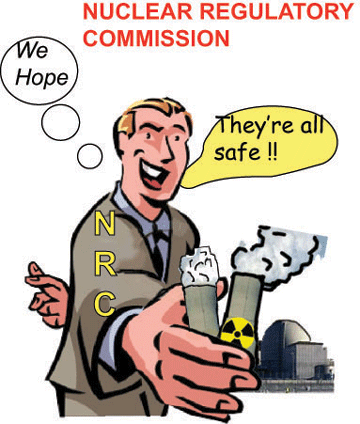
Citizens confront Nuclear Fuel Services regulator over environmental, public health concernsJESSICA FULLER 21 Apr 17 jfuller@johnsoncitypress.comERWIN — A biennial safety performance review that concluded Erwin’s Nuclear Fuel Services is continuing to operate safely brought out concerned citizens who questioned the report’s conclusion.
The U.S. Nuclear Regulatory Commission reviewed the report which spanned from Jan. 1, 2015, to Dec. 31, 2016, and included several enforcement issues in the presentation, including two instances of failure to treat mixed waste and failure to maintain records of maintenance and inspection testing of the facility’s fire protection systems.
The NRC ruled that NFS doesn’t need to improve any areas in its safety culture based on the two-year investigation period.
“An absence of areas needing improvement does not mean that performance in functional areas that we inspect does not have to be improved or enhanced,” NRC representative Charlie Stancil said. “Early detection with comprehensive corrective actions to address these performance issues are key to sustaining safe and secure operations and performance as we go forward.”……
After the presentations, the public was allowed to speak, and commenters had nothing but concern and distrust to hand to the board of NRC inspectors and company representatives. While some inquirers cited specific events listed in the violation reports for comment, others had other bones to pick with the NRC on issues such as public health and environmental safety. A recurring topic brought up by audience members was the discontinuation of an $8 million cancer study that was canceled in 2015.
Jonesborough citizen Linda Modica was questioned the representatives with documentation in her hands. She asked about the levels of plutonium that showed up in the reports, and NRS representative Kevin Ramey said those trace amounts have a dose limit set at 100 milligrams, which he went on to explain means is the limit that a person could ingest either by air or water for an entire year.
“I understand your concern that there’s stuff there you’d rather not be exposed to,” Ramey said. “The commission has made a decision that the regulations we have are protective of the public, and that’s something that we can’t change, that’s something only the commission can change.”
Modica, a two-time cancer survivor, said it is personal issue to her, and said that wasn’t good enough.
“We need the government to reduce the risk of cancer by eliminating these radioactive toxins that are being put in our air and water,” Modica said. “Those numbers need to be zero.”
An injunctive order that would move plutonium disposition forward in Aiken County will have to wait until at least July.
U.S. District Judge Michelle Childs signed an order giving all parties until July 31 to develop a jointly written statement that will be used to frame the order. The previous deadline was April 21.
Childs previously ruled the U.S. Department of Energy failed to comply with an agreement to dispose of 1 metric ton of weapons grade plutonium by Jan. 1, 2016. South Carolina sued the DOE, the National Nuclear Security Administration, NNSA director Lt. Gen. Frank Klotz and former Secretary of Energy Ernest Moniz in February 2016, saying the defendants reneged on their obligations to dispose of plutonium or make $1 million a day “economic assistance payments.”
Childs ruled the federal government failed to dispose of plutonium as agreed, but refused to issue any financial sanctions. Her order asks all parties to develop a joint statement to determine exactly what the injunction will say.
The April 20 order to delay comes at the request of the DOE and its codefendants.
According to court documents, the DOE’s budget is only funded through April 28.
In addition, the DOE cited difficulty in coordinating with a number of program offices and officials, “a process which is complicated by the fact that a number of leadership positions at DOE are not presently filled.”
The motion goes on to say that settlement negotiations will continue. If an agreement can’t be reached by the deadline, then both parties will submit individual statements, court records state.
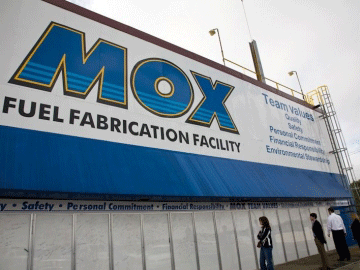
The DOE missed the Jan. 1, 2016 deadline because the mixed oxide, or MOX, fuel fabrication facility at the Savannah River Site in Aiken County isn’t built yet.
Once operational, MOX will convert plutonium stockpiles into fuel for commercial reactors. It’s presently about 73 percent complete, sources familiar with the project say.
The plutonium disposition is part of a nuclear deal with Russia, both nations agreed to dispose of 34 metric tons of defense plutonium. An NNSA news release from 2011 heralding the MOX deal said that’s enough plutonium to make 17,000 nuclear weapons.
Russia suspended, but didn’t withdraw from, the agreement in 2016. While not citing MOX directly, Russian President Vladimir Putin cited “unfriendly” practices by the U.S.
Both nations were supposed to begin disposition in 2018, the NNSA news release said.
The SIPRI said that there were 455 fewer nuclear warheads at the start of 2016 among nine nuclear states than a year earlier. The United States, Russia, Britain, France, China, India, Pakistan, Israel, and North Korea together had a total of 15,395 nuclear warheads at the start of 2016, including 4,120 that were deployed operationally. The total number of nuclear warheads in those countries at the start of 2015 was 15,850, the press release stated Monday.
Global nuclear-weapon inventories “have been declining since they peaked at nearly 70,000 nuclear warheads in the mid-1980s,” Researchers Shannon Kile and Hans Kristensen stated in the report.
The decline has been due primarily to cuts made by Russia and the United States, the report said. But they said “the pace of their reductions appears to be slowing compared with a decade ago, and neither Russia nor the United States…has made significant reductions in deployed strategic nuclear forces since the bilateral New START treaty” came into force in 2011.
SIPRI estimated that Russia had 7,290 nuclear warheads, including tactical, at the beginning of 2016, and the United States had 7,000.
It said that accounts for 93 percent of the nuclear weapons in the world.
It estimated France has 300 nuclear weapons, followed by China with 260, Britain with 215, Pakistan with 110 to 130, India with 100 to 120, Israel with 80, and North Korea with 10.
SIPRI also said that “None of the nuclear weapon-possessing states are prepared to give up their nuclear arsenals for the foreseeable future,” and that Washington and Moscow both have “extensive and expensive nuclear modernization programs.”
SIPRI said India is strengthening its nuclear-capable ballistic-missile program and speeding up its production of plutonium while its regional rival, Pakistan, is developing battlefield nuclear weapons in response to India’s stronger conventional forces.
The SIPRI report said Pakistan’s nuclear arsenal “may increase significantly” during the next decade.
The report concluded that the prospects worldwide for “genuine progress towards nuclear disarmament remain gloomy.”
SIPRI’s report was based on open sources, including data from governments and the International Atomic Energy Agency.
But SIPRI said many nuclear-capable states were “non-transparent.”
The report said SIPRI was unable to verify whether the secretive country of North Korea, which conducted its first nuclear test in 2006, has been able to produce or deploy operational nuclear weapons.











 nuclear-news