Stop focusing on celebrities and shares – inform people on climate change – David Suzuki
“As long as we’re focused on celebrity and economics, we’re not going to see the world in a way that 
allows us to live and thrive,” he said.
“Why don’t you at least give us an indicator of what we’re doing to the planet?” he asked. “We don’t do that. Our priorities are indicated by things like the Dow Jones average and all that crap.
 Suzuki wants journalists to forget the Dow Jones, report on climate every day, National Observer April 13th 2017 David Suzuki cuts straight to the chase. The state of Canada’s climate action is “disgusting,” he says, and the federal government should be ashamed.
Trump administration plans to eliminate climate data collection
Scientists Fear Climate Data Gap as Trump Aims at Satellites, NYT APRIL 10, 2017 Among the sweeping cuts in the Trump administration’s 53-page budget blueprint released last month, one paragraph stood out to climate researchers. It proposed eliminating four of NASA’s climate science missions, including instruments to study clouds, small airborne particles, the flow of carbon dioxide and other elements of the atmosphere and oceans.
Irresponsible of Court rulings to permit restart of restart of Japan’s NPPs
Court rulings permitting restart of NPPs are irresponsible http://www.japan-press.co.jp/modules/news/index.php?id=10497 April 5, 2017 Akahata editorial
‘Safety myth’ may again run rampant
If deeming that as long as the NRA gives a green light to resuming operations of nuclear reactors, courts do not need to judge whether or not such operations are appropriate, they would no longer be judicial apparatuses independent from the government. The Abe Shinzo Cabinet in principle reactivates NPPs which meet the NRA regulatory standards. It is tantamount to reinforcing the “safety myth” about the NRA screening itself.
Both of the court rulings state that people have the right to seek to protect their lives and livelihoods from NPP-related risks as the Constitution guarantees “personal rights”. The two judgements point out that the investigation into the cause of the 2011 Fukushima nuclear meltdown is totally insufficient. Concerning the NRA quakeproofing and tsunami-proofing criteria that the state used in approving the restart of NPPs, the court decisions criticized the criteria as “too lax”, which is of grave significance. The Fukui and Otsu district courts refused to blindly follow the government’s pro-nuclear policy and made independent decisions, clearly highlighting the collapse of the “safety myth”.
However, the recent decisions by the Osaka High Court and the Hiroshima District Court were completely unlike the previous two courts’ decisions. Regarding the nuclear safety standards that the NRA employed in allowing the reactivation of the reactors, the rulings by the two courts acknowledged the safety standards as “not unreasonable”, claiming that they reflect lessons learned from past accidents as well as the latest scientific and technical knowledge”. The Hiroshima ruling not just followed the state policy but abandoned the principle of judicial independence. It asserted that inconsistencies among court judgements will lead to confusion and that the Hiroshima court made the decision in line with the April 2016 decision by the Fukuoka High Court Miyazaki Branch which allowed the operation of Nos 1 and 2 reactors at the Kyushu Electric Power Company Sendai NPP (Kagoshima Pref.). If the judiciary keeps taking such a stance, it will be unable to protect people’s lives and their human rights.
Safeguard people’s rights
In the first place, the Constitution guarantees people’s right to go to court. It is a matter of course that judges should make their own decisions without being influenced by the state.
Experimental deep bore project under consideration
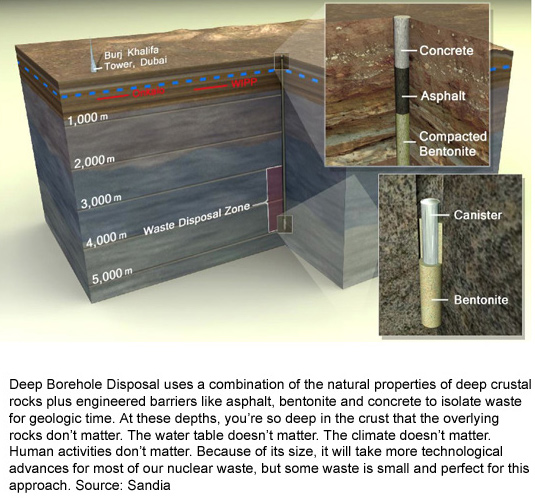 County commissioners weigh nuclear waste storage project http://www.wral.com/county-commissioners-weigh-nuclear-waste-storage-project/16647314/ ALAMOGORDO, N.M. — County commissioners in southern New Mexico are in debate over a federal project that aims to determine whether nuclear waste can be stored far underground.
The Otero County Commission discussed a proposed resolution in opposition of the project Thursday, but the panel decided to hold off on taking any action, The Alamogordo Daily News reported (http://bit.ly/2oaS2oL).
Commissioners say they have received comments from residents both for and against the project, which involves the drilling of narrow, vertical holes deep into the ground to test whether they can hold disposed nuclear material.
The U.S. Department of Energy is paying for the testing by New Mexico-based TerranearPMC and has said no nuclear waste will be involved.
Fred Stong, director of FIRST Robotics New Mexico, voiced his support for the project during Thursday’s meeting, saying he would like to see it continue because there are many residents who support science and technology.
“There is no waste in this program. This is a wonderful geographical opportunity,” Stong said. “Our job is to bring technology in, not drive away technology from this community.” But resident Bobby Jones said the federal government’s plan was too risky and he doesn’t “support the project because of what might happen afterwards.”
TerranearPMC CEO Kenneth Fillman said he shares residents’ concerns and an environmental assessment will be conducted before the company moves forward with the project.
The Otero County Commission meeting came the same day Harding County passed a resolution opposing a similar borehole project in neighboring Quay County.
1 This Month


Tell the Ukrainian Government to Drop Prosecution of Peace Activist Yurii Sheliazhenko

Petition to revoke the licensing of the Near Surface Nuclear Disposal Facility (NSDF) at Chalk River. https://www.ourcommons.ca/petitions/en/Petition/Details?Petition=e-7247


of the week – STOP SMALL MODULAR REACTORS IN CANADA
To see nuclear-related stories in greater depth and intensity – go to https://nuclearinformation.wordpress.com
-
Archives
- March 2026 (204)
- February 2026 (268)
- January 2026 (308)
- December 2025 (358)
- November 2025 (359)
- October 2025 (376)
- September 2025 (258)
- August 2025 (319)
- July 2025 (230)
- June 2025 (348)
- May 2025 (261)
- April 2025 (305)
-
Categories
- 1
- 1 NUCLEAR ISSUES
- business and costs
- climate change
- culture and arts
- ENERGY
- environment
- health
- history
- indigenous issues
- Legal
- marketing of nuclear
- media
- opposition to nuclear
- PERSONAL STORIES
- politics
- politics international
- Religion and ethics
- safety
- secrets,lies and civil liberties
- spinbuster
- technology
- Uranium
- wastes
- weapons and war
- Women
- 2 WORLD
- ACTION
- AFRICA
- Atrocities
- AUSTRALIA
- Christina's notes
- Christina's themes
- culture and arts
- Events
- Fuk 2022
- Fuk 2023
- Fukushima 2017
- Fukushima 2018
- fukushima 2019
- Fukushima 2020
- Fukushima 2021
- general
- global warming
- Humour (God we need it)
- Nuclear
- RARE EARTHS
- Reference
- resources – print
- Resources -audiovicual
- Weekly Newsletter
- World
- World Nuclear
- YouTube
-
RSS
Entries RSS
Comments RSS
 nuclear-news