The flaw in Trump’s North Korea sabre-rattling
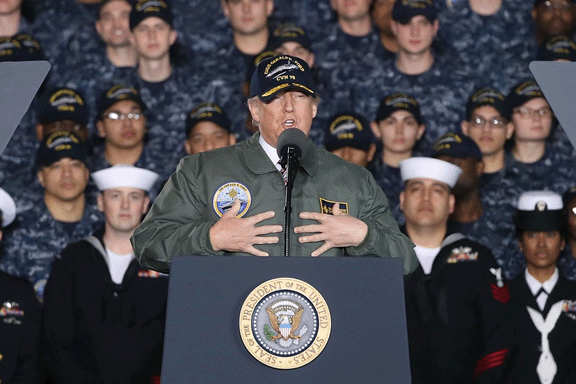 Trump’s North Korea sabre-rattling has a flaw: Kim Jong-un has
  nothing to lose
Strategy of sending in the US navy and attacking Syria and Afghanistan likely only to boost Pyongyang’s nuclear resolve, Guardian, Tom Phillips in Beijing and Justin McCurry in Tokyo, 16 APR 17, In the lead-up to North Korea’s latest missile test, Donald Trump had battled to convince Kim Jong-un he was picking a fight with the wrong guy.
The US president pounded Syria with 59 Tomahawk missiles and then ordered a naval “armada” into the waters around the Korean peninsula. He dropped the “mother of all bombs” on eastern Afghanistan and used Twitter to hammer home his message.
“North Korea is looking for trouble,” the US president tweeted last week as Kim’s technicians made the final preparations for Sunday’s botched but nevertheless defiant test.
But experts say Pyongyang’s latest act has underlined the futility of the billionaire’s efforts to bully Kim Jong-un into abandoning his nuclear ambitions.
“There is a problem with playing the military threat [card] with North Korea because they are inclined to call the bluff,” said John Delury, a North Korea expert from Yonsei University in Seoul. “I’m not saying they tested because of the threats. But bringing a naval strike group doesn’t help if your goal is to put off a test. If anything you are increasing the odds.”…….
Delury claimed Trump’s sabre-rattling rhetoric and erratic use of force would only strengthen Kim’s determination to develop an effective nuclear deterrent that might spare him the fate of Saddam Hussein or Muammar Gaddafi.
“It’s really just playing Pyongyang’s game. It is a waste of time and the Trump administration should move onto a more promising avenue to solve the problem … Since they have nothing to lose and we have everything to lose, they win every game of chicken.”
Leonid Petrov, a North Korea specialist at the Australian National University, said that with its latest missile launch “the message from North Korea is that despite US posturing they are not going to abandon their missile programme”.
Petrov said he was not surprised Kim Jong-un had chosen not to commemorate the 105th anniversary of the birth of the founder of North Korea, his grandfather Kim Il-sung, with an anticipated sixth nuclear test.
“Given the physical damage that would cause to nearby areas, it would have been unusual for a loyal, filial grandson to order a nuclear test on such an auspicious day,” he said.
But when that test does come it would prove the day of reckoning for Trump’s more aggressive approach towards North Korea. “If the US responds with an attack, that would confirm Kim’s claims that he is surrounded by hostile forces that are determined to carry out a pre-emptive strike,” Petrov said.
“The moment of truth for the US will be whether it strikes [in response to a nuclear test] and provokes a resumption of the Korean war at the expense of South Korean security, or stands down and betrays its weakness.”
“What would the US do? Withdraw, hang around or strike?” Petrov asked. “The ball is in the Americans’ court.” https://www.theguardian.com/world/2017/apr/16/north-korea-missile-test-donald-trump-kim-jong-un-has-nothing-to-lose
Donald Trump considers ‘utterly destroying’ North Korea’s nuclear sites
 Trump reportedly considering ‘utterly destroying’ North Korea’s nuclear sites on April 17, 2017,
The former official in the Bush administration, who knows of the Pentagon battle plans is quoted as saying: “Trump is pushing the Chinese hard, but in his gut he ultimately feels he will have to take a strong step himself”.
“There are plans to destroy the missile sites and the military have strong confidence in what they know.
“They wouldn’t launch a pre-emptive strike if there is an underground nuclear explosion but they would if the president thought they were launching an intercontinental ballistic missile.”……https://au.news.yahoo.com/world/a/35057503/us-president-donald-trump-reportedly-considering-utterly-destroying-north-koreas-nuclear-sites/#page1
Why is India still looking to nuclear companies that now face financial ruin?
India flirts with nuclear firms facing financial ruin Two of the major nuclear firms, India is dealing with, have run into financial crisis. As India looks forward to increase its share of nuclear energy in total power generation, the wavering financial condition of the firms raises some serious questions. India Today, IANS by Prabhash K Dutta New Delhi, April 16, 2017, For long a pariah in the global nuclear technology market, Indian policymakers are pleasantly discovering how the boot is on the other foot as they are furiously courted by foreign firms themselves facing financial ruin.
Trump insists he is working with China, on North Korea
‘We have no choice’: Trump sends stern warning to North Korea amid discussion with China By
9NEWS , 17 Apr 17 The United States has slammed North Korea’s latest missile test as a provocation and insisted it is working closely with China to resolve a crisis that Washington sees as reaching a critical stage.
US President Donald Trump threatened the rogue statue with military prowess, overnight tweeting “our military is building and is rapidy becoming stronger than ever before”.
“Frankly, we have no choice,” he wrote.
Amid broader fears that North Korea may again test a nuclear bomb, the Pentagon said yesterday’s “provocative” missile launch was a failure, with the weapon blowing up almost immediately after its early morning take-off near Sinpo on North Korea’s east coast.
Following the test, US National Security Adviser H.R. McMaster told ABC News: “There’s an international consensus now – including the Chinese and the Chinese leadership – that this is a situation that just can’t continue.”
Amid sharply heightened tensions, Mr McMaster said the US and allies were studying all actions “short of a military option,” though the Trump administration has not ruled that out.
North Korea watchers remained on high alert, as leader Kim Jong-un was reportedly poised to conduct a sixth nuclear test……..http://www.9news.com.au/national/2017/04/16/08/55/north-korea-attempts-to-launch-missile-but-fails
The secretive Israeli nuclear weapons program

 The World’s Most Mysterious Nuclear Weapons Program (And Its Not North Korea) National Interest, Kyle Mizokami, 15 Apr 17, In a private email leaked to the public in September of 2016, former secretary of state and retired U.S. Army general Colin Powell alluded to Israel having an arsenal of “200 nuclear weapons.” While this number appears to be an exaggeration, there is no doubt that Israel does have a small but powerful nuclear stockpile, spread out among its armed forces.
World’s first “intelligent energy plant.” – the Smartflower
Someone invented a solar panel system that tracks the sun all day, folds up at night http://mashable.com/2017/02/17/sunflower-inspired-solar-panel-follow-sun/#at3NoAFNikqn FEB 18, 2017
SmartFlower: An Intelligent Solar Panel System Tracks Sun Throughout Day
‘Smartflower‘ claims to be the world’s first “intelligent energy plant.” It’s a solar system that unfolds its giant solar panel petals in the morning and follows the sun throughout the day. It closes up at night or during heavy weather conditions.
Its mobility makes it more efficient than traditional roof solar panel systems, while its design makes it aesthetically appealing and discrete.
Simultaneous North Korean and American nuclear weapons tests. Double standards?
 America’s Peace Making Nukes vs. North Korea’s WMD: Simultaneous Nuclear Weapons Tests by U.S. and North Korea, By Prof Michel Chossudovsky Global Research, April 15, 2017 Double Standards? Whereas President Donald Trump threatens to wage a preemptive attack against North Korea if Pyongyang goes ahead with its nuclear weapons tests, the National Nuclear Security Administration (NNSA) and the US Air Force have announced the carrying out of tests of America’s controversial state of the art B61-12 gravity nuclear bomb.

Time for leadership from United Nations, not Trump, to propmote peace with North Korea
“What have we learned from Iraq, and why is the UN security council not taking a lead in getting the United States, China and North Korea to the negotiating table?” The answer may be that thus far the Trump administration has no intention of going to the United Nations, an organisation that Trump believes is for people to go to “just to have a good time”. As far as Trump is concerned, multilateralism is for the birds
Is Donald Trump the man to promote peace with North Korea? https://www.theguardian.com/world/commentisfree/2017/apr/16/trump-peace-north-korea-nuclear-war-kim-johg-un-missile-test Mark Seddon
After Kim Jong-un’s failed missile test and the US president’s cosying up to China, this is the west’s chance to reset negotiations for a nuclear-free South China Sea
The world can afford a sigh of relief after news that North Korea’s latest attempt to launch a long-range missile has once again led to embarrassing failure. With Mike Pence, the US vice-president, in Seoul, could this be a moment for some realpolitik from the United States?
For as bizarre as it may seem given Donald Trump’s unpredictability and disturbing lurches into infantilism – displayed in his brinkmanship with the equally volatile North Korean dictator, Kim Jong-un – he could just as easily help bring about peace as he could thermonuclear war.
The world has been on tenterhooks this weekend as North Korea ramped up its bloodcurdling rhetoric threatening a nuclear response to any American-led preventive attack on its ballistic missile programme. In the course of a few days Trump has gone from tweeting that “North Korea is looking for trouble”, and if China “does not decide to help” the US “will solve the problem without them”, to sheepishly acknowledging that the North Korean imbroglio was more complex than he had first realised.
That should come as no surprise. Over the past few weeks his administration has gone from making belligerent remarks about China’s activities in the South China Sea to conjuring up visions of a calamitous meeting between President Xi and himself, before finally painting an endearing picture of enduring friendshipbetween the pair. Trump’s policy towards Russia and to intervention in Syria has undergone a similar 180-degree turn, with the blustering British foreign secretary, Boris Johnson, meekly acquiescing at each twist and turn. Who can keep up with Trump? Perhaps he can’t even keep up with himself.
Once this particular crisis on the Korean peninsula has, hopefully, calmed down, Trump could just as easily become a man of peace, taking a leaf from Richard Nixon’s famous meeting with Mao Zedong that normalised relations between the two countries in 1972. Could he tear up all that has gone before and eventually sign a final peace agreement with North Korea that would have, at its heart, an agreement to make the Korean peninsula nuclear free? It is a possibility, just not one that the American military is prepared to countenance so long as North Korea continues with its nuclear programme.
Trump’s boast to a TV host that he had informed President Xi of his Tomahawk missile attack on a Syrian airbase as they shared chocolate cake was surreal theatre at its most grotesque. But it was a message designed explicitly with North Korea in mind, as was his bunker-busting bomb in Afghanistan. The Chinese are intensely nervous and irritated by the behaviour of the formerly useful buffer state that is now a source of potential nuclear conflict and waves of refugees.
Ford, who has been engaged in almost continuous low-level shuttle diplomacy for nearly two decades between Pyongyang, Seoul and Beijing, is clear that the United States will simply not tolerate North Korea becoming a de facto nuclear state. He believes that the window of opportunity could be as little as six months before the US will strike. The Pentagon will have mulled over preventive strikes against the North Korean nuclear programme, but has been facing the horrifying prospect of an artillery response that could lead to the South Korean capital, Seoul, being consumed in what Kim Jong-il – Kim Jong-un’s father – described in 2011 as a “sea of fire”.
Ford also asks the questions: “What have we learned from Iraq, and why is the UN security council not taking a lead in getting the United States, China and North Korea to the negotiating table?” The answer may be that thus far the Trump administration has no intention of going to the United Nations, an organisation that Trump believes is for people to go to “just to have a good time”. As far as Trump is concerned, multilateralism is for the birds.
A window of hope could open after South Korea’s 9 May elections and a fresh new administration with a mandate to seek a solution and avoid an unthinkable military conflict. South Korea’s likely new progressive government could move to reopen the jointly run Kaesong industrial complex in the border area with North Korea. This could be a heaven-sent opportunity for the former UN secretary general Ban Ki-moon, now back in South Korea, to play a key role as peacemaker.
And Britain could begin to play a far more positive and independent role. But this would require Boris Johnson to work more closely with his opposite numbers in Europe and to not make foreign policy on the hoof.
It would also require Michael Fallon, the defence secretary, to halt the pretence that Britain is somehow an equal military player with the United States. He would have to realise that the only real power Britain has is to make it clear that it will not be part of any planned “coalition of the willing” acting without the backing of the UN security council in any future US military venture in Korea.
In fact, Britain could begin to demonstrate its vaunted new independence by taking a clear lead, proposing its own security council resolution demanding new UN-sponsored talks tasked with achieving a final peace agreement on the Korean peninsula.
America field tests New Nuclear Bomb
US Conducts Successful Field Test Of New Nuclear Bomb http://www.globalresearch.ca/us-conducts-successful-field-test-of-new-nuclear-bomb-2/5585314 By Tyler Durden Global Research, April 16, 2017 Zero Hedge With the world still abuzz over the first ever deployment of the GBU-43/B “Mother Of All Bombs” in Afghanistan, where it reportedly killed some 36 ISIS fighters, in a less noticed statement the US National Nuclear Security Administration quietly announced overnight the first successful field test of the modernized, “steerable” B61-12 gravity thermonuclear bomb in Nevada.
Fast development of abrupt climate change
Abrupt Climate Change Is Happening Faster Than Before, April 15, 2017 By Bruce Melton, Truthout | Report In about the last 100,000 years, there have been 23 abrupt temperature changes in Greenland ice cores. In those moments, the temperature abruptly jumped or fell 9 to 14 degrees Fahrenheit across the planet and 25 to 35 degrees Fahrenheit in Greenland. The changes typically took decades to generations, but at their most extreme, they only took two to three years.
Counterintuitively, published consensus statements on climate change do not factor in abrupt change — an omission that seriously affects how climate policy is made. The reason is that we do not yet have the skill to model abrupt changes, even though ample robust evidence exists of the common occurrence of abrupt change in prehistory. It may seem unimaginable that these most important of all climate changes have been disregarded in climate policy, but this is the way the culture of the climate science consensus works. Policy is based upon impacts that we project to happen in the future through modeling.
Weather Models Are Not Climate Models
It’s not that modeling cannot project the future. Climate modeling is actually quite accurate. It’s weather modeling that goes awry after about five days.
However, there are major differences in techniques for predicting weather (in the near term) and predicting climate (over the long term). Weather models use the most recent weather data to project what the weather will be this weekend. Climate models can use weather data from any time frame, and then climate modelers create hundreds of model runs and average them all together to get climate projections.
Abrupt Change: How Do We Know When It Starts?
Modeling can’t tell us when abrupt climate change is beginning, at least not to the satisfaction of the consensus community that creates our climate policy. So, how do we know if we are in the early stages of an abrupt shift? It sure seems that we are warming a lot faster than before. Is this an abrupt change? Are there things other than temperature that we can use to imply that we are changing our climate abruptly?
Because it takes time for science to gather data, and it takes 30 years of data for temperature records to become statistically meaningful because of all the natural variability in the weather, we must move to a different field of decision making to determine if we are in an abrupt change. We have to use circumstantial evidence.
Circumstantial Evidence Is Factually Meaningful……
Forests Flip From Carbon Sink to Carbon Source…..
Gulf Stream Shutdown: Abrupt Changes in Prehistory……
Feedback Loops Rule Abrupt Climate Change May snow cover across the Northern Hemisphere has fallen about 25 percent since 1980. This might seem like a small thing, but snow reflects 90 percent of the sun’s rays back into space, whereas earth, rocks, water, plants, etc. absorb 90 percent of the sun’s rays and change it into heat that gets trapped on Earth by the greenhouse effect.
This is called the “albedo feedback,” and it is responsible for high latitudes and high altitudes warming at a rate that is double to quintuple the rate found at lower latitudes. A little bit of warming melts more snow, which absorbs more heat, which melts more snow — in a chain reaction.
There are many warming feedback loops. Temperature itself creates one. The warmer it gets, the drier it gets. Drier air can warm more than moist air.
Dying forests create a feedback loop, too: As large numbers of trees die, less CO2 is absorbed, creating more warming, which in itself allows more trees to become more stressed, which gives insects a greater advantage in killing trees.
The Gulf Stream shutdown also creates a feedback loop. The North Atlantic is where the Gulf Stream sinks into the abyss. As it sinks, it carries carbon dioxide with it and much of it gets removed permanently by different biological and geochemical means. When the Gulf Stream shuts down, this primary source of ocean carbon sequestration goes away. More CO2 stays in our atmosphere, creating more warmth, which then increases the pool of fresh buoyant Greenland ice loss water in the north Atlantic that blocks the Gulf Stream more, keeping more and more CO2 from being buried in the abyss by deep water formation.
Other new science that is extraordinarily meaningful to abrupt climate change could be far more pertinent than the small amount of space here allows description. In particular, Antarctica has begun initiation of collapse, which could result in 10 feet of sea level rise in 35 to 45 years if upper-ocean warming around Antarctica is not returned to zero by that time.
Until we implement a rule or law that regulates climate pollution like we regulate all other forms of pollution on this great planet, uncertainty, doubt and apathy will rule. Until we finally implement this policy we have been attempting to implement for over 20 years, nothing will change. Except warming.
Note: Detailed references for the claims in this article can be found here. http://www.truth-out.org/news/item/40204-abrupt-climate-change-is-happening-faster-than-before
Apple might save Toshiba, and so help build New Nuclear Plants
Apple Has Some Of the World’s Deepest Pockets
As of the end of December 2016, Apple reported a cash balance of $241 billion with 94% of it – $230 billion – overseas. It has continued to add to that growing pile of cash overseas mainly because it has not paid U.S. corporate taxes on the related earnings. Repatriating it under current provisions in the tax code would require a large payment to the federal government…..
Overseas Investments Logically Escape U.S. Taxman
Like any well-managed company, Apple is not counting on the government making any changes to current law. It’s logical to believe that the company might be seriously investigating the possibility of direct investments or acquisitions in companies that are headquartered outside the U. S…….
Direct overseas investments would deploy the cash pile into a use that might be more lucrative than collecting the tiny amounts of interest currently paid to all savers, including large, successful corporations.
Apple has a long standing working relationship with Toshiba and most likely has a number of fans within Toshiba. In 2005, during the exciting stages of the iPod era, Apple made a long term purchase commitment – which came with a substantial cash advance – that enabled Toshiba and other flash memory suppliers to make the investments that have led to a technological revolution and a reliably profitable business segment.
Both Apple and Toshiba have profited from the relationship over the years. In 2011, Apple stopped buying flash memory from Samsung, indicating that its components no longer met the company’s evolving requirements as it improved its products. That decision shifted more sales volume to Toshiba…….
How Would This Investment Help Electricity Customers In Georgia And South Carolina?
Several years ago Toshiba, as Westinghouse’s large, profitable and then stable parent company, provided substantial guarantees in the case of cost overruns for both the Vogtle and Summer projects. Each of those projects, one in Georgia and one in South Carolina involves the construction of two of Westinghouse’s flagship AP1000 nuclear power plants. According to recent document filings, the total amount of Toshiba’s guarantees is about $4 billion.
Toshiba would like to complete the projects and successfully demonstrate the value of the AP1000 technology. Even though the company has indicated that it no longer wants to be in the nuclear plant construction business, it is still very interested in being a part of the nuclear power plant engineering, manufacturing, fuel supply, and services business. That business line will have a much greater potential for future profits after the first units begin operating.
Both Southern Company’s Georgia Power unit and SCANA, as the lead utilities in each consortium building the power plants, are in an evaluation phase to determine if the plants can and should be finished…..
neither of the state utility regulators will allow project completion if the costs seem prohibitive and if the burden of the cost overruns places an excessive burden on their electricity customers.
Though the cost overrun guarantee from Toshiba will apparently survive the Westinghouse bankruptcy, it may end up near the end of the creditor line if Toshiba itself must seek bankruptcy protection…..
How is climate change affecting us now?
https://wordpress.com/read/feeds/17124327/posts/1420777969 QUORA QUESTION: HOW IS CLIMATE CHANGE AFFECTING US NOW? Quora Questions are part of a partnership between Newsweek and Quora, through which we’ll be posting relevant and interesting answers from Quora contributors throughout the week. Answer from Michael Barnard, low-carbon innovation analyst:
Climate change is already being felt in innumerable ways today.
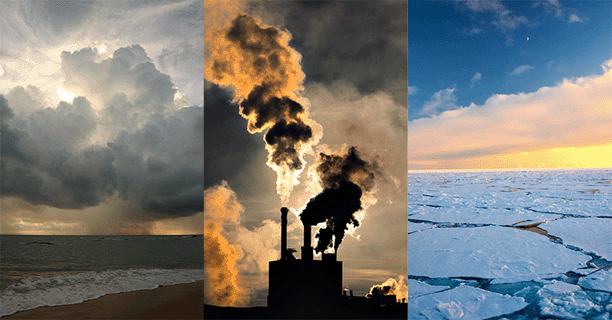
Climate change is one of the underlying contributors to some of the most major stories of the past decade and is being felt broadly and mostly negatively.
Coral Reef Bleaching Event Climate Change Coral reefs are about to enter a record third year of bleaching due to warmer seas, a federal agency announced.
Regional conflicts: Climate change has increased drought in the middle east, and has contributed to the rise of ISIS and the destabilization of the middle east playing out now. This in turn has led to the millions of Syrian and other refugees in temporary refugee camps in countries outside of the worst impacted areas and the hundreds of thousands of refugees attempting to get to Europe and often drowning. Researchers Link Syrian Conflict to a Drought Made Worse by Climate Change.
Miami is sinking: Many parts of Miami are already experiencing sea water welling up from under foot at king tides and some are experiencing regular flooding at merely high tides. This is with the relatively small amount of sea level rise already experienced. This is an indicator of what is to come. Miami Is Sinking Into the Sea—But Not Without a Fight.
Farmers are under stress: Farmers are already adapting to changes in climate, but not without impacts. There is already an increase in frequency and severity of drought and heavy rains, extremes which make getting crops difficult. Already crops are shifting north in the northern hemisphere. Climate Impacts in the Midwest: Becoming More Resilient.
Pine Beetle devastating forests: The Pine Beetle has shifted its range further north with increasingly warm climates in North America, moving into Canada and devastating extremely large areas of pine forest. This has caused significant economic and environmental fallout. The Bug That’s Eating the Woods
Wildfires are increasing: Wildfires are becoming more frequent, more severe and covering more ground due to climate change. This is killing people, burning communities out, reducing air quality substantially over major areas of continents and costing quite a lot to deal with. Is Global Warming Fueling Increased Wildfire Risks?
Insurance premiums are up: Insurance companies have been paying out a lot more in claims due to climate change, and in return have been changing their premium structures and rates. They have seen a statistically clear indication of climate change in terms of extreme weather events which cause significant economic damage. Extreme weather forces insurers to adapt and lobby for change.
Hundreds of thousands are already dying annually: A UN organization tasked with monitoring the impacts of climate change calculates that climate change is already causing 400,000 premature deaths a year. CLIMATE VULNERABILITY MONITOR.
Permafrost is melting: Northern communities and physical infrastructure is built on permanently frozen ground, which if melted is a quagmire. Melting of this permafrost is already occurring, destroying buildings and infrastructure such as roads. Permafrost warming in parts of Alaska ‘is accelerating’ – BBC News.
Jellyfish blooms are causing damage: Jellyfish are enjoying the warmer oceans, and increasing substantially in range and numbers. They are clogging thermal power plant intakes causing the plants to shut down and destroying fish farms. Massive Swarms of Jellyfish Are Wreaking Havoc on Fish Farms and Power Plants.
Tornadoes are increasing and shifting range: Tornadoes are clustering, increasing in destructive power and being seen further north and in different times of the year. This is one of the predictions of climate change models and appears to be playing out. Communities with no tornado warnings or experience in dealing with them are being hit. New U.S. tornado trend is worrisome.
Press link for more: Newsweek
North Korea’s nukes evil? America’s nukes peaceful?
America’s Peace Making Nukes vs. North Korea’s WMD: Simultaneous Nuclear Weapons Tests by U.S. and North Korea By Prof Michel Chossudovsky Global Research, April 15, 2017 “………North Korea versus the United States
US public opinion is routinely led to believe that US nukes are harmless (safe for civilians). The devastating consequences (amply documented) of the use of nuclear weapons is carefully obfuscated. In contrast to the nukes developed by North Korea, the US Department of Defense considers both the B61-11 and the new B61-12 as”harmless to the surrounding civilian population because the explosion is underground“, according to “scientific opinion” on contract to the Pentagon.http://www.globalresearch.ca/americas-peace-making-nukes-vs-north-koreas-wmd-simultaneous-nuclear-weapons-tests-by-u-s-and-north-korea/5585140
While the DPRK’s nukes are considered as bona fide Weapons of Mass Destruction (WMD) and a Threat to Global Security, America’s tactical mini-nukes are categorized as “peace-making bombs”. They’re harmless to civilians according to the military manuals; let’s go head and use them as part of a pre- emptive “humanitarian” war under an R2P mandate (“Responsibility to Protect”).
Lest we forget, the DPRK has been threatened by the US with nuclear war for more than half a century. Barely a few years after the end of the Korean War (1950-53), the US initiated its deployment of nuclear warheads in South Korea. This deployment in Uijongbu and Anyang-Ni had been envisaged as early as 1956.
Trump-Style Political Insanity
All the safeguards of the Cold War era, which categorized the nuclear bomb as “a weapon of last resort”, have been scrapped. “Offensive” military actions using nuclear warheads are now described as acts of “self-defense”.
In the post Cold war era, US nuclear doctrine was redefined. There is no sanity under the Trump administration as to what is euphemistically called US foreign policy. Trump hasn’t the foggiest idea as to the consequences of nuclear war. Nor does he have an understanding of the workings of US foreign policy.
At no point since the first atomic bomb was dropped on Hiroshima on August 6th, 1945, has humanity been closer to the unthinkable… (Image of Hiroshima in the wake of the bombing)
Stay informed, spread the word far and wide. To reverse the tide of war, the broader public must be informed. Post on Facebook/Twitter.
Confront the war criminals in high office.http://www.globalresearch.ca/americas-peace-making-nukes-vs-north-koreas-wmd-simultaneous-nuclear-weapons-tests-by-u-s-and-north-korea/5585140
North Korea’s steady march towards a missile that can hit America
Month-by-month North Korea edges closer to a missile that can hit America http://www.news.com.au/world/asia/monthbymonth-north-korea-edges-closer-to-a-missile-that-can-hit-america/news-story/d524ea3d65ef15906bb1b1439923fb5d\ APRIL 16, 2017 ANALYSIS
THE strategic temperature on the Korean peninsula continues to rise and North Korea’s failed missile launch has done nothing to dial down tensions.
The launch clearly designed to coincide with the visit of US Vice President Mike Pence to South Korea, as well as sending an unequivocal that Pyongyang is not deterred by the US military build-up in the region.
The missile launch proved to be a dud, but it’s wrong to assume this reveals major flaws in North Korea’s capacity to strike targets far and wide.
The regime in Pyongyang has already proven it possesses the ability to acquire an intercontinental ballistic missile (ICBM) by successfully placing satellites into orbit twice. The regime has also rapidly accelerated the country’s nuclear weapons program, which has been central to North Korea’s strategy of military self-reliance since the 1960s.
Month-by-month, Pyongyang is edging closer to weaponising a nuclear-armed missile that can hit the United States (and by definition Australia). This is a sobering prospect, one that deeply concerns policymakers. It explains why the Trump administration has deployed a carrier battle group to waters surrounding the Korean peninsula, and why Washington will move to reinforce this presence if North Korea tests another missile in coming days, or worse still, a nuclear device.
Pyongyang will probably carry out either a nuclear test or another missile launch before the end of the month. The regime will be keen to validate its credentials in standing up to President Trump, not least to demonstrate to the North Korean people that Kim Jong-un is in firm command of the country but also to prove to the world that North Korea will not be pushed around by any other country, no matter how powerful or who’s in charge.
Andrew O’Neil is Professor of Political Science and Dean of Research in the Business School at Griffith University
New and worrying studies on Greenland ice
New study shows worrisome signs for Greenland ice https://www.skepticalscience.com/worrisome-signs-for-greenland-ice.html 14 April 2017 by John Abraham
As humans put more heat-trapping gases into the atmosphere, like carbon dioxide, ice around the planet melts. This melting can be a problem, particularly if the melting ice starts its life on land. That’s because the melt water flows into the oceans, contributing to rising sea levels. Right now there are three main reasons that sea levels are rising. First, as ocean waters heat, they expand. Second, melting of ice in Antarctica flows into the ocean. Third, melting of ice on Greenland flows into the ocean. There is other melting, like mountain glaciers, but they are minor factors.
Okay, so how much is melting of Greenland contributing to sea level rise? Estimates are that about 270 gigatons of water per year are melting. The melting of an ice sheet like that atop Greenland can occur from the surface as air temperatures and sunlight warm the upper layer of ice. It can also occur from the edges as ice shelves collapse and fall into the oceans in large chunks.
For ice-shelf collapse, there’s a complex process that occurs at the bottom of the ice. Part of the ice is floating out over water and part of it is grounded on land. Warm water can get underneath the ice, lift it up, and melt the ice from below.
The bedrock underneath the ice sheet is not flat or gradually changing. There are undulations that rise and fall and change the water-ice-ground connection. Topology called “retrograde” can make it easier for ice to melt and can increase the rate of ice shelfcollapse. So, scientists have a real interest in learning about the topology of the land underneath ice sheets so they can better predict ice collapse and sea level rise.
This brings us to a new study published by the American Geophysical Union in a journal called Geophysical Letters Review. The scientists use gravitometry to obtain a high-quality picture of the land underneath a very fast moving part of Greenland ice called the Jacobshavn Isbrae. Basically, the scientists flew gravity sensors across the ice at low altitudes and low velocity. These sensors are called accelerometers and they can be used to determine the x, y, and z gravity components. The measurements of the gravity allowed them to attain the local height of the subsurface with greater accuracy than previously known.
As stated in the paper, the motivation for this work was clear:
the fjord bathymetry and glacier bed topography of the lower portion of Jacobshavn Isbrae have remained poorly known. At least not sufficiently to provide reliable information for ice sheet numerical models.
They found that the trough underneath the ice was not symmetrically shaped; the northern part of the trough was deeper than the southern part.
1 This Month


Tell the Ukrainian Government to Drop Prosecution of Peace Activist Yurii Sheliazhenko

Petition to revoke the licensing of the Near Surface Nuclear Disposal Facility (NSDF) at Chalk River. https://www.ourcommons.ca/petitions/en/Petition/Details?Petition=e-7247


of the week – STOP SMALL MODULAR REACTORS IN CANADA
To see nuclear-related stories in greater depth and intensity – go to https://nuclearinformation.wordpress.com
-
Archives
- March 2026 (204)
- February 2026 (268)
- January 2026 (308)
- December 2025 (358)
- November 2025 (359)
- October 2025 (376)
- September 2025 (258)
- August 2025 (319)
- July 2025 (230)
- June 2025 (348)
- May 2025 (261)
- April 2025 (305)
-
Categories
- 1
- 1 NUCLEAR ISSUES
- business and costs
- climate change
- culture and arts
- ENERGY
- environment
- health
- history
- indigenous issues
- Legal
- marketing of nuclear
- media
- opposition to nuclear
- PERSONAL STORIES
- politics
- politics international
- Religion and ethics
- safety
- secrets,lies and civil liberties
- spinbuster
- technology
- Uranium
- wastes
- weapons and war
- Women
- 2 WORLD
- ACTION
- AFRICA
- Atrocities
- AUSTRALIA
- Christina's notes
- Christina's themes
- culture and arts
- Events
- Fuk 2022
- Fuk 2023
- Fukushima 2017
- Fukushima 2018
- fukushima 2019
- Fukushima 2020
- Fukushima 2021
- general
- global warming
- Humour (God we need it)
- Nuclear
- RARE EARTHS
- Reference
- resources – print
- Resources -audiovicual
- Weekly Newsletter
- World
- World Nuclear
- YouTube
-
RSS
Entries RSS
Comments RSS
 nuclear-news