UK’s Ministry of Defence brings in nuclear bigwig to run the £41bn programme for Dreadnought nuclear missile submarines
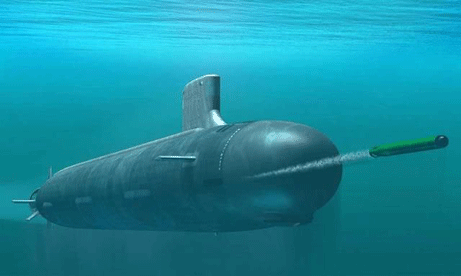 MoD appoints nuclear chief to help keep Dreadnought submarines on course, Telegraph UK, industry editor 14 APRIL 2017 A Treasury troubleshooter has been brought in to run Britain’s military nuclear programmes with a remit to keep the massive Trident replacement submarine programme on track.
Civil servant Julian Kelly will join the Ministry of Defence in May in the new position of director-general nuclear, where he will be responsible for Britain’s nuclear submarines, nuclear warheads and day-to-day policy.
Top of his to do list in the £200,000-a-year role will be ensuring the £41bn programme to build the next generation of Dreadnought nuclear missile submarines for the Royal Navy stays on track. A key task will be working with the soon-to-be appointed head of the Submarine Delivery Authority (SDA), an arm’s-length body created to ensure the Dreadnought programme meets its targets.
The Telegraph understands that final interviews for this role took place in past fortnight, with top engineers and executives being lined up as the MoD looks to tap industry for its experience in running huge projects on time and budget.
The £500,000-a-year job as SDA chief executive is one of the highest paid public roles, reflecting the immense importance of the Trident programme to the UK’s security, with the Navy tasked with keeping one submarine armed with nuclear missiles at sea at all times.
Defence Secretary Sir Michael Fallon has repeatedly warned how critical Britain’s nuclear programmes are, saying delivery of the new submarines “cannot and must not slip”.
Suppliers including BAE Systems, which is leading overall programme, and Rolls-Royce, which is building the submarines’ nuclear powerplants, have been warned of a “pain and gain” regime to contracts. This will mean they will share the results of coming in under budget but cost over-runs and delays will result in heavy penalties.
“We will absolutely challenge BAE and other suppliers such as Rolls-Royce,” the Defence Secretary has warned. “They are going to be incentivised to keep the targets and they will suffer if they don’t.”
Building the four new Dreadnought submarines is seen as the biggest financial risk the MoD faces. Although the work has been costed at £31bn, a £10bn contingency was added on reflecting the huge complexity of the task and vital importance on being on time, with the current Vanguard class missile submarines coming to the end of their lives in the 2030s…… http://www.telegraph.co.uk/business/2017/04/14/mod-appoints-nuclear-chief-help-keep-dreadnought-submarines/
No comments yet.
1 This Month


18 March Webinar @ 1 PM EST: An Assessment of SMR Projects: The Case of Canada
register for the zoom:
https://us02web.zoom.us/webinar/register/WN_o8BIIOUvQ2ONJR1nta65DQ#/registration


of the week – STOP SMALL MODULAR REACTORS IN CANADA
To see nuclear-related stories in greater depth and intensity – go to https://nuclearinformation.wordpress.com
-
Archives
- March 2026 (140)
- February 2026 (268)
- January 2026 (308)
- December 2025 (358)
- November 2025 (359)
- October 2025 (376)
- September 2025 (258)
- August 2025 (319)
- July 2025 (230)
- June 2025 (348)
- May 2025 (261)
- April 2025 (305)
-
Categories
- 1
- 1 NUCLEAR ISSUES
- business and costs
- climate change
- culture and arts
- ENERGY
- environment
- health
- history
- indigenous issues
- Legal
- marketing of nuclear
- media
- opposition to nuclear
- PERSONAL STORIES
- politics
- politics international
- Religion and ethics
- safety
- secrets,lies and civil liberties
- spinbuster
- technology
- Uranium
- wastes
- weapons and war
- Women
- 2 WORLD
- ACTION
- AFRICA
- Atrocities
- AUSTRALIA
- Christina's notes
- Christina's themes
- culture and arts
- Events
- Fuk 2022
- Fuk 2023
- Fukushima 2017
- Fukushima 2018
- fukushima 2019
- Fukushima 2020
- Fukushima 2021
- general
- global warming
- Humour (God we need it)
- Nuclear
- RARE EARTHS
- Reference
- resources – print
- Resources -audiovicual
- Weekly Newsletter
- World
- World Nuclear
- YouTube
-
RSS
Entries RSS
Comments RSS
 nuclear-news
Leave a comment