nuclear-news

The News That Matters about the Nuclear Industry Fukushima Chernobyl Mayak Three Mile Island Atomic Testing Radiation Isotope

California could get catastrophic sea level rise

Sea-level rise in California could be catastrophic, study says http://www.sfgate.com/bayarea/article/Sea-level-rise-in-California-will-be-bad-to-11069686.php  By Kurtis Alexander, April 12, 2017 
A state-commissioned report on climate change released Wednesday raises the stakes for fighting global warming, offering a clearer and, in some cases, more catastrophic picture of how much sea levels will rise in California.

The Bay Area will see the ocean swell as much as 3.4 feet by 2100 if significant action isn’t taken, the report says. The scientists who produced the study pegged the prospect of that outcome at 67 percent. Tougher action on greenhouse gases would mean a lesser rise of up to 2.4 feet, the study says.

The scope of the likely rise is largely in line with earlier estimates, but not completely. One worst-case scenario says ocean levels could rise 10 feet by century’s end, which would swamp countless homes, roads, harbors and even airports along the coast.

 “We have learned that the potential for a higher sea level is greater than we thought,” said Gary Griggs, a professor of Earth sciences at UC Santa Cruz and one of seven climate experts who prepared the report.

The 71-page document was requested by the California Natural Resources Agency and the California Ocean Protection Council, in collaboration with the governor’s office, to help state and local officials plan for rising seas.

The report, an update of a 2013 state analysis, lays out expected ocean levels through 2150 for a number of locations and scenarios varying with the amount of greenhouse gas emissions globally.

Last year, nearly 200 nations committed in Paris to curb greenhouse gases enough so that the Earth’s temperature wouldn’t rise more than 2 degrees Celsius. The emission targets are not binding, however, and many scientists predict that President Trump’s executive order aimed at repealing Obama administration limits on coal-fired power plant pollution will prevent the U.S. from reaching its target.

 The new analysis for California is based largely on recent, better information on ice melt at the Earth’s poles.

The main drivers of rising seas to date have been melting glaciers and the expansion of water that naturally occurs as temperatures warm. However, thawing ice sheets will soon become the primary contributor, according to the state-commissioned study.

The report indicates that Greenland has enough ice to raise global sea level by 24 feet while Antarctica has enough to lift oceans 187 feet. Glaciers, meanwhile, contain only enough ice to raise seas 1.5 feet.

While these continent-size masses of ice are not expected to completely melt, even a small amount of liquefaction could have big effects, particularly for California.

Because the ocean at the poles is lifted by strong gravitational forces, when that ice thaws and water is released toward the tropics, the liquid relaxes and spreads out, according to Griggs.

“It turns out for Antarctica, the biggest impact is along the California coast,” he said. For every foot of global sea-level rise caused by melting ice in the western Antarctic, California will see the the ocean rise about 1.25 feet, according to the report.

The report emphasizes the importance of preparing for the spike.

“California leads the way in both addressing climate change and protecting our coastal and ocean communities and resources,” Jenn Eckerle, deputy director of the Ocean Protection Council, said in a statement. “Our statewide policy on sea-level rise is another example of that leadership. We provide guidance to state agencies and local governments for incorporating sea-level rise projections into planning, permitting, investment, and other decisions.”

Kurtis Alexander is a San Francisco Chronicle staff writer. Email: kalexander@sfchronicle.com Twitter: @kurtisalexander

Rising Reality series

Read Chronicle urban design critic John King’s stories on the challenges posed by sea-level rise in the Bay Area: http://projects.sfchronicle.com/2016/sea-level-rise/
April 15, 2017 Posted by | climate change, USA | Leave a comment

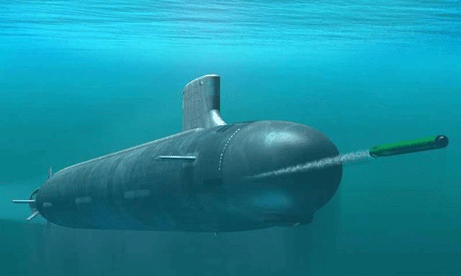
UK’s Ministry of Defence brings in nuclear bigwig to run the £41bn programme for Dreadnought nuclear missile submarines

MoD appoints nuclear chief to help keep Dreadnought submarines on course, Telegraph UK,    industry editor 14 APRIL 2017   A Treasury troubleshooter has been brought in to run Britain’s military nuclear programmes with a remit to keep the massive Trident replacement submarine programme on track.

Civil servant Julian Kelly will join the Ministry of Defence in May in the new position of director-general nuclear, where he will be responsible for Britain’s nuclear submarines, nuclear warheads and day-to-day policy.

Top of his to do list in the £200,000-a-year role will be ensuring the £41bn programme to build the next generation of Dreadnought nuclear missile submarines for the Royal Navy stays on track. A key task will be working with the soon-to-be appointed head of the Submarine Delivery Authority (SDA), an arm’s-length body created to ensure the Dreadnought programme meets its targets.

The Telegraph understands that final interviews for this role took place in past fortnight, with top engineers and executives being lined up as the MoD looks to tap industry for its experience in running huge projects on time and budget.

The £500,000-a-year job as SDA chief executive is one of the highest paid public roles, reflecting the immense importance of the Trident programme to the UK’s security, with the Navy tasked with keeping one submarine armed with nuclear missiles at sea at all times.

Defence Secretary Sir Michael Fallon has repeatedly warned how critical Britain’s nuclear programmes are, saying delivery of the new submarines “cannot and must not slip”.
Suppliers including BAE Systems, which is leading overall programme, and Rolls-Royce, which is building the submarines’ nuclear powerplants, have been warned of a “pain and gain” regime to contracts. This will mean they will share the results of coming in under budget but cost over-runs and delays will result in heavy penalties.

“We will absolutely challenge BAE and other suppliers such as Rolls-Royce,” the Defence Secretary has warned. “They are going to be incentivised to keep the targets and they will suffer if they don’t.”

Building the four new Dreadnought submarines is seen as the biggest financial risk the MoD faces. Although the work has been costed at £31bn, a £10bn contingency was added on reflecting the huge complexity of the task and vital importance on being on time, with the current Vanguard class missile submarines coming to the end of their lives in the 2030s…… http://www.telegraph.co.uk/business/2017/04/14/mod-appoints-nuclear-chief-help-keep-dreadnought-submarines/

April 15, 2017 Posted by | UK, weapons and war | Leave a comment



