Nuclear history, and the false promises of Generation IV reactors
Generation IV reactors to the rescue?
Given these problems, some look to new ‘Generation IV’ designs. They are basically new versions of the old designs looked at in the 1950s, 60s and 70s in the USA and elsewhere – and abandoned as unviable, or after accidents.
They include fast neutron plutonium breeders, High Temperature Reactors (HTRs) and Molten Salt Reactors (MSR) possibly using thorium as a fuel and possibly also in scaled down Small Modular Reactor (SMR) format.
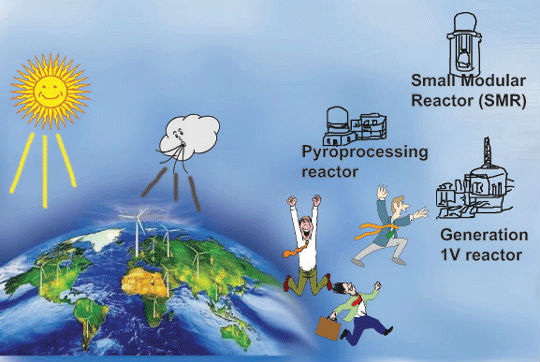
The message from the past is not promising……
False promise: nuclear power: past, present and (no) future http://www.theecologist.org/News/news_analysis/2988856/false_promise_nuclear_power_past_present_and_no_future.html David Elliott 12th April 2017
Nuclear power was originally sold on a lie, writes Dave Elliott. While we were being told it would make electricity ‘too cheap to meter’, insiders knew it cost at least 50% more than conventional generation. Since then nuclear costs have only risen, while renewable energy prices are on a steep decline. And now the nuclear behemoths are crumbling … not a moment too soon.
In a December 1953 speech to the United Nations, President Dwight D. Eisenhower launched the ‘Atoms for Peace’programme, saying:
“The miraculous inventiveness of man shall not be dedicated to his death but consecrated to his life.”
He claimed that “peaceful power from atomic energy is not a dream of the future. That capability, already proved, is here – now – today.” And the USA would help to ensure it could be used worldwide.
However, his advisors soon told him that it wasn’t viable. A classified internal State Department Intelligence Report, circulated in January 1954, ‘Economic Implications of Nuclear Power in Foreign Countries‘, warned that the introduction of nuclear power would
” … not usher in a new era of plenty and rapid economic development as is commonly believed. Nuclear power plants may cost twice as much to operate and as much as 50 percent more to build and equip than conventional thermal plants.” [Quoted by Mara Drogan in ‘The Nuclear Imperative: Atoms for Peace and the Development of U.S. Policy on Exporting Nuclear Power, 1953-1955 Diplomatic History 40 Issue 5 948-974.]
Nonetheless, the nuclear juggernaut rolled on, with, US Atomic Energy Commission Chairman Lewis Strauss, in a 1954 address to science writers, claiming: “It is not too much to expect that our children will enjoy in their homes electrical energy too cheap to meter.”
The USA, followed by the UK, France, Russia and Japan, poured vast resources into nuclear power – new plants and new research projects.
Murphy’s law of nuclear power?
But things didn’t always go to plan. For example, there took place a series of accidents at US experimental reactor test sites, including an explosion at the SL1 project in Idaho in 1961, which killed three operators – one of whom was impaled to the roof by a fuel rod.
Then in 1966, the Fermi fast reactor, near Detroit, suffered a fuel melt down, and in 1979, the Pressurised Water Reactor (PWR) at Three Mile island narrowly avoided a major hydrogen explosion by venting radioactive gas to the air. That signalled the end of nuclear growth in the the USA. The multi-billion dollar plant had to be written off. Opposition mounted. New plants, orders collapsed.
Then came the Chernobyl disaster in the Ukraine in 1986, with the cloud spreading across most of Europe. There was a global meltdown in orders for new plants.
However, it wasn’t just the accidents that were the problem. The poor economics of nuclear gradually became more apparent- as cheaper alternatives began to emerge. It turned out to be too expensive – e.g. it could not compete with cheap gas plants in the UK. As Lord (Walter) Marshall, one- time head of the UK Atomic Energy Authority, when chair of the CEGB in 1987, commented:
“The British Public have never had the cheap electricity that we have always promised from nuclear power. It has been, and continues to be, a case of ‘jam tomorrow, but never today’.”
But for our politicians, the nuclear dream never died
But that didn’t stop Marget Thatcher from pushing ahead with a new nuclear plant (a PWR) at Sizewell, work on it starting in 1987. Or Tony Blair later trying to relaunch a new programme “with a vengence”. That has still yet to happen. But it’s pending, with the £24 billion Hinkley Point C European Pressurised-water Reactor (EPR), if it goes ahead, being the first new UK plant in 30 years.
Fukushima, in 2011, had intervened, slowing the nuclear programme worldwide, and creating liabilities of hundreds of billions of dollars. But the UK has pressed ahead with plans for maybe 18GW of new plant – delivering around 30% of UK electricity in the 2030s.
This expansion is based on so-called ‘Generation III’ reactors, basically upgrades of the Generation II PWRs and similar designs that have been the mainstay of nuclear so far. The new versions are unlikely to be any more competitive against cheap gas and increasingly cheap renewables.
The nuclear industry still has hopes for the French EPR, the Toshiba / Westinghouse AP1000 and the Hitachi ABWR – an upgrade of the Fukushima boiling water reactor design.
But the EPRs being built in France and Finland, Flamanville and Olkiluoto, are both around eight years late and three times over budget. Flamanville’s gigantic stainless steel reactor vessel and dome is also suffering from serious metallurgical flaws which may yet prevent its completion.
The two AP1000s being built in the USA have also been delayed, creating losses of over $10 billion that have pushed Westinghouse into bankruptcy, and its Japanese parent company, Toshiba, into what may prove to be a terminal financial meltdown. The two ABWRs under construction in the US are also seriously behind schedule.
Generation IV reactors to the rescue?
Given these problems, some look to new ‘Generation IV’ designs. They are basically new versions of the old designs looked at in the 1950s, 60s and 70s in the USA and elsewhere – and abandoned as unviable, or after accidents.
They include fast neutron plutonium breeders, High Temperature Reactors (HTRs) and Molten Salt Reactors (MSR) possibly using thorium as a fuel and possibly also in scaled down Small Modular Reactor (SMR) format.
The message from the past is not promising. Most countries (US, UK, France) gave up on fast breeders in the 1980s and 1990s. Japan has now too. The UK tested an HTR in the 1960s with its Dragon project at Winfrith. Germany and the USA had a go too. The US also tested some MSR technology in the 1960s, and also the use of thorium as fuel. SMRs were also tested.
None of these ideas went forward owing to massively escalating costs and successive technical dificulties. But the industry claims that new variants on these old designs will be upgraded, cheaper and safer.
However, in a review of Generation IV options, the French nuclear agency IRSN said that, at the present stage of development, it did not see any evidence that “the systems under review are likely to offer a significantly improved level of safety compared with Generation III reactors, except perhaps for the High Temperature Reactor” – and even that would require “significantly limiting unit power”.
Allison MacFarlane, former chair of the US Nuclear Regulatory Commission, talking about the HTR, said “I do not see past experience pointing at a positive direction.”
She also noted that Fast Breeder Reactors “turn out to be very expensive technologies to build. Many countries have tried over and over. What is truly impressive is that … many governments continue to fund a demonstrably failed technology.”
As nuclear power grows more costly, renewables prices plunge
Cost reduction is clearly vital if any of these ideas is to prosper. That’s one of the arguments used for small modular reactors (SMRs): they would be faster to build and so possibly easier to finance. It might also be possible to use the waste heat from them to supply heat to urban areas – if residents would accept them in or near cities.
But is that likely? SMRs are very unlikely ever to be cheap. The reason why civil nuclear power stations ever got so big as the EPR (1.6GW), ABWR (1.6GW) and AP1000 (1.25GW) is to reap ‘economies of scale’ which would be lost by going small.
And of course there is nothing remotely ‘new’ about SMRs, indeed they are a distinctly mature technology: hundreds of them have been deployed in military submarines and ships, for decades. The reason why they were never used for civil power generation is simple – they cost too much! So what exactly is about to change?
In any case all these Generation IV ideas are a decade or two, or maybe more, away from anything approaching commercial reality. It’s like the situation renewables faced in the 1980s. Renewables did break through and are now viable – wind and PV solar especially. Will Generation IV nuclear be able to do the same? Or do we need to wait until Generation V – fusion? If that ever works. Or do we actually need any of these nuclear ideas?
Renewables have outperformed nuclear across the board – undercutting its cost and delivering over twice its total annual output globally: renewables now supply 24% of global electricity, and are growing rapidly, as against the fairly static 11.5% from nuclear.
Renewables are on the way to 50% of power production in many countries by 2030, and maybe close to 100% by 2050. The resource is huge, and, unlike uranium or thorium, it won’t ever run out, or leave long-term hazardous wastes. That looks like our best future.
Pentagon’s new killing systems for space
Why is America Sending an Aircraft Carrier Near North Korea?, National Interest, Kris Osborn, 12 Apr 17 “……….The Pentagon is also substantially increasing its arsenal of Ground Based Interceptors, or GBIs, currently stationed at Vandenberg AFB, Calif., and Ft. Greeley, Ala. The plan, first announced by former Defense Secretary Chuck Hagel several years ago, aims to increase the number of GBIs to 44 by 2017. GBIs are interceptor missiles designed to shoot up into space and destroy approaching enemy ICBMs.
Mann praised the Army soldiers who work on GBI preparation, maintenance and operation at Ft. Greely, explaining how they endure difficult weather conditions to serve America better protect the U.S. homeland.
Multi-Object Kill Vehicle:
The Pentagon’s Missile Defense Agency is in the early phases of engineering a next-generation “Star Wars”-type technology able to knock multiple incoming enemy targets out of space with a single interceptor, officials said.
“We will develop and test, by 2017, MOKV command and control strategies in both digital and hardware-in-the-Loop venues that will prove we can manage the engagements of many kill vehicles on many targets from a single interceptor. We will also invest in the communication architectures and guidance technology that support this game changing approach,” a Missile Defense Agency spokesman, told Scout Warrior last year.
Decoys or countermeasures are missile-like structures, objects or technologies designed to throw off or confuse the targeting and guidance systems of an approaching interceptor in order to increase the probability that the actual missile can travel through to its target.
If the seeker or guidance systems of a “kill vehicle” technology on a GBI cannot discern an actual nuclear-armed ICBM from a decoy – the dangerous missile is more likely to pass through and avoid being destroyed. MOKV is being developed to address this threat scenario.
The Missile Defense Agency has awarded MOKV development deals to Boeing, Lockheed and Raytheon as part of a risk-reduction phase able to move the technology forward, MDA officials said.
Steve Nicholls, Director of Advanced Air & Missile Defense Systems for Raytheon, told Scout Warrior last year that the MOKV is being developed to provide the MDA with “a key capability for its Ballistic Missile Defense System. The idea is to discriminate lethal objects from countermeasures and debris. The kill vehicle, launched from the ground-based interceptor extends the ground-based discrimination capability with onboard sensors and processing to ensure the real threat is eliminated.”
MOKV could well be described as a new technological step in the ongoing maturation of what was originally conceived of in the Reagan era as “Star Wars” – the idea of using an interceptor missile to knock out or destroy an incoming enemy nuclear missile in space. This concept was originally greeted with skepticism and hesitation as something that was not technologically feasible.
Not only has this technology come to fruition in many respects, but the capability continues to evolve with systems like MOKV. MOKV, to begin formal product development by 2022, is being engineered with a host of innovations to include new sensors, signal processors, communications technologies and robotic manufacturing automation for high-rate tactical weapons systems, Nicholls explained.
The trajectory of an enemy ICBM includes an initial “boost” phase where it launches from the surface up into space, a “midcourse” phase where it travels in space above the earth’s atmosphere and a “terminal” phase wherein it re-enters the earth’s atmosphere and descends to its target. MOKV is engineered to destroy threats in the “midcourse” phase while the missile is traveling through space.
An ability to destroy decoys as well as actual ICBMs is increasingly vital in today’s fast-changing technological landscape because potential adversaries continue to develop more sophisticated missiles, countermeasures and decoy systems designed to make it much harder for interceptor missile to distinguish a decoy from an actual missile.
As a result, a single intercept able to destroy multiple targets massively increases the likelihood that the incoming ICBM threat will actually be destroyed more quickly without needing to fire another Ground Based Interceptor.
Raytheon describes is developmental approach as one that hinges upon what’s called “open-architecture,” a strategy designed to engineer systems with the ability to easily embrace and integrate new technologies as they emerge. This strategy will allow the MOKV platform to better adjust to fast-changing threats, Nicholls said.
The MDA development plan includes the current concept definition phase, followed by risk reduction and proof of concept phases leading to a full development program, notionally beginning in fiscal year 2022, Raytheon officials explained.
MDA officials have told Scout Warrior that the MOKV program shows great promise for the future of missile defense technology.
While the initial development of MOKV is aimed at configuring the “kill vehicle” for a GBI, there is early thinking about integrating the technology onto a Standard Missile-3, or SM-3, an interceptor missile also able to knock incoming ICBMs out of space. The SM-3 is also an exo-atmopheric “kill vehicle,” meaning it can destroy short and intermediate range incoming targets; its “kill vehilce” has no explosives but rather uses kinetic energy to collide with and obliterate its target. The resulting impact is the equivalent to a 10-ton truck traveling at 600 mph, Raytheon statements said. http://nationalinterest.org/blog/the-buzz/why-america-sending-aircraft-carrier-near-north-korea-20136?page=2
Hans M. Kristensen on New START 2017: Russia Decreasing, US Increasing Deployed Warheads
 New START 2017: Russia Decreasing, US Increasing Deployed Warheads https://fas.org/blogs/security/2017/04/newstart2017/ Apr.03, 2017 By Hans M. Kristensen
The latest set of New START aggregate data released by the US State Department shows that Russia is decreasing its number of deployed strategic warheads while the United States is increasing the number of warheads it deploys on its strategic forces.

The Russian reduction, which was counted as of March 1, 2017, is a welcoming development following its near-continuous increase of deployed strategic warheads compared with 2013. Bus as I previously concluded, the increase was a fluctuation caused by introduction of new launchers, particularly the Borei-class SSBN.
The US increase, similarly, does not represent a buildup – a mischaracterization used by some to describe the earlier Russian increase – but a fluctuation caused by the force loading on the Ohio-class SSBNs.
Strategic Warheads
The data shows that Russia as of March 1, 2017 deployed 1,765 strategic warheads, down by 31 warheads compared with October 2016. That means Russia is counted as deploying 228 strategic warheads more than when New START went into force in February 2011. It will have to offload an additional 215 warheads before February 2018 to meet the treaty limit. That will not be a problem.
The number of Russian warheads counted by the New START treaty is only a small portion of its total inventory of warheads. We estimate that Russia has a military stockpile of 4,300 warheads with more retired warheads in reserve for a total inventory of 7,000 warheads.
The United States was counted as deploying 1,411 strategic warheads as of March 1, 2017, an increase of 44 warheads compared with the 1,367 strategic deployed warheads counted in October 2016. The United States is currently below the treaty limit and can add another 139 warheads before the treaty enters into effect in February 2018.
The number of US warheads counted by the New START treaty is only a small portion of its total inventory of warheads. We estimate that the United States has a military stockpile of 4,000 warheads with more retired warheads in reserve for a total inventory of 6,800 warheads.
Strategic Launchers
The New START data shows that Russia as of March 1, 2017 deployed 523 strategic launchers, an increase of 15 launchers compared with October 2016. That means Russia has two (2) more launched deployed today than when New START entered into force in February 2011.
Russia could hypothetically increase its force structure by another 177 launchers over the next ten months and still be in compliance with New START. But its current nuclear modernization program is not capable of doing so.
Under the treaty, Russia is allowed to have a total of 800 deployed and non-deployed strategic launchers. The data shows that it currently has 816, only 16 above the treaty limit. That means Russia overall has scrapped 49 total launchers (deployed and non-deployed) since New START was signed in February 2011.
The United States is counted as deploying 673 strategic launchers as of March 1, 2017, a decrease of eight (8) launchers compared with October 2016. That means the United States has reduced its force structure by 209 deployed strategic launchers since February 2011.
The US reduction has been achieved by stripping essentially all excess bombers of nuclear equipment, reducing the ICBM force to roughly 400, and making significant progress on reducing the number of launch tubes on each SSBN from 24 to 20.
The United States is below the limit for strategic launchers and could hypothetically add another 27 launchers, a capability it currently has. Overall, the United States has scrapped 304 total launchers (deployed and non-deployed) since the treaty entered into force in February 2011, most of which were so-called phantom launchers that were retired but still contained equipment that made them accountable under the treaty.
The United States currently is counted as having 820 deployed and non-deployed strategic launchers. It will need to destroy another 20 to be in compliance with New START by February 2018.
Conclusions and Outlook
Both Russia and the United States are on track to meet the limits of the New START treaty by February 2018. The latest aggregate data shows that Russia is again reducing its deployed strategic warheads and both countries are already below the treaty’s limit for deployed strategic launchers.
In a notorious phone call between Russian President Vladimir Putin and US President Donald Trump, the Russian president reportedly raised the possibility of extending the New START treaty by another five years beyond 2021. But Trump apparently brushed aside the offer saying New START was a bad deal. After the call, Trump said the United States had “fallen behind on nuclear weapons capacity.”
In reality, the United States has not fallen behind but has 150 strategic launchers more than Russia. The New START treaty is not a “bad deal” but an essential tool to provide transparency of strategic nuclear forces and keeping a lid on the size of the arsenals. Russia and the United States should move forward without hesitation to extend the treaty by another five years.
Additional resources:
- New START Aggregate Data (as of March 1, 2017)
- Status of World Nuclear Forces
Foreign Ministers at G7 declare support for Iran nuclear agreement
 G7 FMs declare support for Iran’s nuclear deal IRNA http://theiranproject.com/blog/2017/04/11/g7-fms-declare-support-irans-nuclear-deal/ – The G7 Ministers of Foreign Affairs in the final declaration of their meeting in Lucca, Italy have expressed support for the 2015 nuclear deal between Iran and six world powers, known also as the Joint Comprehensive Plan of Action (JCPOA).
“We support the Joint Comprehensive Plan of Action (JCPOA) as an important contribution to the non-proliferation regime,” the Group of 7 (G7) Industrialized nations, including Canada, France, Germany, Italy, Japan, the United Kingdom, and the United States, said in Italy.
“Continued and full implementation of the JCPOA is essential to build confidence that Iran’s nuclear program is exclusively peaceful in nature,” the declaration further read.
The G7 foreign ministers also called for full commitment by all parties involved in the nuclear deal.
“We value the JCPOA’s comprehensive structure and the commitment by all parties to its solid verification mechanism,” they said. We commend and continue supporting the IAEA in its crucial work in Iran, including monitoring and verification to help ensure compliance with Iran’s JCPOA commitments and safeguard obligations, thus playing a key role in fostering mutual trust,” they said.
They further added that, “We stress the need for all parties to entirely and consistently fulfill all their commitments under the JCPOA in good faith.”
The G7 foreign ministers also asked the Islamic Republic of Iran to remain to comply with its JCPOA-commitments.
“We reaffirm the need for Iran to strictly abide by all its nuclear related commitments,” they said in their declaration.
The declaration further referred to the need for the Resolution 2231 of the United Nations Security Council to be fully implemented.
“UN Security Council Resolution 2231 needs to be fully implemented, including its provisions prohibiting the transfer of arms,” the declaration noted.
It also touched upon Iran’s role in Syria and noted, “We call upon Iran to play a constructive regional role by contributing to efforts to achieve political solutions, reconciliation and peace in Syria, Iraq, and Yemen and other parts of the region and to cooperate in countering the spread of terrorism and violent extremism.’
According to the G7 official website, the G7 Ministers of Foreign Affairs met on 10-11 April in Lucca. A traditional meeting held once a year between the seven most industrialized countries of the world.
US reaffirms Iran nuclear agreement

 http://www.argusmedia.com/news/article/?id=1440687 11 Apr 2017, Washington, 11 April (Argus) — The US administration’s new focus on crises in Syria and North Korea is highlighting a full retreat from President Donald Trump’s pledge to rescind the nuclear agreement his predecessor signed with Iran.
US secretary of state Rex Tillerson today reaffirmed support for the multilateral agreement — the Joint Comprehensive Plan of Action — that lifted restrictions on crude exports from Iran in January 2016. The EU, Russia and China also are parties to the agreement.
The G7 foreign ministers, meeting in Lucca, Italy, in a statement hailed the agreement’s “important contribution to the non-proliferation regime.” Implementation of the agreement will “build confidence that Iran’s nuclear program is exclusively peaceful in nature,” the ministers said.
The US’ approach to Iran so far has not departed greatly from the path former president Barack Obama’s administration paved following the lifting of the nuclear-related sanctions, even though Trump still denounces the deal. Trump imposed new sanctions on Iran following tests of ballistic missiles, just like his predecessor did. And the Pentagon continues to view Iran as a threat to US interests in the Middle East, including the freedom of navigation in the straits of Hormuz and Bab al-Mandeb.
Iran since the lifting of the nuclear-related sanctions increased production by more than 900,000 b/d to 3.8mn b/d in February.
Senior White House officials contend that Iran’s missile tests are evidence of a covert nuclear weapons program. Iran says its program is defensive in nature.
The US administration promised to push for a stronger international response to the missile tests than Obama did. But today’s G7 statement only expresses “deep regret” over the tests.
The need to coordinate sanctions programs with the EU is likely a key driver in the new administration’s approach. EU officials also persuaded US senators to delay advancing a widely supported bill to expand the scope of sanctions on Iran over the missile tests. The Senate Foreign Relations Committee will wait until after the Iranian presidential election on 19 May to schedule a vote on the bill, committee chairman Bob Corker (R-Tennessee) said.
The G7 statement calls on Russia and Iran, as allies of Syrian president Bashar al-Assad’s regime, to ensure Syria’s compliance with the UN convention banning the use of chemical weapons. But the US is directing the bulk of its criticism over Assad’s alleged use of chemical weapons against civilians at Russia.
Overall analysis of the Iran Nuclear Agreement
The Impact of the Iran Nuclear Agreement http://www.cfr.org/iran/impact-iran-nuclear-agreement/p39032
Zachary Laub, Senior Copy Editor/Writer April 11, 2017
Introduction
Iran has dismantled much of its nuclear program and given international inspectors extensive access to sensitive sites under an agreement known as the Joint Comprehensive Plan of Action (JCPOA). Under its terms, the United States, European Union, and United Nations have lifted sanctions that had crippled the Iranian economy, but more than year after the accord took effect, Iranians have yet to see the recovery that President Hassan Rouhani had promised. Meanwhile, as the Trump administration has vowed a more aggressive approach to Iran and the U.S. Congress considers levying new sanctions, international businesses, sensing uncertainty, have largely held back from investing in the country.
The JCPOA, which was signed in July 2015 and went into effect the following January, imposes restrictions on Iran’s stockpiles of uranium and its ability to enrich it. The so-called P5+1—that is, the five permanent members of the UN Security Council (China, France, Russia, the United Kingdom, and United States) and Germany—negotiated the agreement with Iran over nearly two years. During this period, the Obama administration said its intent was to set back Iran’s nuclear program so that any decision to sprint toward producing fissile material for a weapon—an indicator known as “breakout times”—would take at least a year, up from just a few weeks.
Nuclear restrictions on Iran. To extend that breakout time, the agreement requires that uranium enrichment at Fordow and Natanz be restricted and a heavy-water reactor, at Arak, have its core rendered inoperable; its plutonium byproduct, the P5+1 countries feared, could have been reprocessed into weapons-grade material. These facilities are now being repurposed for research, industrial, or medical purposes, and subjected to inspections by monitors from the UN nuclear watchdog, the International Atomic Energy Agency (IAEA). The accord imposes limits on the numbers and types of centrifuges Iran can operate, as well as the size of its caches of enriched uranium. (Mined uranium has less than 1 percent of the uranium-235 isotope, and centrifuges increase that isotope’s concentration. Uranium enriched to 5 percent is used in nuclear power plants, and at 20 percent it can be used in research reactors or for medical purposes. High-enriched uranium, at some 90 percent, is used in nuclear weapons.) The JCPOA also aims to guard against the possibility that Iran could develop nuclear arms in secret at undeclared sites.
Many of the JCPOA’s nuclear provisions have expiration dates. After ten years, for example, centrifuge restrictions will be lifted, and after fifteen years, so too will limits on the low-enriched uranium it can possess, as well as the IAEA’s access to undeclared sites.
Monitoring and verification. Among the open-ended provisions, Iran is bound to implement and later ratify an “additional protocol” to its safeguards agreement with the IAEA, which gives IAEA inspectors unprecedented access to Iran’s nuclear facilities. (As a signatory to the Nonproliferation Treaty, or NPT, Iran has committed to never pursue nuclear weapons, but it is entitled to pursue nuclear technology for peaceful purposes.) The agency’s director-general issues quarterly reports to the IAEA Board of Governors and UN Security Council verifying Iran’s implementation of its nuclear commitments.
The JCPOA established the Joint Commission, with the negotiating parties all represented, to monitor implementation of the agreement. That body, chaired by Federica Mogherini, the EU foreign policy chief, is charged with dispute resolution, and a majority vote of its members can gain IAEA inspectors access to undeclared sites they consider suspect. It also oversees the transfer of nuclear-related or dual-use materials.
Sanctions relief. In exchange for these limitations on its nuclear program and opening up access to international inspectors, the EU, UN, and United States all committed to lifting sanctions that they had imposed on Iran for its nuclear program. While the United States has only suspended extant nuclear sanctions, it pledged in the JCPOA to remove specified entities from sanctions lists and seek legislation to repeal the suspended sanctions within eight years, as long as the IAEA concludes that Iran’s nuclear activities remain peaceful in nature.
Still, other U.S. sanctions [PDF], some dating back to the hostage crisis in 1979, remain in effect. They cover matters such as ballistic missile production, support for U.S.-designated terrorist groups, and domestic human rights abuses. The United States has stopped enforcing its sanctions on oil exports, freeing Iran to trade on international markets again, but restrictions on financial transactions remain in place. Many banks and other companies, including foreign subsidiaries of U.S. businesses, are wary of doing business in Iran for fear of incurring fines or being barred from dealing on Wall Street. A major exception to U.S. primary sanctions allows Boeing to sell aircraft to Iranian airlines.
New Security Council resolutions are periodically needed to keep UN sanctions suspended, so, by alleging a major violation, any one of the P5 members can veto a new resolution. This “snapback” mechanism is set to remain in effect for ten years, after which point the UN sanctions are set to be repealed.
Has Iran upheld its obligations?
Implementation Day, on which sanctions were lifted, came once the IAEA certified that Iran had met preliminary requirements, including taking thousands of centrifuges offline, rendering the core of the Arak heavy-water reactor inoperable, and selling excess low-enriched uranium to Russia. Since then, the IAEA has mostly found Iran in compliance with the JCPOA’s requirements. Iran twice exceeded the amount of heavy water that it is allowed under the agreement, the IAEA reported, but quickly resolved it.
“Monitoring is a physical act, but verification is a political act.” —Christopher Bidwell, Federation of American Scientists
The challenge inspectors face is that they are “looking to prove the negative,” says Christopher Bidwell, a senior fellow at the Federation of American Scientists. “IAEA reports talk about where Iran is compliant, but then are silent on known rough issues,” he says, highlighting military sites, for which inspectors must seek access from Iranian authorities or adjudication by the Joint Commission. Also omitted from the public record, the International Crisis Group notes, are reports on Iran’s caches of low-enriched uranium and research on centrifuges. “Monitoring is a physical act, but verification is a political act,” Bidwell says. “How sure are you that what you’ve monitored has told you what you want to know?”
Have the P5+1 countries upheld their obligations?
The United Nations, European Union, and United States all repealed or suspended the sanctions that the JCPOA specified be lifted on Implementation Day, and since then the United States has also unfrozen or delivered to Iran certain seized funds. (Liquid assets freed up in European and Asian banks might have totaled some $50 billion, according to a U.S. Treasury official; in addition, the United States refunded $1.7 billion delivered for an arms deal that was signed before the 1979 revolution but never fulfilled.) Most significantly, the United States is no longer enforcing secondary sanctions on Iran’s oil sector, which has allowed Iran to ramp up its oil exports to nearly the level it had been prior to sanctions. The International Monetary Fund (IMF) estimated in October [PDF] that Iran’s GDP was growing at 4.5 percent in 2016 as it boosted its oil production to 3.6 million barrels per day.
How is Iran’s economy performing?
Iranians have not seen as robust an economic recovery as many had expected to follow the JCPOA’s implementation. A morass of U.S. sanctions unrelated to the nuclear program has discouraged major international banks from investing in the country and made many companies wary of expanding into Iran. They fear being held liable for transacting with the numerous sanctioned entities associated with, for example, the Iranian Revolutionary Guard Corps (IRGC), which is ubiquitous in some industries. Uncertainty over whether the nuclear sanctions might be restored persists.
But factors unrelated to sanctions are also hampering the recovery. Corruption, mismanagement, and aging infrastructure are widely acknowledged barriers to industry, and, at about $50 a barrel as of April 2017, oil is trading at less than half the price it was five years earlier, so the revenues to be made from export don’t go as far. The IMF projected that Iran’s growth would “taper sharply” [PDF] in 2017 as it would have trouble surpassing its pre-sanctions level of oil production, and in March 2017 Iran said it would limit its oil production to 3.8 million barrels per day if OPEC members’ agreement to cap their production—a bid to raise oil prices—holds.
With the economy underperforming compared to what Rouhani had promised, some Iranian politicians have accused the United States of dealing in bad faith. Supreme Leader Ali Khamenei, who has expressed ambivalence about the JCPOA, criticized the faltering recovery. But so too has Foreign Minister Javad Zarif, who negotiated the agreement. He said at CFR in September 2016, “it takes a lot to change the global climate that is afraid of the United States taking action against any bank that does any business with Iran.” Referring to U.S. Treasury regulations, he added, “there is one sentence that it’s OK to do business with Iran and about five pages of ifs and buts,” discouraging banks from entering the market.
Do U.S. politics jeopardize the JCPOA?
On the campaign trail, Trump pledged to dismantle or renegotiate the nuclear agreement, echoing the criticisms made by some members of Congress as the agreement was being finalized. Many objected to sanctions relief on the grounds that it would enrich Iran and allow it to expand its influence in regional conflicts like the Syrian civil war. Critics also said that monitoring provisions in the JCPOA offered no guarantee that Iran could not covertly develop a nuclear weapon.
Trump could reimpose waived sanctions or add new ones by presidential prerogative, enact statutory sanctions passed by Congress, or allow the presidential waivers of nuclear sanctions to lapse when they come due for renewal. Any of those measures could be perceived by either Iran or other members of the P5+1 as the United States reneging on its commitments.
After Iran tested ballistic missiles in late January 2017, the administration extended sanctions to twenty-five individuals and entities associated with either the missile program or the IRGC’s expeditionary Quds Force. (Though ballistic missiles could be used to deliver nuclear weapons, they are beyond the scope of the JCPOA; the UN Security Council resolution that codified the JCPOA contains only nonbinding language on the matter.) “It wasn’t a drastic departure from previous policy, including from the Obama administration,” says Ariane M. Tabatabai, a visiting assistant professor at Georgetown’s Edmund A. Walsh School of Foreign Service.
A bill cosponsored by the top Republican and Democrat on the Senate Foreign Relations Committee could prevent the president from fulfilling the U.S. obligation to delist certain entities within eight years of implementation; it could also be construed as impeding the benefits Iran can accrue from sanctions relief. That would “threaten the ongoing implementation of the nuclear deal,” says the Arms Control Association, an independent Washington-based nonproliferation group.
Do Iranian politics jeopardize the JCPOA?
The JCPOA is contentious in Iran as well. Rouhani is running for reelection on May 19, and “the main thing he’s being judged on by the electorate is the economic recovery,” Tabatabai says.
“The Rouhani government oversold its ability to generate economic recovery following the sanctions relief,” she says, “and so now it is dialing back expectations of what is realistic.” The government is now arguing that the recovery will take more time, and that its lag cannot be attributed to sanctions alone.
Hard-liners in Iran argue that the United States is angling to keep the Iranian economy depressed and that Rouhani was hoodwinked into unfavorable terms, a view they say is bolstered by extreme rhetoric from some members of the Trump administration and Congress. They argue that Iran has “redesigned its nuclear facilities while the sanctions have only been suspended,” and so the United States can reinstate sanctions with relative ease even as the Iranian nuclear program has been permanently set back, says Mohammad Ayatollahi Tabaar, an assistant professor at Texas A&M University’s Bush School of Government and Public Service
While some U.S. lawmakers continue to criticize the JCPOA, the other members of the P5+1 are firmly behind it. Many close watchers of the accord say that if the United States were to reinstate sanctions without presenting clear evidence of Iranian cheating, its negotiating partners would be unlikely to follow suit and resurrect the global regime that drove Iran to the negotiating table. “Iran’s goal is to create a gap between the U.S. and EU,” says Tabaar, so Iran likely won’t renege on its nuclear commitments. Instead, he says, hard-liners might push back against the United States in areas beyond the scope of the JCPOA, such as testing ballistic missiles or boosting its support for its clients in Iraq, Syria, or Yemen.
More on this topic from CFR
Problems in Europe with Westinghouse nuclear fuel assemblies
 A Bankruptcy That Wrecked Global Prospects Of American Nuclear Energy, Forbes, Kenneth Rapoza “……….Unlike with fossil fuels, in nuclear, fuel assemblies are a high-tech and R&D-intensive product. These assemblies can make even reactors run more efficiently, sometimes exceeding their original lifespan. But under investment impacted the quality and comparative performance of WEC versus their main rival, Russian owned TVEL, a unit of Rosatom. In some markets fuel rods supplied by Westinghouse have failure rates almost 1.5 times greater than those manufactured by its competitors, according to at least one utility in Finland that has a Russian reactor.
Westinghouse supplies fuel assemblies mainly to Europe where it has always used its mighty lobbying clout in Brussels to prop their market share. Back in 2003, the European Commission adopted directive 2003/54/EC which made it compulsory for EDF, the French energy giant, to buy nuclear fuel from an “alternative vendor”. This completely opened the door to WEC, with wheels already in motion a year earlier. EDF buys about 15-20% of its fuel from Westinghouse today.
WEC had Washington’s help within companies operating Rosatom reactors, fiercely lobbying for nuclear fuel supply diversification in Eastern Europe. They tried to supply fuel assemblies to Finland and Czech Republic, but both countries eventually chose TVEL. The Czech even had to cancel their contract with Westinghouse amid safety concerns at their Temelin site, despite a large-scale lobbying push which involved letters from the European Commission to utilities encouraging them to switch to WEC. As of now, even after Washington’s cheerleading Toshiba, Westinghouse’s biggest star as far as nuclear fuel assembly diversification goes is Ukraine.
It’s quite understandable that Ukraine, effectively at war with Russia, may be tempted to turn a blind eye to the issues facing Westinghouse. But concerns over incident risks are growing amid reports that plants using WEC’s fuel have had frequent emergency outages. Many claim that corruption and lack of safety culture in Ukraine make it a really dangerous game potentially leading to another Chernobyl, according to a Washington Times columnist with a flare for the dramatic.
Westinghouse told me that their recent contracts with Ukraine to supply Russian built reactors with fuel assemblies was still intact……….
For Westinghouse’s global ambitions, China was the really big picture and Europe was its hub to challenge Russia’s market in the lucrative fuel assembly business. WEC says that the bankruptcy here will not affect their businesses there, but judge Michael Wiles rejected a request by the company to allow for Apollo’s loan to go towards WEC’s European units. Without those loans, the European companies could face their own funding woes now. AxilPartners said that a cash pool the European affiliates normally draws from was halted by the Swedish bank that serves as its monitor. It is unclear who this monitor is, or what that means precisely, Debtwire’s Tracy says. But without that bank, pensions in Europe could become a problem for Westinghouse, as well as tax and payroll issues cropping up in the U.K.
Westinghouse, meanwhile, is hoping for the best. Or as industry cynics would say: Westinghouse is hoping for pixie dust……https://www.forbes.com/sites/kenrapoza/2017/04/13/a-bankruptcy-that-wrecked-global-prospects-of-american-nuclear-energy/#608e8b7e17a1
New radiation detection system begins operations at Port of Los Angeles
 https://homelandprepnews.com/stories/21961-new-radiation-detection-system-begins-operations-port-los-angeles/ The U.S. Department of Homeland Security (DHS) recently announced that a new radiation detection system recently began operations at the Trans Pacific Container Service Corporation (TraPac) terminal at the Port of Los Angeles.
While all incoming cargo into the port is scanned by radiation detecting equipment, the new system automates the process to expedite trade and provide a needed layer of nuclear protection. Approximately two million containers pass through the TraPac terminal every single year.
The new process begins as rail-bound cargo is placed on conveyers by automated carriers. The system then transports the cargo through a radiation portal monitor for detection. If all cargo passes the security check, the cargo is then transported to rail carriers for transportation to its final destination.
TraPac originally envisioned the system as part of a move to automate scanning processes. At the same time, U.S. Customs and Border Protection needed a new means to scan ship-to-rail containers for radioactive materials. DHS then worked with the Pacific Northwest National Laboratory to test, evaluate, and approve the new system for live rail operations.
DHS said the new system offers a more efficient approach to preventing illicit radioactive materials from entering the country.
The Sahara’s little known nuclear wasteland
 In the Sahara, a Little-Known Nuclear Wasteland, “There’s nothing nuclear in what I do. It’s just rocks we dilute into powder.”, Catapult, Hannah Rae Armstrong Apr 12, 2017 Activist Azara Jalawi lives with her mother, a nomad; her daughter Amina, who watches Mexican soap operas and dates a local human trafficker; her son Doudou, nicknamed “Slim Shady,” and a lean girl, probably a slave, in the town of Arlit, Niger, a mining hub of about forty thousand set deep within the Tuareg Sahara, a slow-baking proto-Chernobyl, a little-known nuclear wasteland.
Around Arlit, prehistoric volcanoes and petrified forests rise from the sand. Beneath it lie the skulls of giant crocodiles who preyed on dinosaurs a hundred million years ago. Within the rocky plateaus are havens like the oasis at Timia, where orange, grapefruit, and pomegranate groves ripen and flower in the desert. For forty years, the French nuclear-energy giant Areva has mined uranium here, and milled it into yellowcake, the solid concentrate that is the first step towards enriching uranium for nuclear fuel or weapons. Three miles outside the town, fifty million tons of radioactive tailings—a waste byproduct containing heavy metals and radon—sit in heaps that resemble unremarkable hills. In strong winds and sandstorms, radioactive particles scatter across the desert. “Radon daughters,” odorless radioactive dust, blanket the town. Public health and the environment exhibit strange symptoms of decay—mysterious illnesses are multiplying; grasses and animals are stunted. The people of Arlit are told that desertification and AIDS are to blame. ………..
Living atop an open-pit uranium mine has made the people ill, in ways they do not understand. Breathing radioactive dust, drinking contaminated well water, and sleeping between walls stitched from radioactive scrap metal and mud, the people tell stories to fill the gaps in their knowledge. ………
At her brother Doudou’s high school, funded by the mining company, students are told not to do drugs or set things on fire. Teachers tell Doudou nothing about the contaminated well water he consumes daily. At lunch on my first day in Arlit, I ask nervously about the source of the water in a chilled glass bottle on the table. “Don’t worry, it’s the well water,” they assure me. “We drink it all the time.” I learn later that well water readings reveal contamination one hundred times beyond the World Health Organization’s threshold for potable water.
………. a dim awareness of the contamination risks was just beginning. Almoustapha Alhacen, a yellowcake miller and environmental activist, recognizes himself on the cover of a 2012 book I’ve brought with me: “Being Nuclear: Africans and the Global Uranium Trade.” He is the man wearing a gas mask and gloves. “The problem with Areva is it never informed people that radioactivity exists and that it is dangerous,” he says. An NGO called the Commission for Independent Research and Information on Radioactivity (CRIIRAD), created by a French EU deputy after the 1986 Chernobyl catastrophe, equipped him with a device and trained him to take readings. Once, he recalls, he saw a pregnant woman eating mud next to the road that leads from the mine to the town. This road is often tamped down with clay from the mines, and the tires that cross it regularly give it a fresh, invisible wash of radon. Almoustapha took a reading there and found radioactivity twenty-four times higher than the safe level. At markets selling scrap metal used for building houses, and at the community taps where people draw water, he took readings that were off the charts.
“Arlit was built around uranium. And humanity needs uranium,” Almoustapha says, speaking quickly and with rage. “But what happens next for us, when the uranium runs out, Areva leaves, and we are left with 50 million tons of radioactive waste?” As an activist, he ponders the future and the environment with seriousness. But these become abstract concerns before the fact of his job, which he needs right now. In a white turban and sunglasses, with sequined leather jewelry adorning his chest, he protests: “There’s nothing nuclear in what I do. It’s just rocks we dilute into powder, powder we dilute into liquid. It’s just mechanics, like for any car.” …….
If any state benefits from the distraction counter-terrorism provides from these underlying issues, it is France. Insecurity shields the mines from environmental scrutiny. Threats justify deepening militarization, an ongoing erosion of Nigerien sovereignty and independence. And the French mines still face no real obstacle to radiating the radiant desert. In fact, they’re expanding. A new mine—Africa’s largest—is being built near Arlit, at a site called Imouraren. There, a “security belt” encircles 100,000 acres, marking the land off limits to nomads.
https://catapult.co/stories/in-the-sahara-a-little-known-nuclear-wasteland#
US: Nuclear waste mislabeled at Washington state site
Skagit Valley Herald, Apr 13, 2017 RICHLAND, Wash. (AP) — A shipment of nuclear waste from a commercial power plant located on the Hanford Nuclear Reservation in Washington state was improperly labeled when it was trucked to a commercial disposal site, the Nuclear Regulatory Commission said.
As a result, Energy Northwest, the consortium that operates the Columbia Generating Station nuclear plant, has been temporarily barred by state regulators from sending waste to the US Ecology disposal site located on leased Hanford land, the Tri-City Herald (http://bit.ly/2pyWwWi ) reported Thursday.
The Energy Northwest plant makes electricity and is located on the sprawling Hanford site, which is half the size of Rhode Island. Energy Northwest is separate from Hanford’s past mission of creating plutonium for the nation’s nuclear weapons, which ended in the 1980s. Plutonium production left Hanford with the nation’s largest collection of radioactive waste.
The incident occurred when a Nov. 9 shipment from the power plant to the disposal site turned out to be more radioactive than claimed on the shipping manifest, the newspaper said…….http://www.goskagit.com/news/state/us-nuclear-waste-mislabeled-at-washington-state-site/article_77794de4-a84d-5bcf-9acb-cadc1146f9b3.html
1 This Month

of the week – Shut Down Drone Warfare!


Tell the Ukrainian Government to Drop Prosecution of Peace Activist Yurii Sheliazhenko

Petition to revoke the licensing of the Near Surface Nuclear Disposal Facility (NSDF) at Chalk River. https://www.ourcommons.ca/petitions/en/Petition/Details?Petition=e-7247
To see nuclear-related stories in greater depth and intensity – go to https://nuclearinformation.wordpress.com
-
Archives
- April 2026 (44)
- March 2026 (251)
- February 2026 (268)
- January 2026 (308)
- December 2025 (358)
- November 2025 (359)
- October 2025 (376)
- September 2025 (257)
- August 2025 (319)
- July 2025 (230)
- June 2025 (348)
- May 2025 (261)
-
Categories
- 1
- 1 NUCLEAR ISSUES
- business and costs
- climate change
- culture and arts
- ENERGY
- environment
- health
- history
- indigenous issues
- Legal
- marketing of nuclear
- media
- opposition to nuclear
- PERSONAL STORIES
- politics
- politics international
- Religion and ethics
- safety
- secrets,lies and civil liberties
- spinbuster
- technology
- Uranium
- wastes
- weapons and war
- Women
- 2 WORLD
- ACTION
- AFRICA
- Atrocities
- AUSTRALIA
- Christina's notes
- Christina's themes
- culture and arts
- Events
- Fuk 2022
- Fuk 2023
- Fukushima 2017
- Fukushima 2018
- fukushima 2019
- Fukushima 2020
- Fukushima 2021
- general
- global warming
- Humour (God we need it)
- Nuclear
- RARE EARTHS
- Reference
- resources – print
- Resources -audiovicual
- Weekly Newsletter
- World
- World Nuclear
- YouTube
-
RSS
Entries RSS
Comments RSS
 nuclear-news