USA asks China “to take additional steps” to rein in the Kim Jong-Un regime.

 As N. Korea threatens nuclear attacks, U.S. calls on China ‘to take additional steps’ by WorldTribune Staff, April 11, 2017
As North Korea warned it has its “nuclear sight focused” on the United States, the Trump administration said it has called on China “to take additional steps” to rein in the Kim Jong-Un regime.
President Donald Trump tweeted on April 11: “I explained to the President of China that a trade deal with the U.S. will be far better for them if they solve the North Korean problem!”
Secretary of State Rex Tillerson, in an interview with ABC News on April 10, said: “I think we need to allow them (China) time to take actions and we will continue to be in very close discussions with them,” adding that the conversations between the two countries have been “very candid.”
North Korea’s official Rodong Sinmun newspaper said the country was prepared to respond to any aggression by the United States.
“Our revolutionary strong army is keenly watching every move by enemy elements with our nuclear sight focused on the U.S. invasionary bases not only in South Korea and the Pacific operation theatre but also in the U.S. mainland,” it said.
Pyongyang issued the warning as a U.S. Navy aircraft carrier strike group sailed towards the western Pacific……http://www.worldtribune.com/as-n-korea-threatens-nuclear-attacks-u-s-calling-on-china-to-take-additional-steps/
As Navy warships approach, North Korea threatens nuclear strike on USA
 North Korea threatens U.S. with #nuclear strike as Navy warships approach https://www.dailydot.com/layer8/north-korea-threatens-nuclear-attack/ David Gilmour—\Apr 11 2017, North Korea this week threatened to launch a nuclear attack on the United States at the first sign of aggression from the U.S. Navy strike group that President Donald Trump ordered to the Korean peninsula.
The importance of securing a deal on banning all nuclear weapons
 Why efforts to secure a deal on banning all nuclear weapons are so important https://theconversation.com/why-efforts-to-secure-a-deal-on-banning-all-nuclear-weapons-are-so-important-75484 The Conversation, April 10, 2017, Last week negotiations to ban nuclear weapons started in New York. The talks came as a result of United Nations General Assembly resolution adopted in December last year.
The resolution takes forward multilateral negotiations on complete nuclear disarmament.
States started negotiations on nuclear disarmament in 1946, a year after the atom bombs were dropped on Japan. But the talks faltered as the Cold War warmed up.
Fearing that the spread of nuclear weapons would make those states that had them even more reluctant to give them up, the Treaty on the Non-Proliferation of Nuclear Weapons was negotiated and entered into force in 1970.
The treaty was the first building bloc on the road to a world without nuclear weapons. It prevented states that didn’t have nuclear weapons before 1968 from acquiring them. And it prohibited states that had nuclear weapons from providing other states with them.
The non-proliferation obligation of the treaty has been exceptionally successful. Nuclear weapons have spread to only four other states since its inception. Today there are nine states with nuclear weapons: the original five, namely the US, Russia, the UK, France and China. The other nuclear armed states are India, Pakistan, Israel and North Korea. They are not members of the nonproliferation treaty.
The non-proliferation obligation of the treaty should be seen in the context of Article VI of that treaty, requiring all its members – including the five original nuclear weapon states – to negotiate in good faith general and complete disarmament of nuclear weapons, in other words, to negotiate a world without nuclear weapons.
This is the disarmament obligation of the treaty. Unfortunately, it stated no deadline for these negotiations. This legal loophole has been used by the nuclear weapon states to delay giving up their arsenals.
In fact, the treaty is disingenuously interpreted to suggest that the five original nuclear weapon states should be allowed to have these weapons, but not any other states. Continue reading
Russia’s plans for nuclear waste ships: but where will they dump the radioactive trash?
Breaking the ice with loads of nuclear waste https://thebarentsobserver.com/en/security/2017/04/breaking-ice-loads-nuclear-waste Russia will build special purpose ship for voyages with radioactive waste and spent nuclear fuel along the Northern Sea Route. By Thomas Nilsen April 07, 2017
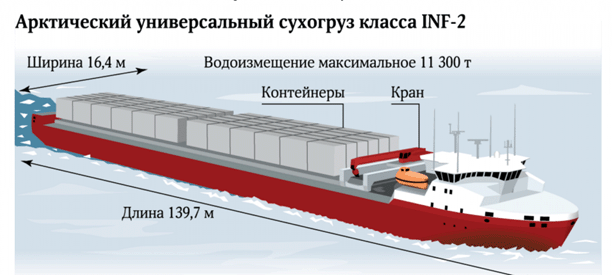
Construction starts in 2020 of the 140 meters long ice-classed vessel, approved for carrying irradiated nuclear fuel and High-Level radioactive waste, Izvestia reports.
Beneath the deck, it will be space for 40 to 70 special transport containers for spent nuclear fuel and the upper deck has space for containers with radioactive waste. The design, named INF-2, is made by Krylov State Research Centre in St. Petersburg, a design bureau that has Russia’s latest generation of nuclear powered icebreakers, submarines and warships on its list of merits.
In addition to sailing along the north coast of Siberia, the nuclear waste cargo vessel can make voyages up the Siberian Rivers like Ob and Yenisei, where several of Russia’s nuclear facilities are located, like the storage and planned reprocessing plant in Zheleznogorsk (former Krasnoyarsk-26).
Today, all transport of spent nuclear fuel from icebreakers, submarines and nuclear power plants from northwest Russia to the reprocessing plant in Mayak north of Chelyabinsk go by train through the most inhabited areas of Russia.
Where will the vessel sail?
Andrey Zolotkov, a nuclear expert and former head of the environmental group Bellona in Murmansk says the news that such cargo vessel will be built raises many questions.
«When stating that radioactive waste will be transported out of the Arctic and the Far East, where, interestingly will it then be taken?» asks Zolotkov. He does not immediately see an urgent need for transportation of spent nuclear fuel and radioactive waste, but agrees that transport to locations along the Siberian rivers could be an option.
«But, maybe they link this vessel to the plans for new floating and smaller nuclear power plants in the Arctic.»
Andrey Zolotkov, that earlier worked on board Atomflot’s service vessel «Imandra» says the icebreaker fleet will need a new service vessel as well in the future.
«Such vessel could very well replace «Imandra» for storage of spent nuclear fuel from icebreakers,» he says.
Floating nuclear power plant
Krylov State Research Centre says on its portal that one of the tasks for such vessel could be to transport the spent nuclear fuel from Bilibino nuclear heat power plant in Pevek on the Chukotka Peninsula. Bilibino is the world’s northernmost nuclear plant and shutdown procedure is likely to start in 2019. As a replacement, Russia’s first floating nuclear power plant, the «Akademik Lomonosov» will be placed in Pevek.
Another task for such new vessel, supposed to be operated in a consortium consisting of Rosatom and the military, could be to transport solid radioactive waste to a future repository. Location of such repository is yet to be decided; one option under consideration and approved by county authorities in Arkhangelsk is is the Arctic archipelago of Novaya Zemlya.
There are today stored tens of thousands of cubic meters of solid radioactive waste both on the Kola Peninsula, in Severodvinsk by the White Sea and at naval yards in the Far East.
On the Kola Peninsula, the Italian built vessel «Rossita» is later this year ready to start transport of containers with spent nuclear fuel out of the Andreeva Bay. The containers will be taken to Atomflot in Murmansk where they will be reloaded to railwagons for transport further to Mayak. «Rossita» is not suitable for voyages along the Northern Sea Route or into the river systems in Siberia.
Earlier, the Russian Northern Fleet had its own transport and storage vessels of the Malina-class (Project 2020) for spent nuclear fuel from submarines.
It was always a mistake, trying to turn nuclear bomb project into (costly) nuclear power
 Nuclear Power’s Original Mistake: Trying to Domesticate the Bomb, Bloomberg View, APRIL 8, 2017
Toshiba to dump UK Moorside nuclear project, in effort to stay afloat?
Toshiba considers sale of Moorside nuclear project in Cumbria as own survival in doubt in wake of £7bn losses http://www.telegraph.co.uk/business/2017/04/11/toshiba-questions-survival-warns-losses-could-hit-7bn/ 11 APRIL 2017
Toshiba is considering selling a stake in its nuclear project in Cumbria after warning it could struggle to remain in business as a result of expected annual losses of more than 1trn yen (£7bn).

The Japanese conglomerate, which makes everything from flash memory drives to laptops and semiconductors, admitted it is considering selling some or all of nuclear specialist NuGeneration to keep itself afloat.
NuGen currently owns 100pc of the Moorside site, after buying 40pc back from France’s Engie for $138.5m (£111m) earlier this month.That sale followed the Chapter 11 bankruptcy filing of Westinghouse, another Toshiba-owned company which is set to provide reactors for Moorside.
Asked what it would do with NuGeneration, a Toshiba spokesman said while no final decisions have been made “we would like to explore alternatives, including the sales of shares.”
He went on to explain that Toshiba is “carefully monitoring the situation in consultation with other stakeholders including the British Government.”Separately NuGeneration said it had been looking for investors prior to Westinghouse’s troubles and emphasised that the construction of Moorside was always going to be done by a third party.
But a spokesman acknowledged “there is no certainty” with regards to Westinghouse’s involvement in the development stage of the project.
Theoretically, Westinghouse’s AP1000 reactors, which have received regulatory approval, remain attached to the project but if a new investor were to come on board, it is unclear if different reactors may be proposed, potentially delaying the already behind schedule project yet further.
Samira Rudiga an energy fund manager at Guinness Asset Management, said the news was another nail in the coffin for the UK’s nuclear hopes.
“Nuclear does not make sense in the UK,” she said. “It takes 10 years to build and can take as long if not longer just to come to a decision to build a plant.”However, she expects the Government to still consider nuclear projects and thought there would be companies in Europe and Asia able to take on Toshiba’s stake in Moorside.
Greg Clark, the Business secretary, travelled to South Korea earlier this month in a bid to save the project, appealing to Korean nuclear giant Kepco to invest.
“For the reasons stated above, there are material events and conditions that raise the substantial doubt about the company’s ability to continue as a going concern,” Toshiba said.
At the end of 2016, the impending multi-billion-dollar write down triggered one of the worst-ever share fallsfor a major Japanese company, with ratings downgrades and investor pessimism erasing almost all of its 87pc rally so far that year. Toshiba delayed publication of its annual results twice prior to publication, and the company took the unusual step of publishing its accounts without sign-off from its auditor, PriceWaterhouseCoopers Aarata.
Toshiba said that while it had not yet fully determined the full cost of restructuring Westinghouse, its calculations suggested net income would fall by roughly 620bn yen.
Florida’s nuclear plans in doubt, as Toshiba corporation looks like crashing
 Toshiba casts doubt on ability to stay in business after nuclear power push falters, Tampa Bay Times, New York Times, April 11, 2017 Toshiba, a pillar of the modern Japanese economy whose roots stretch back to the country’s industrial stirrings in the 19th century, warned on Tuesday that a disastrous foray into nuclear power may have crippled its business beyond repair.
In a stock-market filing in Japan, Toshiba said losses associated with Westinghouse Electric, its troubled U.S. nuclear power subsidiary, had created “substantial uncertainty” over its ability to continue as a going concern. The declaration lifts the stakes as Toshiba seeks outside investors for its coveted microchip business, a portion of which it is selling off to raise cash and stave off disaster.
Westinghouse’s woes have a strong tie to Florida.
Plans for two reactors that were supposed to be built by Westinghouse in Levy County, north of the Tampa Bay market, were shelved in 2014 by owner Duke Energy after early construction delays and massive run-ups in the anticipated price tag that approached $25 billion to complete the nuclear power plants.
As approved by state legislators and regulators, Duke Energy is able to charge its Florida ratepayers for about $1.5 billion in early construction costs for the Levy plant even though it will probably never be built. Duke Energy spent just enough on the plant site to receive a federal license last fall to proceed with the Levy facility, though the odds of restarting its construction appear slim and will further fade in time.
Florida Power & Light, a giant utility which serves most of southern Florida, has also delayed its planned Westinghouse nuclear expansion at its Turkey Point site near Miami…
“We will do what we can to avoid being delisted from the stock exchange,” Satoshi Tsunakawa, Toshiba’s chief executive, said at a news conference after apologizing to shareholders for Toshiba’s latest worrying turn.
The company reported financial details for the quarter that ended in December after multiple delays and disputes with its auditors.
The financial problems are mounting.
The auditors have refused to certify Toshiba’s accounts — a highly unusual signal of doubt about the company’s ability to recover its financial health.http://www.tampabay.com/news/business/energy/toshiba-casts-doubt-on-ability-to-stay-in-business-after-nuclear-power/2319917
A warning to North Korea, from China, against conducting further nuclear weapons tests
Chinese tabloid warns N.Korea against test http://www.news.com.au/world/breaking-news/north-korea-warns-of-nuclear-strike/news-story/27dbacebb5390d5c95245bd82d538925 APRIL 12, 2017 North Korea should halt any plans for nuclear and missile activities “for its own security”, a Chinese newspaper says, warning that the US is making clear it doesn’t plan to “co-exist” with a nuclear-armed Pyongyang.
North Korean state media cautioned on Tuesday of a nuclear attack on the United States at any sign of American aggression, as a US Navy strike group steamed toward the western Pacific – a force US President Donald Trump described as an “armada”.
Trump, who has urged China to do more to rein in its impoverished ally and neighbour, said in a tweet that North Korea was “looking for trouble” and the United States would “solve the problem” with or without Beijing’s help.
The Korean Peninsula has not been so close to a “military clash” since North Korea conducted its first nuclear test in 2006, China’s influential state-run tabloid the Global Times said in an editorial.
“Not only Washington brimming with confidence and arrogance following the missile attacks on Syria, but Trump is also willing to be regarded as a man who honours his promises,” the paper, run by the ruling Communist Party’s official People’s Daily, said.
“The US is making up its mind to stop the North from conducting further nuclear tests. It doesn’t plan to co-exist with a nuclear-armed Pyongyang,” it said.
“Pyongyang should avoid making mistakes at this time.”
The Global Times, whose stance does not equate with Chinese government policy, said that Beijing would likely react strongly to any North Korean test.
“If the North makes another provocative move this month, the Chinese society will be willing to see the (UN Security Council) adopt severe restrictive measures that have never been seen before, such as restricting oil imports to the North,” the paper said.
Beijing has signed on to UN sanctions against North Korea, but it has repeatedly called for a return to dialogue to resolve the tensions.
A military parade is expected in Pyongyang to mark Saturday’s 105th anniversary of the birth of Kim Il-sung, North Korea’s founding father and grandfather of the current ruler. North Korea often marks important anniversaries with tests of its nuclear or missile capabilities.
South Africa’s new Finance Minister all set to rubber stamp nuclear build programme

 Rigorous review process needed for SA nuclear deal http://www.iol.co.za/news/opinion/rigorous-review-process-needed-for-sa-nuclear-deal-8625269 | 11 April 2017 New Finance Minister Malusi Gigaba has the rubber stamp of approval out that Pravin Gordhan kept locked away, writes Lauren Hermanus.
Toshiba warns that it might not survive its nuclear financial crisis
Toshiba warns over its survival as it forecasts £7bn losses Crisis creates concern about future of UK’s Moorside nuclear plant, in which subsidiary Westinghouse is a key player, Guardian, Angela Monaghan, 12 Apr 17, Toshiba, one of the biggest names in consumer electronics, has warned it is facing annual losses of more than £7bn and the future of the company is in doubt as a result of financial turmoil at its nuclear power plant construction business.
The Japanese company finally released third quarter results, after twice delaying publication while auditors attempted to quantify the scale of the problems at Toshiba’s US nuclear engineering subsidiary Westinghouse, which filed for bankruptcy last month.
Toshiba took the unusual decision to publish them on Tuesday without the approval of auditor PricewaterhouseCoopers Aarata. The company said PwC Aarata had been too uncertain about the financial impact of Westinghouse’s takeover of nuclear construction company CB&I Stone and Webster in 2015.
Westinghouse’s plight stems from a $6.1bn (£4.9bn) writedown because costs have overrun on the two plants CB&I is building in Georgia and South Carolina, the first new US nuclear power stations for decades.
The unaudited results showed Toshiba’s total losses widened by 53bn yen to 532bn yen (£3.9bn) in the nine months ending December 2016, adding that losses for the full year ending March could amount to more than 1tn yen (£7.3bn). It would be one of the biggest losses in Japanese corporate history.
Failure to file audited results fuelled speculation that the company could be forced out of the Tokyo Stock Exchange. Toshiba’s president, Satoshi Tsunakawa, called the auditor’s decision not to approve the figures “truly regrettable” and said he hoped the company would not be delisted.
The company’s escalating crisis also heightened fears about the future of Toshiba’s planned Moorside nuclear plant in Cumbria. Earlier this month it was forced to take full control of the venture behind the project, Nugen, after its previous partner, the French utility Engie, exercised the right to sell its 40% stakeunder an option triggered by Westinghouse’s bankruptcy filing.
Unite, Britain’s largest trade union, said it was fearful about what the latest developments at Toshiba would mean for the Moorside plant, and repeated its call on Greg Clark, the business and energy secretary, to intervene to safeguard the future of the project…….. https://www.theguardian.com/business/2017/apr/11/toshiba-losses-uk-moorside-nuclear-plant-westinghouse
Eskom says that South Africa has NOT signed any nuclear deal
 Eskom: SA has not signed nuclear deal http://northglennews.co.za/106808/eskom-sa-not-signed-nuclear-deal/ The power utility has not received any formal proposals from potential supplier SOUTH Africa has not signed any nuclear deal, Eskom recently said. Responding to last week’s media reports alleging that a nuclear deal has been signed, Eskom reiterated the remarks made by National Treasury that no deal has been signed.
“Eskom expects to issue a full Request for Proposal (RFP) to the open market once the Request for Information (RFI) has been assessed and the relevant approvals have been obtained,” said Eskom Chief Nuclear Officer, Dave Nicholls.
Nicholls said the power utility has not received any formal proposals from potential suppliers and has not signed any power plant procurement agreements.
“Eskom has not undertaken any pre-qualification assessment to date related to the potential respondents to a potential RFP,” he said.
South Africa plans to introduce 9 600 megawatts of nuclear energy to the grid in the next decade.
“The funding model of the project will be determined by the response received from the markets once bidders have responded to the RFP. This will also be done at a pace and scale that government can afford,” said the department.
Ohio Bill to subsidise nuclear power draws opponents and backers
 Generators, business groups line up against Ohio nuclear bill http://www.utilitydive.com/news/generators-business-groups-line-up-against-ohio-nuclear-bill/440178/ Peter Maloney
Dive Brief:
- provide financial support for FirstEnergy’s nuclear plants.
- Opponents include AARP, the Ohio Manufacturers’ Association, the Ohio branch of the American Petroleum Institute, the Alliance for Energy Choice, and the Electric Power Supply Association, a generator trade group. They say the subsidies would only serve to prop up FirstEnergy’s bottom line and oppose undue costs on consumers.
- Backers include the International Brotherhood of Electrical Worker Local 245 and FirstEnergy, who argue the plants are essential for the state’s economy and local tax bases.
- Dive Insight:
Measures to shore up nuclear power plants have been put in place in New York and Illinois and are under consideration in legislatures in Connecticut, Ohio and New Jersey.
And in all instances they have encountered resistance.
Non-nuclear generators say the measures in Illinois and New York will distort the economics of wholesale power markets. PJM Interconnection has also weighed in. In a March filling in federal court, PJM’s independent market monitor said Illinois zero emission credit (ZEC) would violate federal law.
A bill in Ohio, called a zero emission nuclear resource (ZEN) program, would provide emissions credits for FirstEnergy’s three nuclear plants.
- Sen. John Eklund (R), the bill’s sponsor, says the continued operation of those nuclear assets is “critical to the economic health of Ohio, and especially to the communities in which they are located.”
The IBEW takes a similar view, focusing on the livelihood of the 517 union workers at the plants, as well as the “thousands” of union contractors who depend on the plants.
But independent generators groups, such as EPSA, argue that bill would first and foremost improve the bottom line of FirstEnergy and distort price formation in organized markets.
The Ohio Manufacturers’ Association takes a similar line, arguing that the bill would allow FirstEnergy to prop up its business on the backs of Ohio consumers.” The group says it supports nuclear power as part of an all-of-the-above approach but calls the bill, SB 128, a “wolf in sheep’s clothing.”
AARP cites the opposition similar measures have attracted and calls them “scams” because they interfere with the working of wholesale energy markets.
The Federal Energy Regulatory Commission is due to address that market question in a technical conference at the beginning of next month focused on state generation subsidies.
South Africa: Beware the nuclear corporates and the governments who cosy up to them
Nuclear deals: Beware the corporates and the governments who cosy up to them https://mg.co.za/article/2017-04-11-nuclear-deals-beware-the-corporates-and-the- governments-who-cosy-up-to-them
My view was (and remains) that we must not let President Jacob Zuma get away with the unaffordable R1-trillion deal he wants with Russia, which lacks transparent conduct and includes the possibility of backhanders. Being told of government and corporate lies in Japan and South Korea was an eye-opener. The 2011 Fukushima disaster was triggered by a tsunami or earthquake. But that tells only half the story.
Contaminated food, children’s sandpits, water
My journey started with a visit to a parish church in Iyaki Laiki, 47km from the epicentre of the 2011 accident. The parish had opened its doors to people evacuated from the centre of the disaster. In all 24 000 people were evacuated, not because of the huge wave of seawater, but because of the high levels of radioactivity. Even here at this distance, radioactivity remains, six years after the accident, unacceptably high. In the local crèche children may not play outside because radioactivity of the playground sand, the swings and jungle gym remains dangerously high. Instead children play inside a pen with sand imported from hundreds of kilometres away.
Government radioactivity meters on street corners measure lower levels of radioactivity than locals’ meters. There is a reason for this: it costs the government millions to provide essential services to those evacuated. The government wanted them to return to their homes in Fukushima by April 1 2017, when all support and aid stops. The government says it is safe to do so but the people I met do not trust its advice. In what was the church vestry there are now two detector cubicles that measure and decontaminate food. Consumers have learnt that food they buy is often contaminated with high levels radioactivity. It takes an hour to decontaminate a litre of milk and three to four hours for water.
In Iyaki Laiki contamination levels vary from 1 to 2 on private meters. Everyone has one. In Tokyo, the government says 0.06 is acceptable. In the world we live in we consider 0.01 acceptable. High incidences of cancer and deformities in newborn babies have placed a blanket of trauma over everyone I met.
Next we drove into the moon landscape that once was Fukushima. In our bus we had five different measuring devices. As we got closer to where the nuclear plant ruptured, the devices started ticking faster and faster, starting at .09 but soon crossing the 2.0 mark, then 3.0 and then off the scale. We were in danger if we stayed.
Deadly Fukushima
Police and government officials in astronaut-like protective clothing stop people from entering houses or streets where contamination remains very high. The houses were left in haste and nothing could be taken because of it oozing radioactivity. Abandoned cars in driveways are covered in dust and have flat tyres. Earthmoving machines are scraping away the topsoil of former rice-paddy fields, bagging the soil and disposing of it. I asked, where to? Well, whoever in the world offers to put it deep into the Earth’s crust – to be forgotten about.
Wherever you stop a tannoy voice warns you not to leave the road and to move on. It is eerie to see fields devoid of animal life or crops. No birds.
For as long as the rupture of the Fukushima plant can be blamed on the tsunami and an earthquake the Japanese government and its associated Tokyo Electricity Company (or rather the taxpayer) pay for rehabilitation and the loss to life and limb Direct and indirect fatalities from the disaster numbers 1 600 people; the health damage to the survivors cannot yet be estimated.
The company that built the Fukushima plant, Toshiba/Hitachi, avoids responsibility. It is here that I learnt my first lesson: Toshiba, which built scores of nuclear plants in Japan and elsewhere, ignored major risks to save costs. Legal investigations point to Toshiba’s liability. Angry Japanese charge that Toshiba places profit before the lives of people — and its effect will be felt by those not yet born. In a nation that has suffered more than its share of nuclear outfall, I heard the words repeatedly: the government-corporate nuclear mafia cannot be trusted; we don’t want compensation, we want prevention.
Back at the parish church the reverend asks that we don’t publicise his name and church for fear of reprisals from those in power. His parting comment: for every child elsewhere that has thyroid cancer we have 180 children.
The message from my hosts is moral and compelling: Toshiba, supplier globally to the booming nuclear energy industry, must stop exporting its lethal technology. Their call is to boycott, disinvest and call for sanctions against this evil industry. Between Japan, South Korea and the coast of China about 130 nuclear plants are in operation or are under construction. There are 90 in Western Europe and 104 in the United States.
South Korea’s pain
In Kori, South Korea, is another nuclear plant, partly shut down because of its age. The real danger of the plant is kept from them. We met Mr Lee and his disabled son. Mr Lee has stomach cancer. His wife contracted thyroid cancer two years ago. They charged the local nuclear plant company for her illness. The court found in her favour on the basis that the company hid the fact that radioactive material had leaked from the plant. Since the court victory 1 000 locals have instituted legal action because their health has been similarly compromised.
Mr Lee continues to run his small business but illness and grief stands written all over his face.
Mrs Yoshi Zaki Sachie, 77, is a Hiroshima survivor. As a five-year-old all she remembers is the huge light when the bomb was dropped. Her family’s distance from the epicentre of the bomb ensured it did not kill her. It maimed her.
Mrs Sachie She has devoted her life to campaign against the lethal power of nuclear plants. She never thought that nuclear power would haunt Japan again. Today the Japanese are perpetrators seeking to sell unsafe nuclear technology to others.
Racism against Koreans is not far from this debate either. When Hiroshima and Nagasaki was bombed, Korea was a colony of Japan. Of those killed, at least 22 000 were Koreans, partly forced labour, in Japanese armaments factories. They have not been acknowledged or compensated. Social prejudice persists to this day.
Koreans not killed but maimed at Hiroshima and Nagasaki returned, mainly, to Hapcheon in South Korea. At the memorial and victim care centre, I saw first, second and third generation victims – their bodies and minds impaired by nuclear venom.
South Korean citizenry is as opposed to nuclear plants as the Japanese are. Koreans want recognition and compensation for their A-bomb victims from the United States.
Taiwan has decided against new nuclear plants while Vietnam cites financial woes to keep out of the Japanese, South Korean and Russian clutches. In Thailand, the Philippines and Indonesia popular sentiment opposes nuclear plants in the face of their governments buckling under corporate pressure.
South Koreans have a special concern: they worry that nuclear plants are the Trojan horse through which a new nuclear arms race will ensue. The US has induced the South Korean government to allow American bases to be built with nuclear warheads aimed at North Korea and potentially at China.
A moral revolution against governments in cahoots with the mega corporations is on the move — the Japanese and Korean Citizen’s Peace Solidarity Against Nukes. South Africa needs to join the global wave of popular uprising and stop the Zuma-Putin deal.
Horst Kleinschmidt’s visit was at the invitation of the movement against corporations in the nuclear industry in South Korea and Japan. Kleinschmidt is an activist. He was arrested and then went into exile in the 1970s, returning post-1994 to turn around the sea fisheries department. Besides opposing the Zuma-Putin deal, he does other ecological and social justice work.
Nuclear Plant Vogtle – a victim to Westinghouse bankrupty
 Nuclear boondoggle http://www.connectsavannah.com/savannah/nuclear-boondoggle/Content?oid=4465661 Westinghouse bankrupty adds yet another setback to the already-problematic Plant Vogtle expansionBy Jim Morekisjim@connectsavannah.com@jimmorekis A PAIR of new nuclear reactors at Georgia Power’s Plant Vogtle, about an hour north/northwest of us on the Savannah River, were supposed to be up and running two weeks ago and sending electricity to the regional grid.
Instead, the project is still less than 40 percent complete.
Originally budgeted at about $14 billion, the expansion at Plant Vogtle is now by some estimations least $6 billion over budget and counting, with no real end in sight.
That much we already knew. But the big news last month was that the manufacturer of the reactor units themselves, Toshiba-owned Westinghouse, has put its North American operations into Chapter 11 bankruptcy.
That’s right — the company making nuclear reactors upstream of us is going bankrupt. Sweet dreams!
None of this stopped the chief executive of Georgia Power’s parent firm, Southern Company, from getting a 34 percent pay raise last week. Thomas A. Fanning is now up to $15.8 million a year.
In the meantime, since 2011 almost ten percent of your monthly power bill goes not just to pay for the Vogtle expansion, but to pay for the financing costs. That’s thanks to special legislation, the Nuclear Financing Act, passed by the state legislature and then-Gov. Sonny Perdue in 2009.
See the line on your bill that says, “Nuclear Construction Cost Recovery?” That’s what you’ve been paying to finance the Vogtle expansion in advance.
(It comes to 9.7 percent of your billed kilowatt usage, not your whole monthly charge. In South Carolina they’ve got it even worse — a planned expansion of the V.C. Summer plant north of Columbia is costing each SCE&G customer more than double what we pay each month, and they don’t even get an itemized bill.)
The Nuclear Financing Act essentially stripped rate increase oversight of this project from elected regulators at the Public Service Commission (PSC). And customers are relieving Georgia Power of virtually all financial risk of its $6.1 billion share of the project cost, including interest on borrowed funds.
It’s quite a sweetheart deal for the subsidiary of Atlanta-based Southern Co., the nation’s second-largest utility.
It gets sweeter: As we reported back in 2010, the legislation has no cap for cost overruns, and doesn’t even have a way to refund customers if the project doesn’t even get completed at all.
What the hell is going on? Sadly, not much that wasn’t predicted over ten years ago when all this began.
“Most all the concerns previously brought to the Public Service Commission are now playing out in real time,” says Stephen Smith, executive director of Southern Alliance for Clean Energy (SACE). “The utilities have totally lost credibility and now we need regulators to do their jobs.”
In 2006, Southern Co. began seeking approval to double the number of reactors at Plant Vogtle. (The first duo, Units 1 and 2, was online by the late ‘80s.)
It was to be the first expansion of nuclear energy since the Three Mile Island nuclear disaster in 1979.
By 2009 the expansion plan had received approval from the PSC. If completed, the Vogtle expansion would make it the largest nuclear plant in the United States.
In 2012 — just a year after the nuclear disaster at Fukushima, Japan — the federal Nuclear Regulatory Council approved the planned use of two Westinghouse AP1000 reactors, a design the parent company says has greater safety parameters than the General Electric reactors at Fukushima.
As of this writing, not a single AP1000 has gone online yet; the first is set to go live at a Chinese plant later this year.
Project and reactor construction delays, and Westinghouse’s financial woes, are slowing new projects in China as well.
Since the Vogtle expansion was approved, the project has experienced one setback after another, all of them underwritten by Georgia Power customers, and almost all of them predicted by environmental watchdogs and media outlets such as this one.
In a grimly symbolic incident, in 2012 a reactor vessel set to contain one of the AP1000s literally fell off a train on the way to Burke County.
News of the accident, which involved no radioactive materials, didn’t reach the public until about a month later.
“Once again PSC staff time after time predicted delays well in advance of Southern Company admitting to them,” says Sara Barczak, High Risk Energy Choices Program Director for SACE.
“Once again there are revised commercial operation dates that represent another delay in the project.”
Originally, Unit 3 was supposed to be online April 2016. Then it was moved to July 2019. Completion for Unit 3 is now estimated to be Dec. 2019. Unit 4 was supposed to be online April 1, 2017. Then it was moved to July 2019. Completion for Unit 4 is now estimated to be to Dec. 2019.
The extreme delay, combined with a complicated pending litigation issue, prompted a new settlement agreement in the closing days of 2016, to reflect the new economic reality of the ballooning financing cost to ratepayers.
“There’s been a slight change in the financing situation because of the settlement reached at the end of the year,” explains Barczak.
“Interest is still going to be collected. But once the certified capital cost is reached, instead of being collected in advance it will go into a different type of accounting process,” she says.
“But customers will still be paying for financing costs far longer than expected, and ultimately will pay far more.”
Because of the huge delay, “Financing costs ended up representing the largest cost increases,” says Barczak.
“It’s like the longer you have a credit card not paid off, the higher the interest is. The interest ends up being what kills you.”
That’s why Barczak and other environmental watchdogs are frustrated with the settlement.
“Ratepayers are just going to pay for financing longer,” she says. “Because by 2017 both reactors were supposed to be operating by now, that advance payment will not be collected. There are no capital costs in the legislation.”
The 2016 settlement now targets a completed project date of Dec. 31 2020, but few observers have much trust in that target.
“This represents a 45-month delay. PSC public interest advocacy staff testified that even using a 45 month delay date, it was unlikely the new completion date can be achieved. It would require a threefold increase in productivity,” Barczak says.
“This forces customers to continue to pay for a facility where the utility cannot accurately predict the cost, and when or even if the facility will be completed, adds Stephen Smith of SACE.
Georgia Power originally said the financing plan would save customers over $300 million in the long run. But that was based on the original, now-obsolete timeline. Any savings realized are now more than outweighed by the cost overrun.
The Westinghouse bankruptcy adds yet another, and potentially very serious, layer of uncertainty to an already very uncertain project.
“Toshiba purchased Westinghouse in 2005-2006. They had developed a reactor design that most facilities across the country decided to go with,” Barczak explains.
“What panned out just recently is that Toshiba started losing big on these projects. They lost $6.3 billion on two projects combined,” she says.
“This bankruptcy has created a worst case scenario for electric power customers in Georgia and South Carolina. There are more questions than answers at this point,” says Smith.
“We see no path forward without some additional financial pain for customers.”
The bankruptcy is particularly tricky, says Tom Clements, executive director of SRS Watch.
“The loan guarantees for the Vogtle expansion run through Southern Co., not Westinghouse. Southern is not directly related to the bankruptcy,” says Clements.
“Once the bankruptcy court starts shifting costs around, you can’t predict what will happen,” he says.
Adding a twist is the fact that most of Westinghouse’s overseas operations aren’t included in the bankruptcy proceeding — raising suspicions that they are looking for a way to back out of the Vogtle deal.
“It’s pretty clear from their filings that they’re looking to us to take over this project,” said SCANA CEO Kevin Marsh, whose company is also contracting with Westinghouse for AP1000 reactors.
All of this is a far cry from the so-called “Nuclear Renaissance” at the turn of the 21st Century, when advances in technology were supposed to relieve the world of what at the time were high fossil fuel costs and an assumption of severe future scarcity.
With the Energy Policy Act of 2005 — a Bush-era initiative enthusiastically endorsed and enhanced during the Obama administration through generous loan guarantees — the future of U.S. energy looked to be a heavily nuclear one.
“After the Energy Policy Act of 2005 passed, over 30 new reactors were proposed, more than half in the Southeast,” Barczak says.
Then came the great recession of 2008, followed by a little thing called fracking.
Seemingly all of a sudden, the fossil fuel industry experienced a huge boom, both financially and in projected availability.
“We’ve seen the demise of the so-called nuclear renaissance,” says Barczak. “A lot of license applications for new nuclear plants were withdrawn.”
But not at Plant Vogtle.
At the time, the Congressional Budget Office was prophetic in its assessment of the state of the nuclear industry.
“If construction costs for new nuclear power plants proved to be as high as the average cost of nuclear plants built in the 1970s and 1980s or if natural gas prices fell back to the levels seen in the 1990s, then new nuclear capacity would not be competitive, regardless of the incentives provided by Energy Policy Act,” said a CBO report from 2008.
“Every single thing we said might happen did happen,” says Barczak. “Then Fukushima happened.”
The tsunami-induced failure of a reactor at the Fukushima Daichi plant, a disaster of such scope that its impacts aren’t fully measured six years later, wasn’t even a speed bump for the Vogtle expansion.
“We are committed to the project and completing the units on schedule and on budget,” said Southern Nuclear Co. spokesperson Beth Thomas at the time. “We’re certainly monitoring the events in Japan and our thoughts and prayers are with the people there.”
A lot of this momentum, Barczak says, it due to the unique situation of a utility building nuclear power plants with all the regulatory burden on the government, and most of the financial risk on ratepayers.
The Southeast, she says, “is in a weird situation in that we’re a regulated market but very weak on consumer protections. States like Georgia, Florida, and South Carolina all had legislators passing legislation to put extra burdens on consumers.”
The nuclear power industry, Barczak says, “isn’t exactly what you’d call a nimble industry. It can’t react to changes that sometimes happen very quickly. It’s based on the old model of, ‘OK you’re gonna have more people, so build a bigger power plant,’” she says.
“For the Southeast, if the coal paradigm seems to be going by the wayside, then we’re still in the nuclear paradigm.”
Noboby knows what happens next, though all eyes are on the bankruptcy court. With the precedent set for ratepayers to stay on the hook regardless of how much sunk cost is going into the Vogtle expansion, there is vanishing hope of a win/win solution for ratepayers.
Donald Trump the laughing stock of environmental protection staff
30-year veteran compares EPA chief’s climate denial to lies tobacco executives told Congress Mike Cox retired after three decades at the Environmental Protection Agency on March 31 with a scathing letter for EPA administrator Scott Pruitt.
Team Trump is apparently an open joke to their staff — something even the Reagan and Bush administrations never experienced. Morale has collapsed, Cox notes.
“I have worked under six administrations with political appointees leading EPA from both parties,” Cox wrote on his last day on the job. “This is the first time I remember staff openly dismissing and mocking the environmental policies of an administration and by extension you.”
The 60-year-old Cox, who worked on climate change for EPA’s Region 10, which covers Alaska and the northwest, was especially harsh on Pruitt’s science denial.
Cox called Pruitt’s claim on national TV that CO2 is not a primary contributor to recent global warming “shocking” — and directly compared it to the congressional hearing with the CEOs of the major tobacco companies where “all of the CEOs categorically denied that smoking causes lung cancer.”
What’s the result of this denial? “You will continue to undermine your credibility and integrity with EPA staff, and the majority of the public,” Cox wrote, “if you continue to question this basic science of climate change.”
In the five-page letter, Cox slams the president for the “false and misleading” claim that killing EPA carbon pollution standards will bring back coal jobs.
In a section on “indefensible budget cuts,” Cox slams Pruitt for standing by while the White House gutted the overall EPA budget. These cuts have real consequences for real people, he says.
Cox directly asks Pruitt:
- Why resources for Alaska Native Villages are being reduced when they are presented with some of the most difficult conditions in the country;
- why you would eliminate funds for the protection and restoration of the Puget Sound ecosystem which provides thousands of jobs and revenue for Washington State; and
- why you would reduce funds for a program that retrofits school buses to reduce diesel emission exhaust inhaled by our most vulnerable population — children.
The entire letter from Cox is a must read for anyone who cares about clean air, clean water, and our children’s future.
1 This Month

of the week – Shut Down Drone Warfare!


Tell the Ukrainian Government to Drop Prosecution of Peace Activist Yurii Sheliazhenko

Petition to revoke the licensing of the Near Surface Nuclear Disposal Facility (NSDF) at Chalk River. https://www.ourcommons.ca/petitions/en/Petition/Details?Petition=e-7247
To see nuclear-related stories in greater depth and intensity – go to https://nuclearinformation.wordpress.com
-
Archives
- March 2026 (230)
- February 2026 (268)
- January 2026 (308)
- December 2025 (358)
- November 2025 (359)
- October 2025 (376)
- September 2025 (257)
- August 2025 (319)
- July 2025 (230)
- June 2025 (348)
- May 2025 (261)
- April 2025 (305)
-
Categories
- 1
- 1 NUCLEAR ISSUES
- business and costs
- climate change
- culture and arts
- ENERGY
- environment
- health
- history
- indigenous issues
- Legal
- marketing of nuclear
- media
- opposition to nuclear
- PERSONAL STORIES
- politics
- politics international
- Religion and ethics
- safety
- secrets,lies and civil liberties
- spinbuster
- technology
- Uranium
- wastes
- weapons and war
- Women
- 2 WORLD
- ACTION
- AFRICA
- Atrocities
- AUSTRALIA
- Christina's notes
- Christina's themes
- culture and arts
- Events
- Fuk 2022
- Fuk 2023
- Fukushima 2017
- Fukushima 2018
- fukushima 2019
- Fukushima 2020
- Fukushima 2021
- general
- global warming
- Humour (God we need it)
- Nuclear
- RARE EARTHS
- Reference
- resources – print
- Resources -audiovicual
- Weekly Newsletter
- World
- World Nuclear
- YouTube
-
RSS
Entries RSS
Comments RSS
 nuclear-news