
 Almost Everyone Agrees that the U.S. Strikes Against Syria are Illegal, Except for Most Governments, Opinio Juris, 9 Apr 17, by Julian Ku The blogosphere is now so fast that we can get an enormous sampling of expert opinion in a very short time. So within 24 hours of President Trump’s military strikes on Syria, we have already heard from former Bush State Department Legal Advisor John Bellinger, former Obama State Department Legal Advisors Harold Koh and Brian Egan, former DOJ officials and law profs Jack Goldsmith and Ryan Goodman, as well as numerous law profs and other experts including our very own Deborah Pearlstein and Edward Swaine. The bottom line: Almost everyone (except for Harold Koh) thinks the strikes violate the U.N. Charter and many think it also violates the U.S. Constitution.
Most of what I have to say I said in 2012-13 on this issue, but I am struck by one group of important actors who seem relatively untroubled by the “illegality” of the U.S. strikes under the UN Charter: states. With the notable exception of the Russian government, very few states have come out to criticize the U.S. strikes as a violation of international law. No one is saying it is illegal, but it is striking how few are willing to say it is illegal. I’ve gathered a few statements and links below.
China’s Ministry of Foreign Affairs:……….
France and Germany (President and Chancellor):…….
United Kingdom Defence Minister:…….
European Union, President of European Council:….
Turkey, Deputy Foreign Minister:……
Japan, Prime Minister……
This survey is not comprehensive and some large players, like India, have yet to weigh in. But it seems only Russia and Iran have condemned the strikes vigorously. The general support for the attacks in Europe, the Middle East, along withChina’s acquiescence, seems to show that many states are not very troubled by the violation of Article 2(4) most scholars think has occurred here. Is this because it is a one-off attack? Or does it suggest Article 2(4) has very little pull with many foreign governments these days?
On the domestic US law front, FiveThirtyEight has counted 69 senators have already issued statements supporting the Syria Strikes and while there are critics on constitutional grounds, it doesn’t seem like close to a majority in Congress.
Of course, none of this means that the experts are wrong on the law. But it is at least worth noting the limited impact of the law so far on governmental actors, as the debate on the legality of the Syria Strikes continues. http://opiniojuris.org/2017/04/07/almost-everyone-agrees-that-the-u-s-strikes-against-syria-are-illegal-under-international-law-except-for-most-governments/
April 10, 2017
Posted by Christina Macpherson |
Legal, USA |
Leave a comment
As noted by the Palmer Report, Trump owns stock in Raytheon, which was reported by Business Insider in 2015.
According to Trump’s financial disclosure reports filed with the FEC in 2015, his stock portfolio includes investments in technology firms, financial institutions and defense firms, including Raytheon.
On Thursday, Trump launched an attack on the al-Shayrat military airfield, used by both Syrian and Russian military forces, hitting it with 59 Tomahawk missiles manufactured by Raytheon. Trump’s attack on Syria was reportedly in response to a deadly gas attack launched by Syrian President Bashar al-Assad against his own people earlier in the week.
While the Tomahawk attack did little damage to the airfield — with the Syrian air force continuing to launch assaults from the same base on Friday — investors, sensing an increasing escalation in tensions between two countries and the possibility of war , pushed Raytheon stock up.
Since taking office, Trump has refused to divulge all of his financial information — including his income taxes — and refused to place his business and financial holdings in a blind trust allowing Trump and his family to move money and investments around as they see fit.
April 10, 2017
Posted by Christina Macpherson |
business and costs, politics, secrets,lies and civil liberties, USA |
Leave a comment
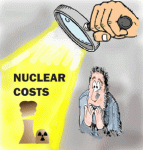
 ‘R1 trillion nuclear deal will guarantee SA junk status’ http://www.iol.co.za/news/politics/r1-trillion-nuclear-deal-will-guarantee-sa-junk-status-8565844 9 April 2017 ANA Reporter Cape Town
 – It is an undeniable fact that South Africa cannot afford, and does not need, government’s planned nuclear energy deal, the Democratic Alliance said on Sunday.
Media reports on Sunday that the nuclear deal was going full-steam ahead were extremely concerning and would essentially guarantee that South Africa would be downgraded by more ratings agencies and make recovering from this status even more difficult, DA spokeswoman Natasha Mazzone said.
Fitch Ratings stated in no uncertain terms on Friday that a key driver behind the decision to downgrade SA’s long-term foreign currency debt and long-term local currency debt to “BB+”, or “junk status”, was that “Eskom has already issued a request for information for nuclear suppliers and is expected to issue a request for proposals for nuclear power stations later this year.
The Treasury under its previous leadership had said that Eskom could not absorb the nuclear programme with its current approved guarantees, so the Treasury will likely have to substantially increase guarantees to Eskom”.
Just days before, S&P Global also downgraded South Africa to sub-investment level – “junk status”. Mazzone said the DA would ask public enterprises portfolio committee chairwoman Dipuo Letsatsi-Dub for an urgent meeting of the committee to ensure that Parliament, as a key oversight body, would fully interrogate all aspects related to the nuclear deal.
“The undeniable fact is that South Africa cannot afford, and does not need, the nuclear deal. Indeed, international ratings agencies agree and this deal has been repeatedly cited as a cause for great concern and a key factor in downgrades not only for Eskom, but the country as a whole.
“These downgrades have already and will continue to have a devastating effect on our economy. Jobs will be lost and the cost of living will increase, which will hurt the poor,” Mazzone said.
Earlier on Sunday, City Press reported that a confidential document reveals that South Africa’s nuclear-build programme kicks off in earnest in June when Eskom issues a formal request for proposals from companies bidding for the estimated R1 trillion contract.
The nuclear deal – for which Russian company Rosatom was widely considered to be the front runner – was, according to senior National Treasury officials, “directly related” to President Jacob Zuma’s axing of finance minister Pravin Gordhan and his deputy Mcebisi Jonas, the newspaper reported.
“It is well known that Gordhan was against the project as he said the country couldn’t afford it.Eskom will be issuing a request for proposals in June and that really is the beginning of procurement. Gordhan had to go because he was going to block it again,” a senior official reportedly said.
The internal Eskom document dated three days before Gordhan and Jonas were axed revealed a tight timeline for the programme that would see four plants built to provide 9600 megawatts of electricity to the country.
After the request for proposals was issued in June, the deadline for bids was September, for evaluation in December. The winning bidder would be decided in March 2018 and the contract signed between December next year and March 2019, City Press reported.
The document also revealed that most of the major nuclear contracts would be implemented through “turnkey” procurement, which Treasury officials were concerned about.
“While Treasury allows for turnkey procurement, we know that it is often used to hide corruption. Companies that are asked to deliver turnkey projects are accountable to themselves. They appoint whoever they like, however they like,” a senior official reportedly said.
Turnkey projects were when a single company was appointed to manage and deliver an entire project. The management company became responsible for appointing all contractors and service providers. This was different from an open tender that was spread over a range of different contractors appointed by the state, City Press reported.
April 10, 2017
Posted by Christina Macpherson |
business and costs, politics, South Africa |
Leave a comment
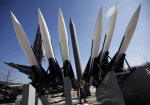
 Trump’s Options for North Korea Include Placing Nukes in South Korea, NBC News 7 Apr 17 by WILLIAM M. ARKIN, CYNTHIA MCFADDEN, KEVIN MONAHAN and ROBERT WINDREM
 The National Security Council has presented President Donald Trump with options to respond to
North Korea’s nuclear program — including putting American nukes in South Korea or killing dictator Kim Jong-un, multiple top-ranking intelligence and military officials told NBC News.
Both scenarios are part of an accelerated review of North Korea policy prepared in advance of Trump’s meeting with Chinese President Xi Jinping this week.
The White House hopes the Chinese will do more to influence Pyongyang through diplomacy and enhanced sanctions. But if that fails, and North Korea continues its development of nuclear weapons, there are other options on the table that would significantly alter U.S. policy.
The first and most controversial course of action under consideration is placing U.S. nuclear weapons in South Korea. The U.S. withdrew all nuclear weapons from South Korea 25 years ago. Bringing back bombs — likely to Osan Air Base, less than 50 miles south of the capital of Seoul — would mark the first overseas nuclear deployment since the end of the Cold War, an unquestionably provocative move.
“We have 20 years of diplomacy and sanctions under our belt that has failed to stop the North Korean program,” one senior intelligence official involved in the review told NBC News. “I’m not advocating pre-emptive war, nor do I think that the deployment of nuclear weapons buys more for us than it costs,” but he stressed that the U.S. was dealing with a “war today” situation. He doubted that Chinese and American interests coincided closely enough to find a diplomatic solution………http://www.nbcnews.com/news/us-news/trump-s-options-north-korea-include-placing-nukes-south-korea-n743571
April 10, 2017
Posted by Christina Macpherson |
politics international, South Korea, USA, weapons and war |
Leave a comment
 North Korea says US air strikes on Syria vindicates decision to develop nuclear weapons, ABC News 9 Apr 17 North Korea has said US missile strikes against a Syrian airfield were “an unforgivable act of aggression” that showed its decision to develop nuclear weapons was “the right choice a million times over”.
Key points:
- North Korea says US strikes vindicates decision to strengthen its military power
- Kim Jong-un has exchanged pledges of friendship and cooperation with Bashar al-Assad
- Mr Trump earlier spoke of an “outstanding” relationship with North Korea’s ally China
The response by North Korea’s foreign ministry, carried by the official KCNA news agency, was the first since US warships launched dozens of missiles at a Syrian air base which the Pentagon says was involved in a chemical weapons attack earlier in the week.
“The US missile attack against Syria is a clear and unforgivable act of aggression against a sovereign state and we strongly condemn this,” KCNA quoted an unnamed spokesman for the North Korean foreign ministry as saying……….http://www.abc.net.au/news/2017-04-09/north-korea-calls-us-syria-air-strikes-unforgivable/8428398
April 10, 2017
Posted by Christina Macpherson |
North Korea, politics international, weapons and war |
Leave a comment
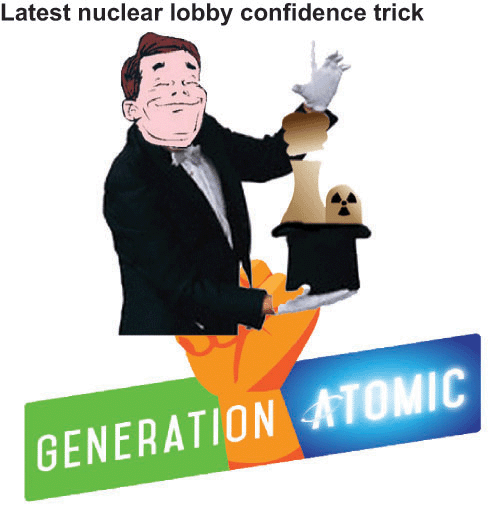
 Nuclear proponents, especially those for “New Nuclear” e.g Small Modular Nuclear Reactors, and Thorium Nuclear Reactors, have set up a new campaign – called “Generation Atomic”. This campaign especially targets young people.
Their sophisticated campaign argues that nuclear power is necessary to combat climate change. they pretend to support renewable energy, but subtly downgrade it.
They argue that ionising radiation is not so bad, perhaps even beneficial.
They depict anti nuclear people as a”anti science”. Nuclear advocates often claim that anti nuclear people are “anti everything” – anti medicine, anti vaccination etc.
April 10, 2017
Posted by Christina Macpherson |
Uncategorized |
Leave a comment
 The Fights to Protect Science, People and Planet Are Inherently Connected, Here’s how the Peoples Climate March and March for Science are working together, and how you can plug into both
,
April 06, 2017 by Common Dreams, by Lucky Tran, Jamie Henn,
The election of Donald Trump has sparked an unprecedented outpouring of public mobilization across the United States and around the world. From the Women’s March to rallies against the Muslim Ban, people are demonstrating creative and powerful ways to take action, in Washington, D.C. and beyond, to resist Trump and fight for the world they want.
This April, two powerful mobilizations will take place in D.C. and around the world, one to stand up for science and truth, the next to defend our climate, jobs, and justice. Together, the
March for Science and the
Peoples Climate March provide a powerful way for all of us to take action—together……..
The March for Science is dedicated to science and truth in all its forms: from combatting climate change, to curing diseases, to protecting our air and water. This powerful uprising of 400 (and counting) marches will demand evidence-based decision making from our politicians and unite local communities behind the importance of science.
Then, a week later, values represented by the March for Science will manifest in the Peoples Climate March. Because the Trump administration’s reckless affronts to truth, none is clearer and more dangerous than its attacks on climate science at the service of fossil fuel interests. The Peoples Climate March will call for bold solutions to address the climate crisis, action that doesn’t just protect our environment, but also creates and retains jobs, and delivers social justice for all. In contrast to Trump’s divisive, fossil fuel based economy, the Peoples Climate March will put forward a bold vision of a clean energy economy that works for all.
In some towns and cities, organizers will combine the two events. That’s great. Both mobilizations are intentionally open-source and encourage collaboration (and even combination) at the local level.
During the week between the two marches, many different organizations, networks, and individuals are putting on other events, film screenings, announcements, and more.
April 10, 2017
Posted by Christina Macpherson |
ACTION |
Leave a comment
Donald Trump’s decision to launch airstrikes on a Syrian airfield was hailed by many corporate media and foreign policy establishment types, but in addition to the myriad questions surrounding the motivation and constitutionality of Trump’s unilateral action, the ineffectiveness of the strike is becoming the story. According to multiple reports, flights from the airbase resumed on Friday, a day after the strikes.
Trump, true to form, wore that insecurity on his sleeve, and his Twitter feed:….
Democratic Congressman Ted Lieu (D-CA) pointed out that the strikes did “basically nothing” to prevent Assad from launching attacks on civilians. Lieu is part of a growing number of lawmakers on both sides of the aisle who are questioning the efficacy of the Syria strikes, including one of the most vocal boosters of Trump’s decision, Sen. John McCain (R-AZ).
The criticism sparked an absurd response from current Trump National Security Advisor H.R. McMaster, who was pressed by Fox News Sunday host Chris Wallace over the fact that the airbase resumed operations so quickly:……..
Trump has definitely sent a lot of messages with this strike, including to the Russians prior to the strike, to Congress by not seeking their authorization, and to the corporate media by getting them to look away from the Russia collusion investigation. The faintest of these was to Assad, who scarcely has any more incentive to cease his brutality than he did last week. http://shareblue.com/trump-team-on-the-defensive-amid-dem-criticism-of-syria-strikes/
April 10, 2017
Posted by Christina Macpherson |
politics, USA |
Leave a comment
 Nuclear plant owners expand search for financial rescue, http://www.pennlive.com/news/2017/04/nuclear_plant_owners_expand_se.html By Marc Levy | The Associated Press April 09, 2017 HARRISBURG, Pa. (AP) — The natural gas boom that has hammered coal mines and driven down utility bills is hitting nuclear power plants, sending multi-billion-dollar energy companies in search of a financial rescue in states where competitive electricity markets have compounded the effect.
Fresh off victories in Illinois and New York, the nuclear power industry is now pressing lawmakers in Connecticut, New Jersey, Ohio and Pennsylvania for action. Lobbying efforts are bubbling up into proposals, even as court battles in Illinois and New York crank up over the billions of dollars that ratepayers will otherwise foot in the coming decade to keep nuclear plants open longer.
Perhaps nuclear power’s biggest nemesis is the cheap natural gas flooding the market from the northeast’s Marcellus Shale reservoir, the nation’s most prolific gas field. Meanwhile, electricity consumption hit a wall after the recession, while states have emphasized renewable energies and efficiency.
“You put all of this together and it’s a perfect storm,” said John Keeley, a spokesman for the Nuclear Energy Institute, an industry group.
Opposition to a so-called nuclear bailout is uniting rivals and the natural gas exploration industry. The potential for a hit to utility bills is drawing pushback from the AARP and manufacturers.
Subsidizing nuclear power could chill investment in lower-cost energy sources and erode competitive markets, critics say, and, with natural gas prices expected to stay low for some time, shutting down nuclear plants may have no impact on electricity bills.
For steel companies, paper companies, food processors and pharmaceutical makers whose electric bill might be their biggest expense, “a mil of an increase in a kilowatt hour turns into a lot of money,” said David Kleppinger of the Industrial Energy Consumers of Pennsylvania.
In Pennsylvania, the nation’s No. 2 nuclear power state after Illinois, it could mean propping up five nuclear plants to help feed the sprawling mid-Atlantic power grid that stretches from New Jersey to Illinois.
The owners of the 11 nuclear plants in Connecticut, New Jersey, Ohio and Pennsylvania are no small potatoes: Exelon, PSEG, FirstEnergy and Dominion, among them.
The plant owners’ strategy is similar to that in Illinois and New York: give nuclear power megawatts the kind of preferential treatment and premium payments that are given to renewable energies, such as wind and solar.
The industry’s pitch is part economic, part environmental. A plant shutting down would devastate a local economy, they say. And, nuclear waste and water consumption issues aside, zero-carbon nuclear plants are better suited than natural gas or coal to fight climate change, they say.
The claim to environmental credentials has drawn jeers from nuclear power’s traditional critics.
“When did highly carcinogenic toxic waste become green?” said Eric Epstein, a longtime nuclear power watchdog in Pennsylvania.
The most vulnerable nuclear plants are those with just one unit — such as Exelon’s Three Mile Island in Pennsylvania, where a second unit was destroyed in a partial meltdown in 1979 — or those in need of expensive upgrades, analysts say.
FirstEnergy says it could decide next year to sell or close its three nuclear plants — Davis-Besse and Perry in Ohio and Beaver Valley in Pennsylvania — unless states make them more competitive.
Exelon is warning that it could close Three Mile Island and PSEG says it won’t operate nuclear plants — it owns all or parts of all three in New Jersey and part of Peach Bottom station in Pennsylvania — that are long-term money losers.
Should nuclear power disappear, it can be replaced.
“The question is, at what cost and whether or not you can find other resources that have the same emission characteristics,” said Joe Dominguez, an Exelon executive vice president.
In the mid-Atlantic grid, it likely would be natural gas. Some 190 natural gas power projects comprising roughly 59,000 megawatts are being studied or built, according to PJM Interconnection, the grid operator. That dwarfs the grid’s nuclear capacity.
April 10, 2017
Posted by Christina Macpherson |
business and costs, politics, USA |
Leave a comment
 TRUMP’S CONFUSING STRIKE ON SYRIA, If President Trump broadens his aims against Assad, he will enter the very morass that Candidate Trump warned against.New Yorker, By Steve Coll APRIL 17, 2017, “……. despite having previously seen similarly horrifying pictures, Trump had been skeptical of military action in Syria. In 2013, Assad’s forces attacked civilians and rebels near Damascus with sarin, a banned nerve agent, killing more than a thousand people. Trump advised President Obama, via Twitter, “Do not attack Syria. There is no upside and tremendous downside.” (Obama had called Assad’s use of chemical arms crossing a “red line,” which might lead the U.S. to take military action, but he did not strike. Instead, Russia helped broker an agreement by which Assad gave up many—but evidently not all—of his chemical arms.)]
Trump has said, “I’m very capable of changing to anything I want to change to.” In the case of Syria, however, he seems to have acted without a clear plan in place. During the campaign, he promised to “bomb the shit out of” isis, which holds territory in Syria, but he also said that it was foolish to become mired in the civil war, or to target Assad, who has opposed isis—at least, rhetorically.
As recently as March 30th, Secretary of State Rex Tillerson said that Assad’s future would be “decided by the Syrian people,” words that signalled a sharp departure from Obama’s insistence that Assad must leave office. Then, last Thursday, Tillerson seemed to shift direction, saying that “it would seem there would be no role” for Assad in Syria’s political future. But he later said, “I would not in any way attempt to extrapolate that to a change in our policy or our posture relative to our military activities in Syria today.”……..
If President Trump broadens his aims against Assad, to establish civilian safe havens, for example, or to ground Syria’s Air Force, or to bomb Assad to the negotiating table, he will enter the very morass that Candidate Trump warned against. He would have to manage risks—military confrontation with Russia, an intensified refugee crisis, a loss of momentum against isis—that Obama studied at great length and concluded to be unmanageable, at least at a cost consistent with American interests……..
once started, even limited wars upend initial plans and assumptions, violence produces unintended consequences, and conflicts are much easier to begin or escalate than to end.
Canadian, European, and Middle Eastern allies, as well as some sections of the Washington foreign-policy establishment, applauded Trump for his strike, pointing out its narrow scope, and noting that Assad had brought it on himself. Unfortunately, Donald Trump’s continual search for approval seems to contribute to his unpredictability. Perhaps he will soon rediscover his inclination to proceed cautiously in Middle Eastern wars. Given his bombast, his inconsistency, and his preference for gut instinct over policy knowledge, he always seemed likely to be a dangerous wartime President. The worry now is that he will also be an ambitious one. ♦http://www.newyorker.com/magazine/2017/04/17/trumps-confusing-strike-on-syria?mbid=nl_TNY%20Template%20-%20With%20Photo%20(155)&CNDID=46508601&spMailingID=10785187&spUserID=MTcxNTIwODYzMTU2S0&spJobID=1140615112&spReportId=MTE0MDYxNTExMgS2
April 10, 2017
Posted by Christina Macpherson |
politics international, USA, weapons and war |
Leave a comment
 THE SINGLE SHINING HOPE TO STOP CLIMATE CHANGE https://jpratt27.wordpress.com/2017/04/09/the-single-shining-hope-to-stop-climate-change-auspol-qldpol-science/ Shining Hope to Stop Climate Change By Michael E. Mann TimeApril 9, 2017
It is the single shining hope to avoid the worst of global warming
Science is under attack at the very moment when we need it most.
President Donald Trump’s March 28 executive order went much further than simply throwing a lifeline to fossil fuels, as industry-funded congressional climate changedeniers have done in the past. It intentionally blinded the federal government to the impacts of climate change by abolishing an interagency group that measured the cost of carbon to public health and the environment.
Now, the government won’t have a coordinated way to account for damages from climate change when assessing the costs and benefits of a particular policy.
With that in mind, Trump should read the landmark “2020” report now published by Mission 2020, a group of experts convened by the former Executive Secretary of the United Nations Framework Convention on Climate Change.
The report establishes a timeline for how we can ensure a safe and stable climate.
We don’t have much time – 2020 is a clear turning point.
If emissions continue to rise beyond 2020, the world stands very little chance of limiting global warming below 1.5 degrees Celsius, the threshold set by the Paris Agreement, and a temperature limit that many of the world’s most vulnerable communities consider a threshold for survival.
We have four years to bend the curve of global greenhouse gas emissions toward a steady decline.
The good news is, we’re already moving in the right direction.
Global carbon emissions have plateaued, and are projected to remain flat over the coming years, thanks to China’s widespread economic transformation and the global boom in renewable energy production.
The 2020 climate turning point is within reach.
But, as the authors of the report reveal, the bad news is we aren’t moving fast.
Thankfully, there is a range of actions that, if achieved, can deliver a safe future.
The study shows that by 2020, renewable energy must beat out coal in all major energy markets.
Countries must commit to electrifying the transportation system, and transmission infrastructure must be built out to host efficient, low-carbon energy systems.
Deforestation must be reigned in, and the restoration of already degraded land must be well underway.
All of the Fortune 500 companies that represent heavy industries must have committed to the Paris targets, and their emissions-reduction plans must be in effect.
And, finally, capital markets must double investment in zero-emission technologies.
Around the world, more and more politicians are listening to scientists.
Nearly 200 heads of state adopted the Paris Agreement in December of 2015, and 136 have since ratified the deal in record time.
Leaders in China and India have redoubled investments in renewables, and investors across the developed world are walking away from coal.
And last fall, all 197 parties to the Montreal Protocol adopted a critical amendment that will phase down Hydrofluorocarbon, a particularly potent greenhouse gas.
Even in the United States, where public concern about climate is high but doubt of the scientific consensus on climate change has also spiked in recent years (I should know, having recently testified to the climate changedenying chair of the House Science Committee), and where the new Administration wants to stop funding climate science, many politicians are redoubling their commitment to climate action.
From mayors of major cities to Congressional Republicans to the Defense Secretary, serious policy responses are being debated. The only way to avoid dangerous climate change, and to keep the 1.5 degree Celsius target in play, is to step up our ambition by 2020, and deliver emissions reductions across all sectors.
Only by drawing down global carbon emissions, by making sure that they drop steadily from 2020 forward, can we ensure that the world avoids the worst fates of climate change.
Science has no political affiliation and shouldn’t be a political issue.
Chemistry and physics don’t care who is president or which party runs a parliament.
No politician should ignore the warnings of scientists, economists and military leaders, and argue against health, increased stability and economic prosperity – all of which depend on how the world responds to climate change.
There is no denying it: 2020 will be a very important year.
This article was originally published on TIME.com
April 10, 2017
Posted by Christina Macpherson |
2 WORLD, climate change, resources - print |
Leave a comment
 France’s oldest nuclear plant in Fessenheim to close by 2020 http://www.dw.com/en/frances-oldest-nuclear-plant-in-fessenheim-to-close-by-2020/a-38358239 Amid a whirlwind of controversy, the French government has ordered the closure of the nuclear power plant. But its closure is dependent on the commissioning of a state-of-the-art nuclear plant in Normandy. French Environment Minister Segolene Royal announced on Sunday that the country’s oldest nuclear power plant will close by 2020.
“The decree on the closure of the Fessenheim plant has been signed and published this morning in the official (government) journal,” Royal said in a tweet.
According to the decree, the Fessenheim plant will close once the new reactor being built at Flamanville on the Normandy coast “enters service.”
The plant has been operational since 1977 and sits near Germany’s border with France. The decree marks the partial fulfillment of French President Francois Hollande’s campaign pledge during the 2012 presidential election to close the plant during his term, which ends in May.
The government’s decision comes days after French nuclear plant operator EDF said it would only shutter the Fessenheim plant after receiving compensation for its closure alongside the successful commissioning of the Flamanville plant.
“I would like to pay tribute to the work of Fessenheim employees and services providers who operate our industrial equipment safely and with excellent performance. I assure them of the consideration I shall bring for their future in all circumstances,” said EDF chief executive Jean-Bernard Levy in a statement.
Problematic reactors The Fessenheim plant has been a source of tensions between France and its neighbors Germany and Switzerland. In 2014, one of the plant’s reactors had to be shut down after water was discovered leaking from several places.
According to documents obtained by the “Süddeutsche Zeitung,” the reactor had to be shut down by adding boron to the pressure vessel, an unprecedented procedure in Western Europe, according to experts. The incident allegedly occurred due to jammed control rods.
However, French authorities played down the incident by not divulging the gravity of the situation. An official report from France’s nuclear authority ASN did not contain information on the need to use boron, nor was the incident reported to the International Atomic Energy Agency in that manner.
Despite the incident, France continues to rely on nuclear energy, which covers 75 percent of its energy needs.
April 10, 2017
Posted by Christina Macpherson |
France, politics |
Leave a comment

 Ohio lawmakers weigh bailout for FirstEnergy nuclear plants, by Associated Press April 9, 2017 TOLEDO, Ohio (AP) – A bailout proposed for Ohio’s two nuclear plants would keep alive a big source of jobs and tax money but end up increasing electricity rates for FirstEnergy Corp.’s customers in the state.
It will be up to the legislature and Republican Gov. John Kasich whether to approve what would amount to a huge subsidy for the plants.
While it’s not known how much FirstEnergy’s rates could go up, the increases would be capped at 5 percent.
Exactly how much the plan would generate for the nuclear plants isn’t clear yet because it’s based on a complex formula that involves plant emissions.
Both New York and Illinois recently approved multibillion-dollar subsidies to stop unprofitable nuclear plants from closing prematurely.
Akron-based FirstEnergy says the subsidies are needed to save the Davis-Besse and Perry plants that sit along Lake Erie and make 14 percent of the state’s electricity. The company has said both might be sold even if the subsidies are approved………http://nbc4i.com/2017/04/09/ohio-lawmakers-weigh-bailout-for-firstenergy-nuclear-plants/
April 10, 2017
Posted by Christina Macpherson |
business and costs, politics, USA |
Leave a comment
 Climate change is literally turning the Arctic ocean inside out, WP, By Chris Mooney April 6
 There’s something special — and very counterintuitive — about the Arctic Ocean.
Unlike in the Atlantic or Pacific, where the water gets colder as it gets deeper, the Arctic is upside-down. The water gets warmer as it gets deeper. The reason is that warm, salty Atlantic-originating water that flows into the Arctic from the south is more dense, and so it nestles beneath a colder, fresher surface layer that is often capped by floating sea ice. This state of “stratification” makes the Arctic Ocean unique, and it means that waters don’t simply grow colder as you travel farther north — they also become inverted.
But in a paper in Science released Thursday, a team of Arctic scientists say this fundamental trait is now changing across a major part of the Arctic, in conjunction with a changing climate.
“I first went to the Arctic in about 1969, and I’ve never seen anything like this,” said Eddy Carmack, a researcher with Fisheries and Oceans Canada and one of the study’s authors. “Back then we just assumed the Arctic is as it is and it will be that way forevermore. So what we’re seeing in the last decade or so is quite remarkable.”
In a large area that they term the eastern Eurasian basin — north of the Laptev and East Siberian seas, which in turn are north of Siberia — the researchers found that warm Atlantic water is increasingly pushing to the surface and melting floating sea ice. This mixing, they say, has not only contributed to thinner ice and more areas of open water that used to be ice covered, but it also is changing the state of Arctic waters in a process the study terms “Atlantification” — and these characteristics could soon spread across more of the Arctic ocean, changing it fundamentally.
The study was led by Igor Polyakov of the University of Alaska at Fairbanks, in collaboration with a team of 15 researchers from the United States, Canada, Russia, Poland, Germany and Norway.
To understand the work, it’s important to first note the extensive and rapid shrinkage of Arctic sea ice of late in an area to the north of Siberia. The area, known as the eastern Eurasian basin, is seeing thinner ice and more months of open water. Arctic sea ice is a linchpin of the Earth’s climate system………https://www.washingtonpost.com/news/energy-environment/wp/2017/04/06/scientists-say-the-unique-arctic-ocean-is-being-transformed-before-our-eyes/?utm_campaign=crowdfire&utm_content=crowdfire&utm_medium=social&utm_source=twitter&utm_term=.40ec22cba221#350509998-tw#1491570060364
April 10, 2017
Posted by Christina Macpherson |
ARCTIC, climate change, Reference |
Leave a comment
Climate change action is good for the economy – and Britain is the proof, Guardian, Michael Howard,10 Apr 17 When John Major set up our global warming strategy, the doom-mongers said it would ruin living standards. New research shows how wrong they were.
Just before the Rio Earth summit 25 years ago, John Major, in whose cabinet I then served as environment secretary, made a bold prediction: reducing Britain’s carbon emissions in line with recommendations of climate science would not, he said, harm our economy: “Our initial measures … will bring a worthwhile economic payoff to the country, to business and to ordinary people.”
This was a controversial statement at a time when solar energy, for example, was a costly technology better suited to spacecraft than British rooftops. And indeed the argument can still be heard that reducing greenhouse gas emissions will ruin our economies – even that it will return us to a pre-industrial living standard.
A quarter of a century later, the approach that we took has been richly vindicated. As research published on Monday by the Energy and Climate Intelligence Unitdemonstrates, in that period the average Briton has grown richer faster than citizens of any other G7 nation; at the same time, his or her carbon footprint has fallen faster than in any other G7 nation. While it would be stretching reality to argue that Britain’s economic success has been driven by its climate change policies, no one can seriously argue any more that our climate policies have generated economic harm……..
Since 1992 science has shown us ever more clearly what “dangerous” climate change looks like. Meanwhile, evidence has been growing that a transition to a low-carbon economy is economically feasible, and will bring added benefits such as cleaner air in major cities. These two factors drove all governments to conclude the Paris agreement in 2015.
Globally, carbon emissions have remained flat for the past three years, even as the world economy has grown by 7.5%. China and India are fast reversing their previous policies of building greater fleets of coal-fired power stations. Replacing our own use of coal with gas and renewable energy has brought UK carbon emissions down to a level last seen during the general strike of 1926.
Yet neither these remarkable developments nor the Paris agreement will secure a stable climate. The latest science tells us that greenhouse gas emissions need to start declining by 2020 at the latest in order to give reasonable confidence that global warming will stay well below the 2C limit, the target governments adopted in Paris. So, having halted the once unstoppable tide, the next logical step is to reverse it – and quickly. This is the mission on which a new initiative launched by Christiana Figueres, until recently the UN’s top climate official, will embark this coming week.
Figueres is to be commended for her vision. The rationale remains exactly that which the British government put forward 25 years ago: thatunchecked, climate change presents unacceptable risks for the future. Fortunately these are not risks that we have to take. Britain has proved the doom-mongers wrong: economies can thrive while emissions fall. Now let us put our collective weight behind the Figueres initiative, and finish the job. https://www.theguardian.com/commentisfree/2017/apr/09/climate-change-good-for-economy-britain-john-major-global-warming
April 10, 2017
Posted by Christina Macpherson |
business and costs, climate change, UK |
Leave a comment



 ‘R1 trillion nuclear deal will guarantee SA junk status’ http://www.iol.co.za/news/politics/r1-trillion-nuclear-deal-will-guarantee-sa-junk-status-8565844 9 April 2017 ANA Reporter Cape Town – It is an undeniable fact that South Africa cannot afford, and does not need, government’s planned nuclear energy deal, the Democratic Alliance said on Sunday.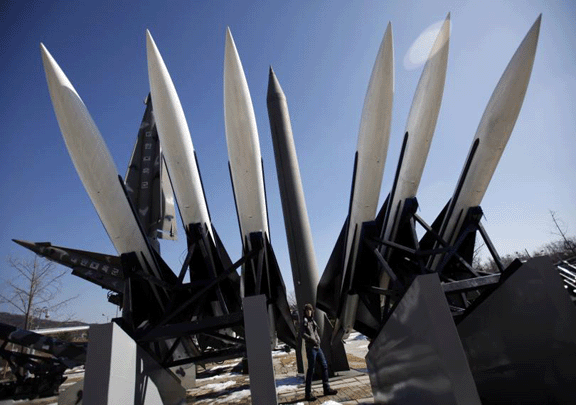











 nuclear-news