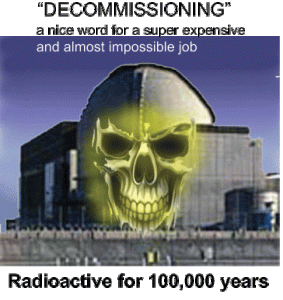
 Another month in UK’s failing new nuclear programme nuClear News No.94 April 2017 EDF Finances A French Parliamentary report from the National Assembly’s Commission for Sustainable Development and Regional Development says the clean-up of French reactors will take longer, be more challenging and cost much more than French nuclear operator EDF anticipates. Whereas Germany has set aside €38 billion to decommission 17 nuclear reactors, and the UK Nuclear Decommissioning Authority estimates that clean-up of UK’s 17 nuclear sites will cost between €109‒250 billion over the next 120 years, France has set aside only €23 billion to decommissioning its 58 reactors. In other words France estimates it will cost €300 million per gigawatt (GW) of generating capacity to decommission a nuclear reactor, Germany estimates €1.4 billion per GW and the UK estimates €2.7 billion per GW.
EDF says it wants to set aside a €23 billion fund to cover decommissioning and waste storage for an estimated €54 billion final bill ‒ and the difference between these two figures will be closed through the appreciating value of its equities, bonds and investments ‒ in other words, ‘discounting’. Unfortunately, recent experience has taught us that markets can go up and down over time ‒ especially the very long-time periods involved in radioactive waste management. But for a company that has huge borrowings and an enormous debt of €37 billion, €23 billion is a large sum of money to find. Any significant change in the cost of decommissioning would have an immediate and disastrous impact on EDFs credit rating ‒ something that the debt-ridden corporation can simply not afford. EDF is already in financial trouble. Along with bailing out collapsing AREVA, EDF also has to bear the huge financial burden of the failing reactor newbuild at Flamanville. It will also have to pay for extending the life of France’s existing nuclear power stations (to 2025), at a cost of €55 billion.
On top of all this the French authority tasked with disposal of all the countries vast and increasing waste burden (Andra) has recently ramped up the estimated cost for the planned national nuclear waste repository at Cigéo, to €25 billion ‒ and EDF must pay for most of Cigéo’s construction. Although €5 billion more than EDF anticipated, it still seems a gross underestimation, and the costs are likely to rise considerably. (21) http://www.no2nuclearpower.org.uk/nuclearnews/NuClearNewsNo94.pdf
April 8, 2017
Posted by Christina Macpherson |
business and costs, decommission reactor, France, politics |
Leave a comment
Another month in UK’s failing new nuclear programme nuClear News No.94 April 2017 French nuclear scandal
EDF, Areva and the French nuclear regulator ASN have known since at least 2005 that Areva’s Creusot Forge factory was not capable of producing nuclear safety compliant components. Yet the factory has been allowed to continue manufacturing components which have now been found to contain anomalies, including the bottom and lid for the reactor pressure vessel (RPV) for the EPR at Flamanville. (12)
The French Radio Station which broke the news commented that:
“Never before has the French nuclear industry suffered such a scandal. And this case challenges the entire chain of control of a sector already shaken by the Fukushima disaster.” (13)
The Creusot Forge is under investigation by ASN after it was discovered to have produced potentially defective parts and substandard safety reports for reactors around the world. But the letters from 2005 and 2006 – obtained by France Inter – show that EDF and Areva were told by the ASN about “numerous incidents” at the facility, including “discrepancies during inspections”. This will raise serious concerns about EDF and Areva’s new nuclear project at Hinkley Point. (14)
In December 2005 ASN sent a letter to EDF alerting it to the deplorable condition of the Le Creusot plant, which was experiencing major malfunctions. Yet the lid and bottom for the RPV for the Flamanville EPR were manufactured by the Creusot Forge, in Burgundy, between September 2006 and December 2007. In August 2006 ASN asked Areva to demonstrate that the steel for these two parts was homogeneous. For seven years letters were exchanged between ASN and Areva, but no analysis was carried out. On 24th January 2014 the RPV arrived at Flamanville, and was placed in the reactor building. Nine months later Areva finally did some tests and discovered that the bottom and the lid had abnormalities. “The steel should normally contain 0.2% carbon,” explains Yves Marignac, of WISE Paris, but the concentration was 0.3%, enough to modify the mechanical properties of the steel and, in particular, to influence the temperature at which it becomes less supple and more brittle. (15)
The regulator – ASN – has been seriously at fault, according to the Observatoir du Nucleaire, since it has said nothing for many years about the criminal practices at Le Creusot. It says ASN is no less guilty than Areva and EDF because, although it was fully aware of the serious problems, it authorized EDF to install the pressure vessel in the EPR at Flamanville in December 2013. It is clear, says the website, that ASN is not able to withstand pressure from EDF and politicians who accuse them of seriously harming the industry if they enforce safety regulations. (16)
Following the discovery of manufacturing irregularities and the falsification of documents at Areva’s Creusot Forge foundry last year, French nuclear regulator ASN and several other international regulators inspected the site in early December. ASN said Le Creusot is not up to the job and did not have the right equipment to produce the parts for the nuclear reactors. “Creusot Forge is at the limit of its technical capacity. The tools at its disposal are not adequate to manufacture such huge components. In such a situation, errors are made.” (17) No2NuclearPower nuClear news No.94, April 2017 5
EDF’s oversight of AREVA, which will supply the Hinkley Point C reactors was questioned in an internal document by the UK Office for Nuclear Regulation (ONR). In an ONR report about the visit dated 16th December disclosed under a Freedom of Information request ONR said the nuclear safety culture at Creusot fell short of expectations and warned about the implications for Hinkley Point C. ONR said it has since decided to implement a series of additional inspections of EDF and its supply chain to ensure all components are manufactured to the required standard. The ONR report said after an inspection in late 2016, that an international team from France, Canada, the United States, China, Finland and Britain had concluded that the nuclear safety culture at Le Creusot Forge foundry fell short of what regulators expect from a major supplier of nuclear equipment. It added that improvement measures ordered by ASN were not yet effective and said despite the prohibition of the use of correction fluid on documents at the foundry, the inspectors found evidence of its continued use. (18)……… http://www.no2nuclearpower.org.uk/nuclearnews/NuClearNewsNo94.pdf
April 8, 2017
Posted by Christina Macpherson |
business and costs, France, secrets,lies and civil liberties |
Leave a comment
Another month in UK’s failing new nuclear programme nuClear News No.94 April 2017 The Trump administration is working to find a new owner for Westinghouse, but doesn’t want the Company to fall under Chinese control. The administration is “keenly aware” of the national security implications attached to the sale of the company, and is trying to pre-empt any possible blocking of a deal by making clear at an early stage that the US government would take a tough stance on any significant Chinese role. A US-led deal for even the profitable operations of Westinghouse could be tricky to arrange though. The only US company with substantial nuclear engineering operations is General Electric, through its joint venture with Hitachi, but its technology is different from Westinghouse’s. Westinghouse has close links to China, where it has four of its AP1000 reactors under construction. As part of the deal for those projects, Westinghouse agreed to transfer intellectual property relating to the plants. More than 75,000 No2NuclearPower nuClear news No.94, April 2017 4 documents were handed over to its Chinese customers in 2010 in the first stage of implementing that agreement. (11) http://www.no2nuclearpower.org.uk/nuclearnews/NuClearNewsNo94.pdf
April 8, 2017
Posted by Christina Macpherson |
business and costs, politics international, USA |
Leave a comment
Russian sub causing nuclear headache in Denmark http://cphpost.dk/general/russian-sub-causing-nuclear-headache-in-denmark.html An elderly Russian nuclear submarine is to pass Denmark on its way to St Petersburg later in the year. April 6th, 2017 3:50 pm| by Stephen Gadd
This summer, a giant Russian typhoon-class nuclear submarine, 172 metres in length, is expected to pass Denmark.
The submarine will depart from Russia, pass Norway and then sail into the North Sea and the Skagerrak, onwards into the Baltic, where it will finally dock in St Petersberg, the Barents Observer writes. The sub will pass underneath the Øresund Bridge as the water is not deep enough by the Great Belt Bridge or at Flintreden.
All the preparations are underway, and now all that is needed is the signature of Russian President Vladimir Putin.
No nukes, please!
The submarine was built in 1981 and has the capacity to carry up to 20 missiles and 200 nuclear warheads at a time. However, nowadays it is used as a test platform for ballistic missiles and is based in the town of Severodvinsk in western Russia.
The age of the vessel might be cause for concern, though, according to Norwegian atomic physicist Nils Bøhmer.
“I’m worried when a 40-year-old atomic submarine with a relatively large reactor aboard sails along the Norwegian coast and into the Baltic,” he told Barents Observer.
“The authorities have to know the exact time of its voyage in order to be prepared. It is also vital to ensure there are not atomic weapons on board.”
April 8, 2017
Posted by Christina Macpherson |
Denmark, Russia, safety |
Leave a comment
With Westinghouse Bankruptcy, the Nuclear Energy Story Nearly Over The much touted nuclear renaissance is now over. News Click Prabir Purkayastha 07 Apr 2017 With Westinghouse announcing its bankruptcy, India’s pledge to buy at least 10,000 MW as a part of the India US Nuclear Deal and reiterated by Modi last year, should be given a decent burial. Any agreement with Westinghouse now means that India would be bailing out Westinghouse and the US nuclear industry with Indian peoples’ money.
This also draws to a close all talk about a nuclear renaissance. The three major reactor manufacturers – Toshiba-Westinghouse, GE-Hitachi and Areva, France – are all in major financial difficulties. Only a fool will still believe their promise that the 3rd generation reactors they are developing – none of which have been successfully commissioned as yet – are either safe or cheap.
The Left’s position during the India US 123 Deal was that it neither served India’s strategic interest, nor made sense in energy terms. It also meant abandoning India’s self-reliant nuclear reactor industry for importing costly and unproven US reactors. Though it failed to stop the 123 Agreement in Parliament, the Left successfully led the struggle to modify India’s Nuclear Liability Act, ensuring that nuclear suppliers, like in any other hazardous industry, should be liable for their faulty equipment.
The Fukushima disaster has shown that a nuclear accident can cost up to $200 billion . Even this could be a conservative estimate. The Indian liability law caps operator and suppliers’ liability to just $ 407 million (300 million SDR’s). Though cost of a reactor is in billions of dollars, even this small liability, only a fraction of its cost, was perceived to be too “dangerous” and unacceptable to the US suppliers.
Last year, Modi, announced during one of his US visits that not only would India buy US reactors, a continuation of the assurance given by Shivshankar Menon, the Foreign Secretary under Manmohan Singh (Letter September 10th, 2008 ), but would also assume the liabilities of the US suppliers in case of of a nuclear accident. India offered Mithi Virdi in Gujarat to Westinghouse and Kovvada in Andhra to GE as the two sites. Subsequently on GE’s failure to show any successful contract combined with local resistance in Mithi Virdi, GE’s project was considered cancelled, and its Andhra site offered to Westinghouse.
Fortunately for India, Modi’s assurances have come too late for the US nuclear industry. The much touted nuclear renaissance is now over. In OECD countries, only 7 new reactors are being built with varying degrees of state support. With huge cost and time overruns, the curse of the nuclear industry, all of them are in deep trouble. GE, unsuccessful in selling even one of its so-called advanced design, has virtually pulled out of the nuclear business. After huge and continuing losses, Areva, the French reactor supplier, is being taken over by EdF, the French state-owned energy utility. EdF has already scrapped the new Areva EPR design, with which the Finnish Olkiluoto and French Flamanville plants were being built. This is also the design Areva is trying to sell for the Jaitapur project in Maharashtra.
The major objections of the Left regarding imported reactors have been proven correct. The untried and untested designs have meant numerous changes and difficulties in construction, leading to significant delays and sharp increase in costs. The cost of the two Areva plants of Euro 3 billion each originally, have increased by almost three times .
The Westinghouse story is no different………
In the exchanges between the UPA and the Left during Manmohan Singh’s government, the cost of new nuclear plants from French or US suppliers had come up. The UPA had presented figures for capital cost per KW of $1,500 and the price of power to be Rs. 1.49 paise per unit from imported nuclear plants. The Left had given figures from Olkiluoto and the US, showing that the capital cost would be at least $4,000 per KW and the price of electricity from such plants around Rs. 5 per unit.
The figures from the US and French projects now show that the capital cost per KW for such plants is in the range of $6,000-7,000, and therefore the price per unit of electricity from such plants will not be less than Rs. 8-10 per unit.
Why did the UPA claim such absurdly low figures for nuclear energy? They were either figments of their imagination or took these figures straight from the promotional material of the nuclear suppliers. To claim nuclear energy to be competitive, the nuclear suppliers took a 60-year life of the plant, left out the interest on capital during construction as a component of the cost, and claimed their new designs had much lower capital costs. They then did what are called levellised cost calculations – the cost of electricity over the lifetime of the plant. By this sleight of hand, they reached figures for the cost of nuclear power to be competitive with coal and gas.
Of course, the actual capital costs are much higher than what the nuclear industry was claiming. The regulators and utilities that price the electricity, have also to look at all the cost components including cost of capital, interest on loans, etc., and fix the price that of electricity. What matters to consumers and utilities (distribution companies or state electricity boards) is not the levellised cost of electricity, but the entry cost of nuclear power to the grid. This is what needs to be competitive to other sources. Any such calculations shows that nuclear energy is simply not competitive.
The collapse of Westinghouse, which has either built or licensed its designs to almost half the world’s reactors, shows that the nuclear story is nearly over. The reality is that with the cost of renewables – solar photovoltaics and wind – dropping sharply, the economics are increasingly against nuclear energy. This is apart from danger of catastrophic accidents or danger from long-term storage of radioactive nuclear wastes. It may still sustain itself for some time in countries, where there is a strong indigenous nuclear industry, such as India, China, Korea and Russia. But its days are now clearly numbered. http://www.newsclick.in/westinghouse-bankruptcy-nuclear-energy-story-nearly-over
April 8, 2017
Posted by Christina Macpherson |
business and costs, India, politics, politics international, USA |
Leave a comment
Lisa Steyn 07 Apr 2017 Once a pioneering nuclear energy giant, the Westinghouse Electric Company now finds itself filing for bankruptcy. This follows uncomfortably close on the heels of another nuclear industry leader, Areva, which was bailed out by the French government in January.
The financial troubles these nuclear powerhouses face is leaving the industry more than a little shaken and raises the question: Is the nuclear industry in meltdown?
“Nuclear industry is not in fine shape at the moment, certainly not in the Western world,” said Chris Yelland, an energy expert and the managing director of EE Publishers…. (subscribers only) https://mg.co.za/article/2017-04-07-00-nuclear-turn-off-tumbles-giants
April 8, 2017
Posted by Christina Macpherson |
general |
Leave a comment




 nuclear-news