nuclear-news

The News That Matters about the Nuclear Industry Fukushima Chernobyl Mayak Three Mile Island Atomic Testing Radiation Isotope

Trump Cuts Spell Trouble for Security at Indian Point Nuclear Power Station and New York Harbor; Removing Critical Coast Guard Resources May Hamper USCG’s Patrols and Emergency Response

miningawareness's avatarMining Awareness +


To the left is open-air, spent nuclear fuel. The spent fuel casks have been called “Chernobyl in a Can” by https://sanonofresafety.org

If Trump doesn’t even care about New York City, what does he care about? Only navel-gazing? His petty spat with Arnold Schwarzenegger suggests that to be so. Nero fiddling while Rome burned! Oh, wait, does Trump prefer Moscow to Manhattan, perhaps?

03.16.17
SCHUMER: PROPOSED ADMIN CUTS WOULD SPELL REAL TROUBLE FOR SECURITY AT INDIAN POINT & NY HARBOR; REMOVING CRITICAL COAST GUARD RESOURCES COULD HAMPER USCG’S PATROLS AND RESPONSE DURING AN EMERGENCY, MAKING THE LOWER HUDSON VALLEY AND NYC LESS SAFE & SECURE; SENATOR VOWS TO PROTECT FUNDING

Senator Says Budget Aims To Slash Already Tight Coast Guard, & Other Vital Security Force, Budgets By A Billion Dollars; Schumer Highlights Security Necessities That Would Lose Amidst Cuts

Schumer: Public’s Safety Is Paramount, Especially At Indian Point, Airports &…

View original post 653 more words

March 17, 2017 Posted by | Uncategorized | Leave a comment

The very serious threat of sea level rise

SEA-LEVEL RISE IS A ‘SERIOUS THREAT’ #CLIMATECHANGE #AUSPOL https://jpratt27.wordpress.com/2017/03/17/sea-level-rise-is-a-serious-threat-climatechange-auspol/

Sea-level rise poses ‘a serious threat’ to millions of Europeans, scientists warn. A new study spells out the threat of sea-level rise in coastal communities.The kind of devastating flooding that occurs once every century along Europe’s northern coastline could become an annual event if greenhouse gas emissions continue to climb, according to a recent study published in the journal Earth’s Future.

New analysis takes into account changes in sea-level rise, tides, waves, and storm surge over the 21st century and found that climate change could prompt extreme sea levels — the maximum levels seen during major storms, which produce massive flooding — to increase significantly along the European coastline by 2100.

This scenario will likely stress coastal protection structures beyond their capacity, leaving much of the European coastline vulnerable to dangerous flooding, according to study authors.

“Unless we take different protection measures, five million people will be exposed to coastal flooding on an annual basis,” said Michalis Vousdoukas, a coastal oceanographer at the Joint Research Centre of the European Commission and lead author of the study.

The study described the projected rise in extreme sea levels as “a serious threat” to coastal communities, noting, “their safety and resilience depends on the effectiveness of natural and man-made coastal flood protection.”

Kevin Trenberth, a scientist with the climate analysis section of the National Center for Atmospheric Research, who was not involved in this research, said the signs of extreme sea levels are already worrisome, not just in Europe, but in the United States as well. “Witness the sunshine flooding in Florida already, the flooding that shows up even with no storm on many streets any time there is a slightly high tide,” he said.

Sea level is going up because the ocean is warming and hence expanding, and because land ice — glaciers, etc. — are melting and putting more water into the ocean. But it is not the gradual rise that matters,” Trenberth said. “Rather, it is the storm surge on top of a high tide riding on top of the increase in sea level that crosses thresholds and causes things to break.”

Richard Alley, professor of geosciences at Pennsylvania State University, who also did not take part in this study, noted that the study didn’t consider the possible collapse of the West Antarctic ice sheet. “If that happens, then sea-level rise and impacts to coasts could be much higher than in this paper,” Alley said. “Rapid West Antarctic collapse could cause enough rise to make many of these other factors of secondary importance. So, the ‘worst case’ in this paper isn’t really the worst case.”

The new paper predicted that some regions could experience an even higher increase in the frequency of these extreme flooding events, specifically along the Mediterranean and the Black Sea, where the present day 100-year extreme sea level could occur as often as several times a year.

“The ‘worst case’ in this paper isn’t really the worst case.”

Information about the number of people at risk from flooding can be used to determine how large the social and economic impact of these events will be, said Marta Marcos, a researcher at the Mediterranean Institute for Advanced Studies in Spain, who was not involved in the new study. “In terms of adaptation strategies and policy-making, it is very relevant,” she said.

The researchers studied changes in extreme sea levels by 2100 under different greenhouse gas scenarios and considered how all these components — mean sea level, tides, waves, and storm surge — will be affected by climate change.

f emissions continue to rise unabated throughout this century, extreme sea levels along Europe’s coastlines could increase by more than 2.5 feet, on average, by 2100. Under a more moderate situation, where greenhouse gas emissions peak in 2040, 100-year extreme sea levels still could jump by nearly 2 feet, on average, by the end of the century — with flooding events occurring every few years — according to study’s authors.

In a related study appearing in Geophysical Research Letters, scientists found that if greenhouse gases continue to rise, there could be disturbing changes by the end of the century in the energy that waves carry to the coast.

In the southern hemisphere, extreme waves could carry up to 30 percent more energy by 2100, according to the study, meaning that stronger waves will become more frequent, and have a greater impact on the coast, said Lorenzo Mentaschi, a researcher at the Joint Research Centre and lead author of the study.

The new study attributed the changes in wave energy to the intensification of weather patterns, like El Niño. The new research will be provided to European Union policymakers. The data will also be made public so it can be used by scientists, engineers, and coastal managers.

Michael Mann, professor of atmospheric science at Pennsylvania State University, said the research once again underscored how climate change, “which has already increased the threat to our coastlines through a combination of sea-level rise and intensified coastal storms, will be catastrophic for coastal communities if we don’t reduce global carbon emissions.”

Marlene Cimons writes for Nexus Media, a syndicated newswire covering climate, energy, policy, art & culture.

Press link for more: Think Progress

March 17, 2017 Posted by | climate change, EUROPE, oceans | Leave a comment

Massive economic costs of climate change

ECONOMIC COST OF #CLIMATECHANGE ARE ‘MASSIVE’, JPratt27, 17 Mar 17 Funding efforts to fight climate change is “a waste of your money,” the director of the Office of Management and Budget Mick Mulvaney said in a press conference today.

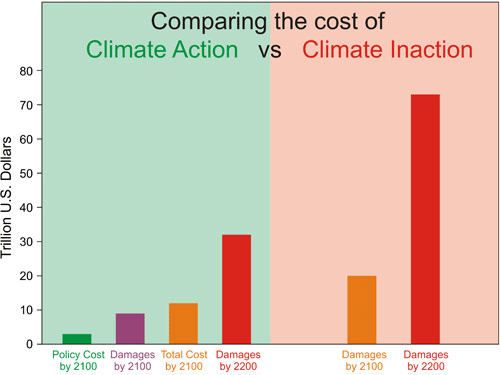
But Mulvaney is dangerously wrong: in fact, experts say that that the economic costs of climate change are so massive that delayed action, or inaction, is the most expensive policy option out there.
Mulvaney was defending President Trump’s proposed 2018 budget, which cuts funding for the Environmental Protection Agency by 31 percent — making good on Trump’s threat to dismantle the agency.

“Regarding the question as to climate change, the president was fairly straightforward,” Mulvaney said.

“‘We’re not spending money on that anymore.’”
That’s a really bad idea, for a couple of reasons.

But first, let’s get this out of the way: there is overwhelming evidence that climate change is real, and caused by carbon emissions.

Scientifically, the debate’s over and this is our fault — no matter how much Scott Pruitt or Ryan Zinke try to duck responsibility on behalf of humankind.
Sitting out on global warming is a bad deal for America

Second, there are big chunks of the US economy that depend on the global temperature staying put — like the agriculture and fish industries, for example. …….as global temperatures climb, severe droughts, extreme rain and snowfall, flooding, and heatwaves have already started to increase — making it a lot harder to grow crops no matter how much they love guzzling down that CO2.

Unchecked climate change will hit farmers where it hurts
We’ve started seeing some of the consequences of climate change on agriculture already, according to a government report: high temperatures in 2011 cost meat producers more than $1 billion dollars in what the EPA called “heat-related losses.” …..

Nationwide, The Risky Business Project estimates that anywhere from $66 billion to $106 billion of coastal real estate is probably going to hard to enjoy without a snorkel by the year 2100.
This is bad for more than just Mar-a-Lago: massive coastal flooding could also have major ripple effects on the economy, according to a report by government-sponsored mortgage company Freddie Mac.

Coastal businesses could relocate or simply go under, taking jobs with them.

Lenders and mortgage insurers could also suffer huge losses because, the report says, “It is less likely that borrowers will continue to make mortgage payments if their homes are literally underwater.”

It gets worse: “Non-economic losses may be substantial as some communities disappear or unravel. Social unrest may increase in the affected areas.”
“It is less likely that borrowers will continue to make mortgage payments if their homes are literally underwater.”
Big picture, global warming could cause the global economy to plummet — leading to a 23 percent drop in gross domestic product per person by the year 2100, according to a 2015 study published in Nature.

“We’re basically throwing away money by not addressing the issue,” Marshall Burke, an assistant professor at Stanford University, told TIME.
Even bankers agree — and they’re not known for being tree-huggers……….

waiting to start fighting global warming — or sitting out the fight altogether — is a bad deal for America’s future. Given President Trump’s claims about his business acumen, he, of all people, should see that.

Press link for more: The Vergehttps://jpratt27.wordpress.com/2017/03/17/economic-cost-of-climatechange-are-massive-auspol-science/

March 17, 2017 Posted by | business and costs, climate change, USA | Leave a comment

Savage attack on the environment: the Trump budget

Aside from the catastrophic impacts on public health and planetary survival, these Trump-Koch attacks on environmental protection and increased energy efficiency bode ill for a struggling U.S. economy. Germany, China and other global competitors are surging ahead with ecologically sound advanced technologies like high-speed rail, EV autos, PV cells, ultra-efficient wind turbines, solar farms, and highways guaranteed to leave America in the dust.

The “tycoon” President who promised full employment and prosperity is instead bringing an ill wind, darkened sun, and scorched planet.

Trump’s Budget Assault on the Environment Packs a Wallop, The Progressiveby  March 17, 2017
Donald Trump’s first budget makes his antipathy to the environment clear—and his love for fossil fuels and nuclear power even clearer.

In addition to slashing funding to the Environmental Protection Agency, he also announced this week that he wants massive rollbacks in automotive fuel efficiency standards and billions in new investments in nuclear weapons and storage for commercial nuclear waste.

The administration’s budget cuts $2.4 billion from the EPA’s operating funds
—roughly 31 percent—taking the agency’s annual budget from $8.1 billion to $5.7 billion, the smallest since it was formed in 1970. These cuts will cripple regulation of air and water quality, strip oversight of a wide range of land management programs, and loosen restrictions on chemical emissions from industrial facilities.

Much of this money would be shifted directly over to the military, which the Trump Administration wants to bolster with an additional $54 billion over the final Obama allocations…….

llowing through on his campaign promise to reduce the EPA to “little tidbits,” Trump’s budget defunds more than 50 programs. These include infrastructure improvement on Indian reservations, major projects to clean up Puget Sound, Chesapeake Bay and the Great Lakes, a wide range of renewable energy development and energy efficiency programs, numerous climate change research programs, national heritage sites, environmental justice programs, oceanographic research and preservation, and much more. Gina McCarthy, a former EPA official under Obama, described it as “a scorched earth budget that represents an all-out assault on clean air, water and land.”

Some of the immediate opposition has crossed party lines. Ohio’s recently re-elected Republican Senator Rob Portman, a close associate of former President George W. Bush, strongly opposed cuts to the $300 million Great Lakes Restoration Initiative. Bill Becker of the National Association of Clean Air Agencies warned, “if such cuts are realized, many more people will die prematurely and get sick unnecessarily due to air, water and waste pollution.”…….

Meanwhile, Illinois and New York are moving toward massive subsidies for uncompetitive, dangerously dilapidated old nuclear reactors in a marketplace where renewables are coming in far cheaper and creating thousands more jobs. In Ohio and other states, owners of money-losing reactors are advocating for massive handouts to block cheaper, job-creating renewables and efficiency from getting into the marketplace.

Adding insult to injury, Trump wants to add $120 million to the long-dead Yucca Mountain nuclear waste dump. ……

Aside from the catastrophic impacts on public health and planetary survival, these Trump-Koch attacks on environmental protection and increased energy efficiency bode ill for a struggling U.S. economy. Germany, China and other global competitors are surging ahead with ecologically sound advanced technologies like high-speed rail, EV autos, PV cells, ultra-efficient wind turbines, solar farms, and highways guaranteed to leave America in the dust.

The “tycoon” President who promised full employment and prosperity is instead bringing an ill wind, darkened sun, and scorched planet. http://progressive.org/dispatches/trump%E2%80%99s-budget-assault-on-the-environment-packs-a-wallop/

March 17, 2017 Posted by | environment, politics, USA | Leave a comment

G20 will not be mentioning that nasty left-wing phrase “climate change”

G20 drop reference to climate change http://www.heraldsun.com.au/news/breaking-news/g20-drop-reference-to-climate-change/news-story/a5325d34d272030935c7b31033588f5d Reuters March 18, 2017

World financial leaders have dropped a reference to financing climate change from their draft communique, says an official taking part in a meeting of finance ministers and central bankers of the Group of 20 leading economies.

At their last meeting in July 2016 in the Chinese city of Chengdu, the G20 financial leaders said they encouraged all signatories of the Paris Agreement on climate change to bring the deal into force as soon as possible.

“Climate change is out for the time being,” said the official, who asked not to be named.

US President Donald Trump has called global warming a “hoax” concocted by China to hurt US industry and vowed to unpick the Paris climate accord that is supposed to curb rising temperatures.

March 17, 2017 Posted by | 2 WORLD, climate change, politics international | Leave a comment

1 reactor at Fukushima No. 2 plant, others – not certain

TEPCO to decommission 1 reactor at Fukushima No. 2 plant, mulling fate of 3 others http://mainichi.jp/english/articles/20170317/p2a/00m/0na/024000c

March 17, 2017 Posted by | decommission reactor, Fukushima continuing, Japan | Leave a comment

A bit of good news: carbon emissions from energy – flat for past 3 years


CO2 emissions from energy remain flat for third year running By New Scientist staff and Press Association, 17 March 2017

Carbon dioxide emissions from energy have not increased for three years in a row even as the global economy grew, says the International Energy Agency (IEA).

Global emissions from the energy sector were 32.1 billion tonnes in 2016, the same as the previous two years, while the economy grew 3.1 per cent, the agency says.

The IEA put the halt in growth down to growing renewable power generation, switches from coal to natural gas and improvements in energy efficiency.

The biggest drop was seen in the US, where carbon dioxide emissions fell 3 per cent, while the economy grew 1.6 per cent, following a surge in shale gas supplies and more renewable power that displaced coal.

US emissions are at their lowest level since 1992, while the economy has grown 80 per cent since that time.

Carbon dioxide output also declined in China, by 1 per cent, and were stable in Europe, offsetting increases in most of the rest of the world, the IEA says.

Emerging trend

“These three years of flat emissions in a growing global economy signal an emerging trend and that is certainly a cause for optimism, even if it is too soon to say that global emissions have definitely peaked,” says Fatih Birol, the IEA’s executive director…….

But the IEA also warns that the welcome pause in emissions growth is not enough to meet globally-agreed targets to limit temperature rises to below 2°C above pre-industrial levels — considered to be the threshold for dangerous climate change. Overall, the levels of carbon dioxide in the Earth’s atmosphere are still rising to record new levels. https://www.newscientist.com/article/2124975-co2-emissions-from-energy-remain-flat-for-third-year-running/

March 17, 2017 Posted by | 2 WORLD, climate change | Leave a comment

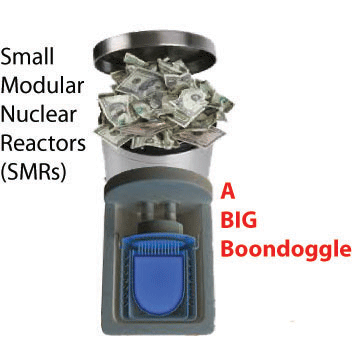
UK plans for small nuclear reactors stalling. Bechtel pulls out.

Bechtel pulls out of mini-nuclear development, Construction News, 17 MARCH, 2017 Bechtel is to pull out of small modular reactor development, the US engineering giant has confirmed. The company said it would no longer be attempting to create its own SMR reactor after it was unable to find investment for its programme, or a utility company that would provide a site.

Bechtel’s SMR aspirations were as part of mPower, a joint venture with energy giant Babcock & Wilcox…..

Bechtel will take itself out of the government’s SMR reactor design competition.

In March 2016 the government launched its £250m SMR competition which set out to identify the preferred reactor technology to be rolled out across the UK over the next 15 years. The Bechtel team was listed as one of the 33 parties to have made it past the first round of the competition, including engineering firms such as Atkins and contractors such as Costain.

Alongside firms such as Westinghouse and NuScale Power, the mPower JV was one of the companies capable of developing the technology after its reactor design was recommended for “further government investigation” by the National Nuclear Laboratory in 2014.

The competition has stalled ever since, with sources telling Construction News that they have been largely left in the dark by the government over the next steps……

March 17, 2017 Posted by | business and costs, politics, technology, UK | Leave a comment

Weird Polar Warming Appears to Have Made February of 2017 the Second Hottest Ever Recorded 

robertscribbler's avatarrobertscribbler

I think the scientific consensus will be that February probably should not have been so darn hot. But it was. And that’s pretty amazingly weird.

****

Clocking in at 1.32 C above 1880s averages, the month was oddly and disturbingly warm. The strong equatorial Pacific Ocean surface warming that was the El Nino of 2015-2016 had long since passed. The effects of a weak La Nina cooling of the same waters during late 2016 still lingered. And the Pacific Decadal Oscillation (PDO) — a measure of ocean surface temperature oscillation in the Pacific that tends to help drive natural variability based warming and cooling cycles — showed a meager warming bias value of 0.08 (or barely positive).

All these factors pointed toward a climate system that should have been pulling the world into a cyclical short term cooling during 2017 and 2018 (relative to 2016 record warmth). Global temperatures…

View original post 570 more words

March 17, 2017 Posted by | Uncategorized | Leave a comment

How to defuse tensions around the issue of North Korea’s nuclear weapons testing?

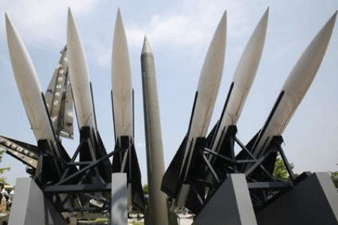
Can Tillerson Crack North Korea?, Carnegie Endowment For International Peace,  RICHARD SOKOLSKY,  JOEL WIT , March 15, 2017, Secretary of State Rex Tillerson’s visit to Northeast Asia this week comes as tensions are running high in the region. North Korea recently conducted a simultaneous test of four ballistic missiles that could be used to attack South Korea and Japan, as well as U.S. forces stationed in those countries with nuclear weapons. The impending American deployment of an anti-ballistic missile system in South Korea to defend against a missile attack has provoked China’s strong opposition. South Korean president Park Geun-hye has just been removed from office for corruption, and a presidential election that could bring the opposition party to power will be held in May. While all this is happening, the Trump administration is doing some serious soul-searching about how to deal with North Korea. In short, Secretary Tillerson will face a diplomatic landscape that is littered with landmines on his first big troubleshooting mission overseas.

North Korea is at the center of this tangled web.

………..The jury is still out on whether Pyongyang has reached its tipping point. Besides some press leaks, there has been little publicity about decapitation, and it is unclear whether the overflights will take place. The recent North Korean missile tests may have been just an immediate one-off reaction to the ongoing joint U.S.–South Korean military exercises. And Pyongyang may still want to exercise caution, with the South Korean election now scheduled soon. Or the tests could reflect a decision that a “wait and see” posture is unlikely to produce results, ushering in a period of bigger and better nuclear weapons and missile tests, possibly including an intercontinental ballistic missile able to reach the United States. If that’s the case, the crisis on the peninsula is only likely to intensify.

The diplomatic hat trick the Trump administration needs to pull off is finding a solution that can stop the growth of the North Korean threat, rebuild cooperation with Beijing and gain support from U.S. allies, particularly a new South Korean government. That’s a very tall order, especially since the overwhelming temptation in Washington will be to double down on sanctions, including measures against Chinese banks and businesses that have ties with North Korea, and to ratchet up rhetoric about military options for eliminating Pyongyang’s WMD threat. If that’s all Secretary Tillerson brings to Asia, his mission will fail. He will only create more running room for Pyongyang to move forward with its nuclear and missile programs by making cooperation between Washington and Beijing even more difficult to achieve.

The smart move would be to defuse tensions while laying the groundwork for a strategy that combines threats with leaving the door open a crack for renewed dialogue with North Korea. The first two stops on his trip—Tokyo and Seoul—will provide him with an opportunity to pledge Washington’s firm commitment to their security. But the real centerpiece of Secretary Tillerson’s trip will be Beijing. China’s public proposal last week that the United States suspend its joint military exercises—a key demand by North Korea—in return for Pyongyang suspending its nuclear and missile tests—a move that would serve Washington’s interests—signals that it is willing to play an active, even positive role in avoiding a “head-on collision,” in the words of Chinese foreign minister Wang Yi. While the Trump administration quickly rejected the proposal, rather than just leaving the matter there, Secretary Tillerson should pick up the diplomatic gauntlet.

Caution, always the watchword when dealing with North Korea, should be reflected in the secretary’s counterproposal. Rather than dive headlong into new negotiations, step one should be “talks about talks”: unconditional preliminary discussions to see if North Korea is willing to put its nuclear weapons program on the table. “Unconditional” is the key word. While the United States has insisted in the past that North Korea agree ahead of time to focus on giving up its nuclear weapons, Pyongyang’s view is that talks should be held without preconditions. There seems to be little if no downside in adopting that approach, since the North Koreans understand that their program will be Washington’s number one topic for discussion. Step two in this process will be a decision by President Trump and Kim Jong-un, based on the results of these preliminary talks, whether formal negotiations should resume. If North Korea proves willing to address Washington’s WMD concerns, formal negotiations can start. If North Korea is not serious, the United States should then move on to putting greater diplomatic pressure on China, enacting new sanctions, and taking further measures to protect Seoul and Tokyo.

Whether the Trump administration adopts this approach or just presses the policy default button—more sanctions and military measures—is the $64,000 question. Consequential secretaries of state solve the thorniest and most important national security problems through patient, skillful diplomacy and negotiations. Fair or not, Secretary Tillerson has been pilloried by the press and pundits as missing in action. This sensitive diplomatic mission offers him an opportunity to show his mettle. The last thing Washington needs, at a time when America’s global leadership and position in Asia is under challenge, is for Secretary Tillerson to leave the region empty-handed, or in worse shape than he found it.
This piece was originally published by the National Interest. http://carnegieendowment.org/2017/03/15/can-tillerson-crack-north-korea-pub-68278

March 17, 2017 Posted by | North Korea, politics international, USA | Leave a comment

US intelligence : new round of missile, nuclear testing by North Korea expected

US anticipates new round of missile, nuclear testing by North Korea By Barbara StarrCNN Pentagon Correspondent, March 16, 2017 Story highlights

March 17, 2017 Posted by | North Korea, weapons and war | Leave a comment

US efforts to ‘denuclearise North Korea’ have failed- US secretary of state Rex Tillerson

Tillerson concedes US efforts to ‘denuclearise North Korea’ have failed
US secretary of state starts four-day Asia-Pacific trip by calling for new approach towards Pyongyang’s weapons programme,
Guardian,  , 16 Mar 17 The US secretary of state, Rex Tillerson, has conceded that 20 years of US attempts to “denuclearise” North Korea have failed, and called for a new approach towards the regime’s nuclear weapons programme.

Speaking in Tokyo at the start of a four-day visit to Japan, South Korea and China, Tillerson said on Thursday: “I think it’s important to recognise that the political and diplomatic efforts of the past 20 years to bring North Korea to the point of denuclearisation have failed.

“That includes a period where the United States has provided $1.35bn in assistance to North Korea as an encouragement to take a different pathway.

“In the face of this ever-escalating threat, it is clear that a different approach is required. Part of the purpose of my visit to the region is to exchange views on a new approach.”

Tillerson said he and his Japanese counterpart, Fumio Kishida, had discussed a fresh approach to North Korea’s “dangerous and unlawful” nuclear programme, but neither revealed details.

 “North Korea and its people need not fear the United States or their neighbours in the region who seek only to live in peace with North Korea,” the secretary of state added. “With this in mind, the United States calls on North Korea to abandon its nuclear and ballistic missile programmes and refrain from any further provocation.”

US administration officials have said that all options are on the table, including military strikes, but Tillerson indicated that Washington would continue to demand the full implementation of UN sanctions and press China to make more effective use of its leverage with the North Korean regime.

Calls for an alternative to the multinational sanctions supported by previous Japanese and US administrations have grown amid worrying evidence that the measures have not prevented North Korea from edging closer to its aim of developing nuclear weapons capable of striking the US mainland.

Japan and South Korea, which host tens of thousands of American troops, are within range of North Korean missiles…….

Chinese cooperation has been further complicated by the forthcoming deployment of a controversial US anti-missile system in South Korea.

China has objected to the Terminal High Altitude Area Defence (Thaad) missile defence system, describing its advanced radar as a threat to its own security. Military officials in the US and South Korea insist that Thaad’s sole purpose is to thwart missile attacks from North Korea……..

Tillerson said making Japan the first stop on his visit “does underscore the importance that the United States places on the Japanese-US relationship, but also the importance of the Asia-Pacific region to the United States. The US-Japan alliance remains the cornerstone of peace and stability in the Asia-Pacific region.”

Tillerson was due to hold talks with Japan’s prime minister, Shinzō Abe, on Thursday evening. On Friday, he will meet South Korea’s acting president, Hwang Kyo-ahn, and visit the demilitarised zone – the heavily armed border separating South and North Korea.

In Beijing at the weekend, Tillerson is expected to attempt to calm Chinese fears over Thaad, play down talk of a possible trade war between the world’s two largest economies, and finalise plans for the Chinese leader, Xi Jinping, to visit Trump in April. https://www.theguardian.com/us-news/2017/mar/16/tillerson-concedes-us-efforts-to-denuclearise-north-korea-have-failed

March 17, 2017 Posted by | North Korea, politics international | Leave a comment

Nuclear war in the 21st century

The truth about Satan: Nuclear war in the 21st century, new atlas  March 15th, 2017   Late last year, the world’s news services were abuzz with articles about Russia’s new super weapon, an ICBM called Satan 2 that is alleged to have the capability to fly at 17 times the speed of sound, penetrate US ICBM defenses, and destroy an area the size of Texas. But do these claims hold water, and just how big is the nuclear threat that the world really faces in the 21st century? What is the truth about Satan 2?

It was an exciting story and for about a week it made the rounds on everything from Twitter to major news outlets. But what was surprising about the coverage was that the Russian claims were accepted almost universally without a trace of skepticism or even context. This was despite the Satan-2, in many ways, is a fairly standard weapon and, in others, the claims didn’t even make sense. Never mind being able to destroy an area equal to Texas, saying that it can fly over the South Pole or dodge the US missile defenses should have set the skeptic alarms ringing.
The problem of nuclear weapons

Not to downplay the risks, but we need to ask what the real significance Satan-2 is, and why so many otherwise well-informed people were taken in by the Russian claims?

………….Conclusion

Using Satan-2 as the jumping off point for this lengthy look at the potential shape of nuclear war in the 21st century isn’t meant to downplay the significance of any such weapon, or to rack the press over the coals. The point is to highlight the fact that our shared knowledge of nuclear weapons and their capabilities has eroded since the end of the Cold War to the point where even fabulist claims like those made for the Satan are received with credulity.

Nuclear weapons are still the single greatest piece on the military chessboard of world diplomacy. If we become complacent about them and the role they play in our world, then we could find ourselves facing a very nasty surprise that shakes us out of that complacency. On the other hand, if we regard them as some all-destroying force that can only lead to the extermination of the human race, then it can lead to fatalism, paralysis, or desperate gambles and brinkmanship.

None of this is meant to minimize the danger of nuclear weapons. Far from it. These are the most destructive weapons ever devised by the mind of man and their use in war can only be justified as a deterrent. The warheads used today may be smaller, fewer, and not anywhere near as universally destructive as popular culture portrays them, but they are terrible things.

On September 11, 2001, terrorists hijacked four jet passenger liners and slammed two of them into the Twin Towers in New York and one into the Pentagon, while the fourth crashed when the passengers tried to overpower the hijackers. This attack did not involve nuclear weapons, and “only” destroyed two skyscrapers and killed about 3,000 people, but it paralyzed the world’s only superpower, caused the loss of many billions of dollars, nearly crippled the airline industry, and has had massive impacts on the world to this day.

Now imagine a 10 kiloton bomb detonating in Manhattan. Even if the island didn’t end up looking like Hiroshima, the toll of death, property damage, and economic disruption doesn’t bear thinking about – but if we are to prevent such a disaster occurring in New York, or London, or Paris, or Moscow, or Tehran, or Jerusalem, we have to do just that. http://newatlas.com/nuclear-weapons-satan-missile/46845/

March 17, 2017 Posted by | general | Leave a comment

GreenLeft did very well in Netherlands election

GreenLeft proves to be big winner in Dutch election Party forecast to boost its MPs from four to 14 after storming campaign by young leader Jesse Klaver, Guardian  , 17 Mar 17, The big winner of Wednesday’s election – and now the largest party of the Dutch left for the first time – was GreenLeft, headed by 30-year-old Jesse Klaver, hailed by his enthusiastic supporters as the “Jessiah”.

With more than 95% of votes counted, the party – formed 25 years ago by a merger of communists, pacifists, evangelicals and self-styled radicals – boosted its MPs from four to 14 after a storming campaign by Klaver.

“This is a fantastic result for us, a historic victory,” said the party chairwoman, Marjolein Meijer.

The result showed there was “very fertile ground in the Netherlands for change and a positive and hopeful story”, she said. “For us this is just the beginning.”……..

The Netherlands’ youngest ever party leader, Klaver built a strong following on social media through small Meetup events after taking over GreenLeft’s leadership in May 2015.

His rallies were among the campaign’s largest, including an Amsterdam meeting that drew more than 5,000 people – plus 5,000 more following live on Facebook.

His TV debates were also widely regarded as triumphs. In one debate watched by 1.6 million viewers, Klaver told his far-right, anti-Islam rival Geert Wilders that it was rightwing populism, not Muslim immigration, that was undermining Dutch culture and traditions. ……https://www.theguardian.com/world/2017/mar/15/dutch-elections-greenleft-jesse-klaver

March 17, 2017 Posted by | EUROPE, politics | 2 Comments

Republican senator slams Trump’s Nevada nuclear waste dump plan

We will not be a nuclear waste dump’: Vulnerable GOP senator slams Trump’s Nevada nuke waste plan   https://www.rawstory.com/2017/03/we-will-not-be-a-nuclear-waste-dump-vulnerable-gop-senator-slams-trumps-nevada-nuke-waste-plan/ ,16 MAR 2017 

Dean Heller (R-NV) got a nasty surprise this week when he discovered that President Donald Trump’s proposed budget would revive the Yucca Mountain storage facility for nuclear power plant waste in his home state.

Heller, by far the most vulnerable Republican in the senate in the 2018 midterm elections, railed against Trump’s proposal in a statement released Thursday, as he insisted that his state would “not be the nation’s nuclear waste dump.”

“As has been stated in the past, Yucca is dead and this reckless proposal will not revive it,” he said. “Washington needs to understand what Nevada has been saying for years: we will not be the nation’s nuclear waste dump. This project was ill-conceived from the beginning and has already flushed billions of taxpayer dollars down the drain.”

Heller also vowed to fight any effort to revive the Yucca Mountain project tooth and nail.

The Las Vegas Review Journal notes that, while Trump would increase funding to revive the Yucca Mountain facility, his budget would also slash the Office of Science’s $5 billion budget by a whopping $900 million, which would dramatically cut the amount of research that it now funds at more than 300 universities and at 10 national labs.

March 17, 2017 Posted by | politics, USA, wastes | Leave a comment