Singapore readers of Straits Times – NOT fans of nuclear power
Netizens up in arms against Straits Times opinion piece about embracing nuclear power in Singapore, THE ONLINE CITIZEN, MARTHA SOEZEAN ON MARCH 16, 2017 Lim Soon Heng, managing director of Floating Solutions LLP, suggested a floating nuclear power plant for Singapore. He wrote his thoughts on the subject as an opinion in The Straits Times on 15 March……“The way I see it, there is only one option to future-proof our economy: Go nuclear,” he declared.
“I am convinced that floating assets unrelated to oil and gas are the new horizon and a new area to develop. In particular, floating nuclear power plants are a disruptive technology worthy of the challenge.” He said at the end of his writing.
However, a lot of Singaporeans do not agree with him, as shown by most of the more than 170 comments on the news on The Straits Times Facebook post when this article is made.
Some comments were considerable detailed in comparison to what you would normally see in a Facebook comment thread.
One such comments come from a netizen, Teow Loo Shuin who asked fellow commenters to consider some points on the article.
1. What is the author’s source when he commented that Singapore is a significant polluter on a per capital basis?
2. Natural gas is the least pollutive among all other fossil fuels.
3. Regasification and tanks are only needed for LNG, most of imported gas from neighbouring countries are compressed natural gas.
4. Yes, based on some scientific studies, genetic mutation, which give rise to genetic diversity maybe due to natural radiation. However we don’t need anymore of it than necessary.
5. The commonly used unit is millisievert (mSv) instead of microsievert. Yes the recommended annual safe dose is 100 mSv or 100,000 microsievert. In comparison a single CT scan give 10 to 16 mSv. By stating such a large figure of 100,000 may give the impression that one need receive a large radiation dosage without harm.
6. Max radiation level record at Fukushima is 400 mSv per hour. And Tokyo is more than 100km away from Fukushima. I doubt that Singapore can place a nuclear reactor 100+km away from the main island.
7. Current reactor design with passive cooling (so called Gen 3+ reactor design), are still under construction, and haven’t been proven yet in operations. The first such reactor is expected to start operation this year in China.
8. Small modular reactors, reactors running on thorium, or Gen 4 reactors designs are still years away from being reality.
9. Although reactors have long lifespan, but current reactors need to refuel about every 2 years in operations. The uranium fuel rods have to be removed, store in a cooling pool before shipping it out for reprocessing. Do we have space to store these rods on-site especially when these rods are highly radioactive?
10. The idea of floating nuclear plant is interesting, but security? If it blows, where can it go? To Indonesia’s or Malaysia’s water? Also Singapore’s surrounding sea may be contaminated, which will affect our desalinated water supply.
Another commenter questioned the writer’s apparent vested interest, Hong Qixian wrote, “The writer Lim Soon Heng is the managing director of Floating Solutions LLP and obviously has vested interests in projects which involve floating plants or structures…..
A few other of the comments are quoted below….. https://www.theonlinecitizen.com/2017/03/16/netizens-up-in-arms-against-straits-times-opinion-piece-about-embracing-nuclear-power-in-singapore/
Guides to nuclear war survival don’t work: “Protect and Survive” Exhibition
Why there’s no modern guide to surviving a nuclear war https://theconversation.com/why-theres-no-modern-guide-to-surviving-a-nuclear-war-73498 March 17, 2017 The risk of thermonuclear war has rarely been greater. But despite the growing threat, the general public are less prepared than they ever have been to cope with an attack. With Trump in the White house, Putin in the Kremlin, North Korea testing ballistic missiles and the perilous state of military security, nuclear war is a real possibility.
It would kill millions (perhaps billions) of people, leave many more seriously injured, coat the planet in radioactive fallout and destroy the ecosystem. The Doomsday clock, which measures how close we are to apocalypse, has been moved from five to three minutes to midnight. Time is short – but the UK is not ready.
The reason the UK is so poorly prepared can be traced back to fairly recent times. In May 1980, the government created a series of public information films, radio broadcasts and the booklet Protect and Survive, which has now been reissued by The Imperial War museum. (The museum has said this is not in response to the current political situation, but as part of the first major exhibition on the anti-war movement.)
Protect and Survive was widely mocked for its advice, which included painting windows with white emulsion to reflect the heat flash from a nuclear explosion, storing water in toilet cisterns, and guidance on how to bury and label the dead. In response, the BBC showed a bleak film called Threads which showed how useless the advice would have been for most city dwellers. The Campaign for Nuclear Disarmament produced a version called Protest and Survive.
Protect & Survive – 1970’s UK Public infommercials On Nuclear War Preparation
The failure of Protect and Survive is the reason the UK doesn’t have public information on how to prepare for a nuclear war today.
My research reveals that the Home Office repeatedly attempted to resurrect Protect and Survive throughout the 1980s. It was hoped that a new and improved public information campaign would include the use of deep nuclear shelters, make provision for vulnerable people, and promote collective planning for a nuclear attack. The Home Office even employed an advertising agency which surreptitiously attended CND meetings to keep an eye on the opposition.
The planned new version of Protect and Survive would also cover advice on preparing for a chemical or biological attack. The Home Office’s failed aim was to produce a fresh public information package, including as many as 20 new television films to be produced by 1987.
But there are three reasons why it never happened. First, other government departments, particularly the Foreign Office and the Ministry of Defence, did not want the population to be reminded that Britain was the base for a new range of US nuclear weapons. In 1982, the Home Defence committee considered that fear of embarrassing the US military would be a good reason not to issue new guidance on protection against nuclear attack. It stated in a secret memo:
In the light of experience at Greenham Common, the United States might be concerned about the further focusing of public attention on their UK installations.
Second, new psychological studies had appeared which suggested that people might not be willing to follow any government advice in the event of a nuclear war. A Home Office report, “Population response to war”, written in 1982, decided that the social and economic burden on the UK might be such that the country would never recover.
Faced with social collapse on such a massive scale, it was predicted that the population would simply not follow official advice. People would try and escape rather than staying at home and hoarding food, in line with government guidelines. It was also predicted that the majority of the population would suffer from clinical depression after a nuclear attack and be mentally unable to follow instructions.
Finally, there was deep and vocal opposition to civil defence in the United Kingdom. The advertising agency commissioned by the Home Office considered the general public to be apathetic and fatalistic with regard to their prospects for survival. Some local authorities declared themselves “nuclear free zones” and refused to consider civil defence measures. Even though a proportion of the population would have welcomed some form of advice, the critics made it difficult to produce any information that would not be immediately rejected in the media.
Ignorance is bliss
In 1989, the Berlin Wall fell and the pressing need to create a civil defence campaign disappeared along with the Cold War. Apart from some generic information on national emergencies, it is currently almost impossible to find out what we should do in the event of a nuclear attack. In some ways, this is what the government intended even before Protect and Survive, which was originally supposed to be released only if the prospect of a nuclear war looked likely.
Indeed there are good reasons for keeping us unaware. Releasing guidance may cause anxiety and even make other countries suspicious that our preparations are a sign that we intend to strike first.
On the other hand, if the government does intend to issue information at the last minute then it is taking a huge risk as to whether it can get the advice out in time. If an accidental launch, or an unexpected first strike, occurs then there may be no time. Maybe now is the right time to buy that reprinted copy of Protect and Survive – just in case.
Protect and Survive is published to coincide with IWM’s major new exhibition People Power: Fighting for Peace
Cold War advice for nuclear attack
 Draw the curtains, bury the dead: Cold War advice for nuclear attack, By Judith Vonberg, CNN March 16, 2017
Story highlights
Trump’s budget attack on science
Trump’s budget is everything scientists have been fearing
The outline cuts at least $7 billion for research on climate change, diseases, and energy, VOX by Mar 16, 2017, The top-line numbers of President Donald Trump’s budget proposal should give the nation’s scientists shivers. The administration doesn’t seem to think science should be a priority at all.
The blueprint released today is preliminary. The administration still needs to draft a full budget, which we won’t see until May. And ultimately, it’s up to Congress to decide who gets what.
But what’s important about this budget proposal is that it tells the public and Congress where the president’s concerns lie. And they don’t appear to be issues like climate change, disease treatment and prevention, or basic research funding for universities.
In all, we count up least $7 billion in reductions to science programs, including:
- A $5.8 billion reduction in funding to the National Institutes of Health (18 percent of its total budget.) Most of the NIH’s budget goes to funding research in health care in universities across the country.
- A $102 million cut to NASA’s Earth science programs, eliminating four NASA Earth science missions completely:
- PACE — a program for measuring changes to ocean ecosystems by tracking concentrations of chlorophyll (what makes algae green) from space.
- OCO-3 — a yet-to-be-launched space station module to track atmospheric carbon dioxide.
- DSCOVR — the “deep space climate observatory,” which is partially run by NOAA. (The budget doesn’t mention if NOAA will retain this program.) DSCOVR is an early warning system for solar storms, and has capabilities to detect changes in levels of ozone and other pollutants in the atmosphere.
- CLARREO Pathfinder — the “Climate Absolute Radiance and Refractivity Observatory.” It’s set to be launched in 2020 to amass highly accurate records of climate change on Earth so scientists can make more precise predictions about the future.
- A $900 million reduction in the Energy Department’s basic science research. The Advanced Research Projects Agency-Energy — a $300 million program that provides grants for energy research — is wholly eliminated because “the private sector is better positioned to finance disruptive energy research.”
- A $250 million cut in NOAA grants “and programs supporting coastal and marine management, research, and education including Sea Grant.”
- And not to mention the many changes coming for the EPA and how the country combats climate change. Vox’s Brad Plumer has more on that here.……….http://www.vox.com/policy-and-politics/2017/3/16/14940444/2018-budget-trump-science-nih
Texas taking federal agencies to court over failure to license nuclear waste facility
Texas sues feds — including Rick Perry — for failing to license nuclear waste facility MARCH 15, 2017 In a lawsuit filed Tuesday, Texas Attorney General Ken Paxton accuses U.S. agencies of violating federal law by failing to license a nuclear waste repository in Nevada. Texas is trying to take the federal government to task for failing to find a permanent disposal site for thousands of metric tons of radioactive waste piling up at nuclear reactor sites across the country.
In a lawsuit filed Tuesday night, Texas Attorney General Ken Paxton accuses U.S. agencies of violating federal law by failing to license a nuclear waste repository in Nevada — a plan delayed for decades amid a highly politicized fight.
Paxton’s petition asks the U.S. Court of Appeals for the 5th Circuit to force the Nuclear Regulatory Committee to cast an up-or-down vote on the Yucca Mountain plan. It also seeks to prevent the federal Department of Energy from spending billions of dollars in fees collected from utilities on efforts to find another disposal site before such a vote……
Karen Hadden, executive director of the Sustainable Energy and Economic Development Coalition, a group fighting the Andrews County site’s expansion, agreed with Paxton’s criticism of the Yucca Mountain process — “a waste of money,” she said. But Hadden worries that the lawsuit could force the government to permit a site ill-equipped to protect public health and safety.
“It’s really important that we get a permanent repository in place that will isolate this waste so we don’t have cancer effects or deaths from contamination today or into the future,” Hadden said. “My concern is that [Paxton] has another Texas permanent disposal site in mind.”https://www.texastribune.org/2017/03/15/texas-sues-feds-rick-perrys-agency-included-over-nuclear-waste/
NRC Accepts NuScale Small Modular Reactor Design Certification Application
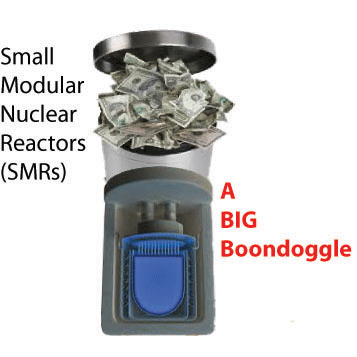 Power Magazine, 03/16/2017 | Aaron Larson The Nuclear Regulatory Commission (NRC) has accepted NuScale Power’s small modular reactor (SMR) design certification application and will provide a design review schedule soon.
The NRC’s acceptance marks a major milestone for the first SMR design to ever attempt obtaining U.S. certification. NuScale, in which Fluor Corp. is a majority investor, submitted its application on January 12.
The certification process can take several years. The NRC set a 40-month target for completion, NuScale said. During that time, the NRC studies the reactor design to determine if it meets U.S. safety requirements. If a certification is issued, it is valid for 15 years and companies can reference the certified design when applying for combined licenses……http://www.powermag.com/nrc-accepts-nuscale-small-modular-reactor-design-certification-application/
Defector’s ‘Astounding’ Theories About A Potential North Korean Nuclear Apocalypse Discredited
http://dailycaller.com/2017/03/16/defectors-astounding-theories-about-a-potential-north-korean-nuclear-apocalypse-discredited/ RYAN PICKRELL A high-ranking North Korean defector believes the North intends to test a nuclear bomb over a dozen times larger than anything it has previously tested, but that theory is a bit off.
1 This Month

of the week – Shut Down Drone Warfare!


Tell the Ukrainian Government to Drop Prosecution of Peace Activist Yurii Sheliazhenko

Petition to revoke the licensing of the Near Surface Nuclear Disposal Facility (NSDF) at Chalk River. https://www.ourcommons.ca/petitions/en/Petition/Details?Petition=e-7247
To see nuclear-related stories in greater depth and intensity – go to https://nuclearinformation.wordpress.com
-
Archives
- April 2026 (19)
- March 2026 (251)
- February 2026 (268)
- January 2026 (308)
- December 2025 (358)
- November 2025 (359)
- October 2025 (376)
- September 2025 (257)
- August 2025 (319)
- July 2025 (230)
- June 2025 (348)
- May 2025 (261)
-
Categories
- 1
- 1 NUCLEAR ISSUES
- business and costs
- climate change
- culture and arts
- ENERGY
- environment
- health
- history
- indigenous issues
- Legal
- marketing of nuclear
- media
- opposition to nuclear
- PERSONAL STORIES
- politics
- politics international
- Religion and ethics
- safety
- secrets,lies and civil liberties
- spinbuster
- technology
- Uranium
- wastes
- weapons and war
- Women
- 2 WORLD
- ACTION
- AFRICA
- Atrocities
- AUSTRALIA
- Christina's notes
- Christina's themes
- culture and arts
- Events
- Fuk 2022
- Fuk 2023
- Fukushima 2017
- Fukushima 2018
- fukushima 2019
- Fukushima 2020
- Fukushima 2021
- general
- global warming
- Humour (God we need it)
- Nuclear
- RARE EARTHS
- Reference
- resources – print
- Resources -audiovicual
- Weekly Newsletter
- World
- World Nuclear
- YouTube
-
RSS
Entries RSS
Comments RSS
 nuclear-news