Bogus claims made for Transatomics’ molten salt nuclear reactor
Molten Salt Reactor Claims Melt Down Under Scrutiny 03/08/2017 more http://www.powermag.com/blog/molten-salt-reactor-claims-melt-down-under-scrutiny/ Kennedy Maize It was an astonishing event when two MIT nuclear engineering graduate students at the end of 2015 announced they had come up with a revolutionary design for a molten salt nuclear reactor that could solve many of the technological problems of conventional light-water 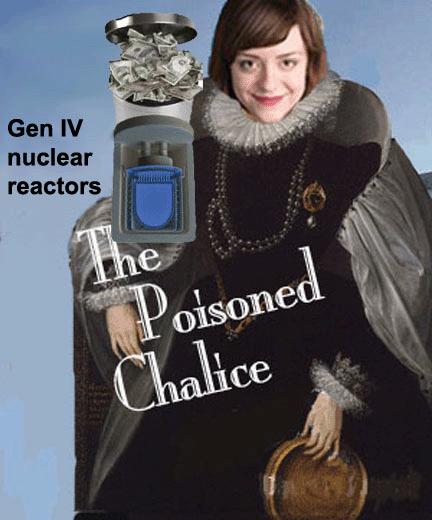 reactors. Cofounders of the firm Transatomic – Leslie Dewan and Mark Massie – hyped their technology as able to run on conventional spent fuel, and “generate up to 75 times more electricity per ton of mined uranium than a light-water reactor.”
Their claims surfaced in MIT’s highly regarded magazine, Technology Review, under the headline, “What if we could build a nuclear reactor that costs half as much, consumes nuclear waste, and will never melt down?”
Dewan and Massie raised millions of dollars in venture capital, including a chunk of Peter Theil’s Founders Fund. Transatomic said it would have a demonstration reactor in operation by 2020. The entrepreneurs touted their technology, which had its roots in work of the legendary Alvin Weinberg at Oak Ridge National Laboratory in the 1950s, as passively safe and more efficient than conventional nuclear generating technology.
Then it came under scrutiny from the MIT nuclear graybeards. The grad students got it wrong. Very wrong.
Transatomic’s response: Never mind.
The hyped claims for the technology prompted MIT physics professor Kord Smith to raise his eyebrows. As Technology Review reported, somewhat shamefacedly, Smith thought the claims for the technology were bogus, based on the physics, notified the MIT hierarchy, and launched an inquiry. The magazine quoted him, “I said this is obviously incorrect based on basic physics.” He asked the company to run a test, which ended up confirming that “their claims were completely untrue.”
Transatomic recalculated its hyperbolic claims, and posted the results. It concluded that “75 times” was fantastic, and the real figure was “twice,” still a worthwhile increase in fuel efficiency, but hardly earth shattering. The new analysis also concluded that the technology could not use spent fuel to power its reactor technology, undercutting a major claimed advantage for the technology.
Founder Leslie Dewan told Technology Review that she now hopes to develop a demonstration reactor by 2021. But any advanced technology of this sort that meets Nuclear Regulatory Commission rules would be decades away.
Was this hyperbolic advancement of the venerable molten salt technology intentional? MIT’s Smith, who blew the whistle on the claims, says it was innocent. The founders didn’t subject their initial calculations and claims to any kind of peer review. Smith told Technology Review, “They didn’t do any of this intentionally. It was just a lack of experience and perhaps overconfidence in their own ability. And then not listening carefully enough when people were questioning the conclusions they were coming to.”
In other words, this was another case of technology hubris, an all-to-common malady in energy, where hyperbolic claims are frequent and technology journalists all too credulous.
No comments yet.
1 This Month

of the week – Shut Down Drone Warfare!


Tell the Ukrainian Government to Drop Prosecution of Peace Activist Yurii Sheliazhenko

Petition to revoke the licensing of the Near Surface Nuclear Disposal Facility (NSDF) at Chalk River. https://www.ourcommons.ca/petitions/en/Petition/Details?Petition=e-7247
To see nuclear-related stories in greater depth and intensity – go to https://nuclearinformation.wordpress.com
-
Archives
- April 2026 (68)
- March 2026 (251)
- February 2026 (268)
- January 2026 (308)
- December 2025 (358)
- November 2025 (359)
- October 2025 (376)
- September 2025 (257)
- August 2025 (319)
- July 2025 (230)
- June 2025 (348)
- May 2025 (261)
-
Categories
- 1
- 1 NUCLEAR ISSUES
- business and costs
- climate change
- culture and arts
- ENERGY
- environment
- health
- history
- indigenous issues
- Legal
- marketing of nuclear
- media
- opposition to nuclear
- PERSONAL STORIES
- politics
- politics international
- Religion and ethics
- safety
- secrets,lies and civil liberties
- spinbuster
- technology
- Uranium
- wastes
- weapons and war
- Women
- 2 WORLD
- ACTION
- AFRICA
- Atrocities
- AUSTRALIA
- Christina's notes
- Christina's themes
- culture and arts
- Events
- Fuk 2022
- Fuk 2023
- Fukushima 2017
- Fukushima 2018
- fukushima 2019
- Fukushima 2020
- Fukushima 2021
- general
- global warming
- Humour (God we need it)
- Nuclear
- RARE EARTHS
- Reference
- resources – print
- Resources -audiovicual
- Weekly Newsletter
- World
- World Nuclear
- YouTube
-
RSS
Entries RSS
Comments RSS
 nuclear-news
Leave a comment