It’s now time to work for climate adaptation and social justice
The pressing priority is always to pull down emissions. Climate change is portrayed a future threat and our responsibility to act is framed in reference to our children and grandchildren. If environmental ruin is already here, it is deemed marginal compared to the tempests amassing on the horizon.
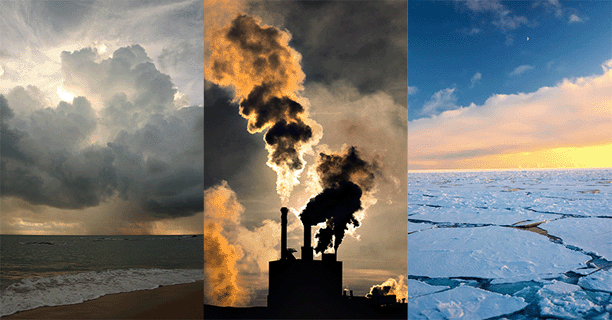
But this uneven focus on the future understates the gravity of present impacts. Today, climate change accounts for 87 per cent of disasters worldwide. Some of the worst droughts in decades are continuing to unravel across southeastern Africa and Latin America. Cyclonic storms, floods, wildfires, and landslides are bearing on the world’s most vulnerable populations.
The sudden violence of disasters is paralleled by the brutality of gradual change. Coastlines are being shaved and eroded by rising tides. The encroachment of sea water is increasing the salinity of littoral lands, leaving them withered and infertile. Rain patterns are shifting, shattering the millions who rely on the sky for sustenance. Every second, one person is forced to flee their home due to extreme climactic conditions.
This context of daily displacement and desolation means that the fight to tackle climate change today is fundamentally a fight to determine the fatality of the future. Yet adaptation, the crucial tool in that fight, has been side-lined and neglected.
So what is adaptation?
Adaptation means preparing our society for the climatic threats it faces and will face, insofar as we can. It means weaving safety nets for the world’s most vulnerable populations. It means bolstering river embankments, introducing measures to prevent diseases, building water-resistant infrastructure, expanding storm sewers and water storage, extending insurance, implementing disaster early-warning systems, and introducing a range of measures to palliate damage.
Some adaptation initiatives are already underway. From the Cook Islands to Morocco, farmers are adjusting practices and diversifying crops, to create a more climate-resilient agriculture. Current agricultural models, where monocultures breed vulnerability, are being transformed into biodiverse agrosystems.
In flood-prone areas, like Delaware, urban planners and citizens are reengineering and redesigning neighbourhoods to reduce the risk of inundation and future sea level rise. In urban areas prone to intense heat, like the Indian city of Ahmedabad (which lost 1,300 citizens to a 2010 extreme heat wave), municipal officials are implementing heat action plans which train health workers, distribute cooling supplies, open public areas for shade, and raise public awareness.
In some areas, the only plausible form of adaptation is abandon. In Fiji, villages such as Vunidogola are already being relocated after Cyclone Winston and other disasters devastated a number of settlements – while rising sea levels provide an additional layer of risk. The Fijian state has listed relocation as a top priority for the government.
A decade ago, the Maldivian government also organized a ‘staged retreat’, concentrating populations away from secluded islands threatened by rising sea levels. In Alaska, the citizens of Newtok have applied for federal disaster relief to finance their own relocation, as thawing permafrost erodes the land under their feet, pulling the village towards the Ninglick River. In China, the government has relocated over a million people away from areas governed by environmental hazards.
But adaptation is not just a technical exercise; it is also a struggle to shape what kind of world will greet the intensifying weather patterns of tomorrow. Whose lives will matter when the storms arrive? Will the seawalls we build to hold back the swelling tides be accompanied by walls to hold out those fleeing?
The challenge of adaptation directly exposes the climate crisis as a crisis of social justice. All disasters break open the wounds of unequal societies. Storms do not discriminate, but they do make landfall on landscapes riven by disparities of wealth, power and safety.
The labels of ‘natural disaster’ and ‘extreme weather’ can mislead us into thinking that the principal dangers we face stem from the atmosphere’s furies. But as geographer Jesse Ribot writes, ‘vulnerability does not fall from the sky.’ The wreckage of climate change is the product of collision: between environmental conditions and human realities.
This collision explains why women are far more likely than men to die in natural disasters and endure the slow violence of environmental degradation. It lies at the root of why ethnic minorities, the disabled, the silenced, and the neglected, are all disproportionately susceptible to the rigours of a changing climate.
Deep adaptation means challenging these inequities……….. https://newint.org/features/web-exclusive/2017/02/22/brace-for-impact-time-to-build-fight-for-climate-adaptation/
No comments yet.
1 This Month
Chernobyl: The Lost Tapes – A good documentary on Chernobyl on SBS available On Demand for the next 3 weeks– https://www.sbs.com.au/ondemand/tv-program/chernobyl-the-lost-tapes/2352741955560

of the week–London Campaign for Nuclear Disarmament

Tell the Ukrainian Government to Drop Prosecution of Peace Activist Yurii Sheliazhenko
To see nuclear-related stories in greater depth and intensity – go to https://nuclearinformation.wordpress.com
-
Archives
- April 2026 (126)
- March 2026 (251)
- February 2026 (268)
- January 2026 (308)
- December 2025 (358)
- November 2025 (359)
- October 2025 (376)
- September 2025 (257)
- August 2025 (319)
- July 2025 (230)
- June 2025 (348)
- May 2025 (261)
-
Categories
- 1
- 1 NUCLEAR ISSUES
- business and costs
- climate change
- culture and arts
- ENERGY
- environment
- health
- history
- indigenous issues
- Legal
- marketing of nuclear
- media
- opposition to nuclear
- PERSONAL STORIES
- politics
- politics international
- Religion and ethics
- safety
- secrets,lies and civil liberties
- spinbuster
- technology
- Uranium
- wastes
- weapons and war
- Women
- 2 WORLD
- ACTION
- AFRICA
- Atrocities
- AUSTRALIA
- Christina's notes
- Christina's themes
- culture and arts
- Events
- Fuk 2022
- Fuk 2023
- Fukushima 2017
- Fukushima 2018
- fukushima 2019
- Fukushima 2020
- Fukushima 2021
- general
- global warming
- Humour (God we need it)
- Nuclear
- RARE EARTHS
- Reference
- resources – print
- Resources -audiovicual
- Weekly Newsletter
- World
- World Nuclear
- YouTube
-
RSS
Entries RSS
Comments RSS
 nuclear-news
Leave a comment