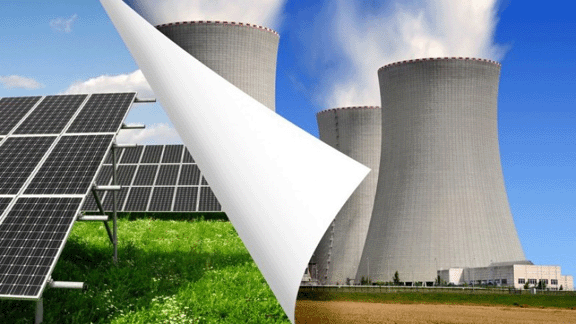
Delays of years in construction times and the doubling of costs, are the new normal, while the prices of low-carbon alternatives, wind and solar, which can be deployed in weeks rather than decades, have continued to fall. It is now clear that solar farms and wind turbines produce cheaper power than new nuclear will ever be able to. In some cases even old nuclear stations are so costly to run that new wind and solar are cheaper.

 Nuclear Revival Looks Bleak as Solar and Wind Costs Continue to Drop http://www.ecowatch.com/nuclear-revival-bleak-2188785870.html Climate News Network By Paul Brown, 12 Jan 17
The prospects for expansion of the nuclear industry worldwide look worse in 2017 than at any time since the first atom stations were built in the 1950s.
Toshiba, the giant Japanese company that owns the American reactor designer Westinghouse, is the latest company to face financial difficulties due to unforeseen cost overruns and delays that run into billions of dollars.
Westinghouse Electric’s troubles began after it bought construction contractor CB&I Stone & Webster and then had to write down the value of the acquisition by billions of dollars because of problems with building four new reactors for U.S. utilities.
Nuclear Problems
Électricité de France (EDF), the French company with ambitious plans to build four nuclear reactors in Britain, is in ever-deepening financial difficulties because it has failed to build new stations on time or on budget at Olkiluoto, Finland and Flamanville, in France. It is also embroiled in an ongoing scandal over faulty reactor parts.
Even Rosatom, the state-owned Russian company, keen to expand sales outside its own borders, is pegging back on its building plans at home. Alexander Lokshin, the first deputy director general, said on the company’s website that, because forecasts of energy use growth in Russia have proved to be inaccurate, the company had settled for life extensions of existing plants rather than a large program of building new ones.
While China and India continue to press ahead with nuclear projects, both countries are putting ever-greater effort into renewables, which provide much quicker returns. China has cut back on nuclear plans, but is continuing to build both its own home-grown designs and two reactors of EDF’s new design, which are still under construction although they should already be in operation.
South Korea seems to be the one bright spot for the industry. It now has 25 working reactors and is building more—including exporting four to be built at Barakah in the United Arab Emirates.
So while there are still plenty of reactors planned or under construction, they appear to be running late and over budget or are in countries where state ownership and subsidy props up the industry and disguises its flaws.
The industry is in most trouble in countries where nuclear has to compete on price with renewables and gas. Raising enough capital to build a nuclear station at market rates is no longer possible without state subsidy. In the European Union and the U.S., where a “free market” in electricity is supposed to prevail, government moves to boost the nuclear industry are increasingly controversial.
However, there are unlikely to be any bankruptcies. The governments of Japan, France and Britain will bail out these flagship companies because they employ far too many voters to let them fail. In addition, closing existing nuclear stations rapidly is technically difficult and would cause serious blackouts in France and possibly some neighboring countries.
But hopes of a nuclear renaissance now appear to be a pipe dream. This is partly because western companies have apparently failed to design new nuclear power stations that can be built on time and on budget.
Delays of years in construction times and the doubling of costs, are the new normal, while the prices of low-carbon alternatives, wind and solar, which can be deployed in weeks rather than decades, have continued to fall. It is now clear that solar farms and wind turbines produce cheaper power than new nuclear will ever be able to. In some cases even old nuclear stations are so costly to run that new wind and solar are cheaper.
Future of the Industry
The outcome of all this financial turmoil for the future of the industry is difficult to predict. It is probable that stations long under construction in the U.S., Finland, France and China, and due to be finished in the next two years, will be completed if no new technical problems arise. Starting them up will probably be a political rather than an economic decision.
But whether these companies embark on planned new constructions is the real issue. EDF continues with plans to build four European Pressurised Reactors in England, two at Hinkley Point in western England, which are supposed to be completed by 2025, and two more at Sizewell, east of London, where plans are still at the consultation stage. How the deeply indebted company will raise the finance for these projects is not clear.
Toshiba’s financial plight puts another British project, the plan to build three Westinghouse AP1000 reactors in north-west England, in jeopardy. With the company’s debts close to its value in equity, the company credit rating has been lowered. It is hard to see who will put up the enormous capital required to finance the building of three new reactors with designs that already have a dubious record on building times and cost overruns.
These seven giant reactor projects are the first of 10 planned for Britain. So far there has not been the slightest hint from either the companies or the UK government that the plans might need revision. Time will tell whether anyone will come up with the $50 billion in capital needed to build them.
January 13, 2017
Posted by Christina Macpherson |
2 WORLD, business and costs, renewable |
Leave a comment
 Global Photovoltaic Installation Market to Grow Nearly 11% through 2018 http://www.solarnovus.com/global-photovoltaic-installation-market-to-grow-nearly-11-through-2018_N10603.html 12 January 2017– Transparency Market Research announces the release of a new report titled “Solar Photovoltaic (PV) Installation Market Global Industry Analysis, Size, Share, Growth, Trends and Forecast, 2012 2018”. According to the report, the global solar photovoltaic installation market is anticipated to expand at a 10.70% CAGR from 2012 to 2018 to reach a value of US$145.9 bn by 2018.
Solar photovoltaic is an excellent source of renewable energy that presents higher efficiency output. This is a key factor driving the solar photovoltaic installation market. In addition, wide range of applications in different sectors, the rising awareness regarding the reduction of carbon footprint, government initiatives and schemes, low cost of installation and maintenance, and constantly evolving technologies have also driven the global solar photovoltaic installation market over the years. Asia Pacific presents strong potential for growth, according to the report. On the down side, limited life of batteries, wet climate in certain regions deteriorating the quality of solar panels, revised feed in tariffs, irregular intensities of solar radiations, and oversupply conditions in certain regions are some of the major challenges that the solar photovoltaic installation market faces.
In order to give readers a better understanding of the scope and dynamics of the solar photovoltaic installation market, the report studies the overall market by segmenting it on the basis of grid type, application, technology, and geography. Based on grid type, the solar photovoltaic installation market is bifurcated into off-grid solar PV and grid-connected solar PV. By technology, the market is segmented into thin film solar PV, crystalline silicon solar PV, and others such as organic solar PV and concentrator PV.
On the basis of application, the solar photovoltaic installation market is categorized into utility scale, commercial, and residential solar PV systems. The use of solar photovoltaic installations in the commercial and residential sectors has risen substantially over the past few years, with major installations in hotels, offices, and hospitals.Geographically, the global solar photovoltaic installation market is divided into Europe, the Middle East, and Africa (EMEA), Asia Pacific, North America, and the Rest of the World. Europe currently dominates the worldwide solar photovoltaic installation market. Asia Pacific is anticipated to witness considerable growth over the next three years owing to rising demand for solar PV systems in countries such as Japan, China, and India.
The research report features a detailed section on the competitive landscape of the solar photovoltaic installation market. Key players are identified and reviewed based on key criteria such as business overview, financial standing, recent developments, and business strategies. With the help of SWOT analysis, the strengths, weaknesses, opportunities, and threats of the major players are discussed. In addition, Porter’s Five Forces give readers a clear understanding of the impact of buyers, suppliers, competitors, substitutes, and new entrants on the overall vendor landscape.
The noteworthy players competing in the global solar photovoltaic installation market include Yingli Green Energy Holding Co. Ltd., Solar World AG, Trina Solar Ltd., Sun Power Corporation, Suntech Power Holding Co. Ltd., Jinko Solar Holding Company Ltd. Corporation, Schott Solar AG, Canadian Solar Inc., First Solar Inc., Solar Frontier Ltd., and Sharp Corporation.
January 13, 2017
Posted by Christina Macpherson |
2 WORLD, business and costs, renewable |
Leave a comment
Solar power to rise from Chernobyl’s nuclear ashes, Guardian, Kieran Cooke, 12 Jan 17
Chinese companies plan to spend $1bn building a giant solar farm on land contaminated by the nuclear disaster in Ukraine, reports Climate News Network It was the worst nuclear accident in history, directly causing the deaths of 50 people, with at least an additional 4,000 fatalities believed to be caused by exposure to radiation.
The 1986 explosion at the Chernobyl power plant in Ukraine also resulted in vast areas of land being contaminated by nuclear fallout, with a 30-kilometre exclusion zone, which encompassed the town of Pripyat, being declared in the area round the facility.
Now two companies from China plan to build a one-gigawatt solar power plant on 2,500 hectares of land in the exclusion zone to the south of the Chernobyl plant.
Ukrainian officials say the companies estimate they will spend up to $1bn on the project over the next two years…….
Radiation that escaped as a result of the explosion at Chernobyl reached as far away as the mountains and hills of Wales in the UK, and a substantial portion of the radioactive dust released fell on farmlands in Belarus, north of Ukraine.
Until now, the exclusion zone, including the town of Pripyat, has been out of bounds for most people, with only limited farming activity permitted on lands that are still regarded as contaminated.
Many former residents of the area are allowed back only once or twice a year for visits – to their old homes or to tend their relatives’ graves. …..
As yet, neither the Ukrainians nor the Chinese have disclosed the safety measures that will be adopted during the construction of the solar plant……https://www.theguardian.com/environment/2017/jan/12/solar-power-to-rise-from-chernobyls-nuclear-ashes
January 13, 2017
Posted by Christina Macpherson |
renewable, Ukraine |
Leave a comment
 Taiwan to end nuclear power generation by 2025 http://www.digitimes.com/news/a20170112VL201.html Adam Hwang, DIGITIMES, Taipei [Thursday 12 January 2017]
Taiwan’s legislature has amended the Electricity Act, ending nuclear power generation in the country by 2025 and liberalizing the local electricity market.
Taiwan currently has three operational nuclear power plants.
The amendments stipulate the state-run Taiwan Power Company (Taipower) go private and separate its business operations into independent electricity generation, distribution and sale business units in six to nine years.
The revamped law also gives renewable energy priority to go on grid and allows its direct sale from generators to users. Currently all electricity must be sold through Taipower.
The Taiwan government will establish an electricity price stabilization fund to prevent drastic fluctuations in electricity price.
January 13, 2017
Posted by Christina Macpherson |
politics, Taiwan |
Leave a comment
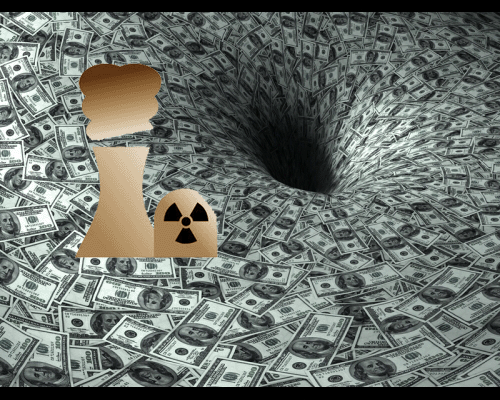
Toshiba Loses Billions On U.S. Nuclear Write-Offs http://oilprice.com/Alternative-Energy/Nuclear-Power/Toshiba-Loses-Billions-On-US-Nuclear-Write-Offs.html By Leonard Hyman & William Tilles – Jan 11, 2017 As a sort of financial casino, Wall Street permits its customers to indulge in all sorts of financial risk. Short selling, for example, betting on a stock’s decline as opposed to its rise. If you short at $10 and it goes to $2? Awesome. If it instead goes the other way, from $2 to $10, you just lost 5 times your principal.
But how can you lose several billion dollars, or ten times your principal investment, on a U.S. asset that you bought for $220 plus million? That’s the question that Toshiba executives are asking themselves.
The goodwill write off triggering this financial commotion relates to cost overruns at two U.S. nuclear construction sites, V.C Sumner and Vogtle in Georgia.
Toshiba, a titan of Japanese industry and owner of Westinghouse Electric dropped a bombshell on the stock market at the end of December and its stock fell by one third. The bond agencies cut Toshiba’s ratings, analysts wondered if the company would have any equity left and sources claimed that Toshiba was thinking of selling its most valuable subsidiary in order to fill the hole in its balance sheet.
This announcement comes in the wake of a previous accounting scandal in which Toshiba was accused of inflating profits. After that, Toshiba seemed ready to raise more equity capital but held off. Now it looks as if the company will have to raise more money on even more dilutive terms for existing shareholders.
What prompted the sudden announcement and what does that announcement mean to the nuclear sector? Let’s go back to 2015. In that year, Toshiba’s Westinghouse subsidiary bought Stone & Webster (S&W), the nuclear construction and services company, from Chicago Bridge & Iron (CBI). It paid $229 million in cash for S&W, and estimated that goodwill, subject to writeoff, was under $87 million, with that number to be determined by December 31, 2016. Near the end of December, Westinghouse informed its corporate parent, Toshiba that “the cost to complete U.S. projects will far surpass the original estimates…leading to a possible recognition of goodwill far exceeding the original…estimate…current estimation shows a level of…several billion U.S. dollars….”
Toshiba is one of a handful of nuclear engineering and manufacturing firms in the world. Its Westinghouse unit produces one of the approved designs (AP 1000) for U.S. construction. Toshiba also owns one of the nuclear construction sites in the UK. If a firm of this size and expertise is surprised by the cost of nuclear construction, that is not a good sign.
But from a financial perspective, if a firm of Toshiba’s size, and one of the premier nuclear engineering firms in the world, is in financial straits due to nuclear overruns, just how big and how accurate in project costing does a firm need to be to take on the risks of nuclear construction? Due to the size of the projects, no small firm can ever take them on. But will the point come when not even large firms execute a nuclear project unless an even larger entity, such as the federal government or the ratepayers over a wide area, guarantees payment of all cost overruns?
Toshiba’s difficulties may reverberate beyond Tokyo’s financial district. They call into question the ability of the most expert of firms to evaluate the risks of what has become bespoke nuclear construction. That will raise costs for new nuclear power since paying a return “of and on” capital is still its biggest cost.
January 13, 2017
Posted by Christina Macpherson |
business and costs, Japan, USA |
Leave a comment

 North Korea’s Nuclear Weapons: Under Kim Jong Un, Plutonium Stockpile Has Reached Unprecedented Levels, International Business Times, BY TIM MARCIN ON 01/12/17 In the past two years, North Korea has steadily increased its supply of plutonium and now has enough for 10 nuclear warheads, according to a report this week from the South Korean Ministry of National Defense. In all, South Korea’s 2016 Defense White Paper found that the North had increased its supply of weapons -grade plutonium to 50 kilograms, up from 40 kilograms two years ago, the Korea Times reported. The plutonium was obtained by reprocessing spent fuel rods.
Under the dictatorial rule of leader Kim Jong Un, North Korea has focused on developing its nuclear arsenal. More recently, North Korea has worked toward developing a reliable intercontinental ballistic missile (ICBM) that would be capable of carrying a nuclear warhead.
The increased stockpile comes amid continued threats from Kim. In a New Year’s speech, Kim provoked the West — the United States and South Korea especially — and claimed an ICBM was nearing completion…….
Should the North develop a reliable ICBM, it would likely have the capability of reaching the United States. A working ICBM could still be a ways off, however…….http://www.ibtimes.com/north-koreas-nuclear-weapons-under-kim-jong-un-plutonium-stockpile-has-reached-2474439
January 13, 2017
Posted by Christina Macpherson |
- plutonium, North Korea, weapons and war |
Leave a comment

 An engineer’s perspective on the Indian Point shutdown http://enformable.com/2017/01/an-engineers-perspective-on-the-indian-point-shutdown/?utm_source=feedburner&utm_medium=email&utm_campaign=Feed%3A+Enformable+%28Enformable%29 Author: Karl Grossman, 11 Jan 17
The good—the very good—energy news is that the Indian Point nuclear power plants 26 miles north of New York City will be closed in the next few years under an agreement reached between New York State and the plants’ owner, Entergy.
New York Governor Andrew Cuomo has long been calling for the plants to be shut down because, as the New York Times related in its story on the pact, they pose “too great a risk to New York City.” Environmental and safe-energy organizations have been highly active for decades in working for the shutdown of the plants. Under the agreement, one Indian Point plant will shut down by April 2020, the second by April 2021.
They would be among the many nuclear power plants in the U.S. which their owners have in recent years decided to close or have announced will be shut down in a few years.
This comes in the face of nuclear power plant accidents—the most recent the ongoing Fukushima nuclear disaster in Japan—and competitive power being less expensive including renewable and safe solar and wind energy.
Last year the Fort Calhoun nuclear plant in Nebraska closed following the shutdowns of Kewanee in Wisconsin, Vermont Yankee in Vermont, Crystal River 3 in Florida and both San Onofre 2 and 3 in California. Nuclear plant operators say they will close Palisades in Michigan next year and then Oyster Creek in New Jersey and Pilgrim in Massachusetts in 2019 and California’s Diablo Canyon 1 in 2024 and Diablo Canyon 3 in 2025.
This brings the number of nuclear plants down to a few more than 90—a far cry from President Richard Nixon’s scheme to have 1,000 nuclear plants in the U.S. by the year 2000.
But the bad—the very bad—energy news is that there are still many promoters of nuclear power in industry and government still pushing and, most importantly, the transition team of incoming President Donald Trump has been “asking for ways to keep nuclear power alive,” as Bloomberg news reported last month.
As I was reading last week the first reports on the Indian Point agreement, I received a phone call from an engineer who has been in the nuclear industry for more than 30 years—with his view of the situation.
The engineer, employed at nuclear plants and for a major nuclear plant manufacturer, wanted to relate that even with the Indian Point news—“and I’d keep my fingers crossed that there is no disaster involving those aged Indian Point plants in those next three or four years”—nuclear power remains a “ticking time bomb.” Concerned about retaliation, he asked his name not be published.
Here is some of the information he passed on—a story of experiences of an engineer in the nuclear power industry for more than three decades and his warnings and expectations.
THE SECRETIVE INPO REPORT SYSTEM
Several months after the accident at the Three Mile Island nuclear plant in Pennsylvania in March 1979, the nuclear industry set up the Institute of Nuclear Power Operations (INPO) based in Atlanta, Georgia. The idea was to have a nuclear industry group that “would share information” on problems and incidents at nuclear power plants, he said.
If there is a problem at one nuclear power plant, through an INPO report it is communicated to other nuclear plant operators. Thus the various plant operators could “cross-reference” happenings at other plants and determine if they might apply to them.
The reports are “coded by color,” explained the engineer. Those which are “green” involve an incident or condition that might or might not indicate a wider problem. A “yellow” report is on an occurrence “that could cause significant problems down the road.” A “red” report is the most serious and represents “a problem that could have led to a core meltdown”—and could be present widely among nuclear plants and for which action needs to be taken immediately.
The engineer said he has read more than 100 “Code Red” reports. What they reflect, he said, is that “we’ve been very, very lucky so far!”
If the general public would see these “red” reports, its view on nuclear power would turn strongly negative, said the engineer.
But this is prevented by INPO, “created and solely funded by the nuclear industry,” thus its reports “are not covered by the U.S. Freedom of Information Act and are regarded as highly secretive.” The reports should be required to be made public, said the engineer. “It’s high time the country wakes up to the dangers we undergo with nuclear power plants.”
THE NRC INSPECTION FARCE
The U.S. Nuclear Regulatory Commission (NRC) is supposed to be the federal agency that is the watchdog over nuclear power plants and it frequently boasts of how it has “two resident inspectors” at each nuclear power plant in the nation, he noted.
However, explained the engineer, “the NRC inspectors are not allowed to go into the plant on their own. They have to be escorted. There can be no surprise inspections. Indeed, the only inspections that can be made are those that come after the NRC inspectors “get permission from upper management at the plant.”
The inspectors “have to contact upper management and say they want to inspect an area. The word is then passed down from management that inspectors are coming—so ‘clean up’ whatever is the situation is.”
“The inspectors hands are tied,” said the engineer.
THE 60- AND NOW 80-YEAR OPERATING DELUSION
When nuclear power plants were first designed decades ago, explained the engineer, the extent of their mechanical life was established at 40 years. The engineer is highly familiar with these calculations having worked for a leading manufacturer of nuclear plants, General Electric.
The components in nuclear plants, particularly their steel parts, “have an inherent working shelf life,” said the engineer.
In determining the 40-year total operating time, the engineer said that calculated were elements that included the wear and tear of refueling cycles, emergency shutdowns and the “nuclear embrittlement from radioactivity that impacts on the nuclear reactor vessel itself including the head bolts and other related piping, and what the entire system can handle. Further, the reactor vessel is the one component in a nuclear plant that can never be replaced because it becomes so hot with radioactivity. If a reactor vessel cracks, there is no way of repairing it and any certainty of containment of radioactivity is not guaranteed.”
Thus the U.S. government limited the operating licenses it issued for all nuclear power plants to 40 years. However, in recent times the NRC has “rubber-stamped license extensions” of an additional 20 years now to more than 85 of the nuclear plants in the country—permitting them to run for 60 years. Moreover, a push is now on, led by nuclear plant owners Exelon and Dominion, to have the NRC grant license extensions of 20 additional years—to let nuclear plants run for 80 years.
Exelon, the owner of the largest number of nuclear plants in the U.S., last year announced it would ask the NRC to extend the operating licenses of its two Peach Bottom plants in Pennsylvania to 80 years. Dominion declared earlier that it would seek NRC approval to run its two Surry nuclear power plants in Virginia for 80 years.
“That a nuclear plant can run for 60 years or 80 years is wishful thinking,” said the engineer. “The industry has thrown out the window all the data developed about the lifetime of a nuclear plant. It would ignore the standards to benefit their wallets, for greed, with total disregard for the country’s safety.”
The engineer went on that since “Day One” of nuclear power, because of the danger of the technology, “they’ve been playing Russian roulette—putting one bullet in the chamber and hoping that it would not fire. By going to 60 years and now possibly to 80 years, “they’re putting all the bullets in every chamber—and taking out only one and pulling the trigger.”
Further, what the NRC has also been doing is not only letting nuclear plants operate longer but “uprating” them—allowing them to run “hotter and harder” to generate more electricity and ostensibly more profit. “Catastrophe is being invited,” said the engineer.
THE CARBON-FREE MYTH
A big argument of nuclear promoters in a period of global warming and climate change is that “reactors aren’t putting greenhouse gases out into the atmosphere,” noted the engineer.
But this “completely ignores” the “nuclear chain”—the cycle of the nuclear power process that begins with the mining of uranium and continues with milling, enrichment and fabrication of nuclear fuel “and all of this is carbon intensive.” There are the greenhouse gasses discharged during the construction of the steel and formation of the concrete used in nuclear plants, transportation that is required, and in the construction of the plants themselves.
“It comes back to a net gain of zero,” said the engineer.
Meanwhile, “we have so many ways of generating electric power that are far more truly carbon-free.”
THE BOTTOM LINE
“The bottom line,” said the engineer, “is that radioactivity is the deadliest material which exists on the face of this planet—and we have no way of controlling it once it is out. With radioactivity, you can’t see it, smell it, touch it or hear it—and you can’t clean it up. There is nothing with which we can suck up radiation.”
Once in the atmosphere—once having been emitted from a nuclear plant through routine operation or in an accident—“that radiation is out there killing living tissue whether it be plant, animal or human life and causing illness and death.”
What about the claim by the nuclear industry and promoters of nuclear power within the federal government of a “new generation” of nuclear power plants that would be safer? The only difference, said the engineer, is that it might be a “different kind of gun—but it will have the same bullets: radioactivity that kills.”
The engineer said “I’d like to see every nuclear plant shut down—yesterday.”
In announcing the agreement on the closing of Indian Point, Governor Cuomo described it as a “ticking time bomb.” There are more of them. Nuclear power overall remains, as the experienced engineer from the nuclear industry said, a “ticking time bomb.”
And every nuclear power plant needs to be shut down.
January 13, 2017
Posted by Christina Macpherson |
climate change, politics, Reference, safety |
Leave a comment
France, which owns 87% of Areva, said it would offer €4.5 per Areva SA share to minority investors which include Kuwait’s investment fund and French energy group Total Paris: France will buy out minority shareholders in Areva and delist the troubled nuclear group, the government said on Wednesday as talks with potential investors in a new nuclear fuel company being spun out of Areva neared a conclusion.
The state, which owns 87% of Areva, said it would offer €4.5 per Areva SA share to minority investors which include Kuwait’s investment fund, French utility EDF and French energy group Total.
Areva’s shares have fallen by as much as 90% from their 2007 highs as the group chalked up repeated losses. The stock was suspended on Tuesday at €5.2.
European Union (EU) antitrust regulators approved the French government’s plan to inject €4.5 billion ($4.8 billion) into Areva on Tuesday, saying the rescue would not unduly distort competition.
The ruling will allow Areva, whose capital has been wiped out by years of losses, to restart as a smaller firm focused on uranium mining and nuclear fuel production and recycling.
Legacy Areva SA—the firm left over after this split and the sale of Areva’s reactor unit to state-controlled EDF—will get a €2 billion capital increase and will hold the liabilities related to the troubled Olkiluoto 3 project in Finland, which has been hit by delays.
Areva said negotiations with unspecified investors in the new company were being finalised. It said last month that two investors have made a €500 million ($526.40 million) offer for a combined 10% stake in the new entity.
Paris: France will buy out minority shareholders in Areva and delist the troubled nuclear group, the government said on Wednesday as talks with potential investors in a new nuclear fuel company being spun out of Areva neared a conclusion.
The state, which owns 87% of Areva, said it would offer €4.5 per Areva SA share to minority investors which include Kuwait’s investment fund, French utility EDF and French energy group Total.
Areva’s shares have fallen by as much as 90% from their 2007 highs as the group chalked up repeated losses. The stock was suspended on Tuesday at €5.2.
European Union (EU) antitrust regulators approved the French government’s plan to inject €4.5 billion ($4.8 billion) into Areva on Tuesday, saying the rescue would not unduly distort competition.
The ruling will allow Areva, whose capital has been wiped out by years of losses, to restart as a smaller firm focused on uranium mining and nuclear fuel production and recycling.
Legacy Areva SA—the firm left over after this split and the sale of Areva’s reactor unit to state-controlled EDF—will get a €2 billion capital increase and will hold the liabilities related to the troubled Olkiluoto 3 project in Finland, which has been hit by delays.
Areva said negotiations with unspecified investors in the new company were being finalised. It said last month that two investors have made a €500 million ($526.40 million) offer for a combined 10% stake in the new entity.
A person familiar with the situation said the two investors are Japan’s Mitsubishi Heavy Industries and JNFL. Talks are continuing with China’s National Nuclear Corporation about also taking a minority stake.
“These talks are continuing and focus on governance issues, and on the issue of the balance between the different third-party investor parties,” French industry minister Christophe Sirugue told Reuters in an interview.
Sirugue, who said he had discussed the governance issue with Chinese vice-premier Ma Kai during his visit to France in November, added that the make-up of the board of the new company is another important issue in the talks. Reuters
January 13, 2017
Posted by Christina Macpherson |
business and costs, France, politics |
Leave a comment

 The F-35 may carry one of the US’s most polarising nuclear weapons sooner than expected http://www.businessinsider.com.au/f-35-b-61-nuclear-bomb-sooner-than-expected-2017-1?r=US&IR=T ALEX LOCKIE JAN 13, 2017 The Air Force designed the F-35A with nuclear capability in mind, and a new report indicates that the Joint Strike Fighter may carry nuclear weapons sooner than expected.
The Air Force originally planned to integrate nuclear weapons in the F-35 between 2020-2022, but Air Force Brig. Gen. Scott Pleus told Defensetech.org that “it would definitely be possible,” to hasten the deployment of B-61 nuclear gravity bombs on the F-35 should the need for it arise.
As it stands, the B-61’s “military utility is practically nil,” wrote General James Cartwright, former vice chairman of the Joint Chiefs of Staff in 2012. The B-61s “do not have assigned missions as part of any war plan and remain deployed today only for political reasons within the NATO alliance,” Cartwright continued.
Currently among fighter jets, only the F-15E and F-16C carry the B-61. Neither of these planes can penetrate contested enemy airspace, so they could only drop the gravity bomb on an area unprotected by air defences.
The F-35, a polarising defence project in its own right, could change that with its stealth capabilities. However, President-elect Trump has voiced concerns about the F-35 project while simultaneously stressing that the US needs to “expand its nuclear capability.”
Immediately this lead to talk of a new nuclear arms race, much to the horror of nuclear experts and non-proliferation advocates. The fact is that Russia and the US already have more nuclear weapons than necessary to meet their strategic needs.
Additionally, nuclear modernisation is due to cost the US hundreds of billions of dollars in the coming decades, and around a trillion dollars in total.
But not only do experts find nuclear expansion costly and unnecessary, they also find it dangerous.
The US has 180 B-61 nuclear bombs stationed in five bases throughout Europe. Russian intelligence services monitor deployments of fighter jets across Europe, and the fact that the F-15E and F-16C regularly deploy to these bases could lead to a catastrophic misinterpretation.
Kingston Reif, the director for Disarmament and Threat Reduction Policy at the Arms Control Association, told Business Insider that the US “should be seeking to strengthen the dividing line between nuclear and conventional weapons, not blur that line” by certifying additional fighter jets to carry nuclear weapons.
F-35s, with their excellent stealth attributes, taking off from European bases that may or may not house the B-61s (it would be extremely difficult for Russia to know) and flying near Russia’s borders could put Moscow on high alert. This could even potentially spook the Kremlin into launching an attack on the US.
Furthermore, the B-61s are low-yield bombs, meaning they don’t pack much of a punch. In the event of an actual nuclear conflict, “the likely hood is that we’re going to use the big bombs, and not the little bombs,” Laicie Heely of the nonpartisan Stimpson Center think tank points out.
So while the F-35 may provide a stealthy, sleek new delivery method for nuclear bombs, they may destabilize already fraught relations between the world’s two greatest nuclear powers — Russia and the US.
“There can be no winners in a nuclear war and that as long as each side has nuclear weapons, strategic stability will remain central to their bilateral relations,” Reif said of US-Russian relations.
January 13, 2017
Posted by Christina Macpherson |
USA, weapons and war |
1 Comment
 Massachusetts judge requires Exxon to hand over climate documents, Reuters 11 Jan 17
 A Massachusetts judge has refused to excuse Exxon Mobil Corp from a request by the state’s attorney general to hand over decades worth of documents on its views on climate change, state officials said on Wednesday.
The decision by Massachusetts Superior Court Judge Heidi Brieger denying Exxon’s request for an order exempting it from handing over the documents represents a legal victory for Attorney General Maura Healey, who is investigating the world’s largest publicly traded oil company’s climate policies.
“This order affirms our longstanding authority to investigate fraud,” Healey said on Twitter following the decision, adding that Exxon “must come clean about what it knew about climate change.”……
The investigations follow separate reports by online news publication Inside Climate News and the Los Angeles Times showing that Exxon worked to play down the risks of climate change despite its own scientists’ having raised concerns about it decades earlier.
The news came on the day former Exxon Chief Executive Rex Tillerson faced a U.S. Senate confirmation hearing on his nomination to serve as President-elect Donald Trump’s secretary of state…….http://www.reuters.com/article/us-exxon-mobil-massachusetts-idUSKBN14W04Z
January 13, 2017
Posted by Christina Macpherson |
climate change, Legal, USA |
Leave a comment
Mattis strikes sharp contrast to Trump on F-35, nuclear weapons 12 JANUARY, 2017: FLIGHTGLOBAL.COM BY: LEIGH GIANGRECO WASHINGTON DC
Donald Trump’s nominee for secretary of defense supports Lockheed Martin’s F-35 Joint Strike Fighter programme, the NATO alliance and restrained use of nuclear weapons during his confirmation hearing, marking a stark departure from the president-elect……..https://www.flightglobal.com/news/articles/mattis-strikes-sharp-contrast-to-trump-on-f-35-nuc-433139/
January 13, 2017
Posted by Christina Macpherson |
politics, USA, weapons and war |
Leave a comment
Tillerson and Trump at odds on nuclear http://www.news.com.au/world/breaking-news/tillerson-and-trump-at-odds-on-nuclear/news-story/20c6219abce5929b3aa29ef8f2095b8d JANUARY 12, 2017
US Secretary of State nominee Rex Tillerson says that he doesn’t agree with President-elect Donald Trump’s comments that it would not be a bad thing if other countries, including Japan, acquired nuclear weapons.
Asked by Democratic Senator Edward Markey about Trump’s comments, Tillerson said during his Senate confirmation hearing that he did not think anyone would advocate for more nuclear weapons on the planet.
Pressed further by Markey on whether he agreed with Trump’s remarks, Tillerson replied: “I do not agree.”
January 13, 2017
Posted by Christina Macpherson |
politics, USA |
Leave a comment
Tillerson Backs Paris Climate Agreement At Confirmation Hearing http://oilprice.com/Latest-Energy-News/World-News/Tillerson-Backs-Paris-Climate-Agreement-At-Confirmation-Hearing.html By Irina Slav Oilprice.com Jan 12, 2017, Secretary of State nominee Rex Tillerson said during his Senate confirmation hearing that the U.S. would be better off sticking with the Paris agreement to tackle climate change. His position stands in contrast to President-elect Donald Trump’s stated opposition to the agreement and his intention to break away from the agreement when he enters office.
Climate change was among the topics on which a 21-senator panel grilled Tillerson yesterday, and was also one of the topics on which his stance differed from that of Trump. Also among these were nuclear proliferation, and to a certain extent, Iran.
Asked to comment on Trump statements that he would not object if U.S. allies such as Japan, South Korea, and Saudi Arabia obtained nuclear weapons, Tillerson said that hardly anyone would advocate the global proliferation of nuclear weapons.
As for the Iran deal that several Western governments closed with Iran last year to deter the country from building its own nuclear weapons, Tillerson was wary in his approach, telling the Foreign Relations Committee he would recommend “a full review” of the deal.
Tillerson was also measured in his responses to questions concerning Russia and bilateral relations. Urged by Republican senator – and former Trump rival for the Republican presidential nomination – Marco Rubio to agree that Russia’s President Putin was a war criminal because of Russia’s involvement in Syria, Tillerson declined, saying these were “serious charges to make,” adding that he needed more information before reaching that determination.
Back to climate change and more specifically Exxon’s role in it and its alleged attempt to hide knowledge about the effect of human activity on climate, Tillerson referred the panel to Exxon itself. Asked whether he was unwilling to answer or rather lacking the knowledge that would allow him to do so, Tillerson responded with “A little of both.”
January 13, 2017
Posted by Christina Macpherson |
climate change, politics, USA |
Leave a comment
 Generators call New York nuclear subsidies an ‘existential threat’ to wholesale markets, Utility Dive by Robert Walton @TeamWetDog 12 Jan 17
Dive Brief:
January 13, 2017
Posted by Christina Macpherson |
business and costs, Legal, USA |
Leave a comment
Another Climate Change Push Comes From Exxon Shareholders, Inside Climate News,
Investors have introduced seven more resolutions, asking the company to address climate change and its risks, moving beyond Rex Tillerson’s resistant stance. David Hasemyer, 12 Jan 17
Once again this year, dissident ExxonMobil stockholders have filed several resolutions with the company asking it to be more forthright in addressing the climate crisis.
Submitted months before Exxon’s annual meeting in May, by a twist of fate it also helps set the stage for Wednesday, when Rex Tillerson, Exxon’s former chief executive and Donald Trump’s pick to become secretary of state, appears at a Senate confirmation hearing.
At the hearing, Tillerson’s critics are likely to connect the dots between his stance on climate change as the head of the oil giant and how he would approach the problem as the nation’s top diplomat, in light of the global climate treaty that Trump has opposed.
And that may mean Tillerson finds himself facing questions about the treaty’s goals that shareholders have pressed him about before.
Most of the seven shareholder resolutions filed under Exxon’s deadline in recent days resemble those the company vehemently opposed in recent years under Tillerson’s leadership.
They ask Exxon to add a board member with environmental expertise; disclose funding of lobbyists and organizations dedicated to influencing climate policy; and to explain in detail how the company might align its business with a low-carbon economy.
Exxon is expected to oppose those resolutions, as it has consistently for more than two decades…….. https://insideclimatenews.org/news/11012017/exxon-shareholders-climate-change-rex-tillerson
January 13, 2017
Posted by Christina Macpherson |
climate change, USA |
Leave a comment




 nuclear-news