Analysing the pros and cons of tax-payer subsidies for nuclear power
Nuclear power producers want government-mandated long-term contracts or other mechanisms that require customers to buy power from their troubled units at prices far higher than they would pay otherwise.
In California and in Nebraska, utilities plan to replace nuclear plants that are closing early for economic reasons almost entirely with electricity from carbon-free sources. Such transitions are achievable in most systems as long as the shutdowns are planned in advance to be carbon-free.
We should not rely further on the unfulfilled prophesies that nuclear lobbyists have deployed so expensively for so long.

 Should troubled nuclear reactors be subsidized? http://bangordailynews.com/2017/01/13/the-point/compete-or-suckle-should-troubled-nuclear-reactors-be-subsidized/ By Peter Bradford, The Conversation
Since the 1950s, U.S. nuclear power has commanded immense taxpayer and consumer subsidy based on promises of economic and environmental benefits. Many of these promises are unfulfilled, but new ones take their place and more subsidies follow.
Today, the nuclear industry claims that keeping all operating reactors running for many years, no matter how uneconomic they become, is essential in order to reach U.S. climate change targets.
Economics have always challenged U.S. reactors. After more than 100 construction cancellations and cost overruns costing up to $5 billion apiece, Forbes magazine in 1985 called nuclear power “the greatest managerial disaster in business history … only the blind, or the biased, can now think that most of the money [$265 billion by 1990] has been well spent.” U.S. Atomic Energy Commission Chair Lewis Strauss’ 1954 promise that electric power would be “ too cheap to meter” is today used to mock nuclear economics, not commend them.
As late as 1972, the Atomic Energy Commission forecast that the U.S. would have 1,000 power reactors by the year 2000. Today, we have 100 operating power reactors, down from a peak of 112 in 1990. Since 2012, power plant owners have retired five units and announced plans to close nine more. Four new reactors are likely to come on line. Without strenuous government intervention, almost all of the rest will close by midcentury. Because these recent closures have been abrupt and unplanned, the replacement power has come in substantial part from natural gas, causing a dismaying uptick in greenhouse gas emissions.
The nuclear industry, led by the forlornly named lobbying group Nuclear Matters, still obtains large subsidies for new reactor designs that cannot possibly compete at today’s prices. But its main function now is to save operating reactors from closure brought on by their own rising costs, by the absence of a U.S. policy on greenhouse gas emissions and by competition from less expensive natural gas, carbon-free renewables and more efficient energy use.
Only billions more dollars in subsidies and the retarding of rapid deployment of cheaper technologies can save these reactors. Only fresh claims of unique social benefit can justify such steps.
When I served on the U.S. Nuclear Regulatory Commission from 1977 through 1982, it issued more licenses than in any comparable period since. Arguments that the U.S. couldn’t avoid dependence on Middle Eastern oil and keep the lights on without a vast increase in nuclear power were standard fare then and throughout my 20 years chairing the New York and Maine utility regulatory commissions. In fact, we attained these goals without the additional reactors, a lesson to remember in the face of claims that all of today’s nuclear plants are needed to ward off climate change.
Nuclear power in competitive electricity markets
During nuclear power’s growth years in the 1960s and 1970s, almost all electric utility rate regulation was based on recovering the money necessary to build and run power plants and the accompanying infrastructure. But in the 1990s, many states broke up the electric utility monopoly model.
Now a majority of U.S. power generation is sold in competitive markets. Companies profit by producing the cheapest electricity or providing services that avoid the need for electricity.
To justify their current subsidy demands, nuclear advocates assert three propositions. First, they contend that power markets undervalue nuclear plants because they do not compensate reactors for avoiding carbon emissions or for other attributes such as diversifying the fuel supply or running more than 90 percent of the time.
Second, they assert that other low-carbon sources cannot fill the gap because the wind doesn’t always blow and the sun doesn’t always shine. So power grids will use fossil-fired generators for more hours if nuclear plants close.
Finally, nuclear power supporters argue that these intermittent sources receive substantial subsidies while nuclear energy does not, thereby enabling renewables to underbid nuclear even if their costs are higher.
Nuclear power producers want government-mandated long-term contracts or other mechanisms that require customers to buy power from their troubled units at prices far higher than they would pay otherwise.
Providing such open-ended support will negate several major energy trends that currently benefit customers and the environment. First, power markets have been working reliably and effectively. A large variety of cheaper, more efficient technologies for producing and saving energy, as well as managing the grid more cheaply and cleanly, have been developed. Energy storage, which can enhance the round-the-clock capability of some renewables is progressing faster than had been expected, and it is now being bid into several power markets — notably the market serving Pennsylvania, New Jersey and Maryland.
Long-term subsidies for uneconomic nuclear plants also will crowd out penetration of these markets by energy efficiency and renewables. This is the path New York has taken by committing at least $7.6 billion in above-market payments to three of its six plants to assure that they operate through 2029.
Nuclear power versus other carbon-free fuels While power markets do indeed undervalue low-carbon fuels, all of the other premises underlying the nuclear industry approach are flawed. In California and in Nebraska, utilities plan to replace nuclear plants that are closing early for economic reasons almost entirely with electricity from carbon-free sources. Such transitions are achievable in most systems as long as the shutdowns are planned in advance to be carbon-free.
In California, these replacement resources, which include renewables, storage, transmission enhancements and energy efficiency measures, will for the most part be procured through competitive processes. Indeed, any state where a utility threatens to close a plant can run an auction to ascertain whether there are sufficient low-carbon resources available to replace the unit within a particular time frame. Only then will regulators know whether, how much and for how long they should support nuclear units.
If New York had taken this approach, each of the struggling nuclear units could have bid to provide power in such an auction. They might well have succeeded for the immediate future, but some or all would probably not have won after that.
Closing the noncompetitive plants would be a clear benefit to the New York economy. This is why a large coalition of big customers, alternative energy providers and environmental groups opposed the long-term subsidy plan.
The industry’s final argument — that renewables are subsidized and nuclear is not — ignores overwhelming history. All carbon-free energy sources together have not received remotely as much government support as has flowed to nuclear power.
Nuclear energy’s essential components — reactors and enriched uranium fuel — were developed at taxpayer expense. Private utilities were paid to build nuclear reactors in the 1950s and early 1960s, and received subsidized fuel. According to a study by the Union of Concerned Scientists, total subsidies paid and offered to nuclear plants between 1960 and 2024 generally exceed the value of the power that they produced.
The U.S. government also has pledged to dispose of nuclear power’s most hazardous wastes — a promise that has never been made to any other industry. By 2020, taxpayers will have paid some $21 billion to store those wastes at power plant sites.
Furthermore, under the 1957 Price-Anderson Act, each plant owner’s accident liability is limited to some $300 million per year, even though the Fukushima disaster showed that nuclear accident costs can exceed $100 billion. If private companies that own U.S. nuclear power plants had been responsible for accident liability, they would not have built reactors. The same is almost certainly true of responsibility for spent fuel disposal.
Finally, as part of the transition to competition in the 1990s, state governments were persuaded to make customers pay off some $70 billion in excessive nuclear costs. Today, the same nuclear power providers are asking to be rescued from the same market forces for a second time.
Christopher Crane, the president and CEO of Exelon, which owns the nation’s largest nuclear fleet, preaches temperance from a bar stool when he disparages renewable energy subsidies by asserting, “I’ve talked for years about the unintended consequences of policies that incentivize technologies versus outcomes.“
But he’s right about unintended and unfortunate consequences. We should not rely further on the unfulfilled prophesies that nuclear lobbyists have deployed so expensively for so long. It’s time to take Crane at his word by using our power markets, adjusted to price greenhouse gas emissions, to prioritize our low carbon outcome over his technology.
Peter Bradford is a the former chair of the Maine’s Public Utilities Commission and former U.S. Nuclear Regulatory commissioner. He also is on the board of the Union of Concerned Scientists. This piece was originally published on TheConversation.com.
Religious leaders of diverse faiths join together, saying that climate change is a moral issue

 Faith leaders reframe climate change as moral issue
Priests, pastors and ministers nationwide are spreading the gospel of climate change — as are imams and rabbis.
In recent years, faith-based advocacy has emerged as a powerful tool in the environmental movement. By reframing climate change and sustainability as moral issues, religious leaders hope to advance environmentalism by elevating it above the political fray.
“I believe that all religions, all faiths share a common goodness,” said Zerqa Abid, founder of My Project USA, a Muslim youth organization in Columbus. “All of us have to look within our houses, within our cities, in our everyday lives.
“We take care of the Earth, or we destroy it.”
Americans report fairly high levels of spirituality, but most do not view climate change as a moral issue, according to a 2015 survey by the Yale Program on Climate Change Communication.
Presenting climate change as a spiritual issue could be a successful strategy for attracting religious folks to environmental causes, the report suggests.
In Ohio, three-fourths of voters identify as religious, but little more than half say environmental laws are worth the cost, according to 2016 Pew Research Center surveys.
“Hitting people in the head with science doesn’t get them in the heart,” said Deborah Steele, fiscal officer for Clinton Township who previously worked for three years as an Ohio Interfaith Power and Light coordinator. “What gets people is a matter of conscience and not the logic of science.”
As leaders of intimate community spaces, religious officials are beginning to address the human-rights implications of climate change.
For example, exploitation of natural resources severely affects the world’s poorest populations and violates divine dictates on how people should treat the planet, said Rabbi Alex Braver of Tifereth Israel.
“The big-picture view, that’s what religion can offer,” Braver said. “I think (environmentalism) has very deep roots in ancient text and tradition, but it’s been lifted up in a different way now that we’re seeing the immense power we can have over the environment.”……….
At a rally on Monday, people from across several faiths and campaigns called on U.S. Sen. Rob Portman, a Republican from Ohio, to reject nominees for President-elect Donald Trump’s cabinet who deny climate change or come from the fossil-fuel industry.
Among the people who attended was Aline Yamada and her two children. Yamada, a Buddhist from Clintonville, said she feels a parallel between her beliefs and the protest’s message.
“We are all connected,” she said. “I think this is the biggest moral challenge of our time.” mrenault@dispatch.com
@MarionRenault http://www.dispatch.com/content/stories/local/2017/01/13/faith-leaders-reframe-climate-change-as-moral-issue.html#
Congressmen introduce Bill to allow high level nuclear trash to be sent to Andrews, New Mexico
 Conaway Introduces Bill to Add More Types of Nuke Waste at Dump in Andrews http://sanangelolive.com/ By Joe Hyde | Jan. 12, 2017
Washington, D.C. — Thursday, Congressman Mike Conaway (R-TX) and Congressman Darrell Issa (R-CA) introduced a bill that will, as Conway described it, pave a path forward for storage of the nation’s nuclear waste in Andrews.
The Texas Tribune reported in April 2016 that Waste Control Specialist, the company that owns the nuclear waste dump near Andrews and the Texas-New Mexico border, applied for the license to build and maintain a temporary storage site for the spent fuel.
“The Interim Consolidated Storage Act would allow the Department of Energy to use interest from the National Nuclear Fund to contract temporary storage facilities for spent nuclear fuel and could have the federal government begin collecting waste from nuclear facilities across the country in as little as five years,” Conaway stated in a release……..
The Andrews nuclear waste facility received approval to store radioactive waste in 2009. It is the only facility to obtain regulatory approval within the last 30 years to store Class A, B and C low-level radioactive waste.
Conaway’s bill is among many steps in approving the storage of “temporary” radioactive waste at the Andrews site. This type of waste is highly radioactive and originates as spent nuclear reactor fuel, according to reports. The WCS proposal requires the Department of Energy to assume the title and liability for the spent nuclear fuel stored at the site, Texas Tribune reported. Congressional approval is required for the DoE to do so. http://sanangelolive.com/news/business/2017-01-12/conaway-introduces-bill-add-more-types-nuke-waste-dump-andrews
Russia to lock Bangladesh into a 20 year big nuclear power debt
 Russia extends $11.38 bln loan to Bangladesh to build nuclear power plant http://tass.com/economy/925025 January 13 Bangladesh will repay the actually spent loan in equal six-month installments over a twenty year period MOSCOW, January 13. /TASS/. Russia’s government has extended a $11.38 billion loan to Bangladesh to build the Rooppur nuclear power plant. The relevant document was published on the government’s website containing legal information.
According to the draft inter-governmental agreement, the loan will be used from 2017 to 2024. Bangladesh will repay the actually spent loan in equal six-month installments over a twenty year period. The first installment will be paid out on March 15, 2017.
Two units of the Rooppur nuclear power plant, with a capacity of 1,200 MW each, which are being built with Russia’s assistance, are planned to be put into operation in 2022 and 2023.
In mid-December 2015, Russia’s Rosatom State Atomic Energy Corporation signed an EPC contract for a nuclear power plant in Bangladesh.
The construction work is being done in accordance with the inter-governmental agreement on cooperation in building a nuclear power plant in Bangladesh, dated 2011. The nuclear power plant will be located on the eastern bank of the Ganges River, 160 kilometers from the country’s capital of Dhaka.
12 Members of USA Congress urge President-Elect Trump to Prioritize Hanford Cleanup,
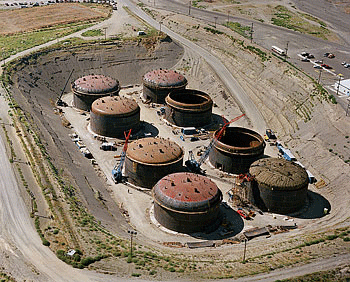 Washington Congressional Delegation Urges President-Elect Trump to Prioritize Hanford Cleanup, Worker Health, Tri-Cities’ Safety U>S> Senate Committee on Energy and National Resources, 9 Jan 2017
“This work is essential to protecting the health and safety of the Tri-Cities community, the Columbia River, Washington state and our nation.”
The letter provided essential background information on the cleanup and remediation operations at the site and emphasized the importance of worker safety and protecting communities in the Tri-Cities region and beyond. The senators and representatives called for the incoming administration’s full support for and attention to the Hanford cleanup mission.
The delegation noted that fully supporting Hanford means maintaining strong and predictable funding for vital cleanup work already underway at Hanford. This “enables progress and ensures our top priority—worker safety—is achieved while these dangerous cleanup operations take place,” said the members. “It is essential that the safety of the more than 9,000 workers come first as they are doing a remarkable job and their efforts keep surrounding communities safe.”
Trump-Pence Transition Office
1717 Pennsylvania Avenue NW
Washington, D.C. 20006
Dear President-elect Trump:
We write to share with you the importance of the U.S. Department of Energy’s (DOE) ongoing cleanup mission at the Hanford Nuclear Reservation in the State of Washington, a region that underwent dramatic transformation nearly 75 years ago to help the United States win World War II, and later the Cold War. We believe, with your strong support, we can continue the vital nuclear waste cleanup and environmental remediation work currently underway at Hanford. This work is essential to protecting the health and safety of the Tri-Cities community, the Columbia River, Washington state, and our nation from waste that was created from over 40 years of nuclear weapons production. Continued cleanup progress, along with strong and predictable funding, is crucial to the federal government fulfilling its legal and moral obligation to remediate the 54.6 million gallons of nuclear and radioactive waste currently stored at Hanford. Additionally, this vital cleanup mission is a top priority for the local communities and our constituents in Washington state, as well as to the strength of the local and regional economies. ……..
We look forward to discussing Hanford, ongoing cleanup work, and its importance to the Tri-Cities community and the Pacific Northwest with you and your Administration in more detail in the coming days and months. Together, we can ensure that the federal government fulfills its obligation through continued progress and safe remediation of the Hanford site.
Sincerely,
“Small” nuclear reactors are still pretty big, AND more expensive than large ones

He says NuScale wants to do things like reduce the size and strength of the reactor containment building and the number of personnel needed to operate the plant. “NuScale is proposing major reductions in all of these areas relative to current NRC requirements for large reactors, based on the assertion that the reactor will be safer,” he says.
European Union approves France’s massive subsidising of AREVA nuclear power industry!!
EU clears French rescue of troubled nuclear firm Areva http://www.business-standard.com/article/pti-stories/eu-clears-french-rescue-of-troubled-nuclear-firm-areva-117011001343_1.html AFP | Brussels January 10, 2017 EU anti-trust regulators today cleared the French government’s massive restructuring of troubled state-owned nuclear reactor builder Areva.
Problem-prone Areva, which is 87-per cent owned by the French state, has faced severe difficulties since 2011, when the Fukushima disaster in Japan called nuclear power generation into question across the world.

“The European Commission has concluded that French plans to grant a capital injection of 4.5 billion euros (USD 4.75 billion) to Areva are in line with EU state aid rules,” a statement said.
The Commission added that other regulatory decisions were still needed, including a greenlight by the EU on the buyout of Areva’s reactor business by EDF, the French state-owned electricity supplier. Areva’s woes were compounded by construction problems affecting its first EPR reactor in Finland — now expected to open nine years late in 2018 — putting company finances deep into the red.
In addition, Areva’s former CEO Anne Lauvergeon has been charged in a case linked to the company’s disastrous 2007 purchase of a Canadian uranium mining firm.
EDF, also majority-owned by the French state, agreed in June 2015 to purchase up to 75 per cent of Areva’s reactor unit at a valuation of around 2.7 billion euros, with the deal expected to be finalised in 2017.
France sees nuclear energy as a key national industry and the government has been closely involved in talks to restructure the sector.
The French state has already poured in billions to keep Areva afloat and thousands of French workers in their jobs.
Hungary’s nuclear regulator not independent, but European Commission approves its Russian-supplied nuclear reactors anyway

 Brussels unswayed by concerns over Hungarian nuclear project http://www.politico.eu/article/brussels-unswayed-by-concerns-over-hungarian-nuclear-project-paks-ii-tender/ Opponents are continuing to fight, but Budapest insists the reactors will be built. Kalina Oroschakoff and Sara Stefanini 1/13/17,
The European Commission is standing behind its approval of Hungary’s decision to buy two nuclear reactors from Russia for its Paks II power plant without holding a tender.
The Commission dismissed the concerns of environmental groups questioning the lack of a bidding process in a letter, saying the “arguments put forward did not provide new elements that would have led the Commission to reconsider its previous position.”
Hungary had argued that only Rosatom’s VVER-1200 reactors could fulfill all of its requirements for the project.
Under EU rules, competitive tenders can be skipped when “for technical reasons the contract may be executed only by a particular economic operator.” Hungary wouldn’t be the first country to make use of that rule. France’s EDF handed the contract to build a reactor at the Flamanville nuclear power plant to state-owned Areva in 2007, arguing it was the only company that could fulfill the technical requirements.
Critics, including Greenpeace and Hungarian Green MEP Benedek Jávor, complained that the Commission hasn’t given an explanation as to why only Russian technology could fulfill Hungary’s requirements. They also pointed out that Hungary had been thinking of holding a competitive bid for the contract before opting for the Russian reactors.
The letter from the Directorate-General for Internal Market, Industry, Entrepreneurship and SMEs said that although Hungary may have initially thought of holding a competitive process, nothing precluded it from concluding that “only the Russian technology could technically fulfill the final Hungarian requirements.”
The Commission still needs to give its final say on whether financial support for the €12 billion project breaches EU state aid rules; Moscow is financing 80 percent of the costs with a loan. However, Brussels is expected to grant its approval in the coming weeks.
Hungary’s nuclear law raises concerns
Despite the Commission’s refusal to block Paks, opponents of the project are continuing a broader fight over Hungary’s nuclear policies.
The parliament in December passed amendments allowing the government to seize powers from the Hungarian Atomic Energy Agency.
The move has raised worries that the new rules not only compromise the regulator’s independence but also enable the Hungarian government to change the license conditions the agency set for Paks II. Environmental groups worry that this essentially makes the government the funder, owner, operator and regulator of the nuclear power station.
A group of NGOs called on the International Atomic Energy Agency to raise concerns about the developments at its next meeting on nuclear safety in March and April.
Budapest dismissed the claims in a statement to POLITICO, calling them attempts “to provoke international tension related to Hungary’s pro-nuclear stance.”
The government said it has no plans to reverse course on Paks II, saying it “is necessary, and we shall realize it — despite opposition from anti-nuclear green organizations.”
Mich.’s reactor shutdown not sounding climate alarms
Nuclear Madness by Teresa May #StopMoorside

Hansard, 11 January 2017
Prime Minister’s Questions
https://hansard.parliament.uk/commons/2017-01-11/debates/4139811D-0756-4C58-827D-E00D1CCD970E/Engagements
· Mark Menzies (Fylde) (Con)
Q3. Westinghouse’s Springfields site in my constituency employs more than 1,200 people in highly skilled jobs manufacturing nuclear fuel, which generates 15% of the UK’s electricity. Does my right hon. Friend agree that the nuclear industry is of crucial importance to the north-west economy? Will she continue to support the construction of a new generation of nuclear power stations to guarantee jobs in the region? [908082]
· The Prime Minister
I certainly agree with my hon. Friend that new nuclear does have a crucial role to play in securing our future energy needs, especially as we are looking to move to a low-carbon society. The industrial strategy that the Government will be setting out will have a strong emphasis on the role of regions in supporting economic growth and ensuring that the economy works for everyone. Like…
View original post 45 more words
The risks of climate change, in a single graph

Destructive Climate Change Has Begun. What Comes Next?
GR: Global average temperature has risen a little more than .8 degrees Celsius since the late 1800’s. Most countries have agreed to hold temperature rise below two degrees. However, the current scientific consensus is that the CO2 and other greenhouse gasses already in the atmosphere will take the global average above 2 degrees. Climate scientists believe that without immediate major cutbacks, global average temperature will rise by 4 degrees, creating what some are calling “hell on earth.” They further warn that with the proposed gradual cutbacks agreed to by most countries, global average temperature will rise by at least 6 degrees this century. No longer just hell on earth, by 2100, 83 years from now, much of the planet will simply be uninhabitable. Between now and then, extreme heatwaves, increased sea level, and massive storms will force hundreds of millions of people…
View original post 413 more words
January 13 Energy News

Science and Technology:
¶ In 2017, a high-tech ocean vessel powered by the sun, wind
and sea water will start a 6 year journey, visiting 50 countries. The vessel is powered by 130 square meters of solar panels, two vertical axis wind turbines, two electric motors and equipment for electrolysis, which will use sea water to create hydrogen fuel. [Energy Matters]
 Energy Observer (Image: Energy Observer)
¶ According to the climate models used by researchers at UMass Amherst, the 48 contiguous US states are projected to cross the 2° C warming threshold about 10 to 20 years earlier than the global mean annual temperature. The Northeast is projected to warm by 3° C (5.2° F) by the time global warming reaches 2° C (3.6° F). [Fusion]
World:
¶ Senvion has signed a contract with Innogy Renewables UK
Ltd to supply 16 wind turbines from its 2-MW…
View original post 772 more words
Agricultural & Economic risk due to Climate Change #auspol

Agricultural risks associated with extreme event and climate and economic risks—
In the agriculture sector typical risks are yield losses due to bad weather, pests and diseases; post-harvest losses during storage and transport; unexpectedly low market prices, as well as further supply chain issues, affecting logistics and food security across many parts of the world.
The IPCC’s Special Report on Managing the Risks of Extreme Events and Disasters to Advance Climate Change Adaptation (IPCC, 2012) illustrates past and projected impacts across different regions, for example:
-

Africa is particularly exposed, as 50 per cent of its total export value is based on agriculture.
As an example, the projections of climate change impacts for Namibia indicate annual losses of 1 to 6 per cent of GDP by 2050, with livestock production, traditional agriculture, and fishing expected to be hardest hit, with a combined loss of USD 461 to 2,045 million per…
View original post 99 more words
Sen. Markey vs. Tillerson Round 1: Exxon’s International Holdings and Ethics

Link: http://youtu.be/sG8hvoOhdmE
All Caps Text from C-Span, emphasis our own:
>> SENATOR MARKEY:
>> MR. TILLERSON, DURING YOUR TENURE AS CEO OF EXXONMOBIL THE COMPANY MASSIVELY EXPANDED IN RUSSIA GOING FROM VIRTUALLY NO HOLDINGS TO HOLDING THE DRILLING RIGHTS TO 63 MILLION ACRES.
THAT’S AN AREA INSIDE OF RUSSIA THAT IS THE SIZE OF WYOMING. AND ALMOST FIVE TIMES THE AMOUNT OF HOLDINGS EXXON HAS HERE IN THE UNITED STATES. AS CEO OF EXXON, YOU VOCALLY OPPOSED THE RUSSIAN SANCTIONS THAT HAVE BEEN PUT IN PLACE WHICH HAMPER EXXON’S ABILITY TO DRILL THERE.
NOW IN RECENT WEEKS WE HAVE LEARNED ABOUT THE INCREDIBLY DISTURBING EXTENT TO WHICH RUSSIA HAS SOUGHT TO WEAKEN OUR NATION FROM ITS EFFORTS TO UNDER MINE THE ELECTION TO YESTERDAY’S NEWS THAT IT HAS COMPROMISING PERSONAL AND FINANCIAL INFORMATION ABOUT THE PRESIDENT ELECT.
NOW I AM SURE THAT I AM NOT ALONE IN SAYING THAT I…
View original post 1,065 more words
The Electric Vehicles are Coming — Global Sales Likely to Exceed 1 Million During 2017

Electric vehicle (EV) performance has been improving so quickly and prices have been falling so fast that the internal combustion engine (ICE) wouldn’t be able to compete for much longer. You will soon be able to get Porsche performance for Buick prices and when you get that, neither Porsche nor Buick are able to compete. — Tony Seba
*****
We talk a lot here about tipping points. Often this is in the negative sense when it comes to climate change. But when it comes to electrical vehicles, which is one of the key renewable energy technologies that has the capacity to mitigate climate harms, it appears that the world is rapidly approaching a much more positive kind of economic tipping point.
Steadily, markets are opening up to a new wave of far more capable electric vehicles. And this is good news — because the combination of wind + solar +…
View original post 1,471 more words
1 This Month
Chernobyl: The Lost Tapes – A good documentary on Chernobyl on SBS available On Demand for the next 3 weeks– https://www.sbs.com.au/ondemand/tv-program/chernobyl-the-lost-tapes/2352741955560

of the week–London Campaign for Nuclear Disarmament

Tell the Ukrainian Government to Drop Prosecution of Peace Activist Yurii Sheliazhenko
To see nuclear-related stories in greater depth and intensity – go to https://nuclearinformation.wordpress.com
-
Archives
- April 2026 (152)
- March 2026 (251)
- February 2026 (268)
- January 2026 (308)
- December 2025 (358)
- November 2025 (359)
- October 2025 (376)
- September 2025 (257)
- August 2025 (319)
- July 2025 (230)
- June 2025 (348)
- May 2025 (261)
-
Categories
- 1
- 1 NUCLEAR ISSUES
- business and costs
- climate change
- culture and arts
- ENERGY
- environment
- health
- history
- indigenous issues
- Legal
- marketing of nuclear
- media
- opposition to nuclear
- PERSONAL STORIES
- politics
- politics international
- Religion and ethics
- safety
- secrets,lies and civil liberties
- spinbuster
- technology
- Uranium
- wastes
- weapons and war
- Women
- 2 WORLD
- ACTION
- AFRICA
- Atrocities
- AUSTRALIA
- Christina's notes
- Christina's themes
- culture and arts
- Events
- Fuk 2022
- Fuk 2023
- Fukushima 2017
- Fukushima 2018
- fukushima 2019
- Fukushima 2020
- Fukushima 2021
- general
- global warming
- Humour (God we need it)
- Nuclear
- RARE EARTHS
- Reference
- resources – print
- Resources -audiovicual
- Weekly Newsletter
- World
- World Nuclear
- YouTube
-
RSS
Entries RSS
Comments RSS
 nuclear-news