Secret efforts by France’s nuclear company EDF to weaken safety rules
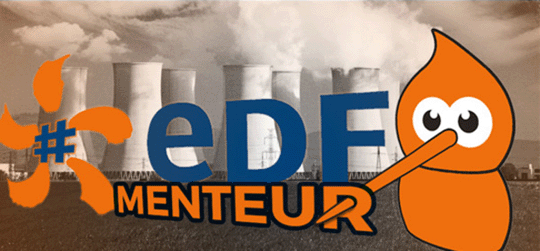
 Safety fears over EDF bid to permit doubling of nuclear reactor cracks The Herald, 22 Jan 17 THE nuclear industry is secretly bidding to relax safety standards to allow the doubling of the number of cracks in the radioactive cores of Scotland’s ageing reactors
EDF Energy is asking for the safety rules to be rewritten so that it can keep running its nuclear power stations at Hunterston in North Ayrshire and Torness in East Lothian until they are at least 47 and 42 years old. They were originally designed to last 30 years.
Prolonged radiation bombardment causes the thousands of graphite bricks that make up reactor cores to crack, threatening a safe shutdown. But EDF is asking the UK government’s watchdog, the Office for Nuclear Regulation (ONR), to permit an increase in the proportion of cracked bricks from 10 to 20 per cent.
The revelation has sparked alarm from politicians and campaigners, who say that the industry is “gambling with public safety” and the public must be consulted. One leading expert argues that Hunterston should be immediately shut down
Hunterston started generating electricity in 1976. EDF currently plans to keep it operating until 2023, and the ONR is due to conclude a safety review of its future operation at the end of January
On January 13 EDF closed down one of Hunterston’s two reactors for planned maintenance, including inspections of cracking in the graphite core. The reactor is due to be restarted on February 10.
Torness was started up in 1988 and is currently planned to operate until 2030. The company, however, has said that it is hoping that the lives of both nuclear stations can be extended by a few more years.
EDF’s bid to relax safety standards at Hunterston and Torness is highlighted in a new report today for the Scottish Greens. It concludes that the risks from graphite cracking are serious and argues that an international convention demands that environmental risks must be assessed, alternative energy sources considered and the public consulted.
According to the report’s author, Edinburgh-based anti-nuclear campaigner and consultant, Peter Roche, Scotland doesn’t need nuclear electricity. “Despite the fact cracks are beginning in the graphite core of these reactors, increasing the risk for us all, the public has still not been asked for its opinion once,” he said……..
John Large, a consulting nuclear engineer, pointed out that the integrity of the graphite bricks was vital to nuclear safety. If they failed, they could block channels that enable control rods to be inserted to close down reactors and prevent them from overheating.
“Ageing problems like this serious cracking of the graphite bricks at the heart of each reactor are deeply worrying, so much so that these nuclear plants should now be permanently shut down,” he said.
Large accused EDF and the ONR of “false confidence” in believing they fully understood graphite cracking, which was difficult to predict. “The Hunterston B nuclear reactors now in their forty-first year of operation, should be immediately shut down,” he stated….
The company also argued that environmental impact assessments – and, by implication – public consultations were not required for life extensions at Hunterston and Torness..
ONR’s deputy chief inspector Mark Foy confirmed that EDF had asked for the proportion of graphite bricks allowed to be cracked to rise from 10 to 20 per cent. “That is provided to us in the form of a comprehensive justification, which we will assess to see whether we’re satisfied it’s safe to operate,” he said…….. http://www.heraldscotland.com/news/15039668.Safety_fears_over_EDF_bid_to_permit_doubling_of_nuclear_reactor_cracks/
No comments yet.
1 This Month

of the week – Shut Down Drone Warfare!


Tell the Ukrainian Government to Drop Prosecution of Peace Activist Yurii Sheliazhenko

Petition to revoke the licensing of the Near Surface Nuclear Disposal Facility (NSDF) at Chalk River. https://www.ourcommons.ca/petitions/en/Petition/Details?Petition=e-7247
To see nuclear-related stories in greater depth and intensity – go to https://nuclearinformation.wordpress.com
-
Archives
- April 2026 (114)
- March 2026 (251)
- February 2026 (268)
- January 2026 (308)
- December 2025 (358)
- November 2025 (359)
- October 2025 (376)
- September 2025 (257)
- August 2025 (319)
- July 2025 (230)
- June 2025 (348)
- May 2025 (261)
-
Categories
- 1
- 1 NUCLEAR ISSUES
- business and costs
- climate change
- culture and arts
- ENERGY
- environment
- health
- history
- indigenous issues
- Legal
- marketing of nuclear
- media
- opposition to nuclear
- PERSONAL STORIES
- politics
- politics international
- Religion and ethics
- safety
- secrets,lies and civil liberties
- spinbuster
- technology
- Uranium
- wastes
- weapons and war
- Women
- 2 WORLD
- ACTION
- AFRICA
- Atrocities
- AUSTRALIA
- Christina's notes
- Christina's themes
- culture and arts
- Events
- Fuk 2022
- Fuk 2023
- Fukushima 2017
- Fukushima 2018
- fukushima 2019
- Fukushima 2020
- Fukushima 2021
- general
- global warming
- Humour (God we need it)
- Nuclear
- RARE EARTHS
- Reference
- resources – print
- Resources -audiovicual
- Weekly Newsletter
- World
- World Nuclear
- YouTube
-
RSS
Entries RSS
Comments RSS
 nuclear-news
Leave a comment