Confusion in Donald Trump’s thinking about nuclear weapons
 Donald Trump’s very confusing thoughts on nuclear weapons, explained
Vox, by Zack Beauchamp@zackbeauchampzack@vox.com Jan 18, 2017 Just days before his inauguration, Donald Trump made headlines by trashing America’s European allies in an interview with two of Europe’s biggest newspapers. The hubbub over Trump’s attack on Europe obscured one of the stranger comments in the interview — that he hoped to work with Russian strongman Vladimir Putin to reduce both countries’ nuclear arsenals.
“Let’s see if we can make some good deals with Russia,” Trump said. “For one thing, I think nuclear weapons should be way down and reduced very substantially.”
To say this is a flip-flop is an understatement. Less than a month ago, Trump tweeted that the US “must greatly strengthen and expand its nuclear capability until such time as the world comes to its senses regarding nukes.” When MSNBC’s Mika Brzezinski asked him about the possibility of this policy setting off an arms race with Russia (which is also talking about expanding/modernizing its nuclear arsenal), Trump’s answer was simple.
“Let it be an arms race.”
Nuclear arms control is a hugely important issue — especially in a world where tensions between the US and two other nuclear powers, Russia and China, are heating up. So where does Trump stand: with his comments from December, or with his comments from January?
The truth is that nobody knows — leaving us in the dark on one of the very few policy issues with the potential to transform the future of human civilization.
“It’s difficult to discern what Trump’s policy will be and whether he has given more than a few minutes’ thought to these issues,”
Kingston Reif, the director for disarmament and threat reduction policy at the Arms Control Association, tells me.
Questions about nuclear policy have dogged Trump for more than a year now. In a December 2015 Republican debate, moderator Hugh Hewitt asked Trump about the “nuclear triad” — America’s three-part system for delivering nuclear weapons (bombers, submarines, and intercontinental ballistic missiles). Trump’s answer was confusing:
We have to be extremely vigilant and extremely careful when it comes to nuclear. Nuclear changes the whole ballgame. … The biggest problem we have is nuclear — nuclear proliferation and having some maniac, having some madman go out and get a nuclear weapon. That’s in my opinion, that is the single biggest problem that our country faces right now.
There are two interesting things about this. First, Trump suggests, as he later did in his January interview, that he sees large global nuclear stockpiles as a problem. Second, he doesn’t appear to know any of the major policy questions surrounding the nuclear triad, or even what the nuclear triad is.
That became especially clear when Hewitt followed up, pressing Trump to answer the actual question about the triad. Trump’s response? “I think — I think, for me, nuclear is just the power, the devastation is very important to me.”
This pattern — an abstract abhorrence of nuclear weapons but seemingly confused views on actual nuclear policy — continued throughout the campaign. . In a March 2016 town hall, for example, host Chris Matthews pressed Trump on whether he’d use nuclear weapons. He seemed to say both no and yes at the same time, saying he’d be “the last one to use nuclear weapons,” but also that he would be very willing to nuke ISIS territory in response to a terrorist attack:………… http://www.vox.com/world/2017/1/18/14310168/trump-nuclear-policy-inauguration-explained
January 20, 2017 -
Posted by Christina Macpherson |
politics, USA, weapons and war
No comments yet.
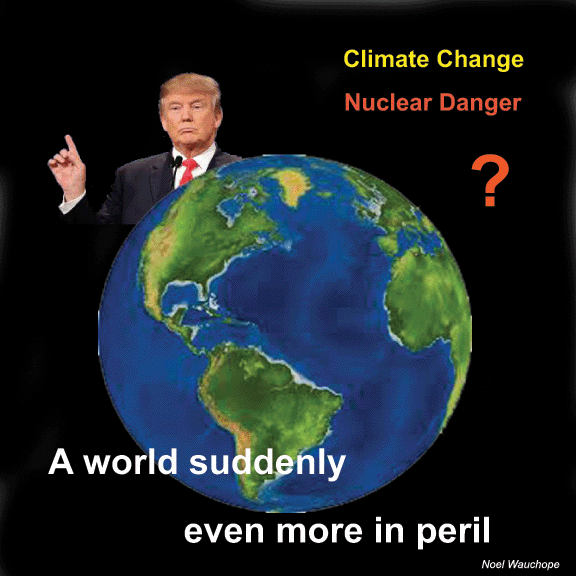 Donald Trump’s very confusing thoughts on nuclear weapons, explained




 nuclear-news
Leave a comment