No deal on closing Indian Point, Gov. Cuomo says after shutdown reports http://pix11.com/2017/01/06/no-deal-on-closing-indian-point-gov-cuomos-office-says/, JANUARY 6, 2017, BY ALIZA CHASAN BUCHANAN, N.Y. — No agreement has been reached to close the Indian Point nuclear plant in Westchester County despite reports the plant would close its two units by 2021, Gov. Andrew Cuomo’s office said Friday.
“There is no agreement,” a spokesman for Cuomo’s office said. “Governor Cuomo has been working on a possible agreement for 15 years and until it’s done, it’s not done. Close only counts for horseshoes, not for nuclear plants.”
The plant has been at the center of potential disasters over recent years and Cuomo has repeatedly called for its shutdown, saying it poses an environmental threat to the Hudson River and a threat to New Yorkers.
“Indian Point is antiquated and does not belong on the Hudson River in close proximity to New York City, where it poses a threat not only to the coastal resources and uses of the river, but to millions of New Yorkers living and working in the surrounding community,” Gov. Cuomo said in November.
Inspectors found hundreds of faulty bolts within the reactor at the Indian Point Unit 2 Plant in March. There was also a 600 gallon oil spill in 2016. Only a small portion of the spill reached the discharge canal.
Entergy, the operator of Indian Point, declined to comment.
The license for Indian Point’s Unit 2 expired in 2013, but can operate as long as the relicensing process continues under the U.S. Nuclear Regulatory Commission. Unit 3’s license expired in 2015, but it remains in operation while the relicensing application is pending. Unit 1 was permanently closed in 1974.
Entergy has applied for a 20-year license renewal for Units 2 and 3.
Indian Point is a key source of energy for the New York area. It has a generating capacity of 2,000 megawatts of clean electricity, according to Entergy. It provides power to about 2 million homes along with businesses and municipal systems.
Indian Point Nuclear Power Plant to Close by 2021 NYT, By VIVIAN YEE and PATRICK McGEEHANJAN. 6, 2017The Indian Point nuclear plant will shut down by April 2021 under an agreement New York State reached this week with Entergy, the utility company that owns the facility in Westchester County, according to a person with direct knowledge of the deal.
The Indian Point nuclear plant will shut down by April 2021 under an agreement New York State reached this week with Entergy, the utility company that owns the facility in Westchester County, according to a person with direct knowledge of the deal.
Under the terms of the agreement, one of the two nuclear reactors at Indian Point will permanently cease operations by April 2020, while the other must be closed by April 2021. The shutdown has long been a priority for Gov. Andrew M. Cuomo, who — though supportive of upstate nuclear plants — has repeatedly called for shutting down Indian Point, which he says poses too great a risk to New York City, less than 30 miles to the south.
“Why you would allow Indian Point to continue to operate defies common sense, planning and basic sanity,” Mr. Cuomo told reporters in June……..
In exchange, the state and Riverkeeper will drop safety and environmental claims against Indian Point they had previously filed with federal regulatory agencies.
Entergy, which is based in New Orleans, has been seeking a 20-year renewal of its license from the federal Nuclear Regulatory Commission since 2007. But New York State officials have challenged that renewal on several fronts and have refused to grant permits that they say the plant needs to continue operating.
Eden Keeper, (USA) 6 Jan 17Faith members considering solar power for churches, temples, mosques, and other houses of worship are discovering that installations are getting both easier and cheaper. Since 2009, according to the Solar Energy Industries Association (SEIA), costs for non-residential solar installations have dropped around 73%, from around $7.50 per kilowatt to today’s cost of about $2 per kilowatt.In Minnesota, for example, approximately 400 congregations are working with Minnesota Interfaith Power and Light (MNIPL), a faith-based nationwide nonprofit concerned with climate change and environmental stewardship. MNIPL Executive Director Julia Nerbonne notes that conversations on solar power for churches are trending all across the state.
Among the 20 Minnesota houses of worship that completed their transition to solar power in 2016 are Unity Church-Unitarian and Woodbury Peaceful Grove United Methodist Church in St. Paul. In Roseville, St. Christopher’s Episcopal Church also completed it’s solar rooftop installation last year……..
Community Solar Farms Offer Additional Solutions……..
Just Community Solar: A Story of Faith in Action
Many States Offer Solar IncentivesCurrent political fearmongering aside, many states are working hard to increase the transition to renewable energy in the US. Minnesota is an inspiring example…
“Tons and Tons of Faith Communities Doing Solar” An additional bill credit especially relating to solar power for churches, faith-based organizations, and other nonprofits may be approved in March 2017, by the Public Utilities Commission………
Learn More about Community Solar Power For ChurchesMNIPL’s project, “Just Community Solar: A Story of Faith in Action” is “connecting the dots between climate, racial, and economic justice.”
Climate change threatens ability of insurers to manage risk
Extreme weather is driving up uninsured losses and insurers must use investments to fund global warming resilience, says study, Guardian, Damian Carrington, 7 Dec 16, The ability of the global insurance industry to manage society’s risks is being threatened by climate change, according to a new report.
The report finds that more frequent extreme weather events are driving up uninsured losses and making some assets uninsurable.
The analysis, by a coalition of the world’s biggest insurers, concluded that the “protection gap” – the difference between the costs of natural disasters and the amount insured – has quadrupled to $100bn (£79bn) a year since the 1980s.
Mark Carney, the governor of the Bank of England, warns in the new report that: “Over time, the adverse effects of climate change could threaten economic resilience and financial stability [and] insurers are currently at the forefront.”
The ClimateWise coalition of 29 insurers, including Allianz, Aon, Aviva, Lloyd’s, Prudential, Swiss Re and Zurich, conclude that the industry must use more of its $30tn of investments to help fund increased resilience of society to floods, storms and heatwaves.
The Bank of England warned in 2015 that insurance companies could suffer a “huge hit” if their investments in fossil fuel companies were rendered worthless by action on climate change and some insurershave already shed investments in coal.
The ClimateWise report, published on Wednesday, also says the industry must also use its risk management expertise to convince policymakers in both the public and private sector of the urgent need for climate action.
The industry’s traditional response to rising insurance risks – raising premiums or withdrawing cover – would not help deal with the rising risks of global warming, it said……..
US delays cleanup rule at uranium mines amid GOP criticism
Federal GOP legislators from Wyoming have said a rule was an unnecessary burden for the uranium industry NBC5 Jan 5, 2017 CHEYENNE, Wyo. —
Federal officials withdrew a requirement for companies to clean up groundwater at uranium mines across the U.S. and will reconsider a rule that congressional Republicans criticized as too harsh on industry.
The plan that the U.S. Environmental Protection Agency put on hold Wednesday involves in-situ mining, in which water containing chemicals is used to dissolve uranium out of underground sandstone deposits. Water laden with uranium, a toxic element used for nuclear power and weapons, is then pumped to the surface. No digging or tunneling takes place.
The metal occurs in the rock naturally but the process contaminates groundwater with uranium in concentrations much higher than natural levels. Mining companies take several measures to prevent tainted water from seeping out of the immediate mining area…….
Along with setting new cleanup standards, the rule would have required companies to monitor their former in-situ mines potentially for decades. The requirement was set for implementation but now will be opened up for a six-month public comment period.
EPA officials didn’t immediately respond to a request for comment Thursday.
Environmentalists and others say uranium-mining companies have yet to show they can fully clean up groundwater at a former in-situ mine. Clean groundwater should not be taken for granted, they say, especially in the arid and increasingly populated U.S. West.
“We are, of course, disappointed that this final rule didn’t make it to a final stage,” said Shannon Anderson with the Powder River Basin Resource Council. “It was designed to address a very real and pressing problem regarding water protection at uranium mines.”
The EPA rule is scheduled for further consideration in President-elect Donald Trump’s administration.
Then, while the first nuclear power plants were being built, extensive delays and modifications resulted in large cost overruns. The utilities incurred these cost overruns, as the contracts were mostly cost-plus, where the construction companies were reimbursed for their costs.
By the end of the last century, 100 nuclear power plants providing 20% of America’s electricity had been built, but the sentiment in the industry was that nuclear power was too costly.
The constant changes and delays while building the first 100 nuclear power plants were attributed to construction being done on site where it was difficult to control events and costs.
It was thought that costs could be controlled by building major components in a factory and then shipping them to the site for installation.
It was believed that a factory environment would allow for the use of manufacturing disciplines and quality control that would keep costs under control.
At the start of this century, there was support for a nuclear renaissance, where new nuclear power plants of a new and safer design could be built at a reasonable cost, with major components being built in a factory.
The Fukushima disaster raised the specter of radiation danger once again, but the new generation of nuclear power plants would shut down safely and automatically if there was a problem.
As construction was started at the four new nuclear power plants, two in Georgia and two in South Carolina, there was great confidence that this time it would be different: Costs would be controlled and the plants would be built on schedule.
With last week’s announcement that Toshiba would take a multi-billion dollar charge against operations due to cost overruns, quality control problems and delays at the four nuclear power plants being built in the United States, it is now clear that nuclear power may be dead … at least for the foreseeable future.
Westinghouse, the Toshiba subsidiary building these new nuclear power plants, has experienced many of the same problems that occurred in the last century.
Toshiba’s stock fell 30% with the announcement confirming the problems at Westinghouse, and of problems with the construction of other nuclear power plants being built in other countries.
Whereas the utilities incurred the overrun costs in the last century, this time the contracts were written so that the construction companies and supplier of reactors incurred most of these extra costs.
Nuclear power was already dying a slow death in the United States as there was considerable doubt whether existing nuclear power plants would receive a second extension to their operating licenses. See Nothing to Fear for a description of why nuclear power is dying in the United States.
The problems at Westinghouse probably preclude any construction company or supplier of reactors from entering into contracts where they would be liable for cost overruns, and it’s doubtful that any utility regulator would allow any utility to assume such liabilities in the future.
This may have been the final nail in the coffin for nuclear power in the United States.
NRC plans to name U.S. nuclear reactors using potentially flawed Areva parts, Japan Times, 6 Jan 17,
WASHINGTON – The U.S. Nuclear Regulatory Commission told French nuclear power company Areva SA it will publish as early as next week the names of U.S. reactors that contain components from its Le Creusot forge that the firm is suspected of falsifying documents despite the company’s claim that the information is proprietary.
The written notice, dated Dec. 30 and seen by Reuters on Thursday, underscores rising tension between the U.S. nuclear regulatory body and Areva after French authorities opened an investigation last month into decades of alleged forgery relating to the quality of parts produced at the forge and used in power plants around the world.
The NRC has investigated whether the suspected falsification of documents poses any risks for U.S. nuclear plants, but has said it has found that the plants are safe.
“At this time, there are no indications of any specific safety concerns for U.S. reactors,” NRC spokesman David McIntyre said on Thursday.
Still, anti-nuclear power advocates, including Greenpeace, have pushed NRC to reveal which U.S. reactors have the components, saying that there could be risks to the public.
The secret nuclear bunker built as the UK’s last hope, Dug for an underground ‘shadow factory’ for aircraft during World War Two, the Drakelow tunnels were re-purposed as a nuclear bunker to be used by the UK government. We went inside., BBC By William Park 4 January 2017
Deep beneath a hill in the Worcestershire countryside, about 20 miles west of Birmingham, lie a series of hidden tunnels. Once home to a secret aeroplane factory during World War Two, they were later repurposed to protect the UK in the event of a nuclear war: it’s from here that the government would have continued to run the country.
“This would have been the last resort of the UK government,” says Michael Scott, a volunteer with the Drakelow Preservation Trust, which is restoring the site. The Trust’s aim is to reopen parts of the tunnels as a museum to preserve their history in World War Two and the Cold War. But the organisation remains some years away from finishing the work, and without much funding, the volunteers are restricted mostly to repainting walls.
When cities across the UK came under siege during the war, the government needed to find a way to continue production of tanks, aircraft and ammunition. The solution was to build underground factories – also called shadow factories – away from large cities. The Drakelow Tunnels housed one of them. And the same remoteness and fortress-like qualities that made Drakelow an effective underground aircraft factory would later make it the location of choice for responding to nuclear attack in Britain.
Today, the entrance used by Scott and the other volunteers is called Adit A; it’s where the security office would have stood. Most of the hillside around the entrance is bare, revealing a sandstone mass towering above us that would have made this site virtually bomb-proof in World War Two.
Adit A shows many signs of the alterations that were made to Drakelow Tunnels to retrofit it for use as a nuclear bunker – including covered air vents that would have protected those inside from fallout. Through the heavy steel door, visitors would have had to strip, incinerate their clothes and shower as they decontaminated themselves……..
There are examples of similar subterranean shadow factories in Germany, too. The largest was Mittelwerk, Kohnstein, which produced V-1 and V-2 bombs from 1943 to 1945. The move underground was a direct result of the destruction of other, above-ground V-2 production plants, like Peenemunde in northern Germany. Unlike Drakelow, Mittelwerk was left in ruins after the war.
Perhaps the most intriguing underground network of Nazi military tunnels is the series of seven structures that make up Project Riese. Buried in the Owl Mountains – then part of Germany but now in south-west Poland near the Czech border – these sites were never finished and documents about their full purpose seem to have been destroyed…….
Cold comfort
Top-secret military construction did not end with World War Two. In 1949, as the Cold War bloomed, the UK government began to build 15 fortified war rooms across the country.
But in the case of the much bigger threat of a nuclear attack, these buildings would not have been enough to protect their inhabitants. They were too small, making them unable to support a workforce for the extended period of time they’d need to remain indoors to avoid the fallout of a nuclear explosion. They also were built too close to the major cities which could have been a target for an attack: five were built in London, for example.
Having seen the effect of a nuclear attack in Japan, the British government commissioned the Strath Committee, led by head of the Central War Plans Secretariat William Strath, to analyse the potential effects of a nuclear attack on the UK. In 1955 the committee published the Strath Report which found that even a ‘limited’ attack would have devastating consequences. Food and water would be contaminated, the NHS would be overwhelmed with four million serious casualties and 12 million deaths, and industry would shut down. In short, the “social and economic fabric of the country [would be] destroyed”.
Inside Glanrhyd, the first solar ‘eco hamlet’ in Wales Residents of the new eco hamlet in Pembrokeshire can expect greatly reduced fuel bills and shared use of an electric car, Guardian, Steven Morris, 6 Jan 17,
Most of the houses in the Welsh village of Glanrhyd are of traditional construction – walls made out of hefty local stone, roofs of grey slate. They can get chilly when the winter winds whistle through the gaps.
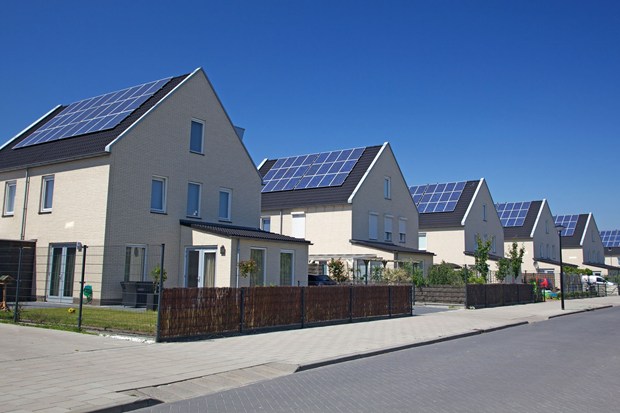
The six houses that make up the “eco hamlet” of Pentre Solar look and feel very different. They are built using light, bright timber sourced from a nearby valley. The houses are carefully insulated, airtight and powered by solar panels.
Over the next few weeks the first tenants, local people from Pembrokeshire county council’s housing list, will move into what is being billed as the only development of its kind in the UK.
Their fuel bills are expected to be a fraction of their neighbours’ – and they will even get the use of a shared electric car for the school run, the shopping trip to nearby Cardigan, or even for a jolly to one of the many glorious local beaches…….
If the project, which has been backed by the Welsh government, does work, the hope is that similar developments could be rolled out across Wales and eventually across the UK.
Western Solar’s first venture was a solar farm, five miles from the eco hamlet. Doubts that it was sunny enough in this part of the British Isles (after all, the nearby village of Eglwyswrw made headlines last year after it rained for more than 80 days in a row) proved unfounded and the project thrived…….
Using technology borrowed from Germany, Western Solar built a prototype eco home called TŷSolar (Tŷis Welsh for house). The idea was to produce a high-quality, brilliantly insulated, airtight house made of locally sourced timber and powered by solar energy…….
GM Commits to 100 Percent Renewable Energy by 2050 15.09.2016 GM pledges to source global electricity from wind, sun and landfill gas, joins RE100
DETROIT – General Motors plans to generate or source all electrical power for its 350 operations in 59 countries with 100 percent renewable energy — such as wind, sun and landfill gas — by 2050.
“Establishing a 100 percent renewable energy goal helps us better serve society by reducing environmental impact,” said GM Chairman and CEO Mary Barra. “This pursuit of renewable energy benefits our customers and communities through cleaner air while strengthening our business through lower and more stable energy costs.”
This new renewable energy goal, along with the pursuit of electrified vehicles and efficient manufacturing, is part of the company’s overall approach to strengthening its business, improving communities and addressing climate change. GM is also joining RE100, a global collaborative initiative of businesses committed to 100 percent renewable electricity, working to increase demand for clean power.
In 2015, GM required 9 terawatt hours of electricity to build its vehicles and power its offices, technical centers and warehouses around the world. To meet its new renewable energy goal, GM will continue to improve the energy efficiency of its operations while transitioning to clean sources for its power needs.
Today GM saves $5 million annually from using renewable energy, a number it anticipates will increase as more projects come online and the supply of renewable energy increases. In addition, the company anticipates costs to install and produce renewable energy will continue to decrease, resulting in more bottom-line returns.
How climate change in Central Asia is threatening to spark regional conflict
Lower water supplies, caused by rising temperatures, is increasing risk of political tensions, Chinese researchers warn SCMP, Stephen Chen, 06 January, 2017, Competition for dwindling water supplies from a mountain range in Central Asia could erupt into regional conflict, Chinese researchers have warned.
Global warming and retreating glaciers in the Tianshan range – the “water tower” of the region – have raised the spectre of water shortages that will affect “the relationship between countries in Central Asia,” the researchers warned in a report on the Chinese Academy of Sciences’ website.
Central Asia is a dry, landlocked hinterland and Tianshan is the tallest and biggest mountain range in the region. About 2,500km long and up to 350km wide, the range winds through numerous countries including Uzbekistan, Kyrgyzstan, Kazakhstan and the Xinjiang region in China.
Its seasonal snowmelt contributes most of the water for the majority of rivers in Central Asia.
But over the past decade, the range has been losing its “total water storage” at a rate of about 223 million cubic metres per year, according to the research led by Professor Chen Yaning from the academy’s Xinjiang Institute of Ecology and Geography in Urumqi.
The culprit, the researchers say, is rising temperatures.
Since 1960, annual average temperatures in the area have been rising at 0.3 degrees Celsius per decade, resulting in warm winters and less snow.
In a paper last year detailing some of their findings, Chen and colleagues warned that the situation “may pose great danger for the water tower and influence the water supply for the oasis and desert regions”.
Labour chiefs urge voters to ignore Jeremy Corbyn’s nuclear views ahead of Copeland by-election, Mirror UK, BYBEN GLAZE5 JAN 2017 The Labour leader is a veteran anti-nuclear campaigner, which could be a problem for him in Copeland in Cumbria Labour chiefs are quietly urging voters to ignore Jeremy Corbyn’s anti-nuclear views in a crunch by-election.
The Labour leader, a veteran anti-nukes campaigner, faces his biggest electoral test when voters go to the polls in Copeland, Cumbria.
The constituency is home to the Sellafield nuclear plant and next-door to Barrow-in-Furness, home to the shipyard building the Navy’s new Trident nuclear submarines.
Labour is defending a slim 2,564 majority in the vote triggered by the resignation of MP Jamie Reed.
The Tories are favourites to win.
Senior Labour figures fear the Conservatives will highlight Mr Corbyn’s lifelong opposition to nuclear power and weapons. The Labour leader will “absolutely” visit the constituency during the campaign, according to party sources.
Copeland council’s Labour group leader Lena Hogg, who voted for Mr Corbyn in his successful leadership campaigns, hoped he would accept nuclear was popular locally.
Pro-nukes Mrs Hogg told the Mirror: “We have got it and it’s staying and people are quite happy about the fact we have had it since 1952.
State, federal leaders push for transparency after shutdown and safety concerns. State officials are pushing for more transparency from federal regulators about safety concerns at the Pilgrim Nuclear Power Plant in Plymouth.
In a letter dated Jan. 4 to the Nuclear Regulatory Commission, Gov. Charlie Baker, Attorney General Maura Healey, Sen. Edward Markey and several other lawmakers called for a public meeting in Massachusetts to allow the agency to answer questions and communicate directly with the public about the safety of the nuclear power plant and provide details about recent shutdowns.
The letter comes after the inadvertent disclosure of an email last month from the leader of the NRC special inspection team noting continued concerns about operations at the plant, including poor engineering expertise and a “safety culture problem.”
In the letter, the team leader commented that plant staff “seems overwhelmed by just trying to run the” nuclear plant.
“The NRC has an obligation to address the operation of the Pilgrim Nuclear Power Plant and the increased public concerns that continue to plague the plant at a time when it should be showing significant improvements,” Healey said. “The public’s serious questions about the safety of this plant and risks it poses to the environment, workers and residents need to be answered immediately.”
The letter states that a public meeting also would provide an opportunity for the NRC to discuss the cause of the plant’s most recent shutdown, including how the leaks in three of the plant’s eight main steam isolation valves were discovered, why they were not discovered earlier, and what steps have been taken to inspect the integrity of the remaining steam isolation valves. These valves are used to prevent a leak of radioactivity into the environment during a nuclear accident.
In light of the documented ongoing safety issues at the plant, the letter also calls on the NRC to deny a request from the plant’s owner, Entergy, for an exemption from NRC’s post-Fukushima Dai-ichi plant safety upgrades.
The NRC downgraded Pilgrim safety’s status to the least safe category in September 2015 based on recurring safety issues at the plant. In October 2015, Entergy announced that it will shut down the plant by June 2019, citing low energy prices, reduced revenues, and increased operational costs.
ReNew Canada reports that The Government of Canada has proposed its pan-Canadian approach to pricing carbon pollution. Under the new plan, all Canadian jurisdictions will have carbon pricing in place by 2018. In order to accomplish this, Canada will set a benchmark for pricing carbon emissions—set at a level that will help Canada meet its greenhouse gas emission targets, while providing greater certainty and predictability to Canadian businesses.
Provinces and territories will have flexibility in deciding how they implement carbon pricing: they can put a direct price on carbon pollution or they can adopt a cap-and-trade system.
Pricing carbon pollution will give Canada an edge in building a clean-growth economy; it will make Canadian businesses more competitive; it will bring new and exciting job prospects for middle class Canadians; and it will reduce the pollution that threatens our clean air and oceans.
“Pricing pollution is one of the most efficient ways to reduce greenhouse gas emissions and to stimulate innovation,” said Catherine McKenna, minister of Environment and Climate Change. “Already 80 percent of Canadians live in a province where there is pollution pricing. We want to continue this trend and cover the final 20 per cent.”
Pricing will be based on greenhouse gas emissions and applied to a common and broad set of sources to ensure effectiveness. The price on carbon pollution should start at a minimum of $10 per tonne in 2018 and rise by $10 a year to reach $50 per tonne in 2022. Revenues from carbon pricing will remain with provinces and territories of origin.
Provinces and territories will use the revenues from this system as they see fit, whether it is to give it back to consumers, to support their workers and their families, to help vulnerable groups and communities in the North, or to support businesses that innovate and create good jobs for the future.
The overall approach will be reviewed in 2022 to ensure that it is effective and to confirm future price increases. The review will account for actions by other countries.

















 nuclear-news