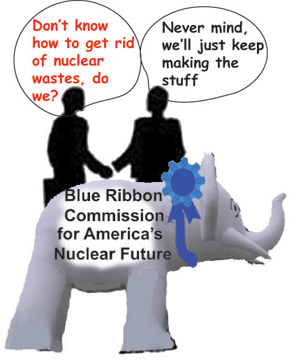
America’s ineffective white elephant Blue Ribbon Commission on nuclear wastes
 The Commission has entirely ignored the immense evidence that DOE’s plans for disposal of
  several types of defense waste pose much greater threats to water resources, most especially at Hanford
“I am dismayed that the Commission saw fit to recommend that the Department of Energy (DOE) have a large upfront role in both the next steps for repository program, … DOE was in large part responsible for the mess the program is in now,
 Radioactive Wastes From Nuclear Bomb Program Given Short Shrift In Blue Ribbon Commission Report EnEws Park Forest, TAKOMA PARK, MD–(ENEWSPF)–January 27, 2012. Arjun Makhijani, Ph.D., President of the Institute for Energy and Environmental Research, today commented on some of the recommendations of the final report of the Presidential Blue Ribbon Commission (BRC) on America’s Nuclear Future.
The commission was created to address U.S. nuclear waste issues after the Obama administration cancelled the Yucca Mountain program….
….On wastes from the nuclear bomb program:
Makhijani: “It is tragic that the Commission did not substantively address the most pressing radioactive waste contamination threats to precious water resources – for instance hundreds of times the drinking water limit at Hanford, Washington on the banks of the Columbia River.
The Commission had a charter to conduct a ‘comprehensive’ review of the nuclear waste problem, including defense wastes from the nuclear bomb program. Yet, it simply said it did not have the resources to deal with all the problems and punted the nuclear weapons waste issue to Congress while focusing on commercial spent fuel at nuclear reactor sites.”
“I am even more dismayed that the Commission suggested that Congress
consider the possibility of leaving the defense waste disposal in the
purview of the Department of Energy (DOE). The Commission has entirely
ignored the immense evidence that DOE’s plans for disposal of several
types of defense waste pose much greater threats to water resources,
most especially at Hanford, than from even Yucca Mountain, a poor
repository site.”
On reprocessing and breeder reactors:
The commission acknowledges in its report that:
“…no currently available or reasonably foreseeable reactor and fuel
cycle technology developments—including advances in reprocess and
recycle technologies—have the potential to fundamentally alter the
waste management challenge this nation confronts over at least the
next several decades, if not longer.” (p. 100)
Makhijani: “The Commission did reject some reprocessing advocates’
claims by recognizing that it will not eliminate the need for a
repository and that no form of reprocessing is economical today. But
it left the door open for reprocessing existing spent fuel at some
future date. Reprocessing spent fuel from existing reactors will
multiply risks and costs. There is simply no economic or technical
case for that, and the Commission was provided with ample evidence to
that effect. Even if the chosen path is breeder reactors, it would be
technically better and economically far superior to use the half
million tons of depleted uranium that already exist, enough to fuel a
U.S. reactor fleet at the present size for 5,000 years. The Commission
unfortunately chose to ignore these facts.”
“To its credit the Commission did recognize that reprocessing is not
an answer to the waste management problem (as indicated by quote
above) and that use of plutonium fuel creates an ‘increased
proliferation risk’ (p. 105) both as currently practiced in France
and as it might in the future be practiced with breeder reactors.”
“Despite having been presented with ample evidence of the failure of
the sodium-cooled fast neutron reactor program – $100 billion has been
spent worldwide on the technology and yet it is nowhere near
commercial – the BRC is suggesting more of the same. This is
unwarranted when there are so many renewable energy options that are
far closer to reality and far safer.”
On spent fuel storage:
Makhijani: “The Commission used the Fukushima tragedy to punt on the
question of hardened dry rather than wet storage of spent fuel at
reactor sites. The National Academies had already concluded well
before Fukushima that dry storage was safer; Fukushima has only made
the risks of wet storage clearer. Nothing we learn from it will
indicate that wet storage is safer than dry storage. Yet, the
Commission, citing lessons yet to be learned from Fukushima called for
yet another study instead of hardened on-site dry storage that has
been urged by dozens or organizations.”
“IEER calls on the Administration and Congress to mandate that all
spent fuel aged more than five years be moved to hardened dry storage
on site, and the remaining spent fuel kept in low-density storage in
reactor pools. Nuclear Waste Fund monies should be used for on-site
hardened dry storage.”….
Makhijani: “I am dismayed that the Commission saw fit to recommend
that DOE have a large upfront role in both the next steps for
repository program, “including R&D on geological media” (p. 118) and
for the Interim Storage site before a new organization is put in place
to take over the responsibility. DOE was in large part responsible for
the mess the program is in now, which began well before Congress cut
off the process in 1987, pointing to Yucca Mountain alone. On the one
hand the Commission has cautioned against haste; on the other hand, it
has encouraged haste in a really ill-advised way by recommending a
continuing DOE role in critical activities better left to an
independent agency.”…
The Institute for Energy and Environmental Research provides
policy-makers, journalists, and the public with understandable and
accurate scientific and technical information on energy and
environmental issues. IEER’s aim is to bring scientific excellence to
public policy issues in order to promote the democratization of
science and a safer, healthier environment.
1 Comment »
Leave a comment
1 This Month


Tell the Ukrainian Government to Drop Prosecution of Peace Activist Yurii Sheliazhenko

Petition to revoke the licensing of the Near Surface Nuclear Disposal Facility (NSDF) at Chalk River. https://www.ourcommons.ca/petitions/en/Petition/Details?Petition=e-7247


of the week – STOP SMALL MODULAR REACTORS IN CANADA
To see nuclear-related stories in greater depth and intensity – go to https://nuclearinformation.wordpress.com
-
Archives
- March 2026 (212)
- February 2026 (268)
- January 2026 (308)
- December 2025 (358)
- November 2025 (359)
- October 2025 (376)
- September 2025 (258)
- August 2025 (319)
- July 2025 (230)
- June 2025 (348)
- May 2025 (261)
- April 2025 (305)
-
Categories
- 1
- 1 NUCLEAR ISSUES
- business and costs
- climate change
- culture and arts
- ENERGY
- environment
- health
- history
- indigenous issues
- Legal
- marketing of nuclear
- media
- opposition to nuclear
- PERSONAL STORIES
- politics
- politics international
- Religion and ethics
- safety
- secrets,lies and civil liberties
- spinbuster
- technology
- Uranium
- wastes
- weapons and war
- Women
- 2 WORLD
- ACTION
- AFRICA
- Atrocities
- AUSTRALIA
- Christina's notes
- Christina's themes
- culture and arts
- Events
- Fuk 2022
- Fuk 2023
- Fukushima 2017
- Fukushima 2018
- fukushima 2019
- Fukushima 2020
- Fukushima 2021
- general
- global warming
- Humour (God we need it)
- Nuclear
- RARE EARTHS
- Reference
- resources – print
- Resources -audiovicual
- Weekly Newsletter
- World
- World Nuclear
- YouTube
-
RSS
Entries RSS
Comments RSS
 nuclear-news
The “Blue Ribbon” commission seems to have mostly repeated old 1950s proposals, including for storage in some salt domes considered unfit for petroleum storage.