Research shows that human activities have brought about freakish weather in the Arctic
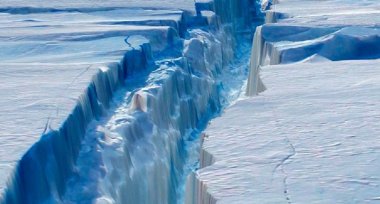 Yes, the Arctic’s freakishly warm winter is due to humans’ climate influence, The Conversation, December 22, 2016 For the Arctic, like the globe as a whole, 2016 has been exceptionally warm. For much of the year, Arctic temperatures have been much higher than normal, and sea ice concentrations have been at record low levels.
The Arctic’s seasonal cycle means that the lowest sea ice concentrations occur in September each year. But while September 2012 had less ice than September 2016, this year the ice coverage has not increased as expected as we moved into the northern winter. As a result, since late October, Arctic sea ice extent has been at record low levels for the time of year.
These record low sea ice levels have been associated with exceptionally high temperatures for the Arctic region. November and December (so far) have seen record warm temperatures. At the same time Siberia, and very recently North America, have experienced conditions that are slightly cooler than normal………
Arctic attribution
Our World Weather Attribution group, led by Climate Central and including researchers at the University of Melbourne, the University of Oxford and the Dutch Meteorological Service (KNMI), used three different methods to assess the role of the human climate influence on record Arctic warmth over November and December.
We used forecast temperatures and heat persistence models to predict what will happen for the rest of December. But even with 10 days still to go, it is clear that November-December 2016 will certainly be record-breakingly warm for the Arctic.
Next, I investigated whether human-caused climate change has altered the likelihood of extremely warm Arctic temperatures, using state-of-the-art climate models. By comparing climate model simulations that include human influences, such as increased greenhouse gas concentrations, with ones without these human effects, we can estimate the role of climate change in this event.
This technique is similar to that used in previous analyses of Australian record heat and the sea temperatures associated with the Great Barrier Reef coral bleaching event.
To put it simply, the record November-December temperatures in the Arctic do not happen in the simulations that leave out human-driven climate factors. In fact, even with human effects included, the models suggest that this Arctic hot spell is a 1-in-200-year event. So this is a freak event even by the standards of today’s world, which humans have warmed by roughly 1℃ on average since pre-industrial times.
But in the future, as we continue to emit greenhouse gases and further warm the planet, events like this won’t be freaks any more. If we do not reduce our greenhouse gas emissions, we estimate that by the late 2040s this event will occur on average once every two years.
All of our analysis points the finger at human-induced climate change for this event. Without it, Arctic warmth like this is extremely unlikely to occur. And while it’s still an extreme event in today’s climate, in the future it won’t be that unusual, unless we drastically curtail our greenhouse gas emissions.
As we have already seen, the consequences of more frequent extreme warmth in the future could be devastating for the animals and other species that call the Arctic home.
Geert Jan van Oldenborgh, Marc Macias-Fauria, Peter Uhe, Sjoukje Philip, Sarah Kew, David Karoly, Friederike Otto, Myles Allen and Heidi Cullen all contributed to the research on which this article is based.
You can find more details on all the analysis techniques here. Each of the methods used has been peer-reviewed, although as with the Great Barrier Reef bleaching study, we will submit a research manuscript for peer review and publication in 2017. https://theconversation.com/yes-the-arctics-freakishly-warm-winter-is-due-to-humans-climate-influence-70648
No comments yet.
1 This Month

of the week – Shut Down Drone Warfare!


Tell the Ukrainian Government to Drop Prosecution of Peace Activist Yurii Sheliazhenko

Petition to revoke the licensing of the Near Surface Nuclear Disposal Facility (NSDF) at Chalk River. https://www.ourcommons.ca/petitions/en/Petition/Details?Petition=e-7247
To see nuclear-related stories in greater depth and intensity – go to https://nuclearinformation.wordpress.com
-
Archives
- April 2026 (57)
- March 2026 (251)
- February 2026 (268)
- January 2026 (308)
- December 2025 (358)
- November 2025 (359)
- October 2025 (376)
- September 2025 (257)
- August 2025 (319)
- July 2025 (230)
- June 2025 (348)
- May 2025 (261)
-
Categories
- 1
- 1 NUCLEAR ISSUES
- business and costs
- climate change
- culture and arts
- ENERGY
- environment
- health
- history
- indigenous issues
- Legal
- marketing of nuclear
- media
- opposition to nuclear
- PERSONAL STORIES
- politics
- politics international
- Religion and ethics
- safety
- secrets,lies and civil liberties
- spinbuster
- technology
- Uranium
- wastes
- weapons and war
- Women
- 2 WORLD
- ACTION
- AFRICA
- Atrocities
- AUSTRALIA
- Christina's notes
- Christina's themes
- culture and arts
- Events
- Fuk 2022
- Fuk 2023
- Fukushima 2017
- Fukushima 2018
- fukushima 2019
- Fukushima 2020
- Fukushima 2021
- general
- global warming
- Humour (God we need it)
- Nuclear
- RARE EARTHS
- Reference
- resources – print
- Resources -audiovicual
- Weekly Newsletter
- World
- World Nuclear
- YouTube
-
RSS
Entries RSS
Comments RSS
 nuclear-news
Leave a comment