Petition calls for Barack Obama to fulfil Green Climate Fund pledge

US promised US$3bn towards fund, which was part of historic Paris agreement, but so far has transferred only $500m, Guardian, Michael Slezak, 21 Dec 16, More than 100 climate and development organisations, along with 70,000 people, have called on Barack Obama to help secure the future of the Paris agreement by transferring the remaining $2.5bn committed by the US.
The Green Climate Fund was a key aspect of the historic Paris agreement signed in 2015, which aims to keep global warming “well below” 2C and aspires to keep warming to 1.5C.
The fund, established in 2010, is financed by wealthy countries and used to assist developing countries with adaptation and mitigation. It was widely seen as a key measure to bring both rich and poor countries to the negotiating table.
The US pledged $3bn towards the fund, making up nearly a third of the $10.3bn pledged in total. But so far, it has only transferred $500m.
“This is one of the only things Obama can do now that Trump can’t undo,” said Jesse Bragg from Corporate Accountability International, the group that organised the petitions. “Once those funds are transferred, Trump won’t be able to take them back.”
As of today, 117 organisations including 350.org, Friends of the Earth and the League of Conservation Voters have joined with Corporate Accountability International to deliver a petition signed by more than 70,000 to the Obama administration.
The organisations signed a letter saying: “The world cannot afford Donald Trump’s steps backward on climate. Right now, people around the world are mobilising to counter Trump’s anticipated actions. You can help us protect your climate legacy by fulfilling your pledge to contribute $3bn to fund climate justice measures in the Global South.”
The petition those organisations delivered said: “Donald Trump plans to do everything he can to reverse progress on climate change. His policies threaten disaster for people and the planet. But there’s one thing President Obama can do before he leaves office that Trump cannot undo.”
Trump has nominated a series of climate deniers to his cabinet, including Rex Tillerson, the chief executive of Exxon Mobil, as secretary of state. He has also nominated Scott Pruitt, who is known for suing the Environmental Protection Agency, to direct that agency.
Tamar Lawrence-Samuel, associate research director at Corporate Accountability International, said: “Donald Trump’s administration will be of, by and for the fossil fuel industry and if we don’t act now, millions will suffer.”
“President Obama must do whatever it takes to fulfil the US’s commitment to the Green Climate Fund before Donald Trump and his Big Oil cabinet take over,” she said.
350.org’s founder, Bill McKibben, said: “The debt for the damage inflicted on the global climate by American carbon will never be fully repaid – and the Trump administration can be counted on to do nothing for the most vulnerable people on the planet … so this call makes both practical and moral sense.”
The first $500m was transferred through a State Department fund, which Obama could use without congressional support. Corporate Accountability International argues that Obama could draw from several relevant funds to fulfill his pledge, including those within the State Department, Treasury Department, Defense Department and other agencies.
Mystery of the uranium disappearance from Pennsylvania
 What Lies Beneath In the 1960s, hundreds of pounds of uranium went missing in Pennsylvania. Is it buried in the ground, poisoning locals—or did Israel steal it to build the bomb?
To Held, the plant, its lights flickering over the western edge of town on the banks of the Kiskiminetas River, was “kind of neat.” When one of the town’s radiation monitors went off, children would dash through neighbors’ backyards to reach the facility—it was housed inside a refurbished steel mill with dirt floors, big windows, and dozens of smokestacks—to see what had happened.
As Held grew older, the plant that inspired his boyish thrill evolved into something more puzzling, and more sinister. NUMEC closed its doors in 1983, and in the mid-1990s, the federal government swooped in and declared several city blocks contaminated. Various agencies rolled in with bulldozers, razed the plant, and carted off the radioactive pieces, barrel by barrel, for disposal. Ever since, Apollo’s residents have been grappling with fears that NUMEC poisoned their town.
One bitterly cold day this January, Held—now 53 and Apollo’s mayor—drove me north on State Route 66, which cuts along one side of the old NUMEC site. A green chain-link fence outlines the desolate acreage where the factory once stood. Held, a stout man with a graying beard, gestured up a hill toward several decaying Victorian houses. The residents, he said, have suffered from various cancers: lung, thyroid, prostate, brain. They have argued that years of radiation soaking into their soil, air, water, clothes, and homes had led to their afflictions. To date, owners of the NUMEC property have shelled out tens of millions of dollars in compensation to locals who’ve filed suit.
Apollo’s woes didn’t end with those payouts, however. Held told me that events shifted, alarmingly, one day in September 2011, two years before he was elected mayor. That’s when he saw several white SUVs, with blue U.S. Homeland Security decals emblazoned on their sides, stationed on the road just five miles north, in Parks Township. As he drove up the road, Held said, men with high-caliber military assault rifles milled around. It looked like a Hollywood blockbuster about a terrorist attack.
In Parks, a second NUMEC facility had produced plutonium starting in 1960, but it also had served another purpose: nuclear disposal. From 1961 to 1970, the corporation dug at least 10 shallow trenches, spread across about 44 acres, into which it dumped radioactive waste; some locals speculate that other companies around the country shipped their waste to Parks to be buried too. Although the U.S. Army Corps of Engineers (USACE) had been put in charge of cleaning up the site in 2002, under congressional authorization, the process didn’t begin until almost a decade later—right before Held encountered the madness on the road.
In October 2011, the USACE announced that excavation activities at the site were suspended. The work was halted after Cabrera Services, a Connecticut-based contractor hired to clean up Parks, mishandled materials, which the company acknowledged. The following year, the USACE uncovered an unexpected variety of “complex” radioactive contaminants in the ground, but it didn’t say all of what it had found or how much of it. In a December 2014 report, the USACE noted that among the contaminants it expects to find are several “radionuclides of concern,” including americium-241, radium-228, uranium-235, and various types of plutonium, which, under the right conditions, could be used as ingredients for a dirty bomb. It seems the material buried at Parks is more dangerous than anyone had previously imagined.
The USACE immediately ceased the excavation and established a 24-hour patrolled security perimeter that’s still in effect today. Bidding for a new cleanup contractor starts this summer, and the work, now forecast to begin in 2017, is expected to cost roughly half a billion dollars—10 times the original estimate in 2002.
The nuclear mess in Parks could hold clues to yet another mystery in this Pennsylvania community, one that has bedeviled nuclear analysts for decades. Beginning in the early 1960s, investigators from the Atomic Energy Commission (AEC), the agency that regulated U.S. nuclear facilities at the time, began to question how large amounts of highly enriched, weapons-grade uranium had gone missing from NUMEC. Any nuclear site had a certain amount of loss, from seepage into walls and floors, for instance. In fact, between 1952 and 1968, lax standards at 20 of the country’s commercial nuclear sites resulted in an apparent loss of 995 kilograms (2,194 pounds) of uranium-235. But investigators found that at NUMEC, hundreds of pounds went missing, more than at any other plant.
NUMEC’s founder, Zalman Shapiro, an accomplished American chemist, addressed the concern in 1978, telling Arizona Congressman Morris Udall that the uranium simply escaped through the facility’s air ducts, cement, and wastewater. Others, such as the late Glenn Seaborg, the AEC’s chairman in the 1960s—who had previously helped discover plutonium and made key contributions to the Manhattan Project—have suggested that the sloppy accounting and government regulations of the mid-20th century meant that keeping track of losses in America’s newborn nuclear industry was well near impossible. Today, some people in Apollo think that at least a portion of the uranium might be buried in Parks, contaminating the earth and, ultimately, human beings.
But a number of nuclear experts and intelligence officials propose another theory straight out of an espionage thriller: that the uranium was diverted—stolen by spies working for the Mossad, Israel’s intelligence agency. In the 1960s, to secure nuclear technology and materials, Israel mounted covert operations around the world, including at least one alleged open-ocean transfer of hundreds of pounds of uranium. Some experts have also raised questions about Shapiro himself. He had contacts deep within Israel’s defense and intelligence establishments when he ran NUMEC; several of them even turned up at his facility over time and concealed their professional identities while there.
Fifty years after investigations began—they have involved, at various times, the AEC and its successors, Congress, the FBI, the CIA, and other government agencies—NUMEC remains one of the most confounding puzzles of the nuclear era. ……….
Today, many people in the nuclear and intelligence communities are still convinced that a diversion occurred. “I tend to think it happened,” Stockton told me. “In fact, I’m damn sure it happened.” But the believers also concede that the evidence against Shapiro remains largely circumstantial; the nail in the coffin, they say, would be a confession from the aging founder of NUMEC or the release of a yet-to-be-identified document that would show definitive proof…….http://foreignpolicy.com/2015/03/23/what-lies-beneath-numec-apollo-zalman-shapiro/
Monju closure marks the end of the failed “nuclear fuel cycle” dream
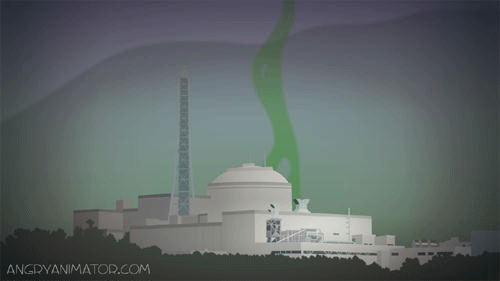 Japan pulls plug on Monju, ending US$8.5 billion nuclear self-sufficiency push, South China Morning Post, 21 December, 2016
Japan on Wednesday formally pulled the plug on an US$8.5 billion nuclear power project designed to realise a long-term aim for energy self-sufficiency after decades of development that yielded little electricity but plenty of controversy.
The move to shut the Monju prototype fast breeder reactor in Fukui prefecture west of Tokyo adds to a list of failed attempts around the world to make the technology commercially viable and potentially cut stockpiles of dangerous nuclear waste……
The plant was built to burn plutonium derived from the waste of reactors at Japan’s conventional nuclear plants and create more fuel than it used, closing the so-called nuclear fuel cycle and giving a country that relies on overseas supplies for most of its energy needs a home-grown electricity source.
With Monju’s shutdown, Japan’s taxpayers are now left with an estimated bill of at least 375 billion yen (US$3.2 billion) to decommission its reactor, on top of the 1 trillion yen (US$8.5 billion) spent on the project.
Japan is still committed to trying to make the technology work and will build a new experimental research reactor at Monju, the government said.
But critics within the ruling Liberal Democratic Party (LDP) think it will be another futile attempt.
“We need to terminate the impossible dream of the nuclear fuel cycle. The fast breeder reactor is not going to be commercially viable. We know it. We all know it,” senior LDP lawmaker Taro Kono said recently at an event in Tokyo. http://www.scmp.com/news/asia/east-asia/article/2056403/japan-pulls-plug-monju-ending-us85-billion-nuclear-self?utm_source=edm&utm_medium=edm&utm_content=20161222&utm_campaign=scmp_today

Solar energy: greenhouse emissions becoming lower – will be very low by 2018

 How clean is solar power? http://www.economist.com/news/science-and-technology/21711301-new-paper-may-have-answer-how-clean-solar-power?fsrc=scn%2Ffb%2Fte%2Fbl%2Fed%2Fhowcleanissolarpower
A new paper may have the answer
Dec 10th 2016 THAT solar panels do not emit greenhouse gases such as carbon dioxide when they are generating electricity is without question. This is why they are beloved of many who worry about the climate-altering potential of such gases. Sceptics, though, observe that a lot of energy is needed to make a solar panel in the first place. In particular, melting and purifying the silicon that these panels employ to capture and transduce sunlight needs a lot of heat. Silicon’s melting point, 1,414°C, is only 124°C less than that of iron.
Silicon is melted in electric furnaces and, at the moment, most electricity is produced by burning fossil fuels. That does emit carbon dioxide. So, when a new solar panel is put to work it starts with a “carbon debt” that, from a greenhouse-gas-saving point of view, has to be paid back before that panel becomes part of the solution, rather than part of the problem. Observing this, some sceptics have gone so far as to suggest that if the motive for installing solar panels is environmental (which is often, though not always, the case), they are pretty-much useless.
Once the team accounted for all this, they found that solar panels made today are responsible, on average, for around 20 grams of carbon dioxide per kilowatt-hour of energy they produce over their lifetime (estimated as 30 years, regardless of when a panel was manufactured). That is down from 400-500 grams in 1975. Likewise, the amount of time needed for a solar panel to produce as much energy as was involved in its creation has fallen from about 20 years to two years or less. As more panels are made, the manufacturing process becomes more efficient. The team found that for every doubling of the world’s solar capacity, the energy required to make a panel fell by around 12% and associated carbon-dioxide emissions by 17-24%.
1 This Month

of the week – Shut Down Drone Warfare!


Tell the Ukrainian Government to Drop Prosecution of Peace Activist Yurii Sheliazhenko

Petition to revoke the licensing of the Near Surface Nuclear Disposal Facility (NSDF) at Chalk River. https://www.ourcommons.ca/petitions/en/Petition/Details?Petition=e-7247
To see nuclear-related stories in greater depth and intensity – go to https://nuclearinformation.wordpress.com
-
Archives
- April 2026 (57)
- March 2026 (251)
- February 2026 (268)
- January 2026 (308)
- December 2025 (358)
- November 2025 (359)
- October 2025 (376)
- September 2025 (257)
- August 2025 (319)
- July 2025 (230)
- June 2025 (348)
- May 2025 (261)
-
Categories
- 1
- 1 NUCLEAR ISSUES
- business and costs
- climate change
- culture and arts
- ENERGY
- environment
- health
- history
- indigenous issues
- Legal
- marketing of nuclear
- media
- opposition to nuclear
- PERSONAL STORIES
- politics
- politics international
- Religion and ethics
- safety
- secrets,lies and civil liberties
- spinbuster
- technology
- Uranium
- wastes
- weapons and war
- Women
- 2 WORLD
- ACTION
- AFRICA
- Atrocities
- AUSTRALIA
- Christina's notes
- Christina's themes
- culture and arts
- Events
- Fuk 2022
- Fuk 2023
- Fukushima 2017
- Fukushima 2018
- fukushima 2019
- Fukushima 2020
- Fukushima 2021
- general
- global warming
- Humour (God we need it)
- Nuclear
- RARE EARTHS
- Reference
- resources – print
- Resources -audiovicual
- Weekly Newsletter
- World
- World Nuclear
- YouTube
-
RSS
Entries RSS
Comments RSS
 nuclear-news