Soaring Arctic temperatures are at cutting edge of climate change research
Arctic ice melt ‘already affecting weather patterns where you live right now’ Soaring Arctic temperatures ‘strongly linked’ to recent extreme weather events, say scientists at cutting edge of climate change research, Guardian, Damian Carrington, 20 Dec 16 The dramatic melting of Arctic ice is already driving extreme weather that affects hundreds of millions of people across North America, Europe and Asia, leading climate scientists have told the Guardian.
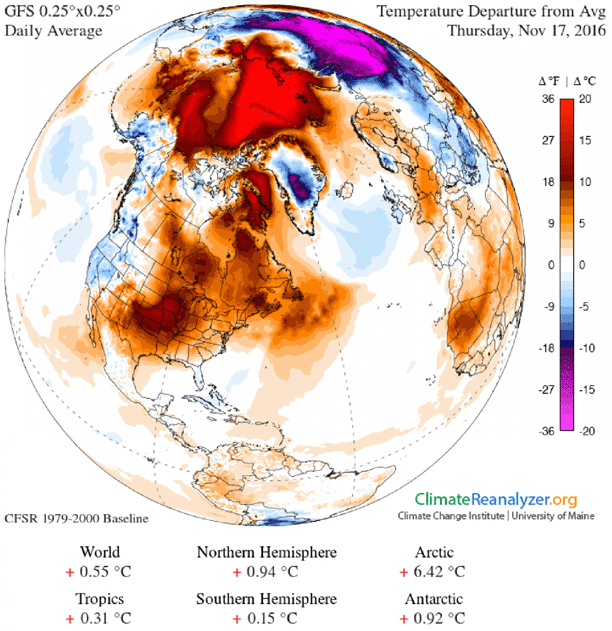
Severe “snowmageddon” winters are now strongly linked to soaring polar temperatures, say researchers, with deadly summer heatwaves and torrential floods also probably linked. The scientists now fear the Arctic meltdown has kickstarted abrupt changes in the planet’s swirling atmosphere, bringing extreme weather in heavily populated areas to the boil.
The northern ice cap has been shrinking since the 1970s, with global warming driving the loss of about three-quarters of its volume so far. But the recent heat in the Arctic has shocked scientists, with temperatures 33C above average in parts of the Russian Arctic and 20C higher in some other places.
In November, ice levels hit a record low, and we are now in “uncharted territory”, said Prof Jennifer Francis, an Arctic climate expert at Rutgers University in the US, who first became interested in the region when she sailed through it on a round-the-world trip in the 1980s.
“These rapid changes in the Arctic are affecting weather patterns where you live right now,” she said. “In the past you have had natural variations like El Niño, but they have never happened before in combination with this very warm Arctic, so it is a whole new ball game.
“It is inconceivable that this ridiculously warm Arctic would not have an impact on weather patterns in the middle latitudes further south, where so many people live. “It’s safe to say [the hot Arctic] is going to have a big impact, but it’s hard to say exactly how big right now. But we are going to have a lot of very interesting weather – we’re not going to get around that one……… https://www.theguardian.com/environment/2016/dec/19/arctic-ice-melt-already-affecting-weather-patterns-where-you-live-right-now
The continuing radiation horror of Russia’s Mayak nuclear plant
Many people we spoke to say they are being used as human guinea pigs. They talk of a secret government experiment looking at the effects of radiation exposure on humans.
They say they have to go to a hospital in Chelyabinsk, the regional capital around 50km away, for treatment of the various radiation related illnesses they suffer.
 Living in a nuclear hell, Aljazeera, By Charles Stratford in Europe , 2012-04-04 The town of Muslymovo has to be one of the saddest places on earth. The thousands of people who have little choice but to live here, on the banks of the Techa river not far from Russia’s
southern border with Kazakhstan, are the victims of a nuclear disaster that began more than six decades ago.
They are still suffering with the consequences of life next door to the Mayak nuclear plant – still dying from the radiation-related illnesses that have claimed the lives of so many before them.
Mayak was constructed in the 1940s. Our driver knew how to avoid checkpoints. We stuck a small camera on our windscreen and drove to within a hundred metres of the plant gates.
It’s like a city. Families work and live here. Teenagers chased eachother in the snow just beyond the fence.
Mayak is surrounded by silver birch forests. Signs by the road warn people not to enter the woodland or pick the wild mushrooms. Mayak once provided the Soviet Union with around 40 per cent of the world’s
weapons-grade plutonium.
The country’s first atomic bomb was built here. Between 1949 and 1951, the plant dumped hundreds of tonnes of highly radioactive waste into the nearby Techa.
Hundreds of villages were resettled but incredibly, four remain in the contaminated area. Residents don’t know why they were never moved.
Many people we spoke to say they are being used as human guinea pigs. They talk of a secret government experiment looking at the effects of radiation exposure on humans.
They say they have to go to a hospital in Chelyabinsk, the regional capital around 50km away, for treatment of the various radiation related illnesses they suffer.
One woman described her visits.
“They must have tested new drugs on us. You come from the hospital where you spend a month then get sick for a month at home. They don’t treat you. They hurt you. They don’t say anything.”
Some of the old Muslymovo village has been moved in recent years but to a place which is only a less than a half hour walk from the highly radiation polluted river. The Geiger counter readings we took by the river showed radiation levels 50 times higher than the level experts say is safe for humans.

Our driver, who himself suffers chronic radiation illness pointed to a car tyre frozen solid in icy marsh. He said if we tested our Geiger counter there we would get a reading at least three times higher than
the one we had.
There were no barriers or fences to keep people out. And there were footprints in the snow everywhere. A rusty sign warned people not to enter or pick the berries. But fishermen still come here. In the summer children still swim…….
Most of the children in this area suffer some form or other of radiation related illness. Symptoms of Chronic radiation sickness include recurrent infections, swellings, anemia, unhealed wounds, hair
loss and bruises. Long term exposure to high rates of radiation causes birth defects and cancer.
Locals call it the “river sickness”.
The boy in our report with the growth on his neck is 17 years old. He has eight brothers and sisters. They all suffer from radiation related illness. His mother says she took him to the local doctor to get his neck checked.
She says the doctor told her the lump would disappear. She says her son was never even offered a biopsy.
This, in a place where people have died of cancer for decades. An area that has some of the highest levels of radiation pollution in the world.
“We are afraid, the consequences are terrifying. But where can we move
to?” she said… .. http://blogs.aljazeera.com/europe/2012/04/04/living-nuclear-hell
Cyber hacking turning its focus on power plants
 Why are power plants the new targets of cyber attacks? http://asian-power.com/people/exclusive/why-are-power-plants-new-targets-cyber-attacks, 16 Dec 15
When electric utilies in Ukraine were hacked in December 2015, the industry was shaken. Two large power distribution companies were the targets of the cyber attack and the power of more than 80,000 people were cut. Even operation workstations were sabotaged by the hackers, making it harder to restore electricity to customers. It took hours to recuperate the grid, and workers even travelled to substations to manually close breakers the hackers had remotely opened.
“The energy industry has become one of the most highly targeted industries when it comes to cyber attacks,” says Dieter Klein, managing director of KEYMILE Asia.
According to Aon’s Global State of Information Security Survey, the number of cyber incidents reported globally in power & utilities industries increased from 1,179 in 2013 to 7,391 in 2014. A recent survey of 625 IT executives in the U.S., U.K., France, and Germany also revealed that 48 percent think it is likely that there will be a cyber attack on critical infrastructure in the next three years. “These alarming statistics highlight the urgent need to ensure our utility operations are well secured,” Klein adds.
The sector has become a vulnerable victim despite energy suppliers and utilities being well-protected against cyber attacks. This is because of one simple reason: cyber attacks could cause large damages. The consequences of cyber attacks in the power sector range from the disruption of public and industrial power provision to business disruptions, information loss, revenue loss or damage to assets.
“Sophisticated attackers have the skills to manipulate equipment, destroy important data, and steal sensitive information from networks, plants and infrastructure. It can even cause the failure of plants and consecutive physical damage. The critical networks within the power sector are of national interest and attacks can have an effect on a country’s prosperity, public safety and national defence,” Klein says.
He adds that the infrastructure of energy suppliers has been secure and enclosed on the outside. Yet, the integration of new applications and the development and decentralization of networks is making the infrastructure more susceptible. New packet-based devices in the networks for remote monitoring are more vulnerable for cyber attacks because they are connected through the internet. “These IP-based applications are selectable through their IP addresses and are potentially unsecured at a point of attack. Attackers can hack the packet-based data transmission between the applications and steal and manipulate data,” Klein explains.
Northwest’s Only Nuclear Plant Shuts Down Unexpectedly
http://www.opb.org/news/article/northwest-washington-nuclear-plant-cold-weather/ AP | Dec. 19, 2016 Richland, Washington The Northwest’s only nuclear power plant shut down unexpectedly shortly before noon on Sunday.
The shutdown was caused by an equipment malfunction at the Bonneville Power Administration’s substation near the Columbia Generating Station, which is operated by Energy Northwest.
The Tri-City Herald reports that cold weather caused the loss of the 500-kilovolt line connecting the nuclear plant’s main output transformers to the substation.
The power plant’s operating crew successfully stabilized the plant and officials for Energy Northwest say it remains safe.
Indigenous leaders excluded from Canada’s climate talks
Indigenous leaders shocked, again, by repeated exclusion from Trudeau’s climate talks, National Observer December 16th 2016 After excluding them from a critical discussion on indigenous people and climate change earlier this year, both the Native Women’s Association of Canada (NWAC) and the Congress of Aboriginal Peoples (CAP) hoped it was a mistake Prime Minister Justin Trudeau would not repeat.
Aging Belgian nuclear reactors causing safety worries for neighbouring Germany
Dangerous neighbors: German-Belgian nuclear agreement doesn’t fix problem, DW 20 Dec 16
Can an agreement allay fears of a looming nuclear accident in Belgium? Two of its power stations, situated very close to Germany, are causing considerable alarm. Doel 3 and Tihange 2 are the names of the nuclear power stations that have got many people living along Germany’s border with Belgium very worried indeed. These reactor blocks belong to power stations that were first connected to the grid more than 40 years ago.
Over the years, the reactor pressure vessels have sustained damage. Germany’s environment minister, Barbara Hendricks (SPD), gives a forthright response when asked about the two reactors. “We know that there are a lot of hairline cracks in the reactor pressure vessels,” she says. It sounds very alarming.
Doel 3 and Tihange 2 are very close to the German-Belgian border. Doel, near Antwerp, is just 150 kilometers (93 miles) away; it’s only 60 kilometers to Tihange, near Liege. This is why Hendricks called on Belgium as early as last April to shut down both reactor blocks until they had been made safe. The Belgian government refused. It doesn’t deem its nuclear power plants to be a risk. This attitude has a lot to do with the fact that more than half of Belgium’s power is supplied by nuclear energy.
‘We can’t change that’
At least an agreement has been reached. Environment minister Hendricks and Belgium’s minister of the interior, Jan Jambon, have signed a new German-Belgian agreement to cooperate on nuclear safety. But what is it worth? The agreement is a compromise. The German side would have much preferred Belgium to shut down the damaged nuclear reactors immediately, but Brussels had little sympathy with Germany’s efforts to intervene. Whether or not reactors are shut down, and how long for, remains a national issue. “We can’t change that,” said Barbara Hendricks – and this was the German government’s dilemma before the agreement was even signed…….
Neubronner says the situation at both nuclear sites in Belgium is extremely alarming. “The number of incidents reported at the plants has risen dramatically. Stresses, such as a thermal shock, could enlarge the cracks in the reactor pressure vessels, which would drastically increase the danger of the pressure vessel bursting,” she says. “This would lead to a reactor core meltdown. There’s a risk of an MCA [maximum credible accident].”
North Rhine-Westphalia would be ‘more or less’ affected
A study has shown that, in the event of a nuclear accident in Tihange, the city of Aachen and the surrounding region could be severely irradiated. Just a few weeks ago, Professor Wolfgang Renneberg from the Institute of Safety and Risk Sciences at the University of Natural Resources and Life Sciences in Vienna calculated that “if an accident were to happen, there is a 10 percent likelihood that Aachen would become uninhabitable.” The whole of North Rhine-Westphalia would be “more or less” affected……….http://www.dw.com/en/dangerous-neighbors-german-belgian-nuclear-agreement-doesnt-fix-problem/a-36840437
Australian government subsidising Giant Indian conglomerate Adani’s coal project despite its web of tax avoidance
 Adani’s Galilee Basin complex corporate web spreads to tax havens, ABC News 21 Dec 16 Stephen Long It is an intriguing corporate web that spreads from North Queensland, across Asia to the Caribbean.
Giant Indian conglomerate Adani, which plans to build one of the world’s largest coal mines in Queensland’s Galilee Basin, has set up a complex network of companies and trusts in Australia which are owned in one of the world’s major tax havens, the Cayman Islands.
The Adani Group is also attempting to shift ownership of the existing Abbot Point coal port — which it bought for $1.8 billion — to a Singaporean company ultimately owned in the Cayman Islands.
An exhaustive search of company filings and documents across the globe has cast light on this opaque structure of ownership and control.
It has alarmed environmental activists and legal experts, who fear it could make it harder to gain compensation from Adani in the event of an environmental disaster from Adani’s planned mine and port expansion on the edge of the Great Barrier Reef.
“I’ve been a businessman for most of my life, as well as an environmental activist, and the risks are great,” said Geoff Cousins, former Optus CEO and chairman of the George Paterson advertising agency, now a board member of the Australian Conservation Foundation.
“With these kinds of approvals of big mining operations or port operations, you always get a set of conditions that the Government puts on.
“But those conditions aren’t worth anything if, when something goes wrong, you try to find the company responsible and either it has no money or if it has money it’s in a tax haven and you can’t reach it.”
It is a view echoed by David Chaikin, a professor of business law at the University of Sydney.
“The advantage of having the money in tax havens is that you are able to conceal the source of money, the use of money, and also to minimise tax,” he said.
Coal infrastructure owned through opaque structures
As well as building Australia’s biggest coal mine in north Queensland, Adani is planning a huge expansion of the existing coal terminal at Abbot Point, near Bowen, to ship coal across the Great Barrier Reef to India — turning it into one of the world’s biggest coal ports.
It also wants to build a new railway linking the mine, about 400 kilometres inland, to the port.
All the planned developments are based on corporate structures involving tax havens.
Control of the railway — which the Federal Government is preparing to support with a $1 billion publicly subsidised loan — ultimately resides in the Cayman Islands, one of the world’s most notorious and secretive tax havens………
Transferring ownership of the critical port infrastructure to a Caymans Islands’ company “means it will be unregulated, unaccountable,” Tim Buckley, director of the Institute for Energy Economics and Financial Analytics told the ABC.
“It will be non-transparent to the Australian Government as to what is going on, who owns it, who are the directors. To me it is a matter of national security.”
Companies and trusts created by Adani for the proposed Carmichael mine are ultimately owned by Adani Enterprises, a publicly-listed company in India, but the control flows via a company registered in the tax haven of Mauritius, Adani Global Ltd.
A $5 billion fund the Federal Government set up for the development of northern Australia, the Northern Australia Infrastructure Facility or NAIF, is considering a request from Adani for a $1 billion subsidised loan for its rail development.
The NAIF refused to disclose which Adani entity had applied for the finance when approached by the ABC.http://www.abc.net.au/news/2016-12-21/adani-corporate-web-spreads-to-tax-havens/8135700
Why is Large Trump Donor-Nuclear Waste King Kimmelman Charging So Much to Bury Nuclear Waste? Probably Because He’s a Greedy Goldman Sachs “Alumnus” – Duh; Comment on High Cost BURIAL of nuclear waste by 11.50 pm 20 December

Related comment deadline 11.59 pm 20 December: “Report on Changes to Low-Level Waste Burial Charges; Draft NUREG for Comment ID“: NRC-2016-0220-0001 https://www.regulations.gov/document?D=NRC-2016-0220-0001
Goldman Sachs Investment banker “alumnus” – now nuclear waste “king” Doug Kimmelman was a major Trump donor: http://www.fec.gov/finance/disclosure/norindsea.shtml. When investment bankers deal in nuclear waste, especially the burial thereof, we need to be very, very scared. https://miningawareness.wordpress.com/2015/01/05/when-investment-bankers-deal-in-nuclear-waste-for-investment-profit-we-need-to-be-very-scared/
The document for comment, showing some costs, is found here: https://www.regulations.gov/document?D=NRC-2016-0220-0002. The document discusses the literal and metaphorical killing being made in the burial of so-call Low-Level Nuclear waste, which isn’t low level at all, but rather mostly dilute high level waste. To be safe for burial it would need to have a half-life in days, in which case it could be held on site.
Common sense suggests that this nuclear waste could be stored properly and monitored for a long time for the insanely high amounts being charged…
View original post 874 more words
1 This Month

of the week – Shut Down Drone Warfare!


Tell the Ukrainian Government to Drop Prosecution of Peace Activist Yurii Sheliazhenko

Petition to revoke the licensing of the Near Surface Nuclear Disposal Facility (NSDF) at Chalk River. https://www.ourcommons.ca/petitions/en/Petition/Details?Petition=e-7247
To see nuclear-related stories in greater depth and intensity – go to https://nuclearinformation.wordpress.com
-
Archives
- March 2026 (251)
- February 2026 (268)
- January 2026 (308)
- December 2025 (358)
- November 2025 (359)
- October 2025 (376)
- September 2025 (257)
- August 2025 (319)
- July 2025 (230)
- June 2025 (348)
- May 2025 (261)
- April 2025 (305)
-
Categories
- 1
- 1 NUCLEAR ISSUES
- business and costs
- climate change
- culture and arts
- ENERGY
- environment
- health
- history
- indigenous issues
- Legal
- marketing of nuclear
- media
- opposition to nuclear
- PERSONAL STORIES
- politics
- politics international
- Religion and ethics
- safety
- secrets,lies and civil liberties
- spinbuster
- technology
- Uranium
- wastes
- weapons and war
- Women
- 2 WORLD
- ACTION
- AFRICA
- Atrocities
- AUSTRALIA
- Christina's notes
- Christina's themes
- culture and arts
- Events
- Fuk 2022
- Fuk 2023
- Fukushima 2017
- Fukushima 2018
- fukushima 2019
- Fukushima 2020
- Fukushima 2021
- general
- global warming
- Humour (God we need it)
- Nuclear
- RARE EARTHS
- Reference
- resources – print
- Resources -audiovicual
- Weekly Newsletter
- World
- World Nuclear
- YouTube
-
RSS
Entries RSS
Comments RSS
 nuclear-news