South Africa’s nuclear experience poses a warning for Zambia
Nuclear Deal(s): What Zambia can learn from South Africa, Daily Maverick, 08 DEC 2016 Zambia has just signed four memoranda of understanding with Rosatom, Russia’s state-run nuclear agency, with a view to signing a nuclear deal worth $10-billion. While government has hailed the deal as a way to solve Zambia’s ongoing energy crisis, Zambians should be asking difficult questions – especially given Rosatom’s track record in South Africa. By SIMON ALLISON.
Three months later, we now have a better idea of what he was talking about. In a ceremony in Lusaka’s plush Pamodzi Hotel on Tuesday, Zambian government representatives signed a series of Memoranda of Understanding with Rosatom, the Russian state-owned nuclear agency.
The deal, which is not legally binding, sets out a 15-year nuclear co-operation plan, with the eventual goal of constructing a nuclear gigawatt nuclear power plant. In addition, Rosatom will help train Zambian nuclear engineers, develop a nuclear energy regulator, and spearhead nuclear research in the country. Local media estimate the total value of the deal to be $10-billion (that’s nearly half of Zambia’s GDP)……
There’s no doubt that Zambia needs an energy plan……..
But is nuclear really the solution? As Zambia prepares to go down the nuclear road, they could learn a few lessons from down south. Although South Africa has successfully operated a nuclear power station at Koeberg for several decades, a government initiative to build two new nuclear power stations has been mired in controversy, with Rosatom playing a central role in the drama. Based on the South African experience, here are three questions that Zambians should be asking.
1. Does Zambia need nuclear power? There’s no question that Zambia needs power…….. But nuclear power might not be the best solution. It’s not just the inherent dangers associated with nuclear power, although that is a factor; but also the nature of the energy generated. Nuclear power stations produce a steady “base line” supply of energy, which may not be appropriate for Zambia’s needs. Nuclear power can’t be turned on and off in response to supply and demand……
Critics of South Africa’s proposed nuclear deal have highlighted similar issues, as well as pointing out that South Africa – and, by extension, Zambia – might be better placed to take advantage of the decreasing cost of renewable energy.
“The promotion of nuclear energy at the expense of renewables bucks global trends. An industrial nation like Germany is phasing out nuclear power, and has a much higher renewable energy investment than sunny, windy South Africa. Chinese renewables expansion currently exceeds nuclear development by far,” said Hartmut Winkler, physics professor at the University of Johannesburg, writing in the Mail & Guardian.
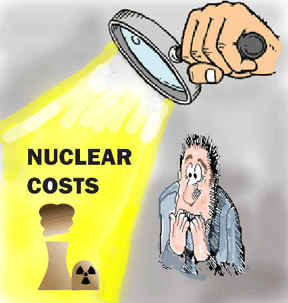 2. Can Zambia afford nuclear power?
Nuclear power is expensive. Very expensive. It’s not just the cost of the construction of the nuclear plant itself, although those numbers are eye-watering (especially in an economy as small as Zambia’s, where GDP in 2015 was $21.2-billion). It is also the cost of financing that construction.
With most banks unwilling to take such a massive gamble, financing usually comes from the vendor itself. In South Africa’s case, Rosatom is supposed to fund the construction of the two new nuclear plants, and recoup its costs by selling the electricity generated at an artificially high price. According to the text of a secret agreement uncovered by investigative journalist Lionel Faull, Rosatom will be able to dictate that price at will – leaving South African energy users at the mercy of a foreign corporation.
 3. Will the nuclear deal be corrupt?
Suspicion of corruption immediately attaches itself to any massive infrastructure project, and with good reason – especially in the case of nuclear deals. South Africa appears to be a textbook example of how the massive sums of money at stake can lead both government and corporations astray.
For example, French nuclear company Areva was accused by Sherpa, an anti-corruption NGO, of attempting to bribe high-ranking South African officials by purchasing unprofitable uranium mining assets for an inflated sum, just months before the tender for the nuclear project was announced. Rosatom itself, meanwhile, has been linked with a suspicious lack of transparency, fuelling fears that not all is above board. As Professor Winkler wrote in a separate piece for The Conversation:
“The nuclear debate gained a political dimension when President Jacob Zuma and his Russian counterpart, Vladimir Putin, started to develop an unusually close relationship… The lack of transparency surrounding the process, coupled with a history of corruption in South African mega-projects like the arms deal, has made the whole scheme seem suspicious to the broader public,” he said……. https://www.dailymaverick.co.za/article/2016-12-08-nuclear-deals-what-zambia-can-learn-from-south-africa/#.WEoQptJ97Gg
No comments yet.
1 This Month

10 March A LIVE WEBINAR THE REAL EFFECTS OF NUCLEAR POWER
What the Industry Isn’t Telling Us
1:00 PM Mountain, 2 pm Central, 3 pm Eastern. Live on the Keepers of the Water Facebook page

18 March Webinar @ 1 PM EST: An Assessment of SMR Projects: The Case of Canada
register for the zoom:
https://us02web.zoom.us/webinar/register/WN_o8BIIOUvQ2ONJR1nta65DQ#/registration


of the week – STOP SMALL MODULAR REACTORS IN CANADA
To see nuclear-related stories in greater depth and intensity – go to https://nuclearinformation.wordpress.com
-
Archives
- March 2026 (62)
- February 2026 (268)
- January 2026 (308)
- December 2025 (358)
- November 2025 (359)
- October 2025 (376)
- September 2025 (258)
- August 2025 (319)
- July 2025 (230)
- June 2025 (348)
- May 2025 (261)
- April 2025 (305)
-
Categories
- 1
- 1 NUCLEAR ISSUES
- business and costs
- climate change
- culture and arts
- ENERGY
- environment
- health
- history
- indigenous issues
- Legal
- marketing of nuclear
- media
- opposition to nuclear
- PERSONAL STORIES
- politics
- politics international
- Religion and ethics
- safety
- secrets,lies and civil liberties
- spinbuster
- technology
- Uranium
- wastes
- weapons and war
- Women
- 2 WORLD
- ACTION
- AFRICA
- Atrocities
- AUSTRALIA
- Christina's notes
- Christina's themes
- culture and arts
- Events
- Fuk 2022
- Fuk 2023
- Fukushima 2017
- Fukushima 2018
- fukushima 2019
- Fukushima 2020
- Fukushima 2021
- general
- global warming
- Humour (God we need it)
- Nuclear
- RARE EARTHS
- Reference
- resources – print
- Resources -audiovicual
- Weekly Newsletter
- World
- World Nuclear
- YouTube
-
RSS
Entries RSS
Comments RSS
 nuclear-news
Leave a comment