Time that lawmakers limited the power of American President to start using nuclear weapons
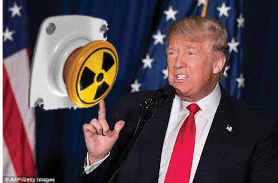 No one can stop President Trump from using nuclear weapons Chicago Tribune, Alex WellersteinSpecial to The Washington Post, 1 Dec 16,
All year, the prospect of giving the real estate and reality TV mogul the power to launch attacks that would kill millions of people was one of the main reasons his opponents argued against electing him. “A man you can bait with a tweet is not a man we can trust with nuclear weapons,” Hillary Clinton said in her speech accepting the Democratic presidential nomination. Republicans who didn’t support Trump — and even some who did, such as Florida Sen. Marco Rubio — also said they didn’t think Trump could be trusted with the launch codes.
Now they’re his. When Trump takes office in January, he will have sole authority over more than 7,000 warheads. There is no failsafe. The whole point of U.S. nuclear weapons control is to make sure that the president — and only the president — can use them whenever he decides to do so. The only sure way to keep President Trump from launching a nuclear attack, under the system we’ve had in place since the early Cold War, would have been to elect someone else.
When the legal framework for nuclear weapons was developed, the fear was about not irrational presidents but trigger-happy generals. The Atomic Energy Act of 1946, passed with President Harry Truman’s signature after nine months of acrimonious congressional hearings, firmly put the power of the atomic bomb in the hands of the president and the civilian components of the executive branch. It was a momentous and controversial law, crafted in the months following the atomic bombings of Hiroshima and Nagasaki, with an eye toward future standoffs with the Soviet Union…….
Eventually, the brass adopted the idea that, when it came to nuclear matters, they were at the president’s beck and call. It was not generals’ responsibility to make the order; it was their responsibility to carry it out.
That the president would be the only person competent to use nuclear weapons was never challenged. Even asking the question would throw the entire system into disarray, as Maj. Harold Hering learned in 1973. Hering was a 21-year Air Force veteran who was decorated for his flying in Vietnam before being sent for training as a nuclear missile squadron commander. He had been taught that officers had an obligation to disobey illegal orders. So when he was told how to launch a nuclear attack, he asked what seemed like a simple question: How could he be sure that an order to launch his missiles was lawful? How could he be sure, for example, that the president wasn’t insane? Instead of an answer, he got the boot: an aborted promotion and an administrative discharge for “failure to demonstrate acceptable qualities of leadership” and for indicating “a defective mental attitude towards his duties.”
The Air Force’s problem, in short, is that once a serviceman starts down the rabbit hole of doubt, he becomes an unreliable second-guesser — and suddenly he is one of the few people who can decide whether nuclear weapons are used.
The procedure for ordering a nuclear attack involves more than one person: The president cannot literally press a button on his desk and start World War III. There is no “nuclear button” at all. Instead, the U.S. nuclear command-and-control system is bureaucratically and technically complex, stretching out to encompass land-based missile silos, submarine-based ballistic and cruise missiles, and weapons capable of being dropped from bombers. The chain of command requires that the president order the secretary of defense to carry out a launch; the secretary serves as the conduit for implementation by the military. There are succession policies in place so that the procedure can be continued in the event of the death or incapacitation of either the president or the secretary of defense — or their designated successors.
Most details of how a nuclear war would be started are classified, because an enemy who knew enough about the system could come up with ways to complicate or defeat it. What is known is that an aide is always following the president, carrying at least one large satchel (often two) known as the “nuclear football,” reportedly containing information about nuclear attack possibilities and how the president could verify his identity, authenticate orders and communicate with the military about implementing them……..
It might be worth resurrecting this debate , if we take seriously the idea that presidents — any of them, much less Trump — should not have the legal authority to conduct arbitrary and unilateral nuclear war. Perhaps now, decades after the end of the Cold War, we are past the moment when we need to entrust that power in a single person. One can imagine a law that would allow the president to use nuclear weapons in the face of imminent danger, the sort of situation in which a matter of minutes or even seconds could make a difference, but would enact formal requirements for outside consensus when more options were on the table. It would not require a full renunciation of the possibility of a first-strike nuclear attack (something the United States has never been willing to make) but might add some reassurances that such decisions would not be made unilaterally.
Congress ceded a considerable amount of power to the presidency in 1946. Seventy years later, maybe it is time lawmakers took some of it back. http://www.chicagotribune.com/news/opinion/commentary/ct-trump-use-nuclear-weapons-20161201-story.html
1 Comment »
Leave a comment
1 This Month


10 March A LIVE WEBINAR THE REAL EFFECTS OF NUCLEAR POWER
What the Industry Isn’t Telling Us
1:00 PM Mountain, 2 pm Central, 3 pm Eastern. Live on the Keepers of the Water Facebook page


18 March Webinar @ 1 PM EST: An Assessment of SMR Projects: The Case of Canada
register for the zoom:
https://us02web.zoom.us/webinar/register/WN_o8BIIOUvQ2ONJR1nta65DQ#/registration


of the week – STOP SMALL MODULAR REACTORS IN CANADA
To see nuclear-related stories in greater depth and intensity – go to https://nuclearinformation.wordpress.com
-
Archives
- March 2026 (62)
- February 2026 (268)
- January 2026 (308)
- December 2025 (358)
- November 2025 (359)
- October 2025 (376)
- September 2025 (258)
- August 2025 (319)
- July 2025 (230)
- June 2025 (348)
- May 2025 (261)
- April 2025 (305)
-
Categories
- 1
- 1 NUCLEAR ISSUES
- business and costs
- climate change
- culture and arts
- ENERGY
- environment
- health
- history
- indigenous issues
- Legal
- marketing of nuclear
- media
- opposition to nuclear
- PERSONAL STORIES
- politics
- politics international
- Religion and ethics
- safety
- secrets,lies and civil liberties
- spinbuster
- technology
- Uranium
- wastes
- weapons and war
- Women
- 2 WORLD
- ACTION
- AFRICA
- Atrocities
- AUSTRALIA
- Christina's notes
- Christina's themes
- culture and arts
- Events
- Fuk 2022
- Fuk 2023
- Fukushima 2017
- Fukushima 2018
- fukushima 2019
- Fukushima 2020
- Fukushima 2021
- general
- global warming
- Humour (God we need it)
- Nuclear
- RARE EARTHS
- Reference
- resources – print
- Resources -audiovicual
- Weekly Newsletter
- World
- World Nuclear
- YouTube
-
RSS
Entries RSS
Comments RSS
 nuclear-news
Stop accusing Trump of being a button pusher.