Donald Trump’s bullying personality adds danger to his future role as Commander In Chief
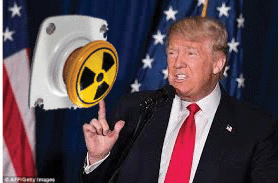 Nuclear weapons: how foreign hotspots could test Trump’s finger on the trigger
From North Korea to Iran to Russia, a president-elect with civilisation-ending weaponry at his fingertips will face an in-tray of potential international crises, Guardian, Julian Borger , 13 Nov 16 On Donald Trump’s first day in office he will be handed the “nuclear biscuit” – a small card with the codes he would need to talk to the Pentagon war room to verify his identity in the event of a national security crisis.
Climate scientists warn that Trump’s election is a disaster for the planet
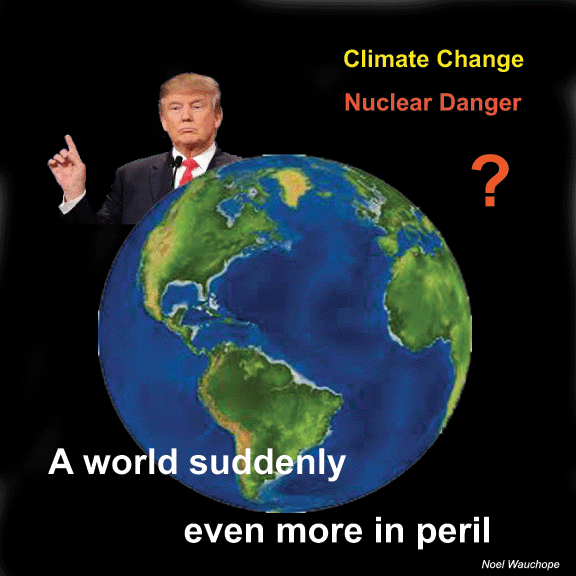 Donald Trump presidency a ‘disaster for the planet’, warn climate scientists
Leading scientists say the climate denier’s victory could mean ‘game over for the climate’ and any hope of warding off dangerous global warming, Guardian, Oliver Milman, 13 Nov 16 The ripples from a new American president are far-reaching, but never before has the arrival of a White House administration placed the livability of Earth at stake. Beyond his bluster and crude taunts, Donald Trump’s climate denialism could prove to be the lasting imprint of his unexpected presidency.
“A Trump presidency might be game over for the climate,” said Michael Mann, a prominent climate researcher. “It might make it impossible to stabilize planetary warming below dangerous levels.”
Kevin Trenberth, senior scientist at the US National Center for Atmospheric Research, added: “This is an unmitigated disaster for the planet.”
Trump has vowed to sweep away the climate framework painstakingly built over Barack Obama’s two terms. At risk is the Paris climate accord, which only came into force last week, and Obama’s linchpin emissions reduction policy, the Clean Power Plan.
At a pivotal moment when the planet’s nations have belatedly banded together to confront an existential threat, a political novice who calls global warming a “bullshit” Chinese-invented hoax is taking the helm at the world’s foremost superpower.
“Millions of Americans voted for a coal-loving climate denier willing to condemn people around the globe to poverty, famine and death from climate change,” said Benjamin Schreiber, climate director at Friends of the Earth US. “It seems undeniable that the United States will become a rogue state on climate change.”
US conservatives are already rubbing their hands in glee at the prospect of a bonfire of regulation. Trump wants the US to exit the Paris deal, which commits nations to keeping the global temperature rise below a 2C threshold, potentially setting off a cataclysmic domino effect where other countries also drop out or ease off efforts to decarbonize. The 2C limit, which was already a stern challenge, now appears perilous.
The Clean Power Plan, the main tool to cut American emissions, is also targeted for elimination, along with billions of dollars in clean energy funding. Republicans will also turn off the tap of aid flowing to developing nations already struggling with climate change-driven sea level rise, heatwaves and drought.
Bitterly contested fossil fuel projects such as the Keystone development and the Dakota Access pipeline, which has caused unprecedented uproar among native American tribes, would likely be waved through, with Trump promising to “lift the Obama-Clinton roadblocks to allow these vital energy infrastructure projects to go ahead”.
Environmentalists are already aghast at Trump’s presidential preparations. He has appointed Myron Ebell, director at a conservative thinktank, to oversee transition plans for the Environmental Protection Agency, which Trump has casually earmarked for abolition. Ebell has said global warming is “nothing to worry about” and that the Clean Power Plan is “illegal”.
Shortlists drawn up for key Trump administration posts have also raised alarm. Oil billionaire Harold Hamm is being touted as energy secretary, while former vice presidential candidate Sarah Palin could make a stunning comeback as interior secretary, putting her in charge of US public lands, including treasures such as Yellowstone and Yosemite national parks. Palin is an enthusiastic proponent of oil and gas drilling, describing the fossil fuels as “things that God has dumped on this part of the Earth for mankind’s use”.
Republicans have already used Congressional committees to hound climate scientists and green groups and this badgering may escalate once climate denial is official White House doctrine. It’s understood that scientists at Nasa are already bracing themselves for cuts to climate research programs.
Predicting Trump’s plans, however, largely relies upon reading the runes from his discursive policy speeches, which regularly dissolved into vituperative diatribes while on the campaign trail.
At the heart of his energy and climate thinking is an “America first” policy where “draconian climate rules” are repealed and the US escalates its production of coal, oil and natural gas. In May, Trump sported a coal miner’s helmet at a rally in West Virginia, a state with a long history of mining, to underscore his message that the “war on coal” is over and that jobs will flow back to the stricken industry.
“Under my administration,” Trump said, “we’ll accomplish complete American energy independence. Complete. Imagine a world in which our foes, and the oil cartels, can no longer use energy as a weapon. It will happen. We’re going to win.”
These bromides to American industrial strength helped propel Trump to the White House but aren’t tethered to reality. US coal production slumped 10% last year, with mining jobs shrinking by 12%. Over the same 12-month period, the US oil industry lost $67bn. These woes have been caused by market forces, rather than onerous regulation, and even Trump’s authoritarianism doesn’t extend far enough to change that.
“As president, Donald Trump will pretend climate change does not exist,” said Prof Tom Lyon of the University of Michigan’s business school. “This is an increasingly untenable position, even for committed climate skeptics.
“His energy policy will encourage investment in high-carbon energy sources that will look foolish in retrospect. And he will anger much of the rest of the world by reneging on policies designed to address global challenges.”
US greenhouse gas emissions have started to taper off in recent years but a Trump presidency would see a resurgence, with an analysis by Lux Research finding that carbon dioxide output would be 16% higherthan the current trajectory should the real estate magnate complete a second term.
This would give the world a hefty shove towards climate disaster and fatally wound the US’s reputation as a global leader. Should other major emitters such as China, India and the European Union fail to make compensatory emissions cuts the planet will likely spiral into runaway climate change where tens of millions of people are displaced by rising seas, food insecurity and conflict, leading to an unprecedented international humanitarian disaster.
Major US cities including New York, Miami and Boston would face inundation. California, already suffering its worst dry spell in 1,200 years, may stage ‘megadroughts’ that last 20 or even 30 years. The Pentagon has warned climate change poses a “threat multiplier” to US national security, to hoots of derision from Republicans……… https://www.theguardian.com/environment/2016/nov/11/trump-presidency-a-disaster-for-the-planet-climate-change
The British nuclear lobby’s sick weapons experiments with chickens
During the Cold War, the UK designed nuclear land mines that were reliant on chickens http://www.businessinsider.com.au/uk-developed-chicken-warmed-nuclear-landmines-2016-11 JEREMY BENDER NOV 14, 2016 The Cold War spawned decades’ worth of bizarre weapon ideas as the West and the Soviet Union strove towards gaining the strategic upper hand over their superpower rival.
Nuclear free New Zealand to hear pioneer antinuclear hero, Helen Caldicott
Helen did not hold back, explaining that nuclear war means “blindness, burning, starvation, disease, lacerations, haemorrhaging, millions of corpses and an epidemic of disease”. Helen’s dramatic and blunt style reduced many in her audiences to tears. She always ended her talks with a call to action – especially to parents – as she strongly believes that nuclear disarmament is “the ultimate medical and parenting issue of our time.”
To those who would claim New Zealand was not a target she had a short reply: “Trident submarines in ports are targeted. They are a first strike target. It is much easier to destroy subs when they are in dock than it is when they are submerged in the ocean.”
The new Labour Government of 1984 passed the New Zealand Nuclear Free Zone, Disarmament and Arms Control Act in 1987, the world’s first national nuclear-free legislation. Dr Helen Caldicott’s influence had culminated in the passage of the cornerstone of New Zealand’s foreign policy.
 Marilyn Waring on the Australian hero of nuclear-free New Zealand http://thespinoff.co.nz/society/14-11-2016/the-australian-hero-of-nuclear-free-new-zealand/ November 14, 2016 The former National MP whose decision to support anti-nuclear legislation led to the 1984 snap election writes on the transformative influence of the passionate Australian physician Helen Caldicott, who speaks in Auckland this week
If you were growing up in New Zealand and Australia post World War II, there’s a chance you knew about the United States using the Marshall Islands as a nuclear testing site from 1947 until 1962. In an agreement signed with the United Nations, the US government held the Marshall Islands as a “trust territory” and detonated nuclear devices in this pristine area of the Pacific Ocean – leading, in some instances, to huge levels of radiation fall-out, health effects, and the permanent displacement of many island people. In all, the US government conducted 105 underwater and atmospheric tests. You would have also known that the British conducted seven atmospheric tests between 1956 and 1963 on traditional Aboriginal land, in Maralinga, Australia.
It may be that you read Neville Shute’s 1957 novel On the Beach, in which people in Melbourne, Australia wait for deadly radiation to spread from a Northern Hemisphere nuclear war. This book made a memorable impact on Helen when she read it as a teenager.
Both Helen and I saw Peter Watkin’s The War Game, a BBC documentary drama about nuclear war and the consequences in an English city. In New Zealand the film was restricted for children unless accompanied by an adult, so I had to get my father to take me. The War Game won the Oscar for the best documentary in 1965.
France began its series of over 175 nuclear tests at Mururoa, in the South Pacific, in 1966. At least 140 of these tests were above ground. In 1973, the New Zealand and Australian governments took France to the World Court for continued atmospheric testing, and forced the last tests underground. The testing finally came to an end in 1976.
In New Zealand the US Navy made regular visits between 1976 and 1983 with nuclear-powered and, most likely, nuclear-armed, ships. These visits produced spectacular protest fleets in the Auckland and Wellington harbours, when hundreds of New Zealanders — in yachts of all sizes, in motor boats and canoes, even on surf boards — surrounded the vessels and tried to bring them to a complete stop. By 1978, a campaign began in New Zealand to declare borough and city council areas nuclear-free and, by the early 1980s, this symbolic movement had quickly gained momentum, covering more than two-thirds of the New Zealand population.
Helen Caldicott and I had not met up to this point, but these were shared parts of our history and consciousness when Helen visited New Zealand in 1983. Helen Caldicott graduated with a medical degree from University of Adelaide Medical School in 1961. She moved to the United States, becoming an Instructor in paediatrics at Harvard Medical School and was on the staff of the Children’s Hospital Medical Centre in Boston, Massachusetts. In the late 1970s, Helen became the President of Physicians for Social Responsibility. This group was founded when Helen was finishing medical school, quickly making its mark by documenting the presence of Strontium-90, a highly radioactive waste product of atmospheric nuclear testing, in children’s teeth. The landmark finding eventually led to the Limited Nuclear Test Ban treaty, which ended atmospheric nuclear testing.
But it was the Three Mile Island accident that changed Helen’s life. An equipment failure resulted in a loss of cooling water to the core of a reactor at the Three Mile Island Nuclear Generating Station in Pennsylvania, causing a partial meltdown. Operator failure meant that 700,000 gallons of radioactive cooling water ended up in the basement of the reactor building. It was the most serious nuclear accident to that date in the US Helen published Nuclear Madness the same year. In it she wrote: “As a physician, I contend that nuclear technology threatens life on our planet with extinction. If present trends continue, the air we breathe, the food we eat, and the water we drink will soon be contaminated with enough radioactive pollutants to pose a potential health hazard far greater than any plague humanity has ever experienced.” In 1980, Helen resigned from her paid work positions to work full time on the prevention of nuclear war.
In 1982, Canadian director Terre Nash filmed a lecture given by Helen Caldicott to a New York state student audience. Nash’s consequent National Film Board of Canada documentary If You Love this Planet was released during the term of US President Ronald Reagan, at the height of Cold War nuclear tensions between the United States and the Soviet Union. The US Department of Justice moved quickly to designate the film “foreign propaganda,” bringing a great deal of attention to the film. It went on to win the 1982 Academy Award for Documentary Short Subject. That same year, Helen addressed about 750,000 people in Central Park, New York in the biggest anti-nuke rally in the United States to that date.
In 1983, I was serving as a member of the New Zealand parliament, having been elected eight years earlier at the age of 23. Our parliament established a Disarmament and Arms Control Select Committee to conduct hearings on the possibility of making New Zealand a nuclear-free zone. During this critically important time, Helen was invited to New Zealand on a lecture tour. The documentary If You Love This Planet was shown at her speaking engagements.
I did not get to meet her, nor hear any of her lectures in person, as I was working in parliament every night. But I did follow the media coverage.
Helen told the Listener about having observed five-star generals in US congressional and senate committees complaining that the Russian missiles were bigger than the American ones. “The Russian missiles are very big [and] inaccurate and clumsy. America has very small, very accurate missiles, which are better at killing people and destroying targets,” she explained. A frequent message in her talks to New Zealand audiences was the redundant overkill capacity of both superpowers. Caldicott noted to her audiences that “The US has 30,000 bombs and Russia 20,000.”
I had sat in a New Zealand parliamentary committee hearing some months earlier, when a government colleague, brandishing a centrefold of a Russian submarine, excitedly called for us to “Look at how big it is.” I had thought that no one would believe me if I had repeated such an inane banality – when an adult male was more impressed by the size of the submarine than its capacity to destroy life on this planet.
Helen’s public addresses were grounded in the potential impact of nuclear weapons. “Imagine a 20-megaton bomb targeted on Auckland,” she told audiences in New Zealand. “The explosion, five times the collective energy of all the bombs dropped in the Second World War, digs a hole three-quarters of a mile wide by 800 feet deep and turns people, buildings and dirt into radioactive dust. Everyone up to six miles will be vaporised, and up to 20 miles they will be dead or lethally injured. People will be instantly blinded looking at the blast within 40 miles. Many will be asphyxiated in the fire storm.”
Helen did not hold back, explaining that nuclear war means “blindness, burning, starvation, disease, lacerations, haemorrhaging, millions of corpses and an epidemic of disease”. Helen’s dramatic and blunt style reduced many in her audiences to tears. She always ended her talks with a call to action – especially to parents – as she strongly believes that nuclear disarmament is “the ultimate medical and parenting issue of our time.”
To those who would claim New Zealand was not a target she had a short reply: “Trident submarines in ports are targeted. They are a first strike target. It is much easier to destroy subs when they are in dock than it is when they are submerged in the ocean.”
In 2015, I asked Helen how she managed to deliver such bad news and yet keep her audiences with her. “Being a doctor helps because you have to learn to negotiate with a patient and with language they can understand,” she explained. “You have to convert the medical diagnosis and treatment to lay language. I also have to keep them awake sometimes by letting them laugh because it relieves their tension and because the stuff I say is pretty awful.” Helen told me that she practises “global preventative medicine”.
Helen’s tour through New Zealand in 1983 had a huge, and lasting, impact. At one stop, Helen addressed over 2,000 people at a public event in Auckland. The librarian with whom I corresponded looking for old newspaper reports of Helen’s visit, wrote to me: “Her chillingly detailed description of the effects of a nuclear device detonated over the hall in which we were sitting remains rooted in my psyche to this day! …The other message I most recall is the dichotomy she evoked between the destructive drive of ‘old men’ rulers, the instigators of war, versus the procreative energy of mothers most impelled to oppose them — which, however reductive, retains the compelling logic of a truism!”
Helen’s approach was transformative in New Zealand. Helen’s speaking events packed auditoriums, and overflows of audiences had to be accommodated using loud speaker systems. People responded strongly to this woman, whose life work involved caring for children, speaking about medical effects of fallout, and speaking without the use of the clichéd military and defence ideological rhetoric that treated people as if they were simpletons who couldn’t understand. Her speeches inspired people to act. After Helen spoke, the volume of mail delivered to my parliamentary office increased—particularly from women.
On May 24, 1983, 20,000 women wearing white flowers and armbands and holding banners with peace signs marched quietly up a main street in Auckland to hold a huge rally and call for New Zealand to be nuke-free. It was one of the largest women’s demonstrations in New Zealand’s history. In her book, Peace, Power and Politics – How New Zealand Became Nuclear Free, Maire Leadbetter writes: “I am one of many activists who think of Helen Caldicott’s visit as the point when the peace movement began to grow exponentially … Helen had a magical ability to motivate previously passive citizens to become activists.”
Shortly after Helen’s visit to New Zealand, in 1984, I advised that I intended to vote for the opposition-sponsored nuclear-free New Zealand legislation. This prompted conservative Prime Minister Rob Muldoon to call a snap election. Muldoon told media that my “feminist anti-nuclear stance” threatened his ability to govern.
The new Labour Government of 1984 passed the New Zealand Nuclear Free Zone, Disarmament and Arms Control Act in 1987, the world’s first national nuclear-free legislation. Dr Helen Caldicott’s influence had culminated in the passage of the cornerstone of New Zealand’s foreign policy.
This essay is one of 28 stories by notable women about remarkable women peacemakers, When We Are Bold: Women Who Turn Our Upsidedown World Right, to mark the 10th anniversary of the Nobel Women’s Initiative. Dr Caldicott speaks at AUT on Tuesday November 15.
Pugwash Japan – anti-nuclear science group strengthens its efforts
Anti-nuclear scientist group aims to boost influence amid growing defense research fears http://mainichi.jp/english/articles/20161113/p2a/00m/0na/004000c November 13, 2016 (Mainichi Japan) Japanese scientists are trying to make Pugwash Japan, the domestic arm of the Pugwash Conferences on Science and World Affairs — an international organization working toward the abolition of nuclear arms and war — more active and influential amid concerns that the defense industry and scientific community are growing increasingly closer.
Since individual scientists join the conference based on their own qualifications, Japanese scientists who took part in past international meetings launched Pugwash Japan to spread the message. The Japan group decided in September to relaunch a better-organized Pugwash Japan with a code of conduct and membership system after an international Pugwash general conference was held in the city of Nagasaki in November last year. The group’s aim is to open the door wider to those who are interested in the group’s activities and strengthen its influence in policy making.
The newly reformed Pugwash Japan, headed by nuclear engineering professor Tatsujiro Suzuki at Nagasaki University, will hold its first general meeting in Tokyo on Nov. 27. It will have some 40 members, with Keio University professor emeritus Michiji Konuma — who worked with Yukawa — on the steering committee, and 16 advisers such as engineer Hiroyuki Yoshikawa, a special adviser to the Japan Science and Technology Agency and former chairman of the Science Council of Japan, and University of Tokyo professor emeritus Seigo Hirowatari.
Member scientists are set to discuss concerns regarding defense research in Japan and the challenges to nuclear disarmament that remain following U.S. President Barack Obama’s historic visit to Hiroshima. To ensure unrestrained discussion, the meeting will be closed to the public, but results of the debate will be incorporated into the statements it releases to the public. The organization is also considering holding symposiums for the general public.
Pugwash Japan chairman Suzuki said he hopes that the group provides scientists with an opportunity for open-minded discussion based on the two pillars of the Pugwash Conference — social responsibility of scientists and dialogue across divides. He added, “We’re concerned about the current tendency for everything to lean toward national security and hope that our discussions that will lead to policy proposals.”
1 This Month

of the week – Shut Down Drone Warfare!


Tell the Ukrainian Government to Drop Prosecution of Peace Activist Yurii Sheliazhenko

Petition to revoke the licensing of the Near Surface Nuclear Disposal Facility (NSDF) at Chalk River. https://www.ourcommons.ca/petitions/en/Petition/Details?Petition=e-7247
To see nuclear-related stories in greater depth and intensity – go to https://nuclearinformation.wordpress.com
-
Archives
- March 2026 (244)
- February 2026 (268)
- January 2026 (308)
- December 2025 (358)
- November 2025 (359)
- October 2025 (376)
- September 2025 (257)
- August 2025 (319)
- July 2025 (230)
- June 2025 (348)
- May 2025 (261)
- April 2025 (305)
-
Categories
- 1
- 1 NUCLEAR ISSUES
- business and costs
- climate change
- culture and arts
- ENERGY
- environment
- health
- history
- indigenous issues
- Legal
- marketing of nuclear
- media
- opposition to nuclear
- PERSONAL STORIES
- politics
- politics international
- Religion and ethics
- safety
- secrets,lies and civil liberties
- spinbuster
- technology
- Uranium
- wastes
- weapons and war
- Women
- 2 WORLD
- ACTION
- AFRICA
- Atrocities
- AUSTRALIA
- Christina's notes
- Christina's themes
- culture and arts
- Events
- Fuk 2022
- Fuk 2023
- Fukushima 2017
- Fukushima 2018
- fukushima 2019
- Fukushima 2020
- Fukushima 2021
- general
- global warming
- Humour (God we need it)
- Nuclear
- RARE EARTHS
- Reference
- resources – print
- Resources -audiovicual
- Weekly Newsletter
- World
- World Nuclear
- YouTube
-
RSS
Entries RSS
Comments RSS
 nuclear-news