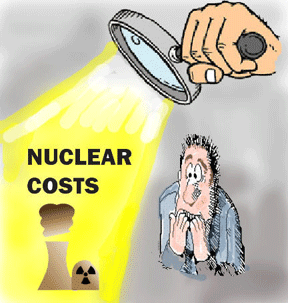

The decision has been mired in controversy and still hangs in the balance and the offer by Eskom to foot the bill raises more questions than it provides answers. Recent claims by Eskom’s management fail to adequately address any of the fundamental criticisms of the proposed nuclear programme. Statements that Eskom can “finance nuclear on its own” don’t add up and are misleading.
Changes in Eskom’s rationale for justifying nuclear procurement over the past two years call into question the merits of these arguments.
Its claims about financing also raise serious questions about the arguments it presented to Parliament last year to justify a R23 billion cash injection and write off a R60bn loan.
The three main problems with the case for nuclear procurement are well established.
The actual power probably will not be needed. Trends in economic growth and electricity demand are much lower than the original forecasts on which the supposed need for nuclear power were based.
The programme is also likely to be very costly although there are still no credible, government cost estimates in the public domain. Many energy experts have argued that even if additional capacity was needed, other energy sources may be cheaper or more appropriate.
Finally, the combination of insufficient demand and costly supply means that nuclear poses a serious threat to the future stability of the country’s public finances and economic growth.
An indicator of problematic motives is the way in which the arguments made for it keep shifting. Last year Eskom chief executive Brian Molefe told Parliament that procurement of nuclear was “urgent” and feasible. Molefe argued that nuclear costs were lower than critics implied and financing concerns reflected a “pedestrian” attitude.
Subsequent to this, Eskom decided on a new line of attack: trying to limit procurement of power from independent renewable energy producers………
It should therefore be clear that the case for proceeding with the procurement of nuclear power is fundamentally flawed. The rational and responsible decision by cabinet would be to halt it.
If economic growth and energy demand increases significantly over the next few years, the matter could be revisited based on an appropriately updated Integrated Resource Plan that uses credible forecasts of future energy needs. http://www.iol.co.za/dailynews/opinion/eskoms-nuclear-energy-offer-doesnt-add-up-2086209


 nuclear-news
Leave a comment