Climate change, mass migration, racist backlash – Donald Trump first demagogue of the Anthropocene
Yet the second trend—the combination of mass migration and racist backlash—could push even more polities toward authoritarianism. Migration is also harder to predict than inequality: Wars and exoduses are not as easy to model as flood damage and agricultural yields.
Climate mitigation is a worthy goal in itself. It is all the more important when understood as one more type of long-term anti-fascism.
 Donald Trump Is the First Demagogue of the Anthropocene He won’t be the
  last. The Atlantic, ROBINSON MEYER OCT 19, 2016
“………I want to propose a new way of understanding Donald Trump. He not only represents a white racial backlash, and he has not only opened the way for an American extension of the European far right. Insofar as his supporters are drawn to him by a sense of global calamity, and insofar as his rhetoric singles out the refugee as yet another black and brown intruder trying to violate the nation’s cherished borders, Trump is the first demagogue of the Anthropocene. We should take Trump at his word when he calls Syrian refugees “one of the great Trojan horses,” or when his son bizarrely describes them as Skittles that “will kill you.” In Europe, Trump’s far-right kin have long blurred the differences between legal immigration, Islamist terrorism, and the refugees fleeting the Syrian War. After the Paris attacks last year, one leader of the French far-right National Front said, “Today, we can see that immigration has become favorable terrain for the development of Islamism.”
This xenophobia is grounded in real-life trends. I will focus on two in particular: moribund economic growth and the mass migration of non-white people. Both will likely intensify as the planet warms. (A third vital trend—the political and cultural upheaval of the U.S. racial hierarchy—will not vary with climate change.)
First, climate change could easily worsen the inequality that has already hollowed out the Western middle class. A recent analysis in Nature projected that the effects of climate change will reduce the average person’s income by 23 percentby the end of the century. The U.S. Environmental Protection Agency predicts that unmitigated global warming could cost the American economy $200 billion this century. (Some climate researchers think the EPA undercounts these estimates.)
Future consumers will not register these costs so cleanly, though—there will not be a single climate-change debit exacted on everyone’s budgets at year’s end. Instead, the costs will seep in through many sources: storm damage, higher power rates, real-estate depreciation, unreliable and expensive food. Climate change could get laundered, in other words, becoming just one more symptom of a stagnant and unequal economy. As quality of life declines, and insurance premiums rise, people could feel that they’re being robbed by an aloof elite.
They won’t even be wrong. It’s just that due to the chemistry of climate change, many members of that elite will have died 30 or 50 years prior. Continue reading
Over $8.25 billion to extend the life of B61-12 atomic bomb
 Updated B61 Nuclear Bomb to Cost $8.25 Billion, Defense News, By: Aaron Mehta, October 19, 2016 WASHINGTON – The life-extension program for the B61-12 atomic bomb will cost just over $8.25 billion, according to a new estimate from the National Nuclear Security Administration (NNSA).
The new cost estimate was completed over the summer as the agency prepared to enter the production-engineering phase of the program. The baseline cost of the program is $7.605 billion, with an additional $648 million in “funds leveraged from other NNSA programs for technology and manufacturing readiness,” according to an agency statement – money that has common applications across multiple weapon systems.
That cost does not include the estimated $1.3 billion that the Department of Defense plans to spend on developing and procuring tailkits for the weapons. With that included, the total cost for the program sits at roughly $9.5 billion.
The agency is perusing a modernization plan known as the “3+2 Strategy,” under which the NNSA is consolidating the American arsenal of warheads into five variants. The five ballistic-missile warheads now in service are being consolidated into three new interoperable warheads known as the IW-1, IW-2, and IW-3, while the five bomb and cruise-missile warhead types are being consolidated into two replacement warhead designs, the W80-4 and the B61-12. …….http://www.defensenews.com/articles/updated-b61-nuclear-bomb-to-cost-825-billion
German cabinet approves landmark nuclear waste deal with utilities
Germany approves landmark nuclear waste deal with utilities: source http://www.businessinsider.com/r-germany-approves-landmark-nuclear-waste-deal-with-utilities-source-2016-10/?r=AU&IR=T BERLIN (Reuters) – The German cabinet approved a deal on Wednesday for its top utilities to start paying into a 23.6-billion-euro ($25.9 billion) fund next year in return for shifting liability for nuclear waste storage to the government, a source said.
The utilities will remain responsible for dismantling the country’s nuclear plants, the last of which will be shut down in 2022 as part of Germany’s abandonment of the technology, a decision triggered by Japan’s Fukushima disaster five years ago.
(Reporting by Markus Wacket; Writing by Caroline Copley; Editing by Joseph Nasr)
Read the original article on Reuters.
Ukraine decides to cease paying Russia for nuclear waste disposal

 Ukraine to stop paying Russia for nuclear waste disposal Rt.com : 21 Oct, 2016 From next year Ukraine is not going to pay Russia $200 million annually to remove spent nuclear fuel from the country, according to Ukrainian Energy Minister IgorNasalik.
The country will build its own spent nuclear fuel storage facility, the minister announced.
The storage site chosen is in the exclusion zone of the Chernobyl nuclear power, but it is not designed to store nuclear waste for a long time.
The exclusion zone is a 30-kilometer radius from the Chernobyl nuclear power plant established by the USSR soon after the 1986 accident.
Construction of the new central used fuel storage facility is expected to start in March 2017, according to a director of a subsidiary of the Ukrainian nuclear power plant operator Energoatom.
European nuclear industry experts are concerned the Ukrainian project does not meet standards for nuclear safety and creates a risk of a radioactive accident.
In August, the former director of the Chernobyl nuclear power plant Mikhail Umanets warned of the rising number of emergency situations in Ukraine’s nuclear energy sector, stressing the country would face a “collapse” in the sector within seven years……https://www.rt.com/business/363655-ukraine-nuclear-waste-russia/
Climate Change barely mentioned in the US presidential debates
Why the silence on climate in the US presidential debates? The Conversation, October 20, 2016 As scientists become more gloomy about keeping global warming below the allegedly “safe” limit of 2℃, the issue is disappearing from the US presidential debates. There was a brief mention in the second debate between Donald Trump and Hillary Clinton debate, with climate change treated as an “afterthought”.
Trump has previously (in 2012) suggested that climate change “was created by and for the Chinese”. Clinton has put forward a detailed climate and energy plan.
Even former Vice President Al Gore joining Clinton on at a campaign rally in Florida didn’t particularly help.
So why has climate change gone AWOL?
Early days
It’s an odd phenomenon, because awareness of the threat of climate change goes back more than half a century, well before its sudden arrival on public policy agendas in 1988…….
A combination of growing scientific alarm about the growth of greenhouse gases in the atmosphere and a long hot summer in 1988 made climate change an election issue. On the campaign trail, then-Vice President George H. W. Bush announced in his presidential compaign:
Those who think we’re powerless to do anything about the “greenhouse effect” are forgetting about the “White House effect”. As President, I intend to do something about it… In my first year in office, I will convene a global conference on the environment at the White House… We will talk about global warming… And we will act.
They didn’t get on with it, of course……… It was 2000 before presidential candidates debated the issue. George W. Bush (2000-09) said:
I think it’s an issue that we need to take very seriously. But I don’t think we know the solution to global warming yet. ……
The peak year for climate concern was 2008, with climate rating a mention in all three presidential debates.
Obama framed climate change as an energy independence issue, arguing that:
…we’ve got to walk the walk and not just talk the talk when it comes to energy independence, because this is probably going to be just as vital for our economy and the pain that people are feeling at the pump – and you know, winter’s coming and home heating oil – as it is our national security and the issue of climate change that’s so important.
Despite a petition with 160,000 signatures, the debate moderators for the 2012 debate did not put the issue on the agenda……
What happened? In two words: Tea Party. The emergence of the hyper-conservative Tea Party Republican faction was the culmination of a longer-term trend of what two American academics call “anti-reflexivity”.
For example, Marco Rubio, from Florida – a state that is already being hit by climate impacts – cannot take a position on it.
The second reason is more gloomy, because it is more intractable. Those who have denied climate change for so very long will find it very costly – both politically and psychologically – to reverse their position and admit that they have been wrong. Climate change denial has become a cultural position, as academics like Andrew Hoffman have noted.
Meanwhile, the carbon dioxide accumulates, and the impacts pile up. https://theconversation.com/why-the-silence-on-climate-in-the-us-presidential-debates-67152
Majority of Swiss back proposal to shut down nuclear power by 2029
Poll finds support for nuclear phaseout, SwissInfo Ch By Urs Geiser , 21 Oct 16
A proposal to decommission Switzerland’s nuclear power plants by 2029 has the backing of a majority of citizens, according to a survey conducted seven weeks ahead of a nationwide vote. Despite this, pollsters believe the initiative is likely to be defeated on November 27.
Supporters of the Green Party proposal had a 21% lead over opponents seven weeks before polling day, while 7% of respondents were undecided, results published on Friday showed.
“The political left, women and citizens in the French-speaking part of the country are in favour,” said Claude Longchamp of the leading GfS Bern research and polling institute.
Supporters face a strong alliance of opponents, including centre-right parties, parliament, the government and the business community.
Longchamp said the grassroots of the centrist Christian Democrats are likely to play a key role……..http://www.swissinfo.ch/eng/november-27-vote_poll-finds-support-for-nuclear-phase-out/42529278
Dairyland Power gets major compensation for radioactive trash from its nuclear reactor that closed in 1987
Feds to pay Dairyland $73.5 million in nuclear settlement Dairyland Power has reached a major settlement with the U.S. Department of Energy over nuclear waste stored from its former nuclear reactor located at the La Crosse Boiling Water Reactor in Genoa.
America’s “false flags” – some Pentagon hawks itching for nuclear war?
Is Washington “False Flagging” The New Russia-Iran-Syria-China “Axis of Evil”, Into Nuclear War?….By Peter Koenig Global Research, October 21, 2016 “………...Intensified through four decades of Cold War, the US has grown increasingly dependent on the military – security industry for its economic advances. Creating weapons to exploit and destroy in foreign lands what later needs reconstruction is an easy way to making huge profits, sustaining an otherwise outsourced production economy and an ever poorer local population that lives off imported junk………
Nuclear Energy Institute is lobbying for new tax credits
 Nuclear power industry seeks new tax credits, Union Bulletin.com
The nuclear industry has faced a host of issues in the past decade that have shrunk its profits. By JEREMY DILLON of CQ-Roll Call , 20 Oct 16 WASHINGTON — Beset by low natural gas prices and tax advantages for its competitors, the nuclear power industry is seeking new tax credits to help it find its footing in an increasingly challenging marketplace.
Green Party calls on Ontario Premier to say no to nuclear Ontario Power Generation raising electricity costs
Ontario Power Generation has applied for permission to increase the price for nuclear power by 180 per cent over the next decade http://www.nugget.ca/2016/10/21/ontario-power-generation-has-applied-for-permission-to-increase-the-price-for-nuclear-power-by-180-per-cent-over-the-next-decade The following letter is addressed to Ontario Premier Kathleen Wynne.
Dear Premier:
Many people in Ontario are struggling to pay their electricity bills.
You need to act now to protect us from further price increases.
Ontario Power Generation wants to raise the price for nuclear power in order to operate its nuclear power plant in Pickering and rebuild the one in Darlington.
It has applied for permission to increase the price for nuclear power by 180 per cent over the next decade. And I expect the price will go even higher – as I’m sure you know, no nuclear project in Ontario’s history has delivered on time or on budget. This is unacceptable.
The people of Ontario simply cannot afford to pay for your plans to spend billions of our tax dollars to rebuild outdated nuclear plants. Studies indicate that Ontario can save $600 million to $1.2 billion per year – or $12 to 24 billion over 20 years – by cancelling the rebuild of the Darlington nuclear plant.
Fortunately, we can cancel the Darlington rebuild and still keep Ontario powered up. There is a cleaner, more affordable alternative: We can get the power we need by importing Quebec’s excess clean water power.
This week you are meeting with top cabinet ministers from Quebec. This gives you a great opportunity to sign a deal for a cheaper and cleaner source of electricity.
To make this work, we would have to upgrade transmission lines at an estimated cost of only about $500 million. All told, Ontario would benefit from a return on investment in just a few months. There are few deals in today’s world with such a short ROI.
Moving forward, the province would enjoy $600 million to $1.2 billion in annual savings. We could use this to fund energy efficiency programs that would help people save money by saving energy.
Premier, I know the nuclear lobby is powerful in Ontario. It spends millions on advertising alone. But I implore you to put the people of Ontario first.
In spite of their criticism, neither opposition party with seats at Queen’s Park has a plan to reduce electricity rate increases. Your government has an historic opportunity to change the conversation on electricity rates in Ontario. The question is whether you have the courage to say no to the nuclear lobby and yes to lower cost water power from Quebec.
Premier, I ask you to put the people of Ontario first by signing a power deal with Quebec for low-cost water power.
Mike Schreiner
Leader, Green Party of Ontario
India not happy with Costs of Nuclear Power Project With France
India Dissatisfied With Costs of Nuclear Power Project With France / sandeepachetan
BUSINESS 19:11 21.10.2016 India sent a strong message to France that it will not go ahead with the project unless the costs of production for the Jaitapur nuclear power project would be affordable.
New Delhi (Sputnik) — India’s Atomic Energy Commission has made it clear that Western nuclear reactors will be welcomed only if it generates power at affordable rates.
https://sputniknews.com/business/201610211046596608-india-france-nuclear-project/
Germany providing nuclear submarines in secret deal, to Israel
Israel in secret deal with Germany to buy 3 nuclear subs, Big News Network.com, Saturday 22nd October, 2016, TEL AVIV, Israel – A deal negotiated in secret will see the Israel Navy take delivery of 3 nuclear-enabled submarines over the next decade.
Germany is to provide the Dolphin-class submarines as a result of secret negotiations which have spanned the last few months.
Israel will pay a substantially discounted price of $1.3 billion for the three submarines.
The deal is expected to be finalised in early November.
According to The Jerusalem Post, quoting foreign reports, the Israel Navy’s Dolphins ‘provide Israel with nuclear second-strike capabilities, as they can travel far from Israel’s territorial waters and are reportedly able to carry long-range cruise missiles tipped with nuclear warheads.’
Israel, which orchestrated the drive against Iran becoming a nuclear power, and has bombed emerging nuclear facilities in Iraq and Syria, has itself been developing nuclear weapons since the 1950s. The Dimona nuclear plant in the Negev desert had its origins in 1954, just six years after the birth of Israel. The late Shimon Peres as Director General of the Israeli Defense Ministry was responsible for the development of the facility. A pact with France was secretly negotiated and hundreds of French scientists were brought in to develop the facility, in absolute secrecy.
To offset the concerns of satellite surveilance, the Jewish state publicly touted the facility as a business park or textile factory. When U.S. President John Kennedy aroused suspicions in 1963, Israel maintained its denials. Kennedy applied so much pressure, David Ben-Gurion resigned as prime minister of Israel just months before Kennedy was assassinated. Some researchers implicate the Israeli inteligence agency Mossad among those considered responsible for the assassination.
Peres himself was asked point blank by Kennedy if Israel was building a nuclear facility. Summoned to the Oval Room in the White House on a 1963 visit to Washington, the young Peres was asked in his words, ’30 rapid-fire questions,’ before Kennedy asked: “Are you building a nuclear option?” Peres said he changed the subject.
To this day Israel has neither confirmed or denied publicly it has a nuclear facility. The only official statement on Dimona was made on December 21 1960 when Ben-Gurion, in response to an aricle in Time magazine which spawned a flurry of media coverage, announced to the Knesset his government was building “a 24 megawatt reactor which will serve the needs of industry, agriculture, health, and science,” and that it “is designed exclusively for peaceful purposes.”
The Israel Navy until last year had a fleet of four Dolphin-class submarines operating out of its naval base at Haifa. A fifth submarine ariived in late December last year after which it was expected to be fitted with Iraeli-built systems which took several months. It is believed it is operational now…….http://www.bignewsnetwork.com/news/248758981/israel-in-secret-deal-with-germany-to-buy-3-nuclear-subs
Plant Vogtle Nuclear Company is now rewarded for bungling and delays
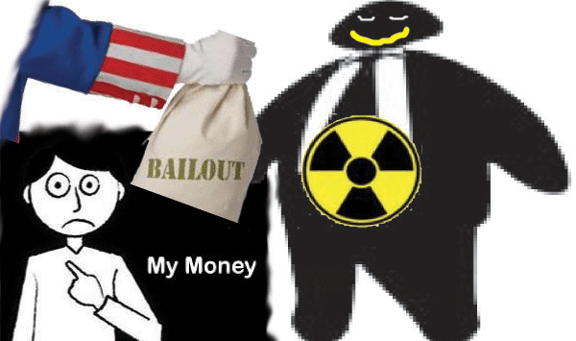 Proposed Agreement Would Reward Southern Company for Bungled, Massively Over Budget and 45-Month Delayed Plant Vogtle Reactors http://www.cleanenergy.org/2016/10/21/proposed-agreement-would-reward-southern-company-for-bungled-massively-over-budget-and-45-month-delayed-plant-vogtle-reactors/
Jennifer Rennicks, SACE, 865.235.1448 Atlanta, Ga. Late Thursday the Georgia Public Service Commission (PSC) Staff issued a proposed Stipulation Agreement that fails to protect Georgia Power customers for increased costs associated with the now 45-month delayed, over budget nuclear reactors under construction at Plant Vogtle near Waynesboro along the Savannah River. The estimated capital cost forecast has increased $1.262 billion for Georgia Power’s share of the project to $5.680 billion from the original $4.418 billion. The PSC press statement identified what appear to be only phantom savings to utility ratepayers while granting the Company guarantee of collection of billions of dollars in increased project costs.
Key items in the proposed Stipulation include:
- A defacto extension of the construction schedule from the current 39-month delay to 45 months with acknowledgement that it could be even further delayed, with nominal penalty for the Company.
- Capital costs up to $5.680 billion are considered reasonable and prudent thus no review in the future; despite the fact that $3.68 billion has been spent in capital costs as of the 15th Vogtle Construction Monitoring (VCM) report. This appears to represent approval of $2 billion in advance of those capital costs even being spent.
- The phantom cost savings to customers over the next four years appears to be due to merely slowing down the collection of financing costs versus actually denying the Company collection of these costs.
Below is a statement from Southern Alliance for Clean Energy’s High Risk Energy Choices Program Director Sara Barczak, an intervening party in the Vogtle Supplemental Information Review process, which the clean energy organization has criticized as an expedited, quasi-prudency review:
Halloween came early in Georgia given the clear treats offered to Southern Company (parent Company of Georgia Power) and the tricks doled out to utility customers. The proposed Stipulation is a major disappointment to consumers for many reasons.
Not one penny of construction costs associated with the construction delay was disallowed, including the $700 million in additional financing costs caused by the delay. Georgia Power will collect 100% of its financing costs. Most of the $325 million in phantom cost reduction to customers is only a delay in collecting financing charges. Georgia Power shareholders may see a tiny drop in their earnings but remain largely protected.
While Georgia Power has spent $3.68 billion on the Project to date, the Stipulation certifies $5.680 billion in construction costs as “prudent” and “reasonable” – essentially an advance approval of $2 billion dollars.
Finally, there is no public record to evaluate whether the PSC Staff negotiated a fair deal or rolled over to the utility company demands.
The proposed Stipulation clearly rewards Southern Company for their and their Contractors’ bungling of the troubled Vogtle nuclear construction project, which has been plagued with a plethora of serious design, engineering and construction problems from Day One that were identified by PSC Staff over years of testimony.
Georgia Power customers will realize little benefit should the Georgia Public Service Commissioners approve this proposal. It’s really sad to see yet another big power company receiving essentially a free pass for their mistakes that will cost families and businesses money.
Additional information: Originally Vogtle reactor Unit 3 was scheduled to come online April 1, 2016 and Unit 4 one year later. As of the 15th VCM report, schedule estimates were June 2019 and June 2020 respectively, a 39-month delay, with a cost estimate of $7.862 billion. The current certified cost for Georgia Power’s share of the project is approximately $6.113 billion. Customers are already paying an additional 9.4% on their monthly bills for the Nuclear Construction Cost Recovery (NCCR) costs due to anti-consumer state legislation passed in 2009 to incentivize building new reactors. Over $1.8 billion in pre-collected financing costs have been charged to ratepayers and the financing costs represent the largest share of the project’s cost overruns. The original approximately $14.1 billion Vogtle project is now estimated to cost well over $20 billion. Georgia Power is 45.7% owner in the project (remaining utility partners are Oglethorpe Power (30%), MEAG (22.7%) and the City of Dalton (1.6%)).
Find more information about Plant Vogtle’s expansion here.
South Africa: How Eskom paid for Gupta mine

 Daily Maverick AMABHUNGANE 20 OCT 2016
UN again to study the effects of depleted uranium contamination
 United Nations highlights cost and difficulty of tackling depleted uranium contamination http://www.bandepleteduranium.org/en/united-nations-highlights-cost-and-difficulty
The resolution is the sixth on the topic to be tabled at the General Assembly since 2007. Shortly before the last resolution was debated in 2014, Iraq called for assistance from the international community in addressing the legacy of DU use in the country in 1991 and 2003. The 2014 resolution, which was supported by 150 states, called on member states to provide such assistance. Disappointingly, assistance has not been forthcoming in the interim and the appalling security situation in Iraq has hampered efforts to assess and clear sites.
“Managing DU contamination to internationally accepted standards is complex, time-consuming and costly,” said ICBUW Coordinator Doug Weir. “Research has repeatedly shown that most countries recovering from conflict are poorly placed to implement these vital risk reduction measures, which are recommended by UN agencies, and it is civilians who all too often pay the cost of inaction.” Part of the problem lies in the fact that unlike land mines and cluster munitions, there are no formal obligations, on either those countries that use the weapons, or are affected by them, to clear them after conflicts.
Previous resolutions have passed by huge majorities, with just four states consistently voting against and, while it is unlikely that the UK, US, France and Israel will vote in favour this year, overall the number of governments abstaining has been on a downward trend since 2007. As a result, there is increasing focus on the likes of Canada, Denmark and a number of EU governments who refuse to vote yes, often on extremely dubious grounds.
However, it is Germany that many will be watching. In 2014, the German government abstained on the DU resolution for the first time, triggering a backlash from German parliamentarians and civil society. A parliamentary question urging the government to vote yes was tabled in September by the Green Party. “Germany has got to accept that the potential hazards from DU contamination are widely accepted by the UN agencies that recommend remedial measures, and by their own military, who take a precautionary approach to DU in their own guidelines,” said PAX’s Wim Zwijnenburg. “Doubtless the German authorities would take steps to prevent civilian harm if DU were dispersed in Germany, why should it be different for other countries following conflicts?”
What will the resolution achieve?
The resolutions do not seek to ban DU weapons, however they do underscore the fact that the overwhelming majority of governments object to their use. Each resolution is also helping to define soft norms around some of the most problematic issues surrounding DU. One of these, the need for DU users to share data on where they fire the weapons, has featured since 2010, and its importance was highlighted by a recent report from PAX and ICBUW over DU use in the 2003 Iraq War. The report showed that more than half the DU fired by the US is still unaccounted for, and that the refusal of the US to release data to UN agencies hampered their post-conflict assessments.
Voting on the resolution will take place in early November. A second vote will take place in early December. You can follow the debate on social media using #FirstCommittee and by following @ICBUW
1 This Month

of the week – Shut Down Drone Warfare!


Tell the Ukrainian Government to Drop Prosecution of Peace Activist Yurii Sheliazhenko

Petition to revoke the licensing of the Near Surface Nuclear Disposal Facility (NSDF) at Chalk River. https://www.ourcommons.ca/petitions/en/Petition/Details?Petition=e-7247
To see nuclear-related stories in greater depth and intensity – go to https://nuclearinformation.wordpress.com
-
Archives
- April 2026 (114)
- March 2026 (251)
- February 2026 (268)
- January 2026 (308)
- December 2025 (358)
- November 2025 (359)
- October 2025 (376)
- September 2025 (257)
- August 2025 (319)
- July 2025 (230)
- June 2025 (348)
- May 2025 (261)
-
Categories
- 1
- 1 NUCLEAR ISSUES
- business and costs
- climate change
- culture and arts
- ENERGY
- environment
- health
- history
- indigenous issues
- Legal
- marketing of nuclear
- media
- opposition to nuclear
- PERSONAL STORIES
- politics
- politics international
- Religion and ethics
- safety
- secrets,lies and civil liberties
- spinbuster
- technology
- Uranium
- wastes
- weapons and war
- Women
- 2 WORLD
- ACTION
- AFRICA
- Atrocities
- AUSTRALIA
- Christina's notes
- Christina's themes
- culture and arts
- Events
- Fuk 2022
- Fuk 2023
- Fukushima 2017
- Fukushima 2018
- fukushima 2019
- Fukushima 2020
- Fukushima 2021
- general
- global warming
- Humour (God we need it)
- Nuclear
- RARE EARTHS
- Reference
- resources – print
- Resources -audiovicual
- Weekly Newsletter
- World
- World Nuclear
- YouTube
-
RSS
Entries RSS
Comments RSS
 nuclear-news