DA SLAMS MINISTER’S PLAN FOR ESKOM TO TAKE CHARGE OF NUCLEAR BUILD http://ewn.co.za/2016/10/11/DA-slams-Joemat-Petterssons-recommendation-of-Eskom-nuclear-procurement-deal
 Tina Joemat-Pettersson said that Eskom is best placed to take over the procurement of the nuclear build.Gaye Davis | about 13 hours ago
CAPE TOWN – The Democratic Alliance (DA) has slammed Energy Minister Tina Joemat-Pettersson’s plan to recommend to Cabinet that Eskom take over the procurement for the country’s proposed mega billion rand nuclear build.
Joemat-Pettersson told Parliament’s energy oversight committee that the power utility is best placed to do it.
“I do believe that on the nuclear programme, Eskom has the experience and has operated a world class nuclear power plant in Africa. The only power plant in Africa which is operated by South Africans for South Africans.”
But the DA’s Gordon Mackay has condemned the move, arguing that it’s aimed at giving Eskom free rein and preventing proper parliamentary oversight over the deal.
“Essentially what we’ve done is, we’ve created serious sleight of hand where we’re actually removing oversight of South Africans and of Parliament off the nuclear by making it subject to internal Eskom processes.”
October 12, 2016
Posted by Christina Macpherson |
general |
Leave a comment

 Swiss ban new nuclear reactors http://reneweconomy.com.au/2016/swiss-ban-new-nuclear-reactors-39247 By Craig Morris on 11 October 2016 Energy Transition
Another setback for the “nuclear renaissance”: Switzerland voted on Friday to focus more on renewables and efficiency. For the first time ever, new nuclear plants are officially off the table—though admittedly, none were planned. The Swiss just “adopted the Energiewende,” writes the Neue Züricher Zeitung. Is no one paying attention? Craig Morris has the details.
Now here’s a news item you probably haven’t heard, at least judging from what I can gather on the internet: Switzerland’s new Energy Act (Energiegesetz, PDF) of 30 September 2016. You would think that, given its scope and Switzerland’s central role in Europe’s power sector, the following contents would have warranted a mention at, say, Reuters, CNN, Bloomberg, and Co.:
- The generation of non-hydro renewable power is to grow from 1.7 TWh last year (PDF in German and French) to 4.4 TWh by 2020 and 11.4 TWh by 2035 (nearly tenfold).
- “Per capita energy consumption” is to shrink by 16 percent from 2000 to 2020 and by 43 percent by 2035. “Per capita” is an important caveat in a small country whose population can easily grow quickly. (Switzerland’s is up around 10 percent over the past decade, like even smaller Norway’s.) Unfortunately, the law does not specify the most important aspect here: final or primaryenergy?
- Power consumption is to drop by 3 percent by 2020 and 13 percent by 2035.
- The law also, confusingly, speaks of “expanding” hydropower to 37.4 TWh by 2035 – even though it came in at 39.5 TWh last year. (If any readers know how to dissect this, please drop us a comment below.)
- It amends the 2003 Nuclear Energy Act (here’s the old one) to ban permits for new nuclear reactors. It also bans the reprocessing and export of spent fuel rods for reprocessing (except for research purposes with the consent of the Bundesrat). And “changes may not be made to existing nuclear plants.”
There’s a lot more in the law, much of which deals with the policy mechanisms (level of feed-in tariffs, etc.). But what’s above is a real breakthrough. So why has it gone unreported in English?
One reason may be that a referendum could change everything, as the Swiss press explains (in German). But the report also suggests there is little support for such a referendum in industry, so the referendum may not even take place; in other words, the Swiss business world is happier with renewables and efficiencythan with old-school energy production, consumption, and waste.
Another referendum will be held on 27 November 2016: the one for a closure of the existing reactors (in German). It does not necessarily stand a good chance of passing; parliamentarians overwhelmingly reject it (it’s an idea of the Swiss Greens). On the other hand, a recent survey of the public revealed support for a total phaseout by 2029 (basically, a limited service life of 45 years per reactor). This idea may have as much as 58 percent public support (in German)—possibly another example of politicians out of touch with the people. The first reactor to be shut down would then go offline in 2019. Leibstadt, the youngest, would be the last to go in 2029.
Opponents of the phaseout referendum will reportedly not try to reject the idea of a nuclear phaseout outright. Instead, they will try to win over the “silent majority” of undecided voters in the middle of the political spectrum by simply arguing that setting a specific date or service life for all reactors makes no sense. This clever tactic is likely to succeed, but a quick comparison with the historic debate in Germany over a nuclear phaseout suggests something less savory for nuclear supporters. Remember that slippery slope? By the time you resort to the tactic of “setting a date for a phaseout makes no sense,” you have reached the bottom of it. There is no way back up the slope for nuclear at that point.
Oddly, the Swiss press outlets all report that the new law is part of the government’s “Energy Strategy 2050” even though “2050” is never even mentioned in the new Act. This law is in fact just a starting point. By the end of this year, we will probably know what direction the country is headed.
One wonders when the international media will catch on. Maybe never—or did you know that Switzerland implemented a nuclear phaseout (by 2034) in the wake of Fukushima back in 2011?
October 12, 2016
Posted by Christina Macpherson |
opposition to nuclear, politics, Switzerland |
Leave a comment
Increases in perinatal mortality in prefectures contaminated by the Fukushima nuclear power plant accident in Japan A spatially stratified longitudinal study
Hagen Heinrich Scherb, Dr rer nat Dipl-Matha,∗ , Kuniyoshi Mori, MDb , Keiji Hayashi, MDc
Abstract
Descriptive observational studies showed upward jumps in secular European perinatal mortality trends after Chernobyl. The question arises whether the Fukushima nuclear power plant accident entailed similar phenomena in Japan. For 47 prefectures representing 15.2 million births from 2001 to 2014, the Japanese government provides monthly statistics on 69,171 cases of perinatal death of the fetus or the newborn after 22 weeks of pregnancy to 7 days after birth.
Employing change-point methodology for detecting alterations in longitudinal data, we analyzed time trends in perinatal mortality in the Japanese prefectures stratified by exposure to estimate and test potential increases in perinatal death proportions after Fukushima possibly associated with the earthquake, the tsunami, or the estimated radiation exposure. Areas with moderate to high levels of radiation were compared with less exposed and unaffected areas, as were highly contaminated areas hit versus untroubled by the earthquake and the tsunami.
Ten months after the earthquake and tsunami and the subsequent nuclear accident, perinatal mortality in 6 severely contaminated prefectures jumped up from January 2012 onward: jump odds ratio 1.156; 95% confidence interval (1.061, 1.259), P-value 0.0009. There were slight increases in areas with moderate levels of contamination and no increases in the rest of Japan. In severely contaminated areas, the increases of perinatal mortality 10 months after Fukushima were essentially independent of the numbers of dead and missing due to the earthquake and the tsunami. Perinatal mortality in areas contaminated with radioactive substances started to increase 10 months after the nuclear accident relative to the prevailing and stable secular downward trend.
These results are consistent with findings in Europe after Chernobyl. Since observational studies as the one presented here may suggest but cannot prove causality because of unknown and uncontrolled factors or confounders, intensified research in various scientific disciplines is urgently needed to better qualify and quantify the association of natural and artificial environmental radiation with detrimental genetic health effects at the population level. …….
http://ebm-jp.com/wp-content/uploads/media-2016002-medicine.pdf
October 12, 2016
Posted by Christina Macpherson |
children, Fukushima 2016, Japan, Reference |
3 Comments
Wind direction is critical in devising response to nuclear disaster https://www.theguardian.com/news/2016/oct/10/wind-direction-is-critical-in-devising-response-to-nuclear-disaster?CMP=share_btn_tw
In order to gauge the spread of radioactivity in the event of a leak, authorities need to consider the prevailing conditions, Guardian, Paul Brown, 11 Oct 16,
he way the wind is blowing at the time of a nuclear disaster is crucial to the action the authorities need to take to protect the civilian population. Among the first priorities is issuing iodine tablets to protect people’s thyroid from absorbing the radioactive particles from the fallout that may later cause cancer.
But in October 1957, when a plume of radioactivity spread out from the burning pile at Windscale in Cumbria, the reaction of the authorities was not to warn the public but to reassure them. Everything was under control. Children continued to pick potatoes in the fields surrounding the plant while the radioactivity showered down on them.
While this disaster was not quite on the scale of Chernobyl orFukushima, there was a radioactive plume that spread for hundreds of miles on a westerly wind across the north of England and deep into Europe. However, on the first day of the disaster, the wind was said to be blowing from the east, across the Irish Sea and dusting Ireland in radioactive fallout.
It remains a sensitive issue and Ireland remains implacably opposed to Britain’s continuing nuclear programme. This is partly based on the belief of those along the Irish coast, closest to Sellafield, that a spate of birth defects in the area after the fire was a result of exposure to radioactivity.
The official inquiry into the accident was later acknowledged as a whitewashdesigned to protect the UK’s atomic weapon programme. The pages for the Met Office’s October record of wind direction at the Windscale plant were missing and replaced with a note “No records, mast dismantled”.
October 12, 2016
Posted by Christina Macpherson |
2 WORLD, safety |
Leave a comment
Britain’s Nuclear Cover-Up, NYT, By PETER WYNN KIRBYOCT. 10, 2016“………If the Hinkley plan seems outrageous, that’s because it only makes sense if one considers its connection to Britain’s military projects — especially Trident, a roving fleet of armed nuclear submarines, which is outdated and needs upgrading. Hawks and conservatives, in particular, see the Trident program as vital to preserving Britain’s international clout.
A painstaking study of obscure British military policy documents, released last month by the Science Policy Research Unit at the University of Sussex, demonstrates that the government and some of its partners in the defense industry, like Rolls-Royce and BAE Systems, think a robust civilian nuclear industry is essential to revamping Britain’s nuclear submarine program.
For proponents of Trident, civilian nuclear projects are a way of “masking” the high costs of developing a new fleet of nuclear submarines, according to the report. Merging programs like research and development or skills training across civilian and military sectors helps cut back on military spending. It also helps maintain the talent pool for nuclear specialists. And given the long lead times and life spans of most nuclear projects, connections between civilian and military programs give companies more incentives to make the major investments required.
One might say that with the Hinkley Point project, the British government is using billions of Chinese money to build stealth submarines designed to deter China.
One can certainly say that the British government is using an ill-advised civilian nuclear energy project as a convoluted means of financing a submarine program.
The British government must be more transparent about its military spending, if only so that those expenditures can be measured against the needs of other public programs. According to the Science Policy Research Unit study, the government itself estimated in 2015 that renewing the Trident deterrent force will cost nearly $38.5 billion. In comparison, the deficit of the National Health Services for the fiscal year 2015-6, a record, was about $3 billion.
Hiding the true costs of a project like Trident by promoting a questionable and ruinous project like Hinkley Point C distorts the economics of both the defense and the civilian energy sectors. It also skews energy policy itself.
If Britain’s energy policy were solely about energy, rather than also about defense, the nuclear sector would be forced to stand on its own two feet. And the government would have to acknowledge the growing benefits of renewable energy and make hard-nosed comparisons about cost, implementation, environmental benefits and safety.
October 12, 2016
Posted by Christina Macpherson |
secrets,lies and civil liberties, UK, weapons and war |
Leave a comment
Washington Should Stop Militarizing the Pacific By NICHOLAS
BORROZ and HUNTER MARSTON, NYT, OCT. 9, 2016 WASHINGTON — Americans often assume that Chinese  military aggression is increasing the likelihood of a clash between China and the United States. But many policy makers in Washington ignore that Beijing has good reason to be troubled by the United States’ military footprint in its neighborhood. President Obama’s “pivot” to Asia — which includes doubling down on Washington’s already-robust military presence in the region — further stokes the potential for conflict between China and the United States.
October 12, 2016
Posted by Christina Macpherson |
oceans, USA |
Leave a comment
End the Nuclear Insanity, The World Post, http://www.huffingtonpost.com/jose-ramoshorta/end-the-nuclear-insanity_b_12436344.html , 11 Oct 16
Muhammad Yunus Nobel Peace Prize winner; founder, Grameen Bank; Chairman, Yunus Centre
Kailash Satyarthi 2014 Nobel Peace Prize Laureate, Founder, Kailash Satyarthi Children’s Foundation
10/11/2016 This month the United Nations has the opportunity to take a major step toward the elimination of nuclear weapons. It is an opportunity that must not be lost.
More than four decades ago, the nations with nuclear arsenals and the world’s non-nuclear states entered into the Nuclear Non-Proliferation Treaty (NPT); the nuclear states — the US, Russia, UK, France and China — pledged that if the states that did not have nuclear weapons agreed not to develop them, they would enter into good-faith negotiations toward the elimination of their nuclear arsenals. During the ensuing years, the three nations that did not sign the NPT — namely India, Pakistan, and Israel — developed nuclear weapons. All of the non-nuclear weapons states that signed the treaty except North Korea have kept their pledge.
Unfortunately, the nuclear powers have not kept their part of the bargain. While the US and Russia have dismantled many of their nuclear weapons since the end of the Cold War, they retain thousands of them, enough to destroy the world many times over.
More importantly, they have made clear that, in defiance of their treaty obligations, they do not intend to eliminate their arsenals. Instead, all of the states that possess nuclear weapons today are engaged in massive upgrades of their nuclear arsenals. The US alone expects to spend $1 trillion on this modernization program over the next three decades.
While the nuclear powers claim that their arsenals only exist to deter the threat of attack from other nuclear states, their actual military doctrines tell a different story. The US refuses to rule out the first use of nuclear weapons, even against states that don’t possess them. Russia plans to use nuclear weapons early on in conventional conflict with NATO. Pakistan similarly threatens to use tactical nuclear weapons against Indian conventional forces. India threatens to retaliate with strategic nuclear forces.
In the face of this intransigence, most of the states that do not possess nuclear weapons have decided that they must act. They are not planning to build nuclear weapons of their own, but are demanding that the nuclear powers honor their obligations.
In 2013 and 2014, more than 150 countries came together — in Oslo, Vienna and Nayarit, Mexico — in a series of historic conferences on the humanitarian impact of nuclear weapons, to focus attention on the actual consequences of nuclear war. These conferences examined the latest scientific findings, that show that even a limited nuclear war, involving less than 0.05% of the world’s nuclear arsenals, would cause catastrophic climate disruption across the planet and lead to a global famine that could put up to 2 billion people at risk of starvation. Other data shows that a large scale war between the US and Russia would cause even more profound climate disruption, producing a nuclear winter that would kill the vast majority of the human race and could cause our extinction as a species.
n response to these warnings from the scientific and medical community, more than 100 nations have met in Geneva over the last five months at an Open Ended Working Group, convened by the UN General Assembly, to consider how to pressure the nuclear powers to disarm.
The recommendation of this OEWG will be presented to the General Assembly this month. A resolution sponsored by Austria, Brazil, Ireland, Mexico, Nigeria and South Africa calls for the UN to convene a formal negotiating conference in 2017 to conclude a new treaty that prohibits the possession of nuclear weapons.
This “Ban Treaty” will not take the place of an actual nuclear weapons convention negotiated by the nuclear powers, which would have to establish a firm timetable for dismantling nuclear weapons, with detailed mechanisms to verify and enforce compliance. But it will create a powerful new norm about nuclear weapons, defining them not as the status symbols of great nations, but as the badges of shame of rogue nations.
Much work will need to be done to use this new treaty to actually get the nuclear powers to disarm, but their fierce opposition to the treaty makes it clear that they are feeling the pressure already even before negotiations have begun.
The non-nuclear weapons states must resist that pressure, and continue their historic efforts to protect humanity from the grave threat posed by nuclear weapons. And the citizens of nuclear weapons states must hold their governments accountable for their unconscionable refusal to meet their treaty obligations and negotiate the elimination of these weapons, which are the greatest threat to the security of all peoples throughout the world.
October 12, 2016
Posted by Christina Macpherson |
2 WORLD, weapons and war |
Leave a comment
Fiscus will not fund nuclear build programme, Tina Joemat-Pettersson says, BD Live BY LINDA ENSOR, 11 OCTOBER 2016 Energy Minister Tina Joemat-Pettersson assured MPs on Tuesday that the fiscus would not fund the nuclear build programme, saying it would be transparent, above board and free of corruption
The minister said the Department of Energy was to propose to the Cabinet that Eskom be the designated procurer for the new nuclear build programme and that the utility’s balance sheet be used to raise funds for the programme.
She said SA’s sovereignty would not be compromised and that the integrity of the programme would be protected against risk. Addressing Parliament’s energy portfolio committee, Joemat-Pettersson stressed that Eskom had the necessary expertise — having operated the existing nuclear plant Koeberg successfully for more than 30 years — to play a central role in the new nuclear build programme.
Eskom would be the owner and operator of the planned new nuclear plants.
In terms of the proposals to be submitted to the Cabinet, the South African Nuclear Energy Corporation would be the procurer for the fuel cycle and multipurpose reactor for the programme. The Cabinet will be asked to designate the department as the programme co-ordinator, Department of Energy officials told MPs.
All three entities would jointly develop a governance framework for the procurement and implementation of the programme.
The committee was told that Joemat-Pettersson would amend the determination under the Electricity Regulation Act to seek concurrence with the National Energy Regulator of SA……..
October 12, 2016
Posted by Christina Macpherson |
general |
Leave a comment
 Changing lives with solar microgrids, Green Biz, Laurie Guevara-Stone Monday, October 10, 2016
 Haiti is the poorest country in the western hemisphere. Only 25 percent of the 10.3 million people in the country have access to electricity. One nonprofit organization is testing a solution that could not only change the lives of the unelectrified in Haiti, but could be a model of how to bring electricity to the 1.2 billion people in the world still living in the dark.
EarthSpark International has built a 93-kilowatt solar-powered microgrid in the small town of Les Anglais (pop. 3,000 in the “downtown” area), which currently supplies clean reliable power to about 2,000 people.
Why a microgrid?
Haiti has more than 30 existing municipal microgrids, but most don’t work. Even when they do function, they run on diesel and operate just a few hours a day, a few days a week. So EarthSpark’s goal was to provide people with 24-hour clean, affordable electricity.
EarthSpark began working in Haiti providing people with small solar home systems and solar lanterns, products that are life-changing tools for people without access to grid electricity. But the organization soon realized that those aren’t the solutions to which everyone aspires. “To truly unlock economic opportunity, people need access to higher levels of electricity than what a solar home system can provide,” Allison Archambault, president of EarthSpark International, told RMI.
“With the right conditions, minigrids can provide energy services in a low-cost sweet spot between small levels of energy consumption that can be effectively served by small stand-alone solar systems and traditional grid extension,” said Eric Wanless, a principal in RMI’s international practice leading the Sustainable Energy for Economic Development initiative.
EarthSpark isn’t the only group focusing on microgrids. Husk Power has brought electricity to 200,000 people in the highly unelectrified state of Bihar in India, using rice husks to fuel microgrids; Powerhive, Devergy and PowerGen are bringing power to East Africa with solar microgrids; and Gham Power is building solar microgrids in rural Nepal.
A microgrid can give residences and businesses enough power to run motors, process agricultural products and power freezers. Plus, much of the electricity used by rural industry is seasonal, such as an agricultural mill, which is used during harvest season and on market days.
“Building an energy system just for that mill would mean an asset that is underutilized much of the time,” said Archambault. “But with a microgrid, you can use that capacity for other uses, and everyone buys down the cost for everyone else. We like to say our system is powerful enough to energize industry, and progressive enough to serve every single customer.”
Tackling technical challenges………
Overcoming logistical challenges
Working in developing countries such as Haiti brings a lot of logistical challenges as well. There is often not a clear process for implementing innovative projects…….
Confronting legal and regulatory challenges
One of the biggest challenges comes in the legal and regulatory framework in Haiti, or lack thereof. ………
Promoting economic development
Residents of Les Anglais not only have access to reliable power 24 hours a day, but are also saving money on their energy expenses. Before the microgrid, they were spending about $10 to $12 each month for kerosene and spending $3 to $4 each month to charge phones (at nearly $0.25 per charge). Now residential microgrid customers are saving 80 percent of their household energy budget, paying about $2 to $3 per month for much better quality power. And EarthSpark’s larger business customers are saving 50 percent over what they were spending on diesel.
EarthSpark’s goal is to build 80 microgrids in the next five years, bringing power to over 200,000 people, a small dent in the 7 million Haitians still living without access to electricity. But for those 200,000 people, it’s a game changer.
“We have small enterprises using electricity for the first time, people starting new businesses. The carpenter now has power tools. The hotel and the mill have been able to drastically reduce their power bills, by switching off their big diesel generators. And people come up to me and tell me their children no longer have the smoke of kerosene burn their eyes when they’re studying,” said Archambault. EarthSpark’s project in Haiti and RMI’s work in sub-Saharan Africa are delivering clean reliable electricity to people and unlocking huge opportunities for rural communities around the world. https://www.greenbiz.com/article/changing-lives-solar-microgrids
October 12, 2016
Posted by Christina Macpherson |
2 WORLD, decentralised |
1 Comment
Over 10 GW of utility-scale solar is under construction in the United States http://www.pv-magazine.com/news/details/beitrag/over-10-gw-of-utility-scale-solar-is-under-construction-in-the-united-states_100026373/#axzz4MoKxV81R05. OCTOBER 2016 | TOP NEWS, MARKETS & TRENDS | BY: CHRISTIAN ROSELUND
Eight states have more than 400 MW-DC of projects under construction each, showing increasing market diversification. The U.S. utility-scale market has long been set for a breakout year in 2016, due to the formerly pending expiration of the U.S. Investment Tax Credit (ITC). But figures on exactly how much solar will get installed have been hard to pin down.
GTM Research has documented a boom in project starts, and according to the company’s Utility PV Market Tracker service there is currently 10.1 GW-DC of utility-scale solar PV under construction nationwide. This includes 8.6 GW of solar projects being built in the top 10 state markets – more PV than was put online in the entire year 2015 across all market segments.
Among this, the company also lists eight states where more than 400 MW-DC of solar is currently under construction. These include not only California and Texas – which each have over 1 GW under construction – but also states that a few years ago had small to non-existent markets, such as Georgia, Florida and Utah.
GTM Research notes that this has been building for some time. “States don’t go from zero to 1 GW, so a lot of the places where we’re seeing diversification, there is only a small amount being developed, but it is indicative of more to come,” GTM Research Solar Analyst Colin Smith told pv magazine.
In at least two of the top eight states – North Carolina and Utah – projects are being driven by PURPA, a 1978 law which mandates that utilities must buy electricity from independent power producers if they can match the price that the utility would otherwise pay for generation.
Rounding out the eight states with more than 400 MW under construction are Nevada and Arizona. Both of these states have seen regulatory set-backs for distributed solar in recent years, and in both utilities are instead pursuing large-scale solar.
October 12, 2016
Posted by Christina Macpherson |
renewable, USA |
Leave a comment
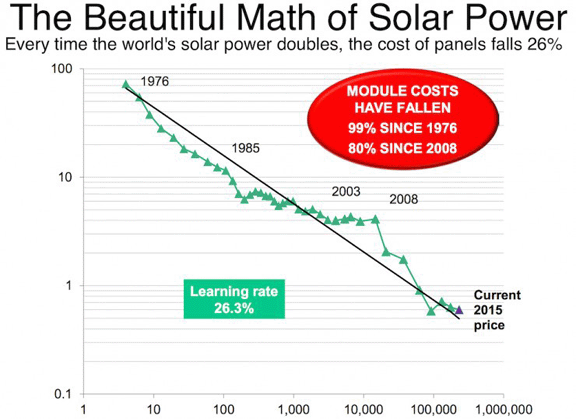
You’ll never believe how cheap new solar power is , Think Progress, Joe Romm , 8 July 16, Solar energy has grown 100-fold in this country in the past decade. Globally, solar has doubled seven times since 2000, and Dubai received a bid recently for 800 megawatts of solar at a stunning “US 2.99 cents per kilowatt hour” — unsubsidized! For context, the average residential price for electricity in the United States is 12 cents per kilowatt-hour.
Solar energy has been advancing considerably faster than anyone expected just a few years ago thanks to aggressive market-based deployment efforts around the globe. Since it’s hard to keep up with the speed-of-light changes, and this is the fuel that will power more and more of the global economy in the near future, here are all the latest charts and facts to understand it.
If you are looking for one chart to sum up the whole solar energy miracle, Bloomberg New Energy Finance (BNEF) Chairman Michael Liebreich has one from his keynote address at BNEF’s annual conference in April titled “In Search of the Miraculous”: [chart on original]
Thanks to sustained long-term deployment programs, Liebreich explained, “We’ve seen the costs come down by a factor of 150 since 1975. We’ve seen volume up by 115,000.”
“How much more miracle-y do you need your miracles to be,” Liebreich added.
What that chart doesn’t reveal is that the price drop and the sales volume increase are directly linked. There is a learning curve: Over the past four decades, for every doubling in scale of the solar industry, the price of solar modules has dropped roughly 26 percent.
BNEF has the learning curve chart in its “annual long-term view of how the world’s power markets will evolve in the future,” their New Energy Outlook(NEO) from June. In a section headlined, “Solar and Wind Prices Plummet,” BNEF says “The chart below is arguably the most important chart in energy markets. It describes a pattern so consistent, and so powerful, that industries set their clocks by it”:
BNEF projects that by 2040, the world will invest an astonishing $3.4 trillion in solar. That’s more than the projected cumulative investment of $2.1 trillion for all fossil fuels — and $1.1 trillion in new nuclear — combined. [ chart]
The result of these investments and the continued learning by solar (and wind) makes “these two technologies the cheapest ways of producing electricity in many countries during the 2020s and in most of the world in the 2030s.”……..
From 2005 through 2015, annual PV sales in this country went up 100-fold! And projections suggest that solar sales may double this year, driven by Congress’s five-year renewal (with phase-out) of the solar Investment Tax Credit (ITC).
And here is what the recent solar boom looks like world-wide — cumulative installed PV capacity and annual additions — from the recent “Renewables 2016 Global Status Report” by REN21, the Renewable Energy Policy Network for the 21st Century: [chart]……….
The ‘Other’ Form Of Solar Energy, Which Can Run At Night
Earlier this month, I wrote about the “other” form of solar, concentrating solar thermal power, which uses sunlight to heat water and uses the steam to drive a turbine and generator. That heat can be stored over 20 times more cheaply than electricity — and much more efficiently — so CSP can provide power long after the sun has gone down……… https://thinkprogress.org/youll-never-believe-how-cheap-new-solar-power-is-7c17051c1152#.ptq1vfrsm
October 12, 2016
Posted by Christina Macpherson |
2 WORLD, renewable |
2 Comments
Indigenous land rights fundamental to climate safety – Lord Stern Climate Home 10/10/2016,
Forests and grasslands would store more carbon if communities’ rights were protected, according to research from the leading climate economist By Karl Mathiesen
Honouring the land rights of indigenous peoples would lead to a safer climate for everybody, according to leading economist Lord Nicholas Stern.
The world must become “zero net carbon” by 2070-80 if it wants to stay within the 2C limit set by the Paris climate agreement, said Stern, or “much earlier for 1.5C”. But some industries – including aviation – are expected to continue emitting carbon late into the century.
“If there are going to be some that are [carbon] positive,” Stern told an audience at a World Resources Institute (WRI) event in Washington, DC, “there have got to be some that are negative and it’s the forests and the grasslands that are the big potential source there.”
Stern was speaking on Friday at the launch of a WRI study that found that securing indigenous land tenure in Colombia, Brazil and Bolivia could avoid the release of an estimated 42.8–59.7 Mt CO2 per year through avoided deforestation. This is equivalent to taking between 9 and 12.6m cars off the road………. The argument went beyond the economy and the environment, Stern added. Indigenous peoples in the Amazon and across the world are being dispossessed by development. In some cases, their rights are being considered. A massive dam project in the Brazilian Amazon was suspended in April over concerns about the impact on local tribes.
“We are talking about justice here, we ought to be very clear about that… If you haven’t got those rights, you’re much more vulnerable to outsiders… If you’re vulnerable to outsiders it’s theft. Its solid rights that protect you against that.”http://www.climatechangenews.com/2016/10/10/indigenous-land-rights-fundamental-to-climate-safety-lord-stern/
October 12, 2016
Posted by Christina Macpherson |
2 WORLD, climate change, indigenous issues |
Leave a comment
 China’s nuclear plant makers seek new markets along the ancient Silk Road into Asia, Europe, Africa and Middle East SCMP, 04 April, 2016
‘One belt, one road’ policy for financing and support for infrastructure projects is helping nuclear plant constructors expand into overseas markets………The policy was first proposed in 2013 to promote infrastructure construction deals overseas along with goods and services trade along the ancient Silk Road from China to Europe and along the ancient maritime trade route linking China to southeast Asia, the Middle East and Africa. The state is offering financing at a time when China’s economy grew at the slowest rate in 25 years and its industry faces severe overcapacity problems.
Beijing has encouraged local firms to become involved in infrastructure projects in southeast Asia, Europe and Africa. Chinese nuclear reactor builders are a growing force in the global nuclear industry.
“The export of nuclear reactors will become one of the key pillars for executing China’s one belt, one road strategy,” Zheshang Securities analyst Zheng Dandan said………
Three Chinese state-backed firms are actively pursuing opportunities to export their reactor construction expertise, especially in developing nations that do not have their own construction capabilities.
Beijing-based projects developer China National Nuclear Corp (CNNC) chairman Sun Qin was quoted by state media China News Service last month as saying that 80 per cent of the up to 300 new reactors projected to be built by 2030 globally could be in ‘one belt, one road’ nations.
CNNC wants to build 30 reactors in such nations, and will use Argentina as a base to develop the South American market, Algeria for reaching out to the greater African market and Pakistan where it is building a project to develop the Asian market, Sun was reported as saying.
State Power Investment, formed via the merger of one of the nation’s “big five” power generators China Power Investment and general contractor State Nuclear Power Technology last year, is also pursuing overseas projects.
It has partnered with the US nuclear technology powerhouse Westinghouse to negotiate a potential deal to build a nuclear power project in Turkey. It has also pursued opportunities in South Africa.
Shenzhen-based projects developer China General Nuclear Power is working towards winning potential projects in Britain, Kenya and southeast Asia. It won one bid to build a plant in Romania.
The mainland leadership has made the globalisation of Chinese firms a key part of its economic reform plans, looking to establish the nation as a major provider of value-added and high-end goods and services. In a series of articles this week, the South China Morning Post examines the key industries targeting overseas expansion, beginning with the nuclear power industry.
October 12, 2016
Posted by Christina Macpherson |
China, marketing |
Leave a comment
Running out of Earth to live on, Korea Herald, [good pics and diagrams], 11 Oct 16
Ecological balance sheet reveals unsustainable lifestyle For more than 40 years, humanity’s demands have exceeded what our planet can regenerate. This year, people are using natural resources equivalent to 1.6 times that found on Earth. And for Koreans, the amount is 3.3 times that found on the planet.
This is according to the ecological balance sheet, known as the Global Ecological Footprint Report, released by the World Wild Fund for Nature, Korea (WWF-Korea) and the Global Footprint Network.
The report shows that there is a significant imbalance between the Earth’s biocapacity and our ecological footprint. The mismanagement of resources is also spreading, with more people in “ecological debt.”
By Aug. 8, the world had used up all the natural resources that can be replenished in the year. It marked a day which environmental advocacy groups call “Earth Overshoot Day.”
For nearly half a century, humanity has been in such an ecological “overshoot,” and the amount of natural resources that can be replenished in a year are being used up quicker every year.
In 1970, Earth Overshoot Day was Dec. 23 — which marks a level close to sustainable — but in 2000, the day was in early October.
In dealing with this over-taxation of the Earth’s resources, humankind is borrowing from future capacity that cannot be regenerated, liquidating stocks of ecological resources and accumulating waste, primarily carbon dioxide, in the atmosphere. ……http://www.koreaherald.com/view.php?ud=20161010000777
October 12, 2016
Posted by Christina Macpherson |
2 WORLD, environment |
Leave a comment
On Melting Ice: Inuit Struggle Against Oil and Gas in the Arctic Tuesday, 11 October 2016 By Chris Williams, Truthout | News Analysis The Inuit in the Canadian Arctic are engaged in a centuries-old fight to retain their culture and reestablish self-determination and genuine sovereignty. In particular, Inuit in the autonomous territory of Nunavut are resisting what American Indian studies scholar Daniel R. Wildcat has described as a “fourth removal attempt” of Indigenous people, coming on the heels of failed efforts at spatial, social and psycho-cultural deletion.
The common discourse on climate change focuses on the physical world: inexorably rising atmospheric concentrations of carbon dioxide and the impact on sea-ice extent; melting glaciers; and roiling, unpredictable perturbations in weather patterns. But these are but the physical manifestations of political decisions made in the social world. The questions behind them include: Who produced all that extra CO2? For what purposes? And which sets of people are paying the most immediate price?
In both realms, the Arctic, one of the regions least responsible for causing climate change, is bearing the most immediate brunt; though as Inuit activist, Nobel Prize nominee and author Sheila Watt-Cloutier warns in her book, The Right to Be Cold, “whatever happens in the poles will eventually happen everywhere else.”
To frame climate change in the Arctic as simply a story of liquefying dihydrogen monoxide is deceptive. The ice-filled north is first and foremost a human story, a story about home and the struggle to preserve it against outside forces. It is about a culture that quite literally rests on knowledge of ice, ocean and the animals that live on top and underneath it.
James Qillaq, mayor of Clyde River in Nunavut, explained, “That connection to the land, that’s our life … that’s the reason why we stand: our connection to the land and water, of something that is ours, that’s it. That’s it and nothing else. That’s our everything — our connection to the land.”…….
Climate Change and Arctic Amplification The most recent displacement attempt against Inuit is related to the fact that the Arctic is warming at twice the rate of lower latitudes. Over the last five decades, sea ice has vanished from an area twice the size of Alaska. The remaining ice is 50 percent thinner. The last nine years have all had the lowest sea-ice extents measured, with February 2015 showing the lowest in 37 years of satellite data. Over 50 percent of the gigantic ice sheet that blankets Greenland was melting during the summer of 2015, contributing to the 36th consecutive year of global glacier loss.
Going further back in time, recent research based on a compendium of historical data shows, “there is no point in the past 150 years where sea ice extent is as small as it has been in recent years,” ……… http://www.truth-out.org/news/item/37921-on-melting-ice-inuit-struggle-against-oil-and-gas-in-the-arctic
October 12, 2016
Posted by Christina Macpherson |
ARCTIC, climate change |
Leave a comment





 nuclear-news