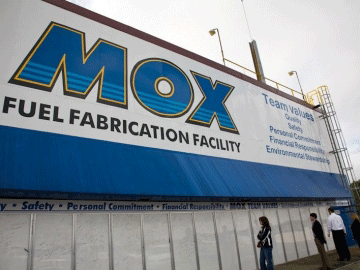
That’s the situation the Department of Energy is facing with the contractor building a nuclear fuel facility in South Carolina. The Mixed Oxide Fuel Fabrication Facility, known as MOX, is a multi-billion dollar boondoggle that is behind schedule, is over budget, and will never be able to complete its mission. Now the Army Corps of Engineers has released an independent cost estimate for the project that reveals things are even worse than we thought.
MOX was originally conceived as part of an agreement between the United States and Russia in which each country pledged to dispose of weapons grade plutonium. But that was back in 2000. As cost overruns and the technical failure has become clear, the Department of Energy asked Congress to cancel the program this year. The South Carolina delegation, defending jobs in their districts, pushed back and claimed doing so would violate the agreement. Last week Russian President Vladimir Putin announced he would be withdrawing from the agreement.
Without Russia being party to the agreement, the last remaining pretense for this boondoggle is shattered.
Congress will soon be reviewing the budget for fiscal year 2018 and should ensure that funding for this project is ended once and for all.
The new independent cost estimate shows that finishing the construction of the MOX facility has gone from $1.6 billion to a staggering $17 billion—more than 10 times the original projection. And while the facility was supposed to be fully constructed in 2007, the Army Corps of Engineers stated that MOX won’t be finished and ready for operations until 2048—putting it 41 years behind schedule.
But even if Congress decides to accept spending $17 billion in taxpayer dollars and waiting 41 extra years for the facility, the project will never work.
MOX technology dates back to the 1960s and has caused experts to raise concerns about the technical viability of the U.S. facility should it ever be completed and become operational. In 2014, Energy Department experts concluded that U.S. implementation of MOX technology still remains a “significant risk.” Moreover, even if the facility were to work perfectly and produce the mixed oxide fuel as intended, there aren’t any commercial nuclear reactor companies interested in purchasing it. In 2008, the project lost its only potential customer and hasn’t been able to find a single replacement.
What is even more unbelievable is that $17 billion isn’t even the bottom line for this monstrosity. Other independent estimates have found that over the facility’s lifetime, which includes the costs of operating the plant for 20 years on top of construction costs, MOX will cost taxpayers $110 billion.
The fact that these cost estimates come from independent sources is important. For the last several years the contractor in charge of the MOX project, CB&I AREVA MOX Services, has been spreading misleading facts and figures about the project’s true costs.
These contractor statements have been proven wrong time and time again by the Department of Energy, independent sources, and reality. The new Army Corps analysis exposes just how the contractors’ optimistic estimates border on delusional. For example, the contractors stated earlier this year that finishing the job will cost $3 billion; the Army Corps found the contractors’ estimate should have come closer to $10 billion. The contractors’ calculation, they found, had serious problems which led to the inaccuracies. “The MOX Services estimate-at-completion is not credible because it was developed using unrealistic production and productivity rates, artificially low escalation, inappropriate allocation of management reserves and contingency that is not time phased across the project duration, and lack of escalation applied to these reserves,” the Army Corps’ report stated. Based on their calculations the MOX project is only 28 percent complete, not 48 percent as the contractor has asserted.
What CB&I AREVA MOX Services also seem to conveniently forget in its calculations is that the project is running on at least a 25 percent rework rate, meaning approximately a quarter of the work already done will have to be re-done—the project takes one step back for every four steps forward. This includes everything from walls that were installed incorrectly to piping that was ordered but didn’t meet specifications.
These kinds of mistakes led to CB&I AREVA MOX Services receiving only half of its possible contract award fee in 2015. “Overall performance is below the level needed for successful project completion, as culminated in cost overruns and schedule delays,” thegovernment documents stated. They cited the contractor’s poor management of the project and failure to adequately perform random drug testing. Still, CB&I AREVA MOX Services received $4.33 million of the possible $8.86 million in bonuses for that year.
It may seem remarkable that CB&I AREVA MOX Services has managed to retain the contract after so many missteps, but it could be the result of a very successful lobbying effort. The two companies that make up CB&I AREVA MOX Services, Chicago Bridge & Iron Works (CB&I) and AREVA, spent a total of $2.4 million lobbying the government in 2015 on various issues including the MOX project. In the first two quarters of 2016 alone the groups have spent $1.4 million. That amount doubles when including other organizations, like the International Brotherhood of Electrical Workers, that listed MOX as a lobbying objective.
The contractor has effectively lined up several Senators and Representatives who have made sure that taxpayer dollars continue to flow to the MOX project, and thus to CB&I AREVA MOX Services. Senators Lindsey Graham (R-SC) and Tim Scott (R-SC), and Representatives Joe Wilson (R-SC), James Clyburn (D-SC), and Rick Allen (R-GA) have done their best to support MOX. During the budget process this year, Wilson wrote a letter to the House Committee on Appropriations Subcommittee on Energy and Water Development urging them to continue funding the MOX program. Clyburn and Allen also signed the letter. It comes as no surprise that Representatives Wilson and Clyburn as well as Senator Scott are among the AREVA Group’s top recipients for campaign donations. Also on the list are Representatives Mike Simpson (R-ID) and Marcy Kaptur (D-OH), the Chairman and Ranking Member of the Energy and Water Appropriations Subcommittee which determines annual funding for MOX. At this point the MOX project is nothing more than pork barrel politics.
“We are confident [the MOX project] is not feasible in this environment. We are going down a road spending money on something that will never happen. Unfortunately, that seems to us to be a very large waste of taxpayer money,’’ DOE Associate Deputy Secretary John MacWilliams told The State reporter Sammy Fretwell on a tour of the construction site.
MOX is unaffordable, 41 years behind schedule, and will never work. And now that Russia has withdrawn from the agreement, the United States would be the only ones trying to uphold it. Congress’s decision to continue funding this disaster was based on grossly inaccurate information about both the cost and performance of this project. But they have time to revisit this decision with unbiased facts and analysis before the next budget decisions need to be made. There are cheaper and faster ways to dispose of the plutonium, methods that the Energy Department is already exploring. There is no reason Congress should continue forcing taxpayers to fund such an obvious boondoggle.
Lydia Dennett is an investigator for the Project On Government Oversight. Lydia works on safety and security of nuclear weapons and power facilities, foreign lobbying and influence, and works with Department of Veterans Affairs whistleblowers.
An analysis of recently declassified military data shows that the United States military ignored its own guidelines for the use of depleted uranium ammunition in the 2003 Iraq War, firing the controversial weapons at unarmoured targets, buildings in populated areas and troops. It has also tripled the number of sites known to be contaminated in Iraq to more than 1,000; even as fears grow that the US has used depleted uranium in Syria.
The targeting data, which details the use of 30mm DU ammunition by USAF A-10 Thunderbolt II aircraft – or “Warthogs”, was released under FOIA and accounts for 54,000kg of the 118,000kg of DU ammunition that the US and UK have acknowledged firing in the conflict. Analysis by PAX and ICBUW of the 1,116 strikes, which took place during the first month of the 2003 invasion, and published in a new report Targets of Opportunity shows that DU use was widespread across Iraq.
For the first time, the data also reveal that the majority of targets attacked with the radioactive and chemically toxic weapons were not armoured. This runs counter to claims by the US that the A10’s ammunition is specifically for destroying tanks and other armoured vehicles. A significant number of the 182,000 30mm PGU-14/B rounds fired by the aircraft – each of which contains 298g of DU – were also fired in or near populated areas, increasing the likelihood that civilians would be exposed.
The need to destroy armour is central to the US’s ongoing military justification for the use of the weapons, which place civilians at risk of exposure and leave a complex and costly legacy for years after the end of conflicts. The US’s own legal guidelines, which were placed on the use of the armour-piercing incendiary weapons in 1975, restricts their use to armoured vehicles, a restriction that appears to have been ignored in the 2003 conflict.
Little transparency, even less assistance
While the UK released information to the UN on where it fired 1,900kg of DU, the US is still withholding data on where it fired 62,000kg of the weapons. This is hampering clearance work. PAX has reported that Iraq continues to struggle with the identification and remediation of DU contaminated sites, and the country has called for assistance in doing so from the international community.
“With the current burden of fighting the Islamic State, the Iraqi government’s capacity is already stretched. But people are worried about DU contamination, especially in southern Iraq,” says one of the report’s authors, PAX’s Wim Zwijnenburg. “The US did too little, too late, and now Iraq’s people are facing layer upon layer of toxic health risks as a result of the conflicts.”
“At present countries that use DU weapons, or are affected by them, are under no formal obligations to clear contamination after conflicts in order to minimise the risks it poses to civilians,” said co-author Doug Weir from ICBUW. “This is in stark contrast to land mines, cluster munitions and other explosive remnants of war. Governments must take steps to meaningfully address the legacy from DU and other toxic remnants of war that can harm civilians and their environment for years after the end of conflicts.”
New information suggests that A-10s have used DU in Syria n early 2015, the US stated – contrary to previous claims – that its A-10 aircraft had not and would not use DU in Iraq or Syria in operations against Islamic State. However information obtained by ICBUW suggests that US A-10s have used DU on at least two occasions in Syria.
ICBUW and PAX are calling for urgent clarification from the US authorities on both the incidents and its DU policy for the conflict, and for them to swiftly release the targeting data to ensure that the relevant authorities can conduct clearance and risk awareness efforts and to isolate and recover contaminated material.
The Hillary Clinton Environmental Scorecard The former Secretary of State could inherit a number of ambitious eco-commitments established by President Obama. Here’s where she stands on each one. Outside By: Juliet Eilperin Oct 17, 2016 “…….
Climate Change and Renewable Energy
In contrast to Obama, who barely mentioned the issue when he was running for reelection in 2012, Clinton has made tackling climate change a major theme in her campaign. She’s mentioned it during both the primary and general election debates, mocking Trump during the first debate by saying, “Donald thinks that climate change is a hoax perpetrated by the Chinese. I think it’s real.” Trump replied, “I did not. I did not. I do not say that.” (He actually did tweet that, and he has also questioned whether global warming is even underway.)
Clinton has vowed to cut U.S. greenhouse gas emissions by as much as 30 percent below 2005 levels by 2025, and 80 percent by mid-century. She’s also pledged to cut U.S. oil consumption by a third, ensure that half a billion solar panels will be installed by 2020, and carry out a ten-fold increase in renewable energy production on public lands. On top of that, she aims to provide $60 billion to state and city officials through a “clean energy challenge fund” so they can reduce their carbon output and enhance their resilience to climate impacts, along with another $30 billion to struggling coal communities.
Such ideas make Clinton attractive to environmentalists. “It’s probably fair to say that, by the time his term is over, President Obama will be regarded as the most environmental president we’ve ever seen, and yet we’re confident Secretary Clinton will build on this record, and even do more,” says League of Conservation Voters President Gene Karpinski, whose group is pouring $10 million into the presidential race this cycle.
Clinton’s 2020 overall emissions target is more aggressive than what Obama has pledged under the Paris climate agreement. Her solar plan, for example, suggests that the U.S. will have 140 gigawatts of installed solar by the end of 2020, compared to the 100 gigawatts that’s now projected. But the question of whether she can deliver on her promises remains—especially since she has yet to embrace the idea of imposing a sweeping carbon tax, and it’s unlikely that Congress would hand over tens of billions of dollars to her administration if she’s elected. While Clinton has vowed to defend federal regulations limiting the carbon output of existing power plants, which are currently being challenged in court, she will have to do much more than that in order to meet her professed goals. …….http://www.outsideonline.com/2125806/hillary-clinton-environmental-scorecard
Stop the Next President From Waging the Next War http://www.counterpunch.org/2016/10/18/stop-the-next-president-from-waging-the-next-war/byZOLTAN GROSSMAN 91 Oct 16Hillary Clinton now says her “number one priority” in Syria is the removal of Bashar al-Assad, putting us on the path of war with Syria and Russia next year. Whether or not you are voting for her, you should commit yourself to stopping her from this insanity, which President Obama wisely averted in 2013. Syria and Russia are indeed committing war crimes in Aleppo, but if you’re tempted to buy in to a “no-fly zone” or “humanitarian intervention” against Syrian, Russian, and Iranian forces, consider these ten facts and observations:
1/ We never hear about the atrocities committed by the Sunni rebel forces backed by the U.S., including the Al Qaeda-aligned Islamists that are now tacitly included in the rebel ranks. A sudden regime change in Syria will result in these forces being in charge, and fighting each other for power. Some victorious rebels would commit ethnic/sectarian cleansing against Alawites, Christians, and Kurds, causing many of these and other minorities to fear the rebels as much as the Sunni majority fears Assad. Yes, the war can and will get even worse with more outside intervention.
2/Any “no-fly zone” over Syria will certainly be followed by the shooting down of both Russian and U.S. jets, in an unpredictable escalation that could easily spread elsewhere in the region or world. Bombing Syrian/Russian forces would result in more civilian deaths, not fewer civilian deaths. In a leaked 2013 transcript, Hillary admitted, “To have a no-fly zone, you have to take out all of the air defense, many of which are located in populated areas. So our missiles, even if they are standoff missiles so we’re not putting our pilots at risk– you’re going to kill a lot of Syrians.”
3/ The U.S. is actively aiding Saudi bombing of Houthi rebels in Yemen, with devastation and civilian deaths that differs little from the Syrian/Russian bombing of Aleppo. The U.S. just directly launched missiles against the Houthis, embroiling us in a very dangerous part of the regional proxy war between Saudi Arabia and Iran. State Department spokesperson John Kirby became tongue-tied when reporters asked him to define the difference between the Russian in Syria and the Saudis in Yemen.
4/ The U.S. has around 800 foreign military bases around the world. Russia has exactly two bases outside former Soviet territory–both of them in Syria. Putin is trying to emulate what the U.S. did in Iraq and Afghanistan, by establishing Russia as a regional and global power. Russia is doing exactly what the U.S. did in Panama–brazenly intervene in the affairs of a country that hosts its bases. The U.S. has zero legitimacy to criticize an upstart in global imperialism, or to demonize Russia for committing the same atrocities that U.S. forces did in Fallujah and elsewhere.
5/ Russia will not back down if we start shooting down its aircraft. Putin was the “Butcher of Grozny” in Chechnya (as the West turned a blind eye), and has intervened against nationalist governments in Georgia and Ukraine. He will pivot to somewhere else in the world–arming Iran, establishing a naval base in Egypt, or threatening Latvia. One way to lessen his popular appeal is to stop feeding into his nationalist propaganda that NATO is encircling Russia and tacitly backing fascists and ultranationalists on its borders. He only thrives politically when the West’s military pressure increases, and he can portray himself as standing up to NATO. Both Russia and Iran also thrive when U.S. and Israeli saber-rattling drives up global oil prices.
6/ The practice of “humanitarian intervention” upholds double standards that only highlight atrocities by the other side and not by U.S. allies. Bill Clinton’s bombings in Bosnia and Kosovo stopped ethnic cleansing by Serbian forces, but actively enabled ethnic cleansing by Croatian and Albanian militias. Obama’s bombing of Libya to supposedly “save” Benghazi ended up turning Libya into a free-fire zone. It wasn’t stepping in as a neutral party, but taking sides in a civil war and prolonging it. A real “humanitarian intervention” would order all sides to freeze in place, not attack one human rights abuser in favor of another.
7/ The U.S. seems to want to rubberstamp the partition of Syria into ethnic/sectarian enclaves as part of a “settlement,” just as it did in Yugoslavia and to a large extent in Iraq. Partition does not bring lasting peace, as the examples of Palestine and India demonstrate. Regional autonomy is helpful to build peace, but communities and even families are too mixed together historically to allow for a “clean” territorial separation without massive violence and genocidal ethnic/sectarian cleansing. But it helps neoliberal capital to have large multiethnic states divided into more easily controllable mini-states.
8/ There have been many paths not followed in bringing peace to Syria since the genuine democratic revolution against Assad began in 2011. There has never been a choice between “doing something” and “doing nothing.” The U.S. and Israel could stop supporting Sunni Islamist rebels in return for Russia and Iran holding back the worst of Assad’s Alawite-led military atrocities, and vice versa. They could both support the Kurds’ valiant defense against ISIS, instead of selling them out (once more) to the Turkish military. They could engage with Syrian civil society that began the revolution, instead of only arming the militaries and militias. They could negotiate for a regional deescalation and coalition government that guarantees minority rights, and allows Syrians to focus on the real threats of ISIS and the economic ruin of war.
9/ The regime change in Iraq will look like small potatoes, if the new Administration tricks the American people into allowing a so-called “humanitarian intervention” in Syria. We could very quickly get involved in a full-blown regional war–with the U.S., Saudi Arabia, Israel, Gulf states, and Syrian, Iraqi, and Yemeni Sunnis on one side, and Russia, Iran, Syria, Iraqi Shi’as, Hezbollah, and Houthis on the other side. The region is a powder keg, with entangled alliances much like Europe on the eve of World War I. It wouldn’t take much for that nightmare to escalate into a nuclear confrontation. Russia is clearly mobilizing for a possible conflict, and signaling its warnings through state media and civil defense exercises, but we haven’t been told by our leaders how risky the situation has become.
10/ A lot more is at stake in Syria in 2017 than in Iraq in 2003.
The Iraq War never had the potential of escalating into a full-blown war with Russia and Iran, or triggering a nuclear confrontation. And since both Hillary Clinton and Donald Trump uncritically accept Benjamin Netanyahu’s view of Iran as the main enemy in the Middle East, Israel and the Gulf States will be unleashed next year to restart military brinkmanship with Iran, which could also bring us to the gates of hell.
It is possible to stand against Assad and Putin, and still oppose wars waged by Clinton or Trump that will inflame the Middle East. Whoever wins on November 8th, the names of the losing candidates will quickly fade. Our “number one priority” the next day should be to stop the new president from taking us down the path of a new major war.
Zoltan Grossman is a professor of Geography and Native Studies at The Evergreen State College in Olympia, Washington, who has been a warm body in peace, justice, and environmental movements for the past 35 years. His website ishttp://academic.evergreen.edu/g/grossmaz and email isgrossmaz@evergreen.edu
Nation-State Hackers Hit Japanese Nuclear Facility, Info Security Magazine, 19 Oct 16,A Japanese nuclear research facility has been hacked, resulting in the theft of 59,000 files.
The University of Toyama’s Hydrogen Isotope Research Center is one of the world leaders in tritium research. Tritium, also known as Hydrogen-3, is a radioactive isotope of hydrogen that is an important fuel for controlled nuclear fusion, and a key component of hydrogen bombs.
It is also one of the contaminants in the water building up at the Fukushima No. 1 nuclear plant.
The infiltrators stole the lab’s tritium research, according to Japanese media, along with the personal details of 1,493 researchers. Attackers stole data in three batches: December 2015, March 2016 and June 2016.
The malware that was used in the breach was delivered via a spear-phishing attack in November of 2015, when a hacker posed as a Tokyo university student working on a research assignment. Investigators said that the malware samples they analyzed were also pre-programmed to search the victim’s computer for the term IAEA, which is the acronym for the UN’s International Atomic Energy Agency.
“The breach at the University of Toyama’s Hydrogen Isotope Research Center is a textbook example of the sort of cyber-threats facing academia,” said Vishal Gupta, CEO of Seclore, via email. “Researchers are extremely lucrative targets for nation-states, as it’s cheaper to invest in the theft of existing data then to conduct the research outright…….. http://www.infosecurity-magazine.com/news/nationstate-hackers-hit-japanese/
Anti-nuclear candidates win in Niigata, Kagoshima prefectures
Three gubernatorial races next year in regions facing restarts
“Even as the Abe administration remains committed to including nuclear power as part of Japan’s energy mix, implementing this vision will require overcoming ever-more-dogged resistance from local communities and their representatives,” Tobias Harris, a vice president with Teneo Intelligence in Washington D.C., said in a note Monday. “The restart process will continue to proceed unevenly at best.”
Almost all the country’s reactors remain shut because of new safety regulations and public opposition following the 2011 Fukushima disaster. Only 2 of Japan’s 42 operable reactors are producing power commercially as of Oct. 6, when Kyushu Electric Power Co. shut its Sendai No. 1 unit for maintenance.
Local Approval
Sendai’s return to service may be delayed due to the recently elected Kagoshima governor’s strong opposition to its operation. Local government approval — including endorsement from the governor — is traditionally sought by Japanese utilities before returning plants to service.
Elections will be watched closely as support from local governments are crucial to get more nuclear reactors back online, according to Syusaku Nishikawa, an analyst at Daiwa Securities Co. About 57 percent of the Japanese public oppose restarts, according to an Asahi newspaper poll earlier this month. Lawsuits have also threatened reactor operations.
Public opposition and the slow pace of returning reactors will be a challenge to Abe’s goal of having nuclear power provide at least 20 percent of Japan’s electricity by 2030, Harris said.
Gubernatorial races are held within about 30 days of when the current term ends, which will happen in 2017 in the following prefectures, according to the local-government websites and data compiled by Bloomberg:
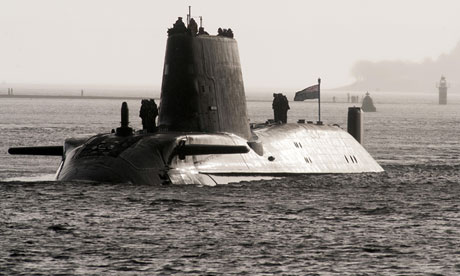
Navy’s old nuclear submarines ‘will not be finally disposed of until after 2040’, Telegraph, Ben Farmer, defence correspondent 18 OCTOBER 2016
A lack of money, expertise and disposal sites mean derelict British nuclear submarines containing radioactive material will not be fully dismantled and disposed of for 25 years, officials have admitted.
The Royal Navy has 19 old nuclear-powered submarines stored in ports waiting to be dismantled, with another eight due to retire and join them in the coming years.
HMS Dreadnought, the Navy’s first nuclear-powered submarine, has been waiting to be dismantled since it retired 36 years ago. Ministry of Defence officials told MPs that radioactive parts on board could not be finally disposed of until an underground dump for all of the UK’s nuclear waste has been chosen and built. That site is not due to be ready until 2040.
The submarines are currently stored at Devonport, near Plymouth, and at Rosyth, on the Firth of Forth.
Stephen Lovegrove, permanent secretary at the MoD, told the Commons defence committee that a lack of money and skills meant it was impossible to speed up the process……..Ministry of Defence officials told MPs that radioactive parts on board could not be finally disposed of until an underground dump for all of the UK’s nuclear waste has been chosen and built. That site is not due to be ready until 2040.
The submarines are currently stored at Devonport, near Plymouth, and at Rosyth, on the Firth of Forth.
Controversial new nuclear plant ignites Belarus Thirty years after Chernobyl catastrophe, construction of new nuclear station on border with Lithuania stirs debate. Aljazeera by Jonathan Brown Minsk, Belarus , 19 Oct 16, – Thirty years after an explosion at the Chernobyl nuclear power station devastated the countryside on the southern border of Belarus, leaving behind lasting consequences for millions of people, the construction of a new nuclear station is stirring discord between government officials, opposition politicians, the local populace and foreign diplomats.
The death of a 43-year-old Russian contractor last month, after an explosion at the Belarusian nuclear power plant (BelNPP) construction site near Astravets in northern Belarus on its border with Lithuania, is only the latest in a string of little-publicised incidents that has raised concerns at home and abroad about the how the station is being constructed.
On July 10 of this year, the 330-tonne reactor casing dropped from a height of between two and four metres in an incident that only came to the public’s attention two weeks later when a member of the Belarus United Civil Party, Mikalai Ulasevich, leaked the news to the local press.
The Ministry of Energy eventually released a statement acknowledging the incident, and Rosatom – the Russian state nuclear corporation and the primary contractor for the project, said that tests had revealed the dropped casing to be safe.
Concerns and opposition
However, with the memory of Chernobyl looming large, both the energy ministry and Rosatom, which agreed to replace the casing to “mitigate rumours and panic among the population” have so far failed to reassure all Belarusians of the station’s safety.
“They are building a crematorium,” Ulasevich says, driving through the rural village of Varniany where BelNPP’s stacks loom over the horizon.
“The only way to guarantee the safety of the plant is to cease its construction.”
Anti-BelNPP activists, including Ulasevich, are concerned by the government’s decision to build the plant in an ecologically pristine region of the country’s north, surrounded by agricultural land and lakes not affected by Chernobyl.
They have also accused the Belarusian government of violating both the Aarhus andEspoo environmental protection conventions in the planning and the construction of the station in Astravets……..
Threatened neighbour
News of the spate of accidents has been met with concern in neighbouring Lithuania. The country’s interior ministry recently indicated that plans were being drafted, in the event of an accident at Astravets, for the evacuation of the capital, Vilnius, which is only 50km from the BelNPP construction site.
Meanwhile, Lithuania has called for Belarus to carry out IAEA stress tests at the site, during which experts both from the EU and Lithuania may be present.
A Lithuanian delegation for the plant said that until the tests are carried out, Belarus should halt the construction work. In August, Lithuanian President Dalia Grybauskaite described the project as an “existential” threat to European security……..
Public mistrust
By June of this year, the Belarussian public was largely split on BelNPP. A poll conducted by the Independent Institute of Socio-Economic and Political Studies suggested that a slight majority – 35 percent or respondents – disapproved of the project.
Tatyana Korotkevich, who was an independent candidate in the country’s parliamentary elections in September, told Al Jazeera in her offices in central Minsk that Belarusians in her electorate feel their questions about the plant have not been sufficiently addressed by the government………
Who will profit?
Energy analysts and activists alike say that the government’s economic arguments for the station are outdated since the Belarusian economy entered into a decline that the World Bank forecasts will continue into 2017 [PDF].
They say there is little evidence to suggest that the country’s economy would benefit from or even require the energy surplus the $11bn BelNPP will produce.
Minsk, which in July owed Moscow almost $300m in energy debts, hopes its nuclear project will help to levy energy independence. But anti-nuclear activists and independent analysts note that Russia, the primary contractor, will be the sole supplier of fuel for the project once completed…..
Like thousands of Belarusians following Chernobyl, anti-nuclear activist Tanya Novikova was diagnosed with thyroid cancer. She, like other anti-nuclear activists in Belarus, including Ulasevich, report having been detained and harassed in their opposition to the plant. But Novikova won’t be deterred, she told Al Jazeera.
Ultimately, this dump is about helping the global nuclear industry. The current build-up of site-by-site waste acts as a brake on investment. They want somewhere to dump it forever so they can go on producing more of it.
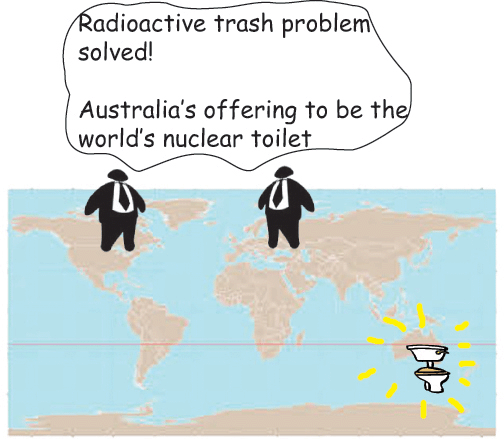
South Australia to become global nuclear waste capital https://redflag.org.au/node/5521Sixty years ago, Maralinga went up in a mushroom cloud. The British government had been given permission to test atomic weaponry in South Australia.
That is to say, they had been given permission by the right wing Menzies government. The local Maralinga Tjarutja people had no say in it at all. Many of them were not even forewarned of the first blast. Thunderous black clouds condemned them to radiation exposure, illness and death, the survivors being driven from their homeland during the long years of British testing and fallout.
South Australia has a dark history with the nuclear industry. Maralinga remains contaminated, despite cheap clean-up efforts. Uranium tailings have leaked from BHP’s Olympic Dam mine at Roxby Downs. Fukushima’s reactors held South Australian uranium when catastrophe struck in 2011.
Today, Jay Weatherill’s state Labor government is trying to open a new radioactive chapter. He wants South Australia to construct the world’s first international high-level nuclear waste dump. This would mean no fewer than 138,000 tonnes of waste (one-third of the world’s total) being shipped from the world’s reactors into South Australian ports, to be permanently buried in Aboriginal land.
This would be history’s largest nuclear dumping operation, and make South Australia the hazardous waste capital of the world.
Weatherill, aware of most people’s instinctive and rightful mistrust of anything nuclear, has launched a meticulous, expensive PR campaign. He is trying to fit a Hello Kitty mask onto Mr Burns.
The propaganda machine was put into motion by the Nuclear Fuel Cycle Royal Commission, at a cost of $7.2 million. Headed by Kevin Scarce, a former naval officer and South Australian governor, the commission imagines a lip-licking profit to be made by importing and burying the waste. It also recommends expanding uranium mining and laying the groundwork for nuclear power generation.
To soothe concerns, the government is periodically erecting “Know Nuclear” stalls across the state. These stalls spread misinformation. For instance, the government pamphlet “What is Radiation?” boasts that bananas contain potassium-40, a low-level radionuclide found in nature. But they make no comparison to human-made fission products such as strontium-90, which releases almost 20 million times more radiation than your friendly fruity isotope.
In August, more than 150 high school students were whisked to a secretly organised forum about the future of nuclear industry in the state. Secrecy was justified by the suggestion that violent anti-nuclear protesters might endanger the pupils.
Why does the state need to pour such big bucks into this festival of confusing roadshows, misleading science, TV ads and youth re-education sessions? Because most people who know anything about nuclear waste will recognise the danger posed by the proposed dump.
We live in a country in which black lung disease has re-emerged. Mining companies, in a world of competition, refuse to pay for basic safety measures to prevent excessive coal dust inhalation. This logic of cutting costs infuses all business under capitalism; nuclear waste dumps are no exception. As the MUA correctly stated: “Maritime workers – seafarers and wharfies – will be the first exposed to this toxic waste … Nowhere on this planet has a country designed a safe repository for nuclear waste”.
Indeed, the most technologically advanced repositories in the world, no matter how deep underground, have failed. Over many years, German radioactive waste had been disposed of in a deep facility in Lower Saxony. In 2008, it was discovered that some of the 126,000 barrels of waste had been leaking into ground water for decades. In 2014, New Mexico’s Waste Isolation Pilot Plant suffered a burst drum, contaminating the whole facility, including ventilation and surrounding air. Soon after, workers at the plant tested positive for radiation exposure.
This is the most hazardous waste ever produced by industry or the military. The royal commission explains that this stuff “requires isolation from the environment for many hundreds of thousands of years”. That makes the Roman Empire seem like yesterday; it is longer than the human race has existed.
Moreover, previous projects have involved only national waste storage; to transport waste by sea to an international dump has never been attempted and involves multiple dangers of accidental spillage.
Ultimately, this dump is about helping the global nuclear industry. The current build-up of site-by-site waste acts as a brake on investment. They want somewhere to dump it forever so they can go on producing more of it.
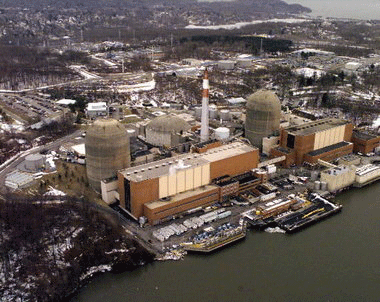
Medical and Disaster Experts Investigate Pipeline Construction Next to Indian Point Nuclear Plant: Prompts Strong Call to Immediately Halt Pipeline Construction and Operation, Physicians For Social responsibility October 18, 2016 Buchanan, NY – With a sense of utmost urgency, health care professionals, nuclear and disaster experts, public officials and members of the public had a first hand look this morning at the dangerous siting of the 42 inch diameter, high pressure Spectra AIM gas pipeline only 105 feet from vital structures at the aging Indian Point nuclear power plant located near two major earthquake fault lines in the most densely populated region in the nation. The pipeline construction which is nearing completion is targeted for operation on November 1st further heightening experts’ warnings and deep concerns regarding the unacceptable risk the pipeline poses to more than 20 million people in the region and the imperative to immediately halt construction and operation of the pipeline project to avert a potential nuclear disaster. The tour and press conference, hosted by Physicians for Social Responsibility (PSR), a national organization comprised of medical professionals, that has been advocating for public health and safety for over 50 years, featured Dr. Irwin Redlener, Director of the National Center for Disaster Preparedness at Earth Institute at Columbia University and Paul Blanch, a nuclear power expert.
Leading nuclear and pipeline safety experts have repeatedly warned that a pipeline rupture at Indian Point could result in catastrophic nuclear releases worse than the Fukushima nuclear disaster endangering millions of people throughout the New York tri-state area who live within the 50-mile impact radius. Numerous documents in the record submitted by safety experts to the Federal Energy Regulatory Commission (FERC), the Nuclear Regulatory Commission (NRC), and other state and federal agencies reflect serious concerns regarding the lack of pipeline thermodynamics expertise and the complete absence of comprehensive independent risk, health and safety assessments of the co-location of these two major hazardous sites despite repeated urgent calls for such evaluations before any consideration of approval of the pipeline project. Serious concerns have also been raised about the considerable national security implications of the vulnerability of multiple, proximate sources of critical power infrastructure. However, FERC disregarded all of those concerns and requests and granted approval for the project in March 2015 allowing construction to begin in October 2015. The unacceptable risk to New York’s vast population compounded by the total lack of emergency protocols, safety training and preparedness, evacuation plans and public education in emergency scenarios have prompted public officials on local, state, and federal levels to join health and safety experts and the public in their demand for FERC to immediately halt construction and operation of the Spectra AIM pipeline.
Requests by safety experts and public officials for emergency protocols and safety preparedness indicate no evidence of planning for a pipeline rupture or explosion adjacent to the nuclear plant. The lack of emergency training and preparedness reflects the lack of recognition of the safety experts’ concerns regarding the perilous impact of a pipeline accident at that location and the imminent and permanent danger the AIM pipeline poses to the nuclear plant and the entire New York metropolitan area. Data from the U.S. Department of Transportation Pipeline Hazardous Material Safety Administration (PHMSA) confirms that pipeline accidents are commonplace and have been significantly increasing in frequency in recent years including in newly constructed pipelines. There were 143 gas transmission line accidents in 2015.
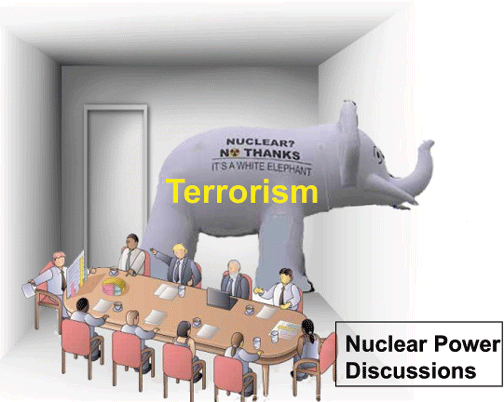
Nuclear power plants are terrorist bait, need extra protection – ex-IAEA chief to RT Rt.com. 11 Oct, 2016Nuclear power plants are one of the best protected facilities in the world, but they still remain likely targets for terrorists and therefore require extra protection, Hans Blix, former IAEA chief, told RT.
“One has to be very careful, of course, about installations like nuclear power plants and enrichment plants,” said Blix, who headed the International Atomic Energy Agency between 1981 and 1997…..
Blix stressed that modern nuclear facilities “are getting more digitalized – earlier, they weren’t – and they now have to be given a special new protection” from potential cyber-attacks.
He recalled the hack at Iran’s uranium enrichment facility at Natanz back in 2010 “where a malware called ‘Stuxnet’ was smuggled in and managed to stop several hundred enrichment centrifuges.”…….
According to Blix, the risk of radicals creating a so-called ‘dirty bomb,’ which combines radioactive material with conventional explosives, shouldn’t be ignored either.
“Caesium [which is extracted from waste produced by nuclear reactors] is something that is used in hospitals in many places and if it’s stolen or goes astray it can also be used in a dirty bomb and exploded somewhere in the center of a city – whether Moscow, New York or Washington. We have to be careful everywhere,” he said……
Also on Tuesday, current IAEA head, Yukiya Amano, warned that risks of terrorist attacks against nuclear power plants or militants eventually making a “dirty bomb” are very real. He stressed that terrorist groups, such as Islamic State (IS, formerly ISIS/ISIL), pose a serious threat to nuclear power stations.
The U.S. government just made its biggest clean energy purchase ever , WP, By Chris MooneyOctober 14On Friday in Maricopa County, Ariz., the U.S. government will hit a clean energy milestone: What officials are calling the largest procurement ever of renewable energy by the federal government, in this case from a desert solar array.
The new 150-megawatt, or million-watt, Mesquite 3 solar array is located in Arizona, but the electricity it generates will be sent to California’s electric grid and will power roughly one-third of the electricity needs of 14 naval installations in the state, including San Diego’s naval base and the Marines’ Twentynine Palms and Camp Pendleton………
The move is being celebrated not only by the Navy, but also the Energy Department, which contends that the dramatic growth of large-scale solar plants in the Southwest is a direct result of major investments made by its Loan Programs Office as part of the stimulus legislation passed in the wake of the financial collapse in 2008-2009……..
The over 10 gigawatts of installed utility scale solar photovoltaic capacity in the United States today is just one part of the tremendous solar boom the country has seen. None of this takes into account more medium-sized arrays or individual rooftop solar installations. The Energy Department has also given loans for a different type of large-scale solar array, called concentrated solar power, many of which also have been built.
Bailing out aging nuclear power plants can impact development of renewable energy technologies, Enformable, 17 Oct 2016 “………Rickover: “Outlaw Nuclear Reactors”
The bottom line when it comes to nuclear power comes from Admiral Rickover, considered the “father” of the U.S. nuclear navy as well as being in charge of building Shippingport. When he retired from the Navy in 1982 he addressed a Congressional committee and said—his remarks are included in Cover Up—that until several billion years ago “it was impossible to have any life on Earth; that is, there was so much radiation on Earth you couldn’t have any life—fish or anything. “ Then, “gradually, “the amount of radiation on this planet and probably in the entire system reduced and made it possible for some form of life to begin.”
“Now,” he went on, by utilizing nuclear power “we are creating something which nature tried to destroy to make life possible…every time you produce radiation,” a “horrible force” is unleashed, “in some cases for billions of years.” In other words, nuclear power plants recreate the very radioactive poisons that precluded life from existing. “And,” said Rickover, “I think there the human race is going to wreck itself.”
We must, for the sake of life, Rickover told the Congressional committee, “outlaw nuclear reactors.”
Rickover, deeply involved in nuclear technology, finally saw—as we all must—the light.http://enformable.com/
Charges Dropped Against Amy Goodman–No Thanks to Corporate Media, Common Dreams, byJim Naureckas , 18 Oct 16
North Dakota District Judge John Grinsteiner stood up for the First Amendment by dismissing “riot” charges against Democracy Now!’s Amy Goodman (Democracy Now!,10/17/16). That’s more than you can say for most of Goodman’s corporate media colleagues.
After Goodman reported on the use of pepper spray and attack dogs against Native American demonstrators opposing the construction of the Dakota Access Pipeline (Democracy Now!, 9/4/16), North Dakota State’s Attorney Ladd Erickson charged her with criminal trespassing. Realizing that he couldn’t make that charge stick, he sought to charge her instead with participation in a “riot”—based on Erickson’s contention that Goodman “was not acting as a journalist” because “everything she reported on was from the position of justifying the protest actions” (FAIR.org, 10/15/16).
Few corporate media journalists took note of a fellow reporter being charged with trespass for doing her job (FAIR.0rg, 9/15/16). When the prosecutor upped the ante by trying to build a criminal charge based on his perception of a reporter’s point of view, this still did not provoke much attention—let alone outcry—from outlets whose lucrative commercial enterprises are dependent on the protection of the First Amendment.
A handful of journalists at commercial outlets did weigh in to defend Goodman. Will Bunch, columnist for the Philadelphia Daily News (Philly.com, 10/16/16), wrote that “the First Amendment was created to prevent exactly this: the jailing of a writer for his or her political point of view.” The LA Times‘ Michael Hiltzik (10/17/16) called out the charges as “an attempt to quash legitimate news reporting.” Matt Taibbi in Rolling Stone (10/13/16) noted the odd fact that Erickson is an avowed fan of Taibbi’s work—but nonetheless urged him to stop prosecuting Goodman, saying she is “as close to the ideal of what it means to be a journalist as one can get in this business.”
That’s about it for journalists in the corridors of corporate media who defended Democracy Now!‘s reporter. A few others took note of the threat she was under; AP‘s James MacPherson and Blake Nicholson wrote a piece that was picked up by outlets like the Minneapolis Star Tribune, Idaho Statesman, Fresno Bee and Arizona Daily Star. Public Radio International‘s The Takeaway (10/17/16) ran a 12-minute interview with Goodman.
A few new media outlets covered the riot charges, like Jezebel (10/15/16) and TechCrunch(10/16/15). Some journalism sites also weighed in, like The Wrap (10/15/16) and Poynter(10/17/16)—though Poynter’s James Warren buried the item under ten other items, heading his one-paragraph report “Post-Pipeline Protest Hoopla,” a headline that may accurately convey the degree of importance corporate journalism accords to First Amendment threats to alternative reporters.
That would explain why people who wanted to be informed about an independent journalist facing criminal charges based on her presumed opinions mostly had to go to overseas outlets (BBC, 10/17/16 ; Independent, 10/17/16) or to alternative sources likeThe Nation (10/15/16) and Common Dreams (10/15/16)………
If there are any regretful reporters at the New York Times, Washington Post, the broadcast or cable news outlets, or any of the other media properties that neglected to cover Goodman’s case when she stood accused of thoughtcrime, they can make up for it by reporting on the still-pending case of documentary filmmaker Deia Schlosberg, who is facing up to 45 years in prison based on three felony counts derived from her reporting on the Dakota Access protests (Reuters, 10/13/16). The First Amendment you save may be your own. http://www.commondreams.org/views/2016/10/18/charges-dropped-against-amy-goodman-no-thanks-corporate-media
US Prepares For Nuclear War, Air Force Drops Two Faux Nukes, Popular Resistance, by Marcus Weisgerber, www.defenseone.comOctober 8th, 2016 The tests in the Nevada desert come as tensions rise with Russia and the Pentagon seeks to replace its aging nuclear arsenal.
A pair of U.S. Air Force B-2 bombers dropped two 700-pound faux nuclear bombs in the middle of the Nevada desert within the past few days. Now the Pentagon wants to tell you about it.
Conducted “earlier this month,” according to an Oct. 6 press release, the test involved two dummy variants of the B61, a nuclear bomb that has been in the U.S. arsenal since the 1960s. One was an “earth penetrator” made to strike underground targets, the other a tactical version of the B61. Neither carried an actual warhead.
“The primary objective of flight testing is to obtain reliability, accuracy, and performance data under operationally representative conditions,” said the statement from the National Nuclear Security Administration, the Energy Department arm that oversees such tests. “Such testing is part of the qualification process of current alterations and life extension programs for weapon systems.”
But why now? Perhaps it has to do with tensions with Russia, which are higher than they have been in decades, and which have sparked fears of a new nuclear arms race. Earlier this week, the Russian government announced it would conduct a massive drill to prepare its citizens for nuclear war.
But it may also have to do with the Pentagon’s quest to replace its decades-old nuclear arsenal with new bombs and delivery vehicles, an endeavor whose price tag tops several hundred billion dollars. The Air Force, for one, has been making its case for new intercontinental ballistic missiles and a nuclear cruise missile. At an Air Force Association conference in the Washington suburbs last, Boeing touted its work on the Minuteman IIIICBM, mounting large-scale models of the long-range missiles front and center in its sprawling display area………
Last year, the Air Force inked a deal with Northrop Grumman to build a new long-range, stealth bomber — recently named the B-21 Raider — that will eventually be equipped to carry nuclear weapons. At the same time, the Navy is preparing to buy 12 newColumbia-Class submarines that will replace the Ohio-Class, which can launch nuclear missiles.



















 nuclear-news