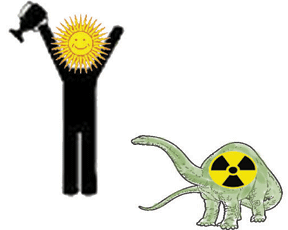
 Nuclear Power Rapidly Losing Race With Renewable Energy, http://www.ecowatch.com/nuclear-power-renewable-energy-2031607650.html, by Sun Day Campaign, Oct. 05, 2016 Two new reports from the Federal Energy Regulatory Commission (FERC) and the U.S. Energy Information Administration (EIA) confirm that nuclear power is rapidly losing the race with renewable energy sources.
Renewable energy racing ahead, nuclear energy falling behind
Nuclear Power Rapidly Losing Race With Renewable Energy, http://www.ecowatch.com/nuclear-power-renewable-energy-2031607650.html, by Sun Day Campaign, Oct. 05, 2016 Two new reports from the Federal Energy Regulatory Commission (FERC) and the U.S. Energy Information Administration (EIA) confirm that nuclear power is rapidly losing the race with renewable energy sources.EIA’s latest “Monthly Energy Review” notes that during the first six months of this year, renewable sources—i.e., biofuels, biomass, geothermal, hydropower, solar and wind—accounted for 5.242 quadrillion Btus (quads) of domestic energy production. This includes thermal, liquid and electrical forms of energy. By comparison, nuclear power provided only 4.188 quads. That is, renewablesoutpaced nuclear by more than 25 percent.
Meanwhile, FERC’s latest “Energy Infrastructure Update” states that the total available installed generating capacity in the U.S. from the combination of utility-scale (i.e., greater than 1-MW) hydropower, wind, solar, biomass, and geothermal has grown to 215.82 gigawatts (GW) or 18.39 percent of total generating capacity. Nuclear power’s installed capacity is only107.06 GW or 9.12 percent of the total. Thus, renewable energy generating capacity is now more than double that of nuclear.
However, actual electrical generation by nuclear plants for the first seven months of 2016 is 19.9 percent of total generation. That is still higher than that provided by renewable sources whichcontributed 15.8 percent—a figure which does not include electricity produced by distributed renewables such as rooftop solar.
But while nuclear power’s share of net electrical generation has remained essentially flat over the past decade—e.g., it was 19.4 percent in 2006, renewable energy’s share is growing rapidly, increasing from 9.5 percent 10 years ago to 15.8 percent today with EIA forecasting continuedstrong growth in the years ahead.
“If renewable sources maintain their current growth rates, they could fully eclipse nuclear in the trifecta of not only energy supply and generating capacity but also electricity production within the next five or six years … or less,” Ken Bossong, executive director of the SUN DAY Campaign, concluded.
No comments yet.
1 This Month

of the week – Shut Down Drone Warfare!


Tell the Ukrainian Government to Drop Prosecution of Peace Activist Yurii Sheliazhenko

Petition to revoke the licensing of the Near Surface Nuclear Disposal Facility (NSDF) at Chalk River. https://www.ourcommons.ca/petitions/en/Petition/Details?Petition=e-7247
To see nuclear-related stories in greater depth and intensity – go to https://nuclearinformation.wordpress.com
-
Archives
- March 2026 (251)
- February 2026 (268)
- January 2026 (308)
- December 2025 (358)
- November 2025 (359)
- October 2025 (376)
- September 2025 (257)
- August 2025 (319)
- July 2025 (230)
- June 2025 (348)
- May 2025 (261)
- April 2025 (305)
-
Categories
- 1
- 1 NUCLEAR ISSUES
- business and costs
- climate change
- culture and arts
- ENERGY
- environment
- health
- history
- indigenous issues
- Legal
- marketing of nuclear
- media
- opposition to nuclear
- PERSONAL STORIES
- politics
- politics international
- Religion and ethics
- safety
- secrets,lies and civil liberties
- spinbuster
- technology
- Uranium
- wastes
- weapons and war
- Women
- 2 WORLD
- ACTION
- AFRICA
- Atrocities
- AUSTRALIA
- Christina's notes
- Christina's themes
- culture and arts
- Events
- Fuk 2022
- Fuk 2023
- Fukushima 2017
- Fukushima 2018
- fukushima 2019
- Fukushima 2020
- Fukushima 2021
- general
- global warming
- Humour (God we need it)
- Nuclear
- RARE EARTHS
- Reference
- resources – print
- Resources -audiovicual
- Weekly Newsletter
- World
- World Nuclear
- YouTube
-
RSS
Entries RSS
Comments RSS
 nuclear-news
Leave a comment