So far, in 2016, solar energy is outstripping coal power in UK
A spokeswoman for the Solar Trade Association (STA) said: “This is a valuable milestone on the road to renewables overtaking fossil fuels. It is a testament to just how effective the British solar industry has been at installing clean and reliable power and at bringing down costs.”
Solar outstrips coal in past six months of UK electricity generation
More power came from solar panels than from Britain’s ageing coal stations from April to September this year, report shows, Guardian, Adam Vaughan, 4 Oct 16, Electricity generated by solar panels on fields and homes outstripped Britain’s ageing coal power stations over the past six months in a historic first.
Climate change analysts Carbon Brief found more electricity came from the sun than coal from April to the end of September, in a report that highlighted the two technologies’ changing fortunes.
Solar had already eclipsed coal for a day in April and then for the whole month of May, with coal providing zero power for the first time in more than 100 years forseveral days in May. The latest milestone saw an estimated 6,964 gigawatt hours (GWh) generated by solar over the half-year, or 5.4% of the UK’s electricity demand. Coal produced 6,342GWh, or 4.7%.
The trend will not continue into winter because of solar’s seasonal nature, but the symbolic records reveal the dramatic impacts solar subsidies and environmental penalties for coal have wrought.
Increases in the carbon floor price last year have driven three major coal power plants – Longannet, Ferrybridge C and Rugeley – to close earlier this year. That came on top of a similar amount of coal power being closed between 2012 and 2014 because upgrading the stations to meet higher air pollution standards was deemed uneconomic……….
Solar has grown rapidly in the last six years, though figures published last week by the Office for National Statistics showed installations had crashed after the government came to power and cut the industry’s subsidies.
A spokeswoman for the Solar Trade Association (STA) said: “This is a valuable milestone on the road to renewables overtaking fossil fuels. It is a testament to just how effective the British solar industry has been at installing clean and reliable power and at bringing down costs.”
The government said last week that solar power could produce electricity more cheaply than the price agreed for a new nuclear power station at Hinkley Point, but officials suggested solar would have additional costs for the National Grid.
But a new report for the STA, published on Tuesday, concluded that integrating many more solar panels into the grid would not add excessive costs to accommodate the fact the sun doesn’t always shine and backup power is required to cover solar.
“With intermittency costs today of around £1.3/MWh for solar [with around 10-12GW of solar installed], increasing to £6.8/MWh with a substantial 40GW of solar on the system by 2030, we would suggest these costs do not provide a strong argument against the further build out of renewable generation,” said the report, by the consultancy Aurora. https://www.theguardian.com/environment/2016/oct/04/solar-outstrips-coal-in-past-six-months-of-uk-electricity-generation
Nuclear power? Not right for Kenya.
Kenya not ready to generate nuclear energy http://www.standardmedia.co.ke/ureport/story/2000218411/kenya-not-ready-to-generate-nuclear-energy Erick Kizito 04th Oct 2016 Six years ago, Kenya announced it was going to build a nuclear power plant, which would generate 1,000MW (1GW) of electricity.
By 2030, the country hopes to produce 4GW from nuclear sources. This implies that nuclear will at that time account for 19 per cent of Kenya’s total energy output, second to hydroelectric power.
I am highly pessimistic about Africa’s largest geothermal energy producer’s capacity to harness and safely utilize nuclear energy.
It is only KenGen that is showing seriousness in geothermal energy production and putting in place safety measures to curb accidents and damages. The overriding concern about any nuclear project is safety. There is the potential damage in terms of costs and casualties in the event of a nuclear accident.
Although advancements in nuclear science have led to improved reactor designs with the ability to shut down automatically during an emergency, scientists say the probability of a nuclear accident will never be zero.
In the event of a reactor meltdown or terrorist attack on the plant, which would release dangerous radioactive particles into the atmosphere, Kenya’s disaster preparedness and response will ultimately make the difference between minimal and widespread damage.
The second concern is disposal of radioactive waste from the plant, which is hazardous to human health and the environment. The third worry is that much of the knowledge and materials employed in a civilian nuclear programme can be used to develop nuclear weapons.
Kenya is a signatory to the Treaty on the Non-Proliferation of Nuclear Weapons, which aims to promote safe use of nuclear energy by preventing the spread of nuclear weapons or their technology.
Kenya’s installed electricity generation capacity is much smaller than the expected nuclear output.
The USA’s nuclear lobby’s main aim? -to weaken NRC safety regulations
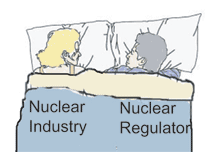 Nuclear power lobby names new CEO, The Hill, By Timothy Cama – 10/04/16 The Nuclear Energy Institute (NEI) has tapped Maria Korsnick, a veteran of the nuclear industry, to be its new CEO.
Korsnick, currently the chief operating officer at NEI, will start her new role Jan. 1, when Marv Fertel, the current CEO, retires.
The changes come at a crucial moment for the nuclear sector. Numerous plants are expected to close in the coming years amid competition from cheap natural gas and renewables, and increasing safety and security requirements.
A small handful of new plants or reactors are under construction domestically as well.
NEI is working on various major policy priorities, like getting a tax credit renewed for newly built plants, trying to get the Yucca Mountain nuclear waste site built and reforming the Nuclear Regulatory Commission. http://thehill.com/policy/energy-environment/299158-nuclear-lobby-names-new-ceo
Chinese villagers intimidated by graphite plant owners in collusion with local authorities
 IN YOUR PHONE, IN THEIR AIR A TRACE OF GRAPHITE IS IN CONSUMER TECH. IN THESE CHINESE VILLAGES, IT’S EVERYWHERE. WASHINGTON POST, STORY BY PETER WHORISKEY PHOTOS BY MICHAEL ROBINSON CHAVEZ VIDEOS BY JORGE RIBAS OCTOBER 2, 2016 “…….BEING WATCHED
One of the main obstacles in clearing the pollution, villagers said, is the powerful alliance between local government officials and the owners of the graphite plants. The officials, the villagers said, protect the factories from environmental complaints.
At three of the five villages visited by Post journalists in May and June, a village official either tried to attend interviews or soon after inquired of the interviewees what had transpired in the interviews. Moreover, plant managers and party officials sometimes discouraged journalists from speaking with villagers.
After Post journalists visited the Haida Graphite plant in Pingdu, for example, a plant employee jumped in a car to follow their taxi off the property and through the village streets.
The taxi stopped twice in the village so The Post could interview more people. At each stop, the driver of the Haida car approached to within a few feet and blared the car horn continuously, making talking to villagers impossible. The driver relented only when The Post’s taxi left the area. Asked to comment later about the pollution complaints, a Haida official accused a Post reporter of “espionage” and refused to answer questions.
Similarly, after The Post visited a BTR graphite factory in Jixi, two cars with several men inside began following the reporters’ taxi. Three times, over several miles, the taxi pulled over to let them pass. Each time, the following cars pulled over and stopped behind the Post taxi. Confronted, the men in the cars told reporters that it was just a coincidence that they had stopped at the same time that the taxi did. The men said they were mapping out a bicycle race.
The intimidation has an effect on villagers.
Not far from the Hensen graphite plant in Laixi is a small factory that makes women’s underwear. Han Wenbing, 48, is the owner. A large man, proud of his workshop, he was eager to talk about the graphite pollution.
He readily invited reporters into his home, showing the dust quickly gathering on his kitchen table and showing how his well water, which had been fine for drinking, now is topped with a gray film.
But as he made his case against the graphite plant, his wife grew nervous — and then angry. To speak out would only cause trouble with the plant manager and village officials, she warned her husband.
“Yes, there is absolutely an impact [from the graphite], but we don’t want to be on TV,” she said. “This could offend the boss of the company, which could affect our lives. You [reporters] wash your hands and walk away, but we live here.”
Han nevertheless wanted to make his complaints known. Once his wife acquiesced, he offered to point out a field that showed some of the worst effects of the pollution. The field had been used by small farmers, he said, but industrial runoff had affected the soil so much that “not even the weeds can grow.”………Story by Peter Whoriskey. Photos by Michael Robinson Chavez. Videos by Jorge Ribas. Graphics by Lazaro Gamio andTim Meko. Design by Matt Callahan, Emily Chow and Chris Rukan. https://www.washingtonpost.com/graphics/business/batteries/graphite-mining-pollution-in-china/
Rising demand for lithium, and the pollution resulting from this
IN YOUR PHONE, IN THEIR AIR A TRACE OF GRAPHITE IS IN CONSUMER TECH. IN THESE CHINESE VILLAGES, IT’S EVERYWHERE. WASHINGTON POST, STORY BY PETER WHORISKEY PHOTOS BY MICHAEL ROBINSON CHAVEZ VIDEOS BY JORGE RIBAS OCTOBER 2, 2016 “……DEMAND RAMPS UP
While U.S. consumers may seem uninvolved in — and untouched by — the Chinese pollution, the truth is more complicated.
The U.S. demand for cheap goods helps keep the Chinese factories going. More than a quarter of the emissions of two key pollutants in China — sulfur dioxide and nitrogen oxides — arose from the production of goods for export, according to research published in 2014 in the Proceedings of the National Academy of Sciences. The largest share of exports goes to the United States.
Moreover, the same researchers found that some of the pollution in China reaches the United States — the air pollution drifts across the ocean and raises ozone levels in the western part of the country, according to the study.
“Outsourcing production to China does not always relieve consumers in the United States . . . from the environmental impacts of air pollution,” according to the authors of the study, which was conducted by a consortium of scientists from China and the United States.
Now the rise of the electric-car industry promises a huge surge in the lithium-ion battery business.
Making batteries big enough to power cars will cause a daunting leap in demand. A laptop requires just a handful of the familiar, thin, cylindrical lithium-ion batteries known as “18650s.” A smartphone requires even less. But a typical electric car requires thousands of times the battery power.
Today, the best known “gigafactory” for electric-car batteries is the one being built by Tesla in the Nevada desert — a plant the company says will produce 500,000 electric-car batteries annually. But it’s just one of many. About a dozen other battery gigafactories are being planned around the world.
This is “not just a Tesla story,” said Simon Moores, managing director of Benchmark Mineral Intelligence, a firm that tracks demand and assesses prices for raw materials in the industry. “The demand is rising everywhere, especially in China.” Todd C. Frankel and Yanan Wang in Washington and Xu Jing contributed to this report.
The connection between optimism, and having a global point of view

These differences can lead to heated debates, such as the Brexit situation which pitted English citizens against one another as the country decided whether or not to leave the E.U. What if our global or local mindsets influenced the types of goals we set and the way we think about our own lives?
This was the question that researchers set out to answer, and their findings are available online in the Journal of Consumer Psychology. The investigators suspected that people with a global mindset would adopt goals that encourage growth and advancement (promotion goals).
“Previous research has shown that people with a promotion mindset think more broadly and about the future,” says researcher Rajeev Batra, a professor in the Ross School of Business at the University of Michigan. “They are more optimistic and want to maximize the positive things in their lives.”
People with a local mindset, however, would most likely focus on goals that center around roles and responsibilities (prevention goals). “These people think about the here and now and want to minimize the negative, prevent losses and think about reasons not to do things,” Batra says……
The researchers also conducted two other experiments that showed similar variations between people who associated with global versus local identities.
“These mindset differences might help us understand why we see some of the population adopting a more broad, optimistic view while others are more protective of the status quo,” Ng says. “Policy makers who want to influence people to think more globally may want to design campaigns about global issues, such as climate change, that help people connect with the worldwide community.” https://www.eurekalert.org/pub_releases/2016-10/sfcp-tgl100316.php
“Population Mixing” Theory Debunked


Kinlen Theory Debunked By Dr Ian Fairlie
October 3, 2016
The Kinlen hypothesis debunked
A recent COMARE report on child cancers near NPPs was published on the day after the Government committed the UK to a new nuclear power station. This was not a coincidence: it is a prime example among many of nuclear policy-led science. We should have science-led policies but these rarely, if ever, occur on nuclear matters.
The report downplays radioactive releases from NPPs as an explanation for the nearby raised levels of cancers. Instead it champions the Kinlen hypothesis.
Since 1988, Professor Kinlen has been suggesting that increases in childhood cancers near nuclear facilities are due to an infective, perhaps viral, agent arising from the influx of new workers to rural areas. But most scientists throughout the world discredit this theory because of its myriad problems and inconsistencies.
First, the idea leads to the expectation of…
View original post 298 more words
USNRC Issues Criticality Hazard Warning to Nuclear Fuel Facilities Due to Toshiba Criticality Hazard in South Carolina; Does Toshiba Have Uranium Accounting Problems Too?

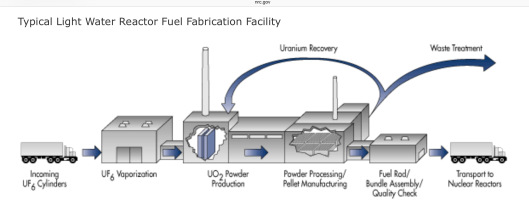
According to the USNRC: “The long-term accumulation of uranium in equipment with an unfavorable geometry, particularly in process ventilation and scrubber systems, has been a recurring issue throughout the nuclear fuel industry.”
The accumulation in an unfavorable geometry can lead to a criticality accident. At Toshiba’s Westinghouse Facility the amount of uranium exceeded the criticality safety evaluation (CSE) mass limit by over three times.
“A criticality accident is an uncontrolled nuclear chain reaction. It is sometimes referred to as a critical excursion or a critical power excursion and represents the unintentional assembly of a critical mass of a given fissile material,… In the history of atomic power development, 60 criticality accidents have occurred, including 22 in collections of fissile materials located in process environments outside of a nuclear reactor or critical experiments assembly“. https://en.wikipedia.org/wiki/Criticality_accident
“Criticality control should be part of an integrated program that…
View original post 1,181 more words
October 4 Energy News

Opinion:
¶ “Quid Pro Quo In Environmental Politics” • Prime Minister Justin Trudeau wants British Columbia’s backing for a national carbon strategy. In return for her support, Trudeau is willing to endorse Premier Christy Clark’s plans for an LNG project that appears to be condemned by every scientist “not funded by the proponent.” [CleanTechnica]
 Parliament (Photo by Alex Indigo, via Flickr, CC BY SA 2.0)
¶ “Off-grid renewables: the sustainable route to 100% global electricity access” • World households without electricity pay 60 to 80 times as much as people in New York or London for the same amount of light. Exposure to smoke from wood-fired cook stoves cause more than 4 million premature deaths each year. There is an off-grid solution. [The Ecologist]
World:
¶ At the beginning of the decade, Cape Verde authorities set a goal of getting 50% of its power from renewables by…
View original post 672 more words
October 3 Energy News
World:
¶ Tidal Lagoon Power has launched a £22 million tender for
the turbine manufacturing and pre-assembly plant for its up to 320-MW Swansea Bay project. The 100-meter-long hub will be located between the Kings and Queens Dock at Swansea Bay following a competitive tender of potential locations for the facility last year. [reNews]
 Artist’s impression of Swansea Bay tidal lagoon (TLP image)
¶ India ratified the landmark Paris climate pact Sunday. India’s formal agreement brings the accord closer to coming into force. It is to take effect after 55 countries producing 55% of the world’s emissions ratify it. With India onboard, 62 countries accounting for more than half the world’s emissions would have ratified the agreement. [Voice of America]
¶ The first review of economic bids in Argentina’s tender for one GW of renewable energy shows that wind and solar offers have fallen to as…
View original post 529 more words
1 This Month

of the week – Shut Down Drone Warfare!


Tell the Ukrainian Government to Drop Prosecution of Peace Activist Yurii Sheliazhenko

Petition to revoke the licensing of the Near Surface Nuclear Disposal Facility (NSDF) at Chalk River. https://www.ourcommons.ca/petitions/en/Petition/Details?Petition=e-7247
To see nuclear-related stories in greater depth and intensity – go to https://nuclearinformation.wordpress.com
-
Archives
- March 2026 (237)
- February 2026 (268)
- January 2026 (308)
- December 2025 (358)
- November 2025 (359)
- October 2025 (376)
- September 2025 (257)
- August 2025 (319)
- July 2025 (230)
- June 2025 (348)
- May 2025 (261)
- April 2025 (305)
-
Categories
- 1
- 1 NUCLEAR ISSUES
- business and costs
- climate change
- culture and arts
- ENERGY
- environment
- health
- history
- indigenous issues
- Legal
- marketing of nuclear
- media
- opposition to nuclear
- PERSONAL STORIES
- politics
- politics international
- Religion and ethics
- safety
- secrets,lies and civil liberties
- spinbuster
- technology
- Uranium
- wastes
- weapons and war
- Women
- 2 WORLD
- ACTION
- AFRICA
- Atrocities
- AUSTRALIA
- Christina's notes
- Christina's themes
- culture and arts
- Events
- Fuk 2022
- Fuk 2023
- Fukushima 2017
- Fukushima 2018
- fukushima 2019
- Fukushima 2020
- Fukushima 2021
- general
- global warming
- Humour (God we need it)
- Nuclear
- RARE EARTHS
- Reference
- resources – print
- Resources -audiovicual
- Weekly Newsletter
- World
- World Nuclear
- YouTube
-
RSS
Entries RSS
Comments RSS
 nuclear-news